

Bexelora A313 Retinol Cream has recently gone viral across social media, marketed as a skincare miracle that promises the “Botox effect without needles.” For just $14.95, it claims to reduce wrinkles overnight, brighten skin, clear acne, and give you glowing results.
At first glance, this seems like a dream come true. But dig a little deeper, and the red flags start piling up: massive discounts, fake reviews, copied before-and-after images, customer complaints about fake products, and scam reports on Trustpilot.
So, is Bexelora A313 really the miracle anti-aging solution it claims to be — or just another scam site selling knockoff creams? This investigation will take a closer look at the marketing tactics, product claims, customer complaints, and hidden risks so you can make an informed decision.
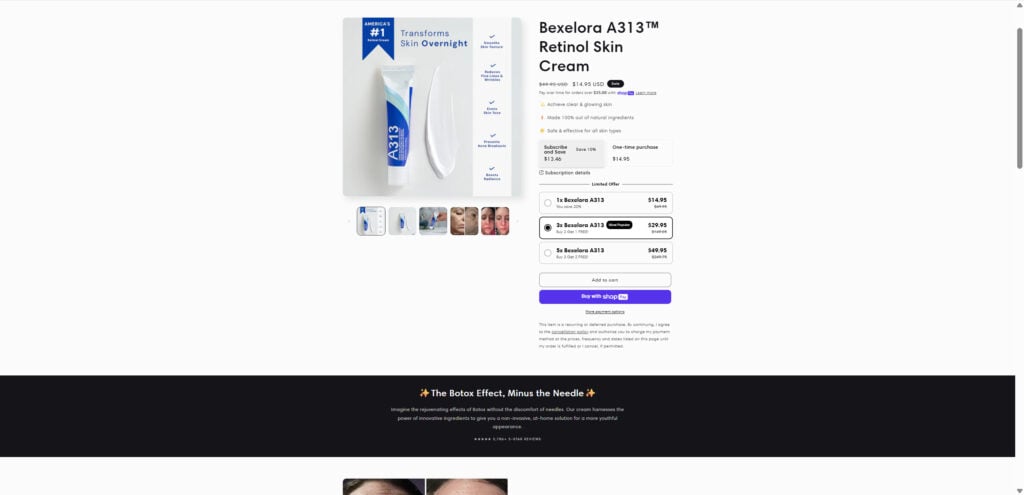
Overview of Bexelora A313 Retinol Cream
The Bexelora website markets its A313 cream as a revolutionary skincare product that transforms skin almost instantly. They present it as a French-inspired retinol cream designed to:
- Smooth skin texture overnight.
- Reduce fine lines and wrinkles.
- Even skin tone.
- Prevent acne breakouts.
- Brighten and boost radiance.
They even compare it to Botox, suggesting it can deliver the same results without expensive injections.
Price and “Discounts”
The product is advertised at:
- $14.95 per tube (supposedly marked down from $49.95).
- Multi-pack deals like “3 for $29.95” or “5 for $49.95.”
- Subscription options that automatically bill your card.
This pricing strategy is classic urgency-based marketing. By slashing the price to an unbelievable level, they make it feel like a limited-time bargain — pushing people to buy fast without researching.
Marketing Claims
The company emphasizes:
- “Transforms skin overnight.”
- “Botox effect without needles.”
- “Safe and effective for all skin types.”
- “Made with 100% natural ingredients.”
While retinol can improve skin over time, no cream works overnight to erase wrinkles or acne scars. Dermatologists consistently warn that results take weeks to months, not 24 hours.
Fake Endorsements
The website shows logos of big outlets like Elle, Vogue, and others to suggest media coverage. But there’s no real evidence that these outlets endorsed or reviewed Bexelora. This is a borrowed credibility tactic commonly used in scams.
Before-and-After Photos
Many of the transformation images on the site are:
- Low-quality and inconsistent (different lighting, makeup, or angles).
- Found elsewhere online through reverse image searches (e.g., Reddit and stock photo libraries).
- Misleading, suggesting dramatic changes in just days.
Reviews
Bexelora’s website showcases hundreds of glowing 5-star reviews. However:
- The wording is repetitive and generic (“Best cream ever! Saw results overnight!”).
- Some reviewer names appear multiple times with different comments.
- Real reviews on Trustpilot tell a very different story.
Customers there report:
- Never receiving their orders.
- Fake tracking numbers.
- Receiving a cheap, fake cream that isn’t the original French A313.
- Emails going unanswered and no refunds.
The Real A313 vs. Fake Versions
The real A313 cream is a well-known French pharmacy retinol product, often recommended by dermatologists. It’s not expensive but must be bought from legitimate pharmacies or trusted retailers.
The Bexelora version appears to be an unverified knockoff. Without proper labeling, ingredient transparency, or quality assurance, there’s no way to know what’s actually in the tube.
Risks
- Unknown ingredients → possible skin irritation or allergic reactions.
- Subscription traps → recurring billing without consent.
- Safety concerns → putting unverified creams on your face is dangerous, especially with strong actives like retinol.
How the Operation Works
To understand why so many people are calling Bexelora a scam, let’s break down exactly how the operation is structured.
Step 1: Social Media Ads
The company runs flashy Facebook and Instagram ads featuring:
- Clips of women applying cream at night.
- Bold captions like “Erase wrinkles overnight!”
- Scarcity triggers like “Limited stock – order today!”
These ads go viral quickly, reaching thousands of users who are looking for quick anti-aging fixes.
Step 2: The Landing Page
Clicking the ad takes you to a polished website that emphasizes:
- The “Botox effect without needles.”
- 3,000+ 5-star reviews.
- A fake discount ($49.95 slashed to $14.95).
- Before-and-after images to create instant trust.
The design is meant to look like a legitimate skincare brand, but closer inspection reveals red flags like vague ingredient lists and generic testimonials.
Step 3: Checkout and Upsells
Once you decide to purchase, the checkout page offers:
- 1 tube for $14.95.
- 3 tubes for $29.95 (labeled “Most Popular”).
- 5 tubes for $49.95.
Some buyers also get pushed into subscription models without realizing it, leading to recurring charges.
Step 4: The Waiting Game
After paying, customers receive fake tracking numbers or confirmation emails that don’t update. Some never receive a product at all.
Others receive a cream in cheap packaging that looks nothing like the authentic French A313. Reports suggest it may be a generic cream from unknown overseas suppliers.
Step 5: Customer Service Blockade
When customers complain:
- Emails go unanswered.
- Phone support doesn’t exist.
- Refund requests are ignored.
This creates a dead end, leaving customers frustrated and unable to recover their money.
Step 6: Review Manipulation
To keep the scam alive, the company:
- Floods its own site with fake 5-star reviews.
- Reposts stolen images as “customer results.”
- Buries negative comments on social platforms.
Meanwhile, independent reviews on Trustpilot expose the scam, but these are often drowned out by fake positive ratings.
Step 7: Shutdown and Rebrand
Like many dropshipping scams, once negative attention builds, the website may shut down and reopen under a new name. Customers lose money, and the scam continues under a different label.
What to Do if You Have Fallen Victim
If you’ve purchased Bexelora A313 Retinol Cream and suspect you’ve been scammed, here’s what to do:
- Stop Further Payments
- Contact your bank or credit card company.
- Block recurring charges and request a chargeback if possible.
- Document Everything
- Save confirmation emails, receipts, and screenshots of the website.
- Keep the product packaging if you received anything.
- Request a Refund
- Contact the seller (though responses are unlikely).
- File a chargeback with your bank if they refuse.
- Report the Scam
- U.S.: Federal Trade Commission (FTC).
- U.K.: Action Fraud.
- EU: European Consumer Centre (ECC).
- Post warnings on consumer forums and social media.
- Check Skin Health
- If you used the product and developed irritation, stop immediately.
- Consult a dermatologist, especially if you suspect it’s a counterfeit cream.
- Warn Others
- Share your experience on Trustpilot, Reddit, or Facebook groups.
- Help others avoid falling for the same scam.
The Bottom Line
Bexelora A313 Retinol Cream promises the impossible — instant wrinkle removal, acne clearing, and the “Botox effect” for under $15. But the red flags are overwhelming:
- Fake reviews and endorsements.
- Knockoff versions of the real A313 cream.
- Customer complaints of never receiving products.
- Fake tracking numbers and ignored refunds.
- Safety risks from unverified skincare.
The authentic A313 cream is a legitimate French pharmacy product that dermatologists sometimes recommend. But the version sold by Bexelora appears to be a counterfeit scam targeting unsuspecting buyers through flashy ads.
If you truly want to try A313 retinol cream, buy it from a trusted pharmacy or reputable retailer — never from viral ads on Facebook or Instagram.
So, should you buy Bexelora A313?
The answer is simple: No. It’s not worth the risk. Protect your skin, your money, and your peace of mind by avoiding this scam.








