


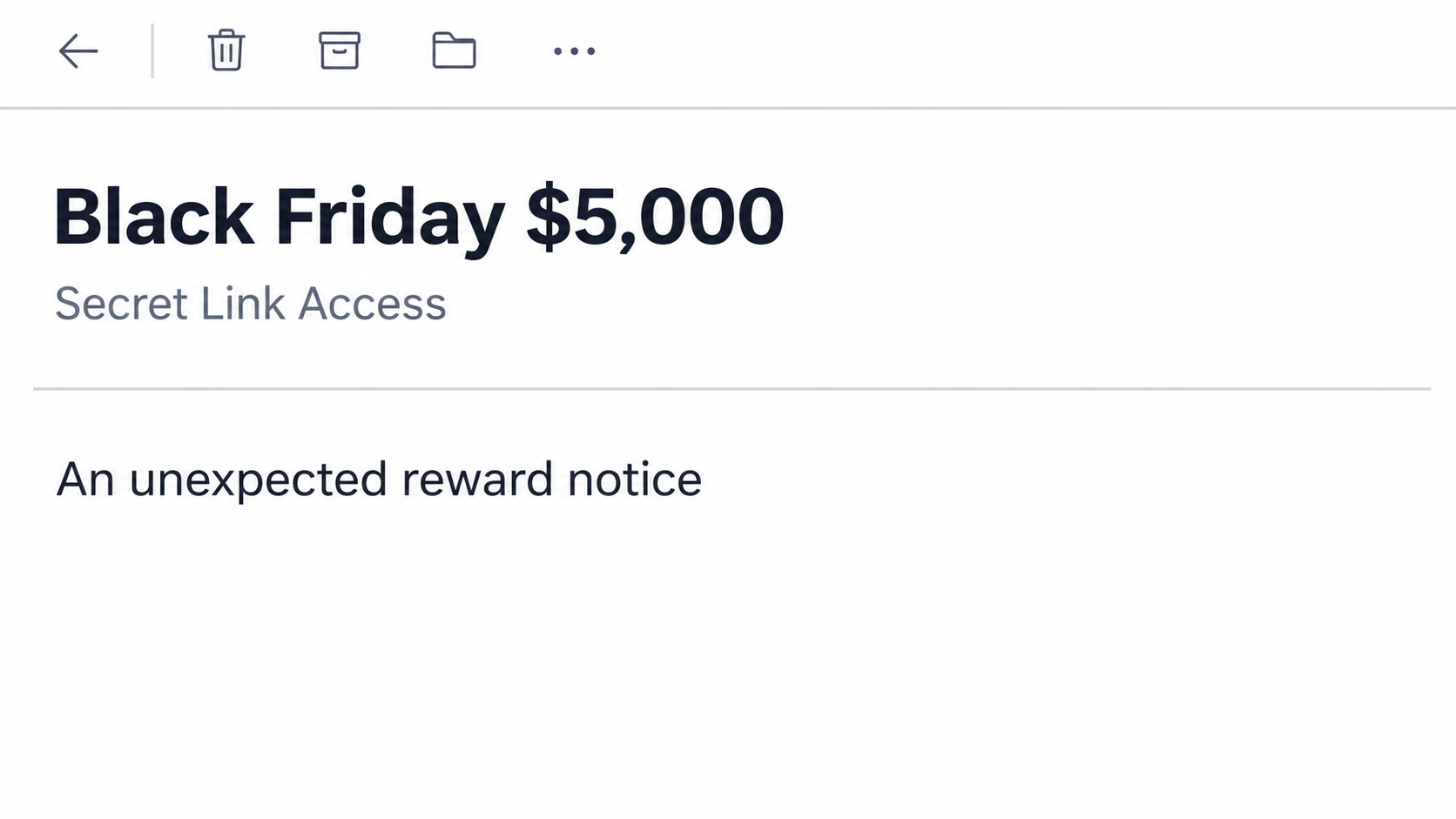
The subject line puts a $5,000 reward right beside Black Friday. You weren’t waiting for a giveaway result, but apparently a secret link has found you anyway.
Then the email puts a famous name on the offer. Before you decide whether it’s worth opening, take a closer look at the kind of reward it describes.
Overview
The prize is the invitation to register
Bitdefender’s researchers documented a Black Friday $5,000 email scam that borrowed Kanye West’s name. The message told recipients they had been picked at random for an exclusive reward.
The offer didn’t end with a winner’s notice. The email led to a rewards page, where visitors were asked to register with an email address and password.
The invitation mentioned a code, and the page suggested you could play, grow the balance or take it out. Those options aren’t the same as receiving money.
The key detail is what you can actually verify. A balance a website shows belongs to its interface until you can establish that the funds exist independently.
What Bitdefender saw, and what it didn’t prove
The original Bitdefender campaign report identifies the message and registration flow. It says Kanye West wasn’t associated with the emails, promotion, or website.
That doesn’t tell us what every later visitor might have been asked to do. The report doesn’t establish that this sample collected a particular payment or completed a withdrawal.
There is enough here to make a decision without testing it. An unsolicited email uses someone else’s name to lead you into creating a password on an unrelated site.
Three clues you can check from the inbox
- The message announces a cash prize even though you don’t know which contest you entered.
- The celebrity’s name appears in the email, but the invitation comes through a private route you can’t independently verify.
- The supposed payout turns into a registration and rewards screen instead of an independently documented prize claim.
You don’t need to see all three signs before stopping. If the giveaway can’t be found anywhere except the invitation, the invitation isn’t a sound place to verify it.
Why a Secret Link Makes the Offer Feel More Believable
Ordinarily, a giveaway that large would make you ask who organized it. The word secret quietly supplies an answer to why you haven’t seen it announced anywhere else.
It also nudges you away from asking your friends. If only a small number of recipients were chosen, a person who hasn’t heard of it can seem irrelevant.
Consider the opposite situation: you enter a known contest through a shop you visit. You can look up its rules and compare the winner’s notice with the entry.
Here, there’s no independent thread to pull. The email is doing the work of announcing the contest, establishing your eligibility, and furnishing the only route to the supposed organizer.
Black Friday supplies a plausible backdrop without proving anything. Real promotions do arrive that week, but a date on the calendar can’t explain an unsolicited $5,000 cash award.
A recognizable name adds familiarity rather than accountability. If you have a question about prize rules, can you find a named organizer that acknowledges the offer outside the email?
Searching the supposed sponsor’s name is a way to check, not an obligation to investigate the sender. If you can’t find independent confirmation, leave the offer alone.
You might see other results repeating the reward amount. Ten pages discussing a message aren’t ten sponsors confirming it, especially if all of them refer to the same screenshot.
How the Black Friday $5,000 Email Scam Works
Step 1: A seasonal email tells you that you were chosen
The opening pitch changes an ordinary shopping day into a personal opportunity. A surprisingly large number makes the message stand out among receipts, order updates, and genuine discounts.
Nothing about finding your email address proves the sender has a record of your contest entry. Receiving a message is only evidence that someone was able to send it.
If you usually check email on your phone, the subject may take up most of the notification. You can dismiss it without opening the email to read the fine print.
Step 2: The name and code stand in for a real organizer
The message attributes the prize to a celebrity. The private code makes it feel as though the organizer has set aside a reward specifically for this group of recipients.
A promo code can be nothing more than a string that lets a page proceed. It doesn’t tell you whether an organizer set aside money, or who controls the page.
Don’t try variations of the code or pass it around to see whether it works for someone else. Acceptance only proves the form recognized it.
Step 3: The rewards page asks you to create an account
At this point the question shifts from whether you won to whether you’ll share sign-up details. In the reported flow, the form called for an email address and password.
Creating a new account can feel safer than signing into an existing one. But it matters whether the password you choose is already doing a job on another site.
For example, using your email password because you remember it gives the person collecting the form two pieces of information that can be tried together.
Changing a single digit isn’t a strong way to separate accounts. If you reused it or used a close variation, treat every account with that password family as exposed.
Step 4: The screen lets you imagine the withdrawal before it happens
Talk of playing, growing a reward, or cashing out can make a balance feel like an asset. You picture what you could do with it rather than asking who pays.
A site can display a balance without moving any money. The more useful comparison is between the page and your actual bank or payment account, opened through your usual route.
Don’t supply a card to see whether a transfer will go through. Giving the site another piece of payment information doesn’t tell you whether the balance was ever funded.
If a later request mentions a fee, don’t pay it. The FTC’s prize guidance explains why paying to receive a prize is a warning sign.
A Reward Balance Isn’t the Same as a Refund, Gift Card, or Deposit
A real merchant’s refund can usually be tied to an order you recognize. You can look at the transaction, see the amount originally paid, and check where it returns.
A gift card has an identifiable issuer and an official place to check its balance. It isn’t authenticated simply because a page calls itself a portal or accepts a code.
The email’s prize claim gives you none of those independent records. A new dashboard may look like an account, but there is no verified payment to reconcile against it.
Likewise, a claim might move from cash to credits or points after registration. Before you give an unfamiliar service any information, pause if you can’t say what you would receive.
You’re not losing money by refusing a reward that hasn’t reached you. The number on the page shouldn’t be the starting balance for deciding how much you’re willing to risk.
If you shop online during the sales, keeping an order list helps. An actual refund belongs next to a specific order, while this message doesn’t depend on anything you bought.
What to Do If You Responded to the Prize Email
-
Decide what you actually shared. Write down whether you opened the message, loaded its page, registered, provided payment details, or made a payment. Those events call for different responses.
Keep the original message and a redacted screenshot if you can do so safely. A record of what happened is more useful than returning to the offer to finish it.
-
If you didn’t submit anything, leave the page. Report the message through your mail app and close any duplicate tabs. Don’t reply just to decline the prize.
If you approved site notifications, remove that permission in your browser settings. If a file downloaded, don’t open it to see whether it contains the reward.
-
If a password was reused, change it where it matters. Start with your email if that password worked there. Go to the real account from a trusted device.
Use a new, unique password for every affected service. Where available, check active sessions and recovery details, remove unfamiliar access, and enable an additional sign-in factor.
You don’t need to change an unrelated password just because you gave the page your email address. Watch instead for tailored messages pretending to follow up on the prize.
-
If you entered card information, contact the issuer promptly. Find the number on the card or open your banking app. Describe the form and any charges separately.
Tell them whether a charge appeared, whether you approved it, and whether the site saved the card details. Follow the issuer’s guidance on replacement, monitoring, or disputing the payment.
-
If you downloaded and ran something, deal with the device as well. If you think it’s compromised, use a different trusted device to secure your accounts and reach support.
Malwarebytes can help scan a device that ran an untrusted download. AdGuard can help reduce exposure to malicious ads, but neither tool can recover a payment or invalidate a password.
-
Report the reward offer and ignore recovery pitches. U.S. readers can file a report at ReportFraud.ftc.gov. Keep confirmations or transaction references from any complaint.
Anyone who contacts you offering to recover the supposed winnings in exchange for a deposit is asking you to risk more money on the same unverified promise.
What a Reused Password Can Give Away
Imagine the password you chose for the prize portal is also the password you use to open your inbox. That inbox is a much more valuable target.
Think of the password-reset emails you receive. Someone who gets into the inbox may be able to request those messages for other accounts and use them before you notice.
After you reset the mailbox password, check more than your sent folder. Review recovery email addresses, phone numbers and devices that still have permission to stay signed in.
Look at forwarding rules and mail filters too. A rule can hide security notices or quietly send copies to another address without producing a message in your sent folder.
If you aren’t sure which password you supplied, check your password manager for matching or reused entries. Do that locally, not by typing several guesses into the prize portal.
Use unique passwords for those other accounts when you make changes. Start with anything that controls account recovery, payments or access to work records.
How to Help Someone Who Wants to Claim It
Start by asking whether they entered the draw, not whether they should have known better. You can check the supposed promotion together without opening the link.
Look for the organizer’s own rules, the entry period and the method it says it uses to notify winners. The message’s claim of secrecy isn’t an alternative to those details.
If they already signed up, ask them which information they provided and whether they approved a payment. Those answers matter more than proving who ran the page.
Do not ask them to read out the password. Help them change it through the actual provider, then document the email without sharing a reusable secret.
If the only thing they did was read the message, reassure them that no prize money is at stake. They can report the email and get back to their day.
Frequently Asked Questions
Is the Black Friday $5,000 email from Kanye West?
It didn’t come from Kanye West. Bitdefender found his name used to advertise a fake reward he wasn’t associated with. Leave the registration link in the email alone.
Does a promo code mean I was selected?
A code can make a sign-up flow feel private without proving anyone selected you. Look for independently published rules or an organizer you can reach without the invitation.
What if I used a password I had never used before?
A unique password limits the direct risk to other accounts. Watch for further messages at the address you provided, and don’t treat any follow-up as evidence of a real claim.
Can I cash out a balance displayed by the rewards site?
The displayed number isn’t evidence that the money exists. Don’t provide a card, send a fee, or connect a payment account to find out whether the payout is real.
Does opening the email mean my email account was stolen?
Opening an email is different from sharing a password, approving a login, or installing a file. Focus your recovery steps on what you actually did after opening it.
What if another website says the same giveaway is real?
Find out whether it cites the same message or links to the same signup. Repetition isn’t confirmation from the person or organization supposedly funding the prize.
The Bottom Line
Don’t claim the Black Friday $5,000 prize through the email. The celebrity connection is false, and the site asks for account details without giving you a verified prize.
If you registered, secure any other account where you reused that password. If you gave payment details, contact your provider through an official channel and explain what you submitted.

Join the discussion
0 commentsShare your experience or ask a question about this article.
Community experiences
Did this happen to you?
Your experience could help someone recognize the same scam. Submit a private report for our team to review.
I experienced this tooReports are reviewed before publication. Sharing publicly is always your choice.
Discussion
Start the conversation
Have a question or something useful to share? Add the first comment.