


A college sends you an enrollment notice, but you never applied. Then another message mentions a student account, financial aid, or classes you have never taken.
It is tempting to delete everything as junk. Before doing that, find out whether the message points to an actual record in your name.
Overview
A ghost student can exist in records without being the person named
A ghost student scam exploits college enrollment and student-aid processes. Criminals may use stolen identities to apply for online study and obtain financial assistance.
The person whose details appear on the application may have no connection to the school. They can discover the problem only when unexpected correspondence or account records appear.
The Department of Education’s Office of Inspector General describes student-aid fraud rings that exploit distance education programs to obtain aid balances.
That confirms the underlying fraud mechanism. It does not establish that every unfamiliar college email represents identity theft or that a named school’s employees participated.
The objective is aid money, while the identity belongs to somebody else
The criminal wants the application to look like a real student seeking education. Your name and identifying information can supply that appearance without your permission.
The resulting paperwork may mix admission, enrollment, aid applications, and loans. Those records are related, but they are not interchangeable.
An admission message does not prove that a loan was issued. A loan record needs its own investigation, including the school, date, and organization handling it.
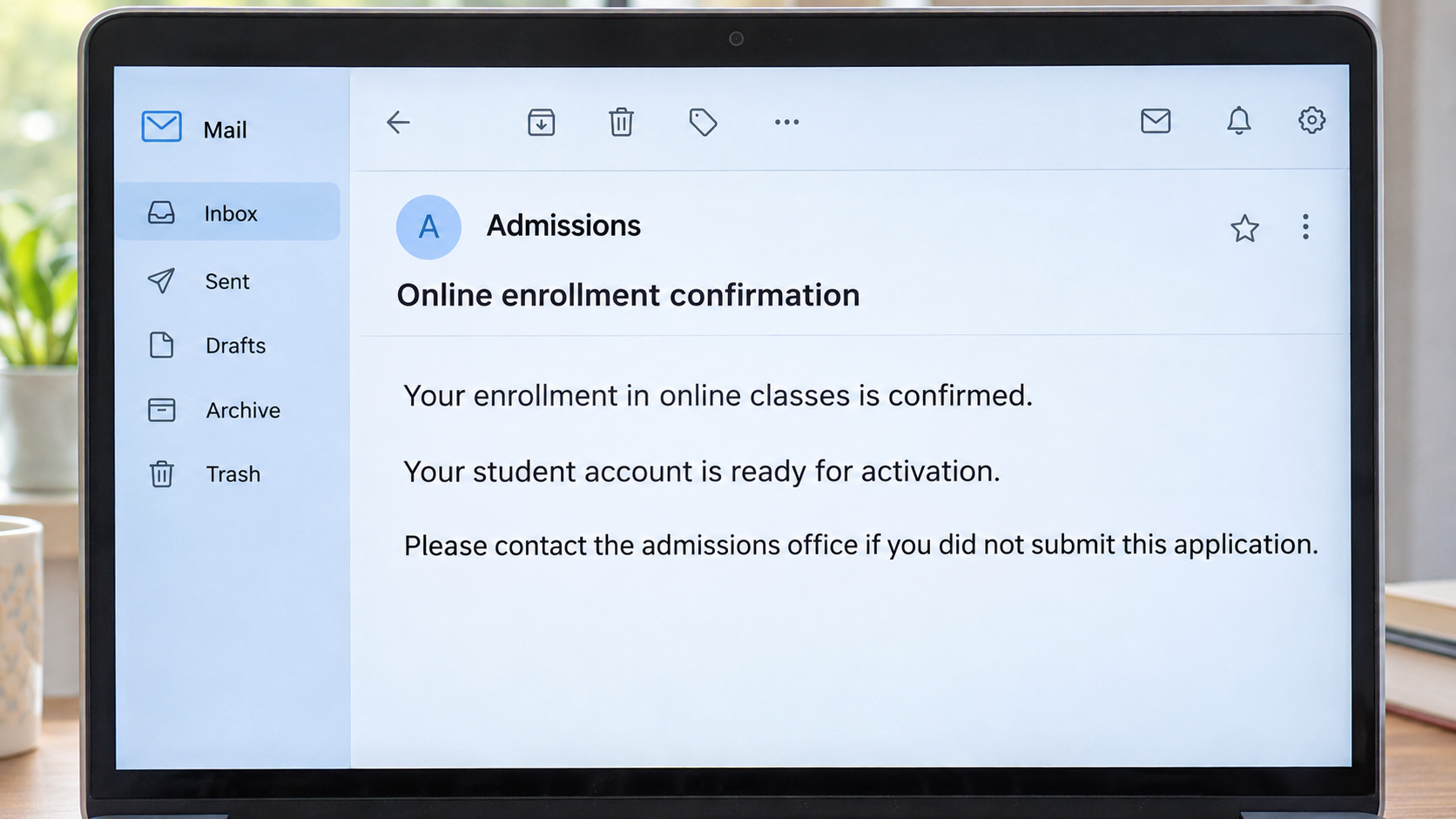
The email pictured above is a fictional reconstruction of an unexpected enrollment notice. It contains no real student’s records and does not depict a particular college.
Your response should establish the records before following instructions
Locate the school’s genuine contact details independently. Ask whether it holds an application or enrollment under your identity, without using links in the unexpected message.
- Identify the school and the term connected with the notice.
- Ask whether any financial-aid application or disbursement is associated.
- Check federal loan information through your own StudentAid.gov access.
- Preserve account references and the dates you discovered unfamiliar records.
- Dispute unauthorized activity through the organizations holding those records.
Do not pay an unfamiliar caller to erase the enrollment. A legitimate investigation should not depend on a stranger’s promise to remove everything immediately.
Why This Can Happen Without an Obvious Phishing Conversation
Many scam warnings begin with something you were asked to do. This one can begin with an application you never saw and a decision you never made.
Criminals using somebody else’s identity do not need that person to attend an interview or deliberately apply for financial aid.
However, an unexpected email does not reveal where the information came from. Do not assume a specific employer, website, or college leaked your details.
The first useful task is narrower: determine which records actually exist and separate them from claims made only in a message.
A real enrollment record and a fabricated email require different responses. The first calls for identity and record correction; the second may simply be phishing.
There can also be a clerical mistake or an incorrect contact address. Independent confirmation helps avoid handing additional personal information to the wrong party.
If the school confirms that your identity was used without permission, keep that response. It can help connect later correspondence to the same disputed activity.
You do not have to identify the criminal personally before reporting the record. Explain what you know, what you did not authorize, and what remains unclear.
How the Ghost Student Scam Works
Step 1: Someone else’s identity becomes the application material
The fraud begins with identifying information that allows the applicant to present themselves as another person. The legitimate identity holder has not consented to that use.
Exactly which information was obtained can differ. A recipient should not infer the criminal’s complete file simply from the details included in one notice.
A name by itself is different from a record that matches your Social Security number and other identifiers. Share sensitive details only through a verified, appropriate channel.
Keep the original message while making those checks. Forwarded summaries can omit the sender information and account references that help an institution locate the relevant record.
Step 2: An online enrollment creates a plausible student record
The identity is used to pursue admission or enrollment in an online program. From the school’s perspective, the application initially presents itself as an ordinary request.
The OIG describes ringleaders enrolling fake, ghost, or straw students to pursue federal aid. These labels can describe related conduct, including cases involving stolen identities.
They should not all be treated as identical. Some fraud involves people participating knowingly; an identity-theft victim did not authorize the application made in their name.
For that victim, the immediate concern is the false connection to the program. The school’s registrar or admissions office can help establish the enrollment details.
Step 3: Aid records are added to the education story
The scheme may involve a FAFSA submission and other records used to seek financial assistance. A real person’s identity gives those records an apparently consistent student identity.
Do not assume every enrollment has already produced federal loans. Ask the financial-aid office what was requested, approved, or disbursed under the disputed record.
Those are separate stages, and the distinction matters. A pending application may require intervention before money moves, while an existing loan needs a specific dispute.
If somebody says the case is resolved, ask which stage they addressed. Canceling admission would not, by itself, explain what happened to an associated aid record.
Step 4: Aid balances become the financial target
The OIG identifies federal student-aid award balances as the objective of these rings. The online program supplies a route through which the money can be pursued.
A scammer’s apparent interest in classes may therefore have little to do with earning a qualification. The education record supports the financial deception.
For an affected identity holder, ask the institution to explain any associated disbursement and its status. You do not need to speculate about where every payment went.
Keep statements about the disputed funds precise. An application, an approved amount, and a completed payment are different facts that should remain separate in your report.
Step 5: The identity holder encounters the paperwork afterward
An unexpected enrollment confirmation, aid message, school bill, or unfamiliar loan may bring the issue to your attention. The first notice is not necessarily the first event.
Ask for the dates attached to the underlying records. That creates a timeline extending beyond the day you happened to open an email.
A criminal may have supplied different contact details. Ask which information can be corrected and what secure verification the institution needs from you.
You may need responses from more than one organization. Keep admissions, student accounts, financial aid, and loan servicing correspondence connected without assuming one office controls everything.
The Records You Need to Separate
An application is different from an active enrollment
Start by asking what status the school actually has on file. A submitted application, accepted offer, and active class registration can require different corrections.
Request the relevant term, program, and reference number where the institution can provide them securely. Those details make follow-up more useful than repeatedly explaining an unfamiliar email.
Make your position explicit: you did not submit or authorize the application. Avoid simply asking to withdraw, which may leave your identity-theft concern unclear.
If a normal cancellation process is proposed, ask how the unauthorized use will be documented. The goal is an accurate record of what happened.
A tuition balance is different from a federal loan
A school’s account statement describes that institution’s records. Federal loan information may involve a separate holder or servicer, which needs to hear about the identity misuse too.
The OIG’s identity-theft guidance directs affected people to their loan servicer, credit reporting agencies, the OIG, and the FTC.
Use the same factual timeline when contacting each organization. Keep the school, academic period, disputed loan, and account references together so unrelated issues are not merged.
If only a school balance exists, say that clearly. Do not describe it as a federal loan unless the relevant record confirms one.
An identity-theft report is different from a correction decision
A report documents your account of the misuse. It does not mean every institution has corrected its records or every disputed loan has been discharged.
Ask what review remains open and how you will receive the outcome. Keep the organization’s response alongside your submission and supporting documents.
For qualifying federal loans, there is an official false-certification discharge application for identity theft. Eligibility and supporting evidence still require assessment.
Do not treat finding the form as approval. Ask the loan holder how to submit the appropriate application securely and what happens while it is reviewed.
What to Do if You Have Fallen Victim to This Scam
-
Verify the notice through the school’s independently located website. Contact admissions or the registrar and ask whether the application or enrollment actually exists.
Do not use a callback number supplied by an unfamiliar sender as your only route. Keep the original notice while you establish a trustworthy contact.
-
Tell the school that your identity was used without authorization. Ask it to involve the appropriate fraud, financial-aid, and student-account staff.
Request written confirmation of the disputed record and next steps. Ask which associated records require separate correction, rather than assuming an enrollment cancellation settles everything.
-
Check your federal student-aid records directly through StudentAid.gov. If you cannot access the account or find unfamiliar activity, use Federal Student Aid’s official help routes.
Check the school and loan details carefully. An unfamiliar marketing email should not be converted into a loan dispute unless there is a corresponding record.
-
Notify the servicer or loan holder about any unauthorized loan. Ask what documentation it requires and whether the identity-theft discharge process applies.
The official application asks how you discovered the loans and requests supporting evidence. Complete it accurately, and obtain current submission instructions from the holder.
Ask for written guidance about the account’s status during review. Do not assume that submitting a complaint automatically changes payment requirements or stops collection activity.
-
Create an identity-theft recovery record through IdentityTheft.gov where applicable. Preserve the report, related correspondence, and a dated account of each discovery.
The FTC’s official recovery service provides a route for documenting identity misuse. Keep your report private and share it through verified channels when needed.
-
Review your credit reports for unfamiliar accounts and consider credit protections. Contact Equifax, Experian, and TransUnion directly if placing freezes.
The FTC explains that credit freezes are free and help prevent new credit accounts. They do not correct an existing enrollment or remove a disputed loan.
Save any dispute reference and response separately from the freeze confirmation. Those actions address different parts of the problem.
-
Report suspected federal student-aid identity theft to the Department of Education OIG. Provide a clear description and the relevant institutional and loan references.
Follow the reporting instructions for your role. An identity-theft victim should describe themselves as the person affected, rather than guessing the criminal’s name or organization.
-
Secure accounts connected with the activity and watch for follow-up impersonation. If email access was exposed, change credentials and review recovery settings through the real provider.
Do not pay a stranger who promises immediate deletion of school or loan records. Work through the institutions and official reporting channels already handling your case.
How to Make Follow-Up Less Confusing
Create a simple timeline containing the first notice, each institution contacted, and the response received. Add reference numbers without putting complete identifiers in ordinary email subject lines.
Separate what you personally observed from what somebody told you. An admissions employee’s explanation and a document you obtained can support different parts of the account.
When an office refers you elsewhere, ask what remains unresolved with that office. A referral is useful, but it should not obscure which record it maintains.
Keep copies of submitted forms and supporting documents. If you receive a correction, compare it with the particular enrollment, aid, or loan item you disputed.
A response about one academic term should not be assumed to cover another. Likewise, confirmation from one school does not automatically resolve an unfamiliar record elsewhere.
If you need help organizing the case, use a trusted person without sharing account passwords. They can help track correspondence while you retain control of access.
The goal is a documented outcome for each affected record. That is more useful than an informal assurance that everything should be fine.
Frequently Asked Questions
Can someone enroll in college using my identity?
Yes, the Department of Education OIG documents student-aid fraud involving stolen identities and online enrollment. Confirm your specific records independently before assuming an unexpected notice proves misuse.
Does an enrollment email mean I already owe a loan?
No, admission, enrollment, aid applications, and loans are different records. Ask the school and check official federal loan information to establish what actually exists.
Does this mean the college itself committed fraud?
No, criminals can misuse a legitimate institution’s enrollment process. A particular school’s involvement or responsibility needs evidence beyond an unfamiliar record or a consumer complaint.
Should I just withdraw from the unfamiliar classes?
Report the unauthorized use explicitly and ask how the institution will correct it. A routine withdrawal alone may leave the underlying identity dispute unexplained.
Will a credit freeze remove the student record?
No, credit freezes address new credit access. Existing school records and disputed loans require their own correction or review through the organizations maintaining them.
Can an identity-theft student loan be discharged?
An official false-certification discharge process exists for qualifying identity-theft cases. Ask your loan holder about eligibility, required evidence, submission, and the account’s status during review.
The Bottom Line
Do not ignore a confirmed enrollment or loan created with your identity. The ghost student scam is documented, but each unfamiliar record needs independent verification.
Contact the school, Federal Student Aid, and any affected loan holder through genuine channels. Document the unauthorized use and pursue a written outcome for each disputed record.

Join the discussion
0 commentsShare your experience or ask a question about this article.
Community experiences
Did this happen to you?
Your experience could help someone recognize the same scam. Submit a private report for our team to review.
I experienced this tooReports are reviewed before publication. Sharing publicly is always your choice.
Discussion
Start the conversation
Have a question or something useful to share? Add the first comment.