


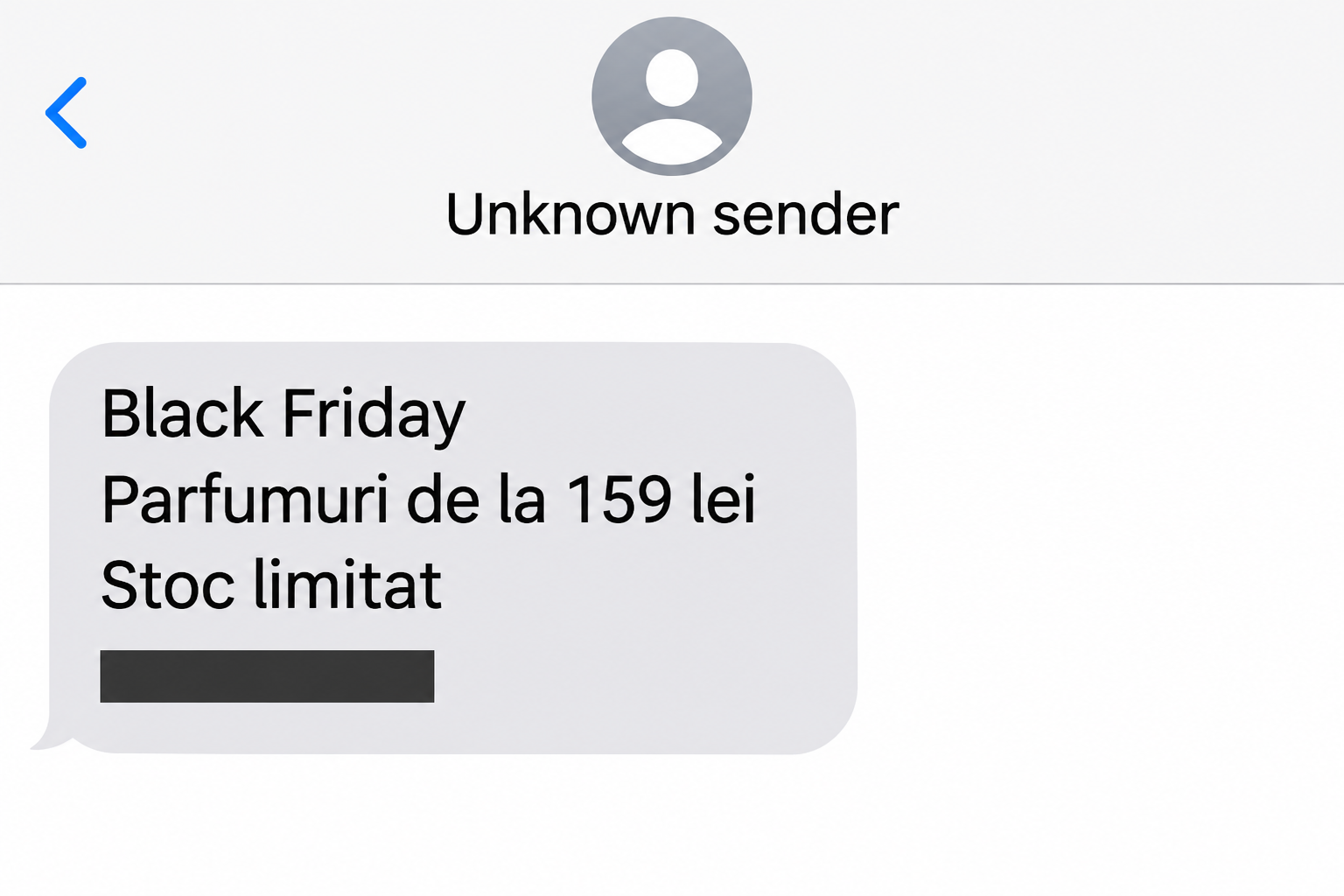
A Black Friday text promises designer perfume for less than you expected to spend on a gift. The starting price is 159 lei.
It says stock is limited, and there’s a link right there in the message. Before you tap, take a closer look at what the text actually tells you.
Overview
What the 159 lei text actually says
Bitdefender Labs flagged a Romanian Black Friday perfume text that named Dior, Yves Saint Laurent and Armani. It promised genuine fragrances starting at 159 lei.
The text combined that price with a limited-stock claim and a link. It made the brands easy to recognize without giving you a trustworthy seller to recognize.
The original Black Friday investigation quotes the text but leaves the destination hidden. The illustration above shows the pitch, not a capture of its website.
That distinction matters when you’re deciding what to do. The fraudulent promotion is documented, but there is no confirmed checkout or order outcome for this exact text.
Three names you know, but who would actually sell you the bottle?
Dior, YSL and Armani weren’t behind the message. Seeing their names together doesn’t tell you who would accept your payment, ship the goods, or answer a return request.
Legitimate shops can carry all three brands. What this text lacks is a reason to trust the offer that exists outside the message itself.
The phrase “from 159 lei” also leaves the product open. It doesn’t specify a fragrance, concentration, bottle size, condition, or total with delivery.
What would make the deal worth checking?
- You can find the same product on a retailer’s site or app that you opened independently.
- The listing identifies the seller and gives the size, concentration, final price, and delivery terms.
- You can check those details without sharing a card number first or installing anything from the message.
These checks don’t require tapping the original link. If you want a deal on the fragrance, you can start with the fragrance rather than with the text.
How the Black Friday Perfume Text Scam Works
Step 1: The message looks like ordinary seasonal advertising
During sale season, a message about a discount doesn’t seem out of place. You may already have an inbox full of early deals and limited editions.
This one doesn’t announce a surprise charge or claim your account was locked. It catches you while you might already be looking for a gift.
Receiving it doesn’t mean someone saw your shopping history or accessed an account. The report identifies a campaign in Romania, not how your number was obtained.
Step 2: The brands are recognizable but the price has no product attached
You can picture an Armani or Dior fragrance as soon as you see the names. The text leaves you to imagine which bottle the 159 lei might buy.
Compare a full-size fragrance with a small travel spray. Even when the name is identical, those are different purchases, and their prices tell you little about each other.
When an ad makes the brand and price clearer than the item, there isn’t enough information to compare the offer. You don’t have to open the link to learn that.
Step 3: The stock claim makes checking feel like a risk
Limited stock suggests the advantage goes to whoever taps first. In a short text, that can turn an ordinary shopping pause into a fear of missing out.
There may be a legitimate sale somewhere that overlaps with the advertised timing. That wouldn’t make the incoming text a reliable route to the real offer.
Let the alleged deadline pass if necessary. If you can find a real listing yourself, you’ll have more to go on than a message that says hurry.
Step 4: The link tries to become your only route to the offer
Once you leave the message, any page you reach can present its own account of who sells the product. A familiar picture or logo won’t settle that question.
A dubious shop might ask for an address, password, or payment information before you’ve checked the seller. Stop if the page needs sensitive details just to show the deal.
Those are possible exposures, not findings about this unseen destination. If you already supplied information, respond to what you entered or approved rather than assuming every possible outcome happened.
How to Verify a Perfume Deal Without Using the Text
Start with the product and compare equivalent listings
Write down the exact fragrance you want. Include its size and whether it is an eau de toilette, eau de parfum, or a different formulation.
Next, note whether the listing is a sealed retail box, a refill, a tester, a sample, or a miniature. A low starting price might refer only to the smallest option.
Check the seller’s total including shipping and any fees before you compare prices. A starting price tells you even less when the product and delivery costs are both unspecified.
The European Consumer Centres Network’s Black Friday guide recommends checking the shop and its terms. Save the listing and order confirmation if you buy.
Find the shop through a route you choose
Open the retailer you already know in a fresh browser tab, or use its installed app. Don’t search for the unusual wording or shortened address in the text.
If you’re not sure where to start, a brand’s own site can help. Dior’s beauty store locator is one example for checking a store independently.
The locator showing a store does not validate a text using its name. You still need to confirm the offer through the retailer’s own listing or service channel.
On a marketplace, find the business named as the seller. The marketplace logo tells you where a listing is displayed, not necessarily who will fulfill the order.
Check who would handle a problem before paying
Find the return policy before entering card details. Look for who accepts returns, which condition the product must be in, and whether you pay to ship it back.
Check whether the seller identifies the actual business taking your order. A brand name at the top and a different seller at checkout need an explanation you can verify.
If you’re buying a gift, check the delivery estimate and the retailer’s route for a missing parcel. Paying through a text leaves you with fewer useful facts to work from.
What a Real Promotion Can Tell You Before You Buy
Imagine you find the same starting price on a store’s own site. The bottle shown in the banner might not be the one the price actually covers.
Open the exact listing and see which option is selected. You want to know if you’re getting one travel spray, a full-size bottle, or a gift set.
Read the unit and quantity as well as the total. A set with several miniatures isn’t automatically a better deal than one bottle of the fragrance you wanted.
Occasionally a real offer needs a loyalty account. If it does, use the retailer’s login you reached independently and check whether that promotion appears under your benefits.
If the store says the offer is for in-person customers, call the branch through its independently listed number before making the trip. Don’t call a number from the text.
If the only evidence of a deal is a screenshot in a group chat, ask where the person bought it. A forwarded screenshot can be genuine and still be outdated.
Likewise, if a friend shows you a receipt, it describes their order. It doesn’t authenticate another text or tell you what would arrive from a different seller.
These comparisons solve the problem a short message leaves open: which product, from which shop, under which terms. They also give you a sensible way to pass on the deal.
What If the Bank App Shows a Payment Approval?
A bank approval screen can make a suspicious checkout feel legitimate. It only asks you to approve a transaction; it does not confirm that the seller is trustworthy.
If the approval shows a different amount or an unfamiliar merchant, decline it. Then check the transaction from the bank’s own app.
A message asking for a code to “cancel” a transaction deserves the same caution. Don’t give anyone a code or approve a second payment to fix the first one.
If you already tapped approve, tell your bank exactly what you saw and did. An attempted payment, a pending authorization, and a posted charge can require different actions.
Save the message and bank details privately for the fraud team. When asking a friend for a second opinion, don’t share full card numbers or codes.
If no charge appears yet, tell the bank if you entered the full card number anyway. A person can be exposed before a payment shows in the activity list.
If you did pay, keep the confirmation the bank provides. It can help you refer to that one transaction without confusing it with other Black Friday orders.
Be precise about what you authorized. Paying for goods that weren’t supplied is different from never approving a transaction, even when both problems started with the same text.
What to Do if You Have Fallen Victim to This Scam
-
If the text is all you received, leave the link unopened.
Save the text and its time if you plan to report it. Use your messaging app’s report or block option rather than replying to the sender.
Nothing in the public sample shows that receiving the message moves money or changes your account. You don’t need to replace a card merely because a text arrived.
-
If you opened the page, check what happened next.
Close it and think about whether you entered data, allowed notifications, or installed anything. A visit alone is not the same exposure as entering a card number.
If you allowed notifications, remove that site’s permission in the browser. If you installed an unexpected app or file, get device help before using that device to bank.
-
If you entered card data or approved a payment, call your bank.
Use the bank app, the number on your card, or another trusted route. Explain whether you typed the card details, approved a request, or saw a completed transaction.
Ask whether the bank recommends locking or replacing the card and what dispute options apply. Don’t wait for an unfamiliar seller to promise a refund over text.
Keep any receipt, statement entry, and merchant name shown by your bank. Those details can help identify what happened even if the shopping page is gone.
-
If you entered a password, secure the real account separately.
Open the actual retailer or email service directly and change the exposed password. Change it wherever else you reused it, starting with accounts that can reset other logins.
Look for unexpected addresses, saved payment changes, or account recovery updates. Use the legitimate service’s security controls to sign out unfamiliar sessions if that option exists.
-
If you shared contact details, watch for a second request.
A follow-up may claim that a parcel needs a small fee or that a refund requires card verification. Knowing your address doesn’t give the sender authority to bill you.
If you made a separate real purchase, use that shop’s order history to look up shipping. Don’t link a new text to the order just because its timing fits.
-
Report the message and keep your transaction records.
In Romania, the joint Black Friday advisory from DNSC, police, and the banking association explains where to report. Contact your bank first if money is at risk.
If you also file a fraud report, use a copy of the original text and evidence showing what happened afterward. Don’t put your card details in a public warning.
Frequently Asked Questions
Is every perfume sold for 159 lei a scam?
No price can answer that question on its own. The confirmed case is a deceptive text, not proof that every sale at that price is fraudulent.
Did Dior, YSL or Armani send this offer?
The original researchers said those brands weren’t associated with the message. Look up the fragrance separately through the brand or a retailer you can verify.
Can I check the page without putting my card details in?
You don’t need to interact with the destination at all. A verified seller’s listing should be reachable without following the suspicious text to find it.
Does a padlock mean the fragrance shop is safe?
A padlock means your connection to that site is encrypted. It doesn’t confirm who is operating the store or what it would ship.
What if I paid but didn’t get an order email?
Check whether the bank shows a pending or completed transaction. Contact your payment provider with the details rather than trying again through the same message.
Should I forward the text to friends as a warning?
Send a screenshot with the clickable destination and personal details covered. You can explain the 159 lei hook without passing along the original link.
The Bottom Line
Don’t buy perfume through the 159 lei Black Friday text. The message borrows familiar names, but it isn’t an offer that Dior, YSL or Armani sent.
If you still want the fragrance, find the exact bottle through a retailer you can verify. If you already shared card details or approved a payment, contact your bank.

Join the discussion
0 commentsShare your experience or ask a question about this article.
Community experiences
Did this happen to you?
Your experience could help someone recognize the same scam. Submit a private report for our team to review.
I experienced this tooReports are reviewed before publication. Sharing publicly is always your choice.
Discussion
Start the conversation
Have a question or something useful to share? Add the first comment.