


A message carrying Kevin Costner’s name arrives after you comment on a fan page. The conversation feels personal, and the attention keeps coming.
Then a private invitation introduces a manager, a payment request, or a problem only you can supposedly solve. Here’s what to check before answering.
Overview
The actor’s identity is being used to approach fans
The Kevin Costner romance scam uses a familiar public figure to make an unfamiliar sender seem trustworthy. The supposed connection develops through private messages.
Costner is being impersonated; the warnings concern people borrowing his identity. They do not accuse the actor of collecting these payments.
AARP has received multiple reports naming Costner among celebrity impersonators. Surrey and Sussex Police also identify him among celebrities repeatedly used in romance fraud.
A friendly conversation becomes a financial obligation
The approach can begin with appreciation for your support. Money enters later, once refusing the request feels like disappointing someone you care about.
Celebrity fraud can involve supposed VIP access, charitable help, or a personal relationship. Police specifically warn about requests for Apple or Amazon voucher codes.
- A public comment gives an impostor an opening for private contact.
- The sender claims a personal connection that you cannot independently establish.
- Affection or exclusive access becomes tied to sending money or voucher codes.
- Someone introduced through the same conversation claims to handle the arrangements.
The safest response begins outside the conversation
Do not pay a private contact claiming to be Costner or his representative, whether the approach involves romance, friendship, or exclusive fan access.
A separate message from a supposed manager does not validate the first account. Both claims still need an independent source.
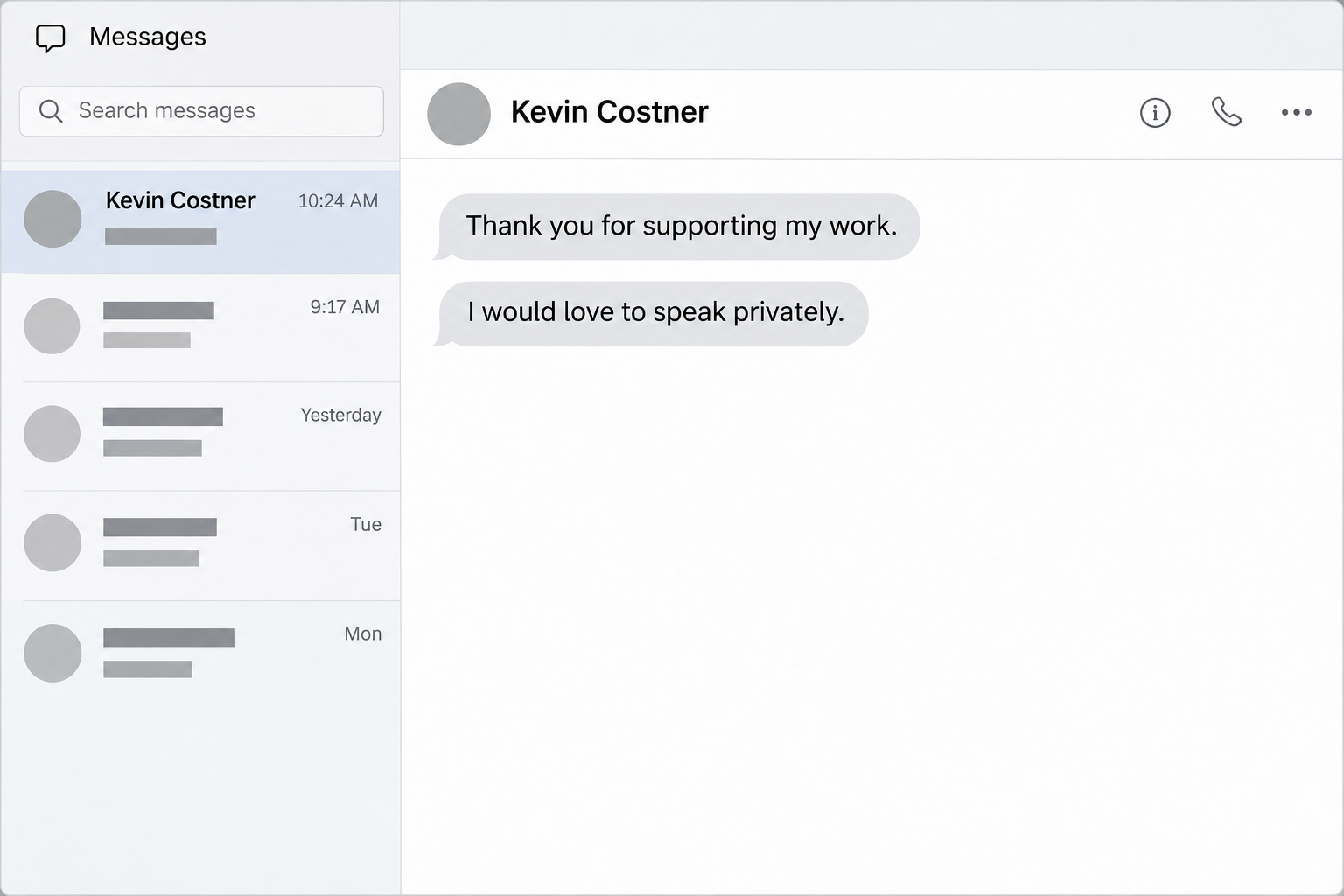
The opening image is a fictional reconstruction of the approach, with invented wording. It is not a recovered conversation with a victim.
Police Warn About Scammers Using Costner’s Name
Police have identified a repeating pattern behind these private approaches. Surrey Police’s celebrity romance fraud advisory specifically names Kevin Costner.
The police describe approaches through unofficial fan pages, followed by affectionate messages and requests for money. Their warning covers Facebook, Instagram, and TikTok.
AARP’s celebrity impostor warning independently identifies Costner among names reported to its Fraud Watch Network Helpline.
These sources establish a recurring impersonation problem. They do not identify whoever controls every account using his photograph or promise a particular victim’s recovery.
A fan page can discuss films without claiming a private relationship with you. The concern is the message that borrows Costner’s identity to collect money.
How the Kevin Costner Romance Scam Works
Step 1: A public expression of interest becomes an invitation
You might comment on a photograph, a performance, or a fan discussion. An impostor can see that interest without knowing anything private about you.
The approach then feels connected to something you actually did. Recognition of your comment can seem like evidence that the celebrity noticed you.
In reality, the reply only shows that someone could read the same public post. It does not establish who wrote the message.
A copied picture, familiar name, and references to public appearances can make that distinction easy to miss during an exciting exchange.
Step 2: The conversation moves somewhere more private
The sender suggests continuing through a messaging service. Surrey Police list Telegram, Zangi, WhatsApp, and Signal among platforms used in celebrity romance fraud.
Those applications provide legitimate ways to communicate. Moving onto one does not prove fraud, but it also provides no assurance about the person messaging you.
Pay attention to the explanation for moving. A claim that management must never discover the friendship leaves the sender controlling how the relationship gets checked.
You can refuse the move without supplying another phone number or email address. An unsolicited admirer has no right to your additional contact information.
Step 3: Frequent attention makes the relationship feel established
Messages become part of your routine, with affectionate language and repeated interest in your life. Police describe this sustained attention as part of the manipulation.
The time invested can make the connection seem too elaborate to be dishonest. Yet a long conversation still leaves the sender’s identity unresolved.
Ask yourself what changed besides the number of messages. Feeling close to the account is different from having independently verified its owner.
You do not need to prove that every compliment was scripted before stopping. A financial request is reason enough to step outside the conversation.
Step 4: Access or affection acquires a price
The financial request may be framed as supporting the relationship, arranging VIP access, or helping a cause. The celebrity’s name supplies the persuasion.
Apple and Amazon voucher codes are particularly important warning signs in the police advisory. A photographed code can let another person use the card’s value.
A request does not become trustworthy because the sender calls it temporary or promises repayment. The recipient’s identity remains the central problem.
For a genuine event, locate the organizer independently and check its published arrangements. Do not use a private contact’s payment instructions as verification.
Step 5: Another account supplies apparent confirmation
A supposed manager can make the arrangement feel more official. AARP warns that celebrity approaches may come from people claiming either role.
However, someone introduced by the original sender is part of the same unverified story. An email signature or invoice does not create independent confirmation.
Follow the claimed organization back to contact details you found separately. Ask whether that exact arrangement exists, without using links supplied in the chat.
If the explanation requires secrecy from your bank or family, stop the transaction. You should not have to hide a legitimate purchase.
Checks That Matter More Than a Familiar Face
Look at the account you are actually messaging
Save the profile link and exact username, rather than only its displayed name. Several accounts can show identical names and copied photographs.
Compare that profile with links reached independently from the public figure’s established presence. Do not let the suspect account choose its own confirming accounts.
A search can reveal other warnings, but a clean search result is not a certificate. New accounts may have little searchable history.
Separate a video from a financial instruction
Surrey Police warn that artificial intelligence can make celebrity impersonation more convincing. That does not mean every message or video in this scam uses AI.
A clip showing Costner cannot, by itself, authorize the bank account or gift card request beside it. The payment destination needs its own verification.
Likewise, details about films or public appearances can be copied. Knowing accurate public facts is not the same as controlling the celebrity’s account.
Check the actual event or charity separately
If the message mentions a benefit event, search for the organizer’s own listing. Check the venue, ticketing route, and published contact information together.
For a donation, find the charity independently and read its giving instructions. A private wallet or voucher request should not replace that process.
A real organization can be mentioned in a fraudulent message. Its existence does not authenticate the person asking you to send money elsewhere.
What to Do if You Have Fallen Victim to This Scam
-
Stop the next payment before debating the relationship. Do not buy another card, send another transfer, or pay a fee to cancel a meeting.
If you are standing at a checkout or transfer counter, tell the staff member that a suspected celebrity impostor directed the purchase.
You can deal with the emotional questions afterward. Preventing an additional transfer is an immediate task that does not require the sender’s agreement.
-
Save the details that identify the transaction. Keep the account link, message history, payment request, receipts, recipient details, and dates together.
Write a brief sequence of events while you remember it. Distinguish money already sent from requests you refused or payments that remain pending.
Preserve the material privately, rather than posting card codes or personal documents in a public warning. Investigators need useful records without creating another exposure.
-
Call the gift card issuer immediately. Use contact information from the card or issuer’s genuine website, and explain that an impostor obtained the code.
Ask whether any remaining value can be protected and whether a refund is possible. Keep the card and purchase receipt for follow-up questions.
The FTC’s recovery instructions cover gift cards and other payment methods. Reporting quickly helps, but reimbursement is not guaranteed.
-
Tell your bank or payment provider exactly what happened. Explain whether you authorized a transfer after deception or noticed a payment you never made.
Ask about stopping a pending transfer, attempting a recall, and the documents needed for a fraud claim. Record the reference number and follow-up deadline.
If cryptocurrency was involved, retain the transaction identifier and receiving address. Contact the sending service promptly, without assuming a completed transfer can simply be reversed.
-
Report the impersonating accounts through the relevant platform. Include the profile identifier and the messages asking for money, then block further contact.
Report associated manager accounts separately when they participated. Keep their connection clear, without claiming to know whether one person controlled every account.
For US reporting, submit the incident through the FBI’s Internet Crime Complaint Center. Include the payment details alongside the claimed celebrity identity.
-
Address any information you actually disclosed. If you supplied a password, change it through the genuine service and review its account security settings.
If you shared identity documents or financial identifiers, document exactly which ones. Use IdentityTheft.gov for US identity theft recovery guidance appropriate to that exposure.
Simply exchanging messages does not establish that someone accessed your bank or device. Base additional recovery steps on what you shared and what occurred.
-
Bring another person into the recovery process. Choose someone who can help organize calls and receipts without taking over your accounts without permission.
A second reader can separate the sender’s emotional pressure from the practical tasks. You do not need to handle both problems alone.
Be cautious when a new stranger promises to recover everything for an upfront payment. Verify any professional independently before providing information or money.
Explain the Payment Clearly When Asking for Help
Your payment receipt may describe only a routine transfer. The conversation supplies the missing explanation of how an impostor persuaded you to make it.
When calling a provider, connect those records: identify the transaction, then explain the celebrity claim and the reason given for paying.
If someone else purchased the gift cards for you, ask them to retain their receipt too. Explain who supplied the codes and when.
Keep borrowed money separate in your notes from money already sent. A loan balance and the recipient’s payment record answer different questions.
Ask the provider how to submit supporting messages securely, rather than sending an entire conversation to an address supplied by the suspected impostor.
Afterward, note what the provider actually agreed to do. An investigation reference is not a refund confirmation, so keep any follow-up instructions alongside it.
If another payment demand arrives, add it to the existing record without answering. That preserves the sequence without creating another conversation to manage.
Helping Someone Who Believes the Relationship Is Real
Start with the payment request rather than an argument about intelligence. A person can recognize a suspicious transaction before accepting that an entire relationship was invented.
Ask to review one concrete detail together: the account link, gift card request, or supposed event organizer. Keep the conversation focused on something checkable.
Agree on a pause while you review the request together. The purpose is to protect the next payment, without demanding an immediate verdict on the relationship.
Show the police warning naming Costner, rather than relying on your own opinion about celebrity relationships. Give your relative time to read it.
Offer to sit alongside them during a bank call. Practical support can be easier to accept than a demand to admit everything immediately.
Avoid posting their conversations publicly to prove a point. Exposure and embarrassment can make it harder for someone to ask for help again.
The FTC’s romance scam guidance recommends involving someone trustworthy. That support matters even when there is no money left to recover.
If they agree to stop payments, help build a plan for the next message. Decide whom they can contact before answering another urgent appeal.
Frequently Asked Questions
Is Kevin Costner responsible for these messages?
The documented scam involves impostors exploiting his identity. A sender’s use of Costner’s name does not show that he authorized the message or received money.
Does a private account prove it is his personal profile?
A claim that an account is private or reserved for trusted fans is still only a claim. Verify the profile through independently located official links.
Why would the sender ask for Apple or Amazon cards?
Police identify those voucher requests in celebrity romance fraud. Sharing a redeemable code can give the recipient access to value without an ordinary ticket purchase.
Can a manager confirm that the relationship is genuine?
A manager introduced by the same stranger supplies no independent verification. Locate the organization separately and check the specific arrangement through its published contact route.
What if I only replied and never paid?
Stop responding and report the account without sending further personal details. Review what you disclosed, then address any specific account or information exposure that resulted.
Should I send one final payment to get a refund?
Do not send additional money to the impersonator for a promised refund. Ask the original payment provider about recovery and preserve any new demands as evidence.
The Bottom Line
Do not send gift card codes or money to a private contact claiming a relationship with Kevin Costner. Police and AARP identify a recurring impersonation scam.
If you already paid, contact the payment provider now, preserve the conversation, and report the account. You do not need the impostor’s permission to stop.

Join the discussion
0 commentsShare your experience or ask a question about this article.
Community experiences
Did this happen to you?
Your experience could help someone recognize the same scam. Submit a private report for our team to review.
I experienced this tooReports are reviewed before publication. Sharing publicly is always your choice.
Discussion
Start the conversation
Have a question or something useful to share? Add the first comment.