


A private message carrying Reese Witherspoon’s name can turn an ordinary moment online into something exciting. The sender seems interested in speaking with you personally.
But when the conversation starts arranging a meeting or asking for your details, there are checks worth making before you tell the account anything else.
Overview
Witherspoon has warned about accounts impersonating her
Fake Reese Witherspoon DMs are a documented impersonation problem. The actress has publicly warned that people are using her name to approach other users privately.
Her warning describes efforts to build relationships, obtain private information, and arrange meetings. She expressly disowns messages seeking money or personal details.
AARP’s Fraud Watch Network also names Witherspoon among celebrities impersonated in reports received by its helpline. This is more than speculation about an unfamiliar account.
The request can matter before any money changes hands
A conversation does not have to begin with a payment button to become dangerous. A request for your address or private information deserves its own scrutiny.
The celebrity identity makes a personal request seem exceptional. That excitement can push the ordinary question, who is actually receiving these details, into the background.
- The message claims a direct connection with Witherspoon or someone representing her.
- The sender encourages a relationship that remains inside private conversations.
- Meeting arrangements become an explanation for requesting personal information.
- A familiar photograph substitutes for independently checking the person contacting you.
A genuine warning provides a clear stopping point
Do not send money, identity documents, or private meeting details to an unsolicited account claiming to be Witherspoon. Leave the conversation before verifying anything.
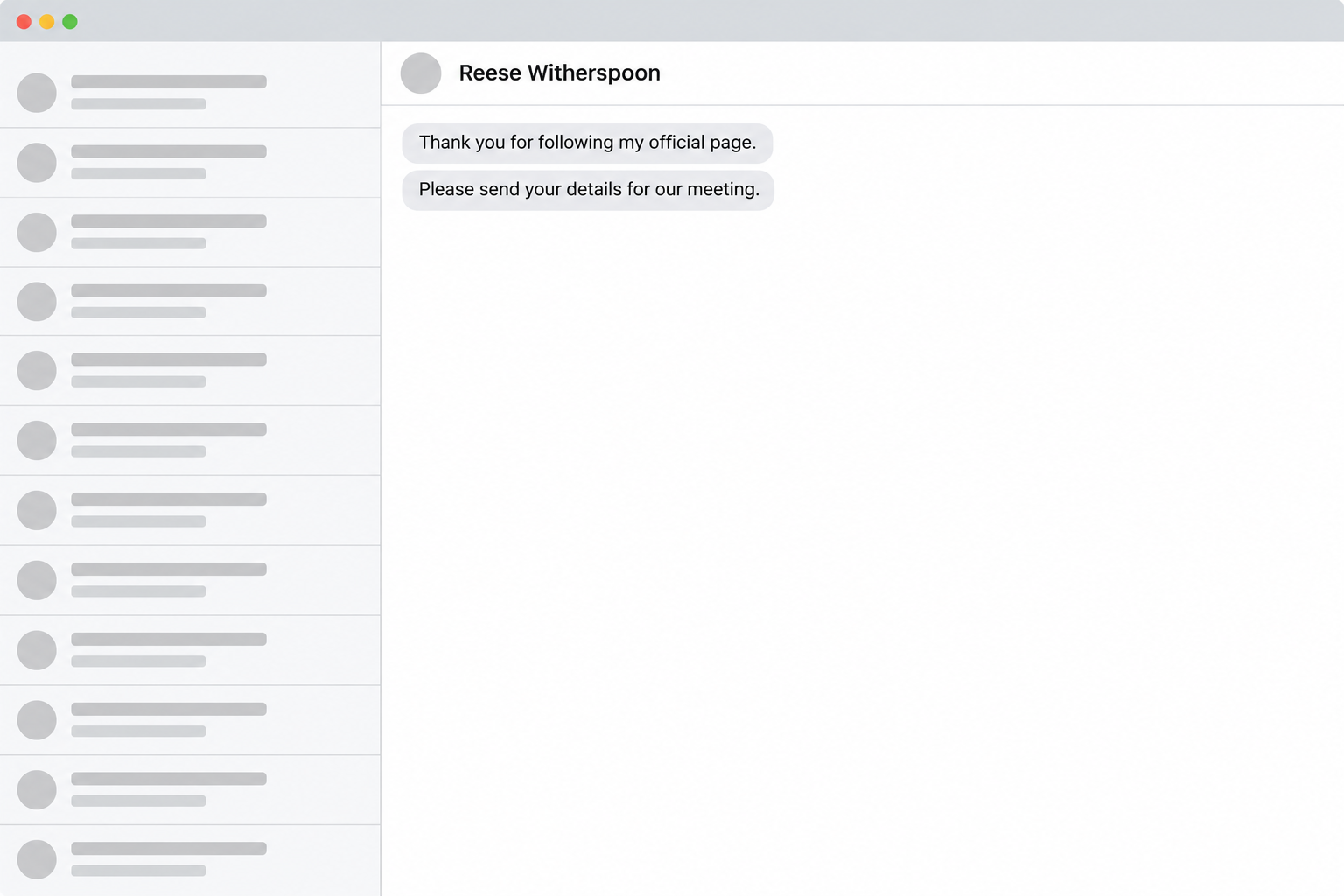
The illustration uses invented messages to show that approach. It is a fictional reconstruction, not a screenshot of an actual exchange involving the actress.
This article concerns impersonators using her identity. Her real work, businesses, and legitimate public events should not be confused with those private approaches.
What Reese Witherspoon Actually Said
In a warning on her verified TikTok account, Witherspoon says multiple people on TikTok and Instagram are impersonating her.
She describes them approaching people through direct messages, trying to establish relationships, seeking personal information, and proposing meeting times.
She also states that she would not reach out to obtain money or private information, or create a meeting through those approaches.
The importance is practical: someone claiming to arrange that kind of private contact is contradicting her own warning. You need not negotiate an exception with them.
AARP’s celebrity impersonation advisory separately identifies Witherspoon among names reported to its helpline. It describes impostors approaching fans as celebrities or managers.
The warning does not identify every fraudulent username or establish one shared operator. Accounts can change while the borrowed identity and private approach remain recognizable.
How the Reese Witherspoon Impostor Scam Works
Step 1: A familiar name makes the sender seem recognizable
The account uses the identity of a person you already recognize. A copied name and image can make the message feel less like contact from a stranger.
That impression is the first thing to question. Recognizing the person in the photograph does not establish who operates the account sending it.
The impostor does not need access to the real actress’s account to copy publicly available material. An attractive profile can still belong to an unrelated person.
Step 2: A private conversation creates an apparent connection
The sender begins building a relationship through direct messages. This stage is specifically part of Witherspoon’s warning, rather than an assumption about every fan interaction.
Attention can make later questions feel more reasonable. Once you have discussed your life, sharing one more detail may seem like continuing an existing friendship.
Keep the distinction clear between a friendly tone and an established identity. Neither frequent replies nor knowledge of public events closes that gap.
Step 3: A proposed meeting explains the request for information
Witherspoon specifically warns about impostors planning meetings. The suggestion creates an apparently practical reason to ask where you live or how to reach you.
Before answering, ask what you would be giving an unverified stranger. Information shared for an exciting invitation remains personal information after the invitation disappears.
Do not send a document simply because the sender calls it registration. A label in a chat does not establish a legitimate need for identification.
If there is a real public event, find its organizer’s own published listing. Follow that route independently, rather than treating the DM as a ticket.
Step 4: The claimed identity is used to overcome hesitation
A sender can keep pointing to the same profile as reassurance. But returning to a photograph does not answer questions about the request’s legitimacy.
The actress’s warning provides a better reference than explanations supplied by the account. Read it outside the chat, without letting the sender narrate it for you.
You do not have to identify the operator’s real name or location before declining. Protecting your information does not require completing an investigation yourself.
Step 5: Any payment request adds a separate financial risk
Witherspoon’s statement also addresses requests for money. The FTC warns that celebrity impostors use supposed prizes, charity appeals, and other stories to obtain payments.
These are possible variations of celebrity impersonation, not proof that every fake Witherspoon account uses the same demand. Judge the instructions you actually received.
If an account asks for a transfer, card code, or fee, stop there. Do not pay to demonstrate loyalty or unlock a promised private interaction.
How to Check the Account Without Giving It More Information
Compare the exact profile, not just the displayed name
Find Witherspoon’s established account independently, then compare its exact username and profile link with the sender. A matching displayed name is an incomplete check.
Take care with screenshots supplied by the sender. A picture of a genuine profile does not show that the message came from that profile.
Save your own record of the account that contacted you. That identifier will be more useful in a report than a cropped celebrity photograph.
Understand what a verification badge can establish
Witherspoon encourages people to check verification. TikTok explains its own badge, including where it appears on an account.
Read the platform’s explanation directly rather than accepting an icon placed inside someone’s profile picture. A decorative symbol is not the platform’s verification process.
Even after checking a profile, assess the request itself. A badge should not persuade you to ignore Witherspoon’s explicit warning about private solicitations.
Find an organizer without following the sender’s directions
For a book event, appearance, or other public activity, locate the organizer through its own established website. Check the date and venue together.
A legitimate public listing can explain ticketing and attendance requirements. An account offering a secret alternative still needs independent confirmation from that organizer.
Do not send your address to a new account merely to ask whether it is genuine. Verification should reduce disclosure, rather than create another opportunity.
What to Do if You Have Fallen Victim to This Scam
-
Pause contact and record what you already provided. List the information shared, including contact details, documents, passwords, payment information, or a planned meeting location.
Be specific without assuming the worst. Providing an email address creates a different problem from handing over its password or sending a photograph of identification.
Do not answer another request while making that list. An impostor has no legitimate authority to insist that you finish a registration process.
-
Preserve the actual messages and profile identifier. Keep the conversation that explains what was promised, what was requested, and where any payment went.
Include dates and the exact username in your private notes. If a different account became involved, record how it was introduced and what it requested.
Keep personal records out of public comment threads. A useful report can identify an account without exposing your documents to everyone reading it.
-
Cancel arrangements made through the unverified account. Do not travel to a private meeting or send additional location details to keep the invitation alive.
If you need to confirm a real public event, contact its organizer through information you found separately. Ask about that event, rather than forwarding sensitive documents.
If someone threatens you or creates an immediate safety concern, seek local emergency assistance. Preserve the threat without bargaining for the sender’s silence.
-
Secure accounts whose credentials you disclosed. Open the genuine service yourself, change the affected password, and review available session and recovery settings.
Replace the same password anywhere else you reused it. Enable the service’s additional authentication options so a password alone is less useful to an intruder.
If you cannot sign in, follow that service’s official recovery process. Another social media stranger offering paid access is not an account recovery authority.
-
Get tailored help for exposed identity information. In the United States, IdentityTheft.gov provides recovery guidance when someone misuses your personal details.
Keep a record of which document images you supplied. Contact the issuing organization when necessary to ask about its response to a compromised document.
Avoid treating every shared detail as proof that a new account has been opened. Check relevant records and act on the information actually exposed.
-
Ask the payment provider about recovery immediately. Explain the impersonation and identify the precise transaction, recipient, amount, and date.
For a gift card, retain the card and receipt, then contact its issuer. For a bank or app payment, report it through that provider’s genuine channel.
The FTC lists payment-specific recovery steps. Ask what can be stopped or disputed, without assuming that every completed payment is reversible.
-
Report the account through the platform’s own tools. The eSafety Commissioner’s TikTok guide links to reporting options; use the relevant platform’s process for contact elsewhere.
Describe the identity being claimed and the request you received. A clear report is more helpful than sending only a photograph of the real actress.
Block the sender after preserving the evidence. For US fraud reporting, use ReportFraud.ftc.gov and include any related payment information.
-
Warn someone you trust about possible follow-up contact. Explain that the account was an impostor, particularly if you shared details about friends or family.
Ask them to verify unusual messages through a contact method they already know. They should not rely on information relayed by the same suspect account.
Refuse new demands for a release, cancellation, or recovery fee. An additional payment does not undo the disclosure or establish who is contacting you.
What a Reply Does and Does Not Tell You
If you only replied to a message, review the conversation calmly. A reply is not, by itself, evidence that the sender accessed your account.
Separate information you typed from access you authorized. Sharing a password, entering a code, or approving a login requires a different response from saying hello.
The same distinction helps when discussing the incident with a bank or platform. Describe what happened without adding details that you only fear might have occurred.
If a message asks you to open a form, leave it and locate the relevant organization independently. There is no need to test the form yourself.
Be wary of public accounts offering private assistance after you report the impostor. Check the platform’s genuine help pages before following anyone’s recovery instructions.
Ask for Help Without Publishing Your Private Details
If you want a friend to review the exchange, show the request and account identifier first. They usually do not need your identification document.
Keep an untouched copy of the original conversation for an official report. Make a separate redacted copy if you need to discuss it more widely.
Remove your address, document numbers, payment identifiers, and other people’s details from public posts. Explaining the approach does not require sharing everything the impostor obtained.
Also distinguish a request from a completed action when warning someone. Saying that you were asked for identification is different from saying you sent it.
That distinction helps another person prioritize support. They can assist with a report immediately, while account recovery becomes necessary only when the relevant access was exposed.
If you reported the profile already, keep the confirmation privately with your notes. A new username or follow-up account can then be connected to the original contact.
You can help others recognize the scam without publishing the actress’s photograph as supposed proof. The deceptive request and claimed identity explain the problem more clearly.
Frequently Asked Questions
Has Reese Witherspoon personally warned about fake accounts?
Her verified TikTok account contains a warning about impersonators seeking relationships, private information, meetings, and money. She says those approaches are not coming from her.
Can a message be a scam without asking for payment?
An impostor may seek personal information before requesting money, or seek that information as the immediate goal. Do not wait for a charge before stopping disclosure.
Does a copied photograph show that her real account was hacked?
A copied image does not demonstrate access to her account. Someone can reuse publicly available material while operating a separate profile under a similar name.
Should I send identification to confirm a private meeting?
Do not provide identification to an unsolicited account claiming a connection with Witherspoon. Verify any genuine public event directly with its independently located organizer.
What should I do if I shared my home address?
Stop further disclosure and retain the messages explaining the request. Watch for follow-up approaches using that information, and seek local assistance if specific threats develop.
Is reporting the profile enough to recover money?
A platform report concerns the account and its behavior. Financial recovery requires contacting the bank, card issuer, or payment service involved in the transaction.
The Bottom Line
Decline private requests for money, documents, or meeting details from accounts claiming to be Reese Witherspoon. Her own warning directly describes this impersonation tactic.
If you already responded, identify what you shared, protect the affected accounts, and contact your payment provider if money moved. Preserve the evidence before blocking contact.

Join the discussion
0 commentsShare your experience or ask a question about this article.
Community experiences
Did this happen to you?
Your experience could help someone recognize the same scam. Submit a private report for our team to review.
I experienced this tooReports are reviewed before publication. Sharing publicly is always your choice.
Discussion
Start the conversation
Have a question or something useful to share? Add the first comment.