


Bloody Fairy sells Halloween sweaters, leggings and witch-themed clothes at about half the “regular” price. Its banner promises free shipping, and its pages look festive and polished.
The fine print tells a different story. Here is what BloodyFairy.com offers, what its policies say and whether RunicWin, a crypto casino site, has any link to it.
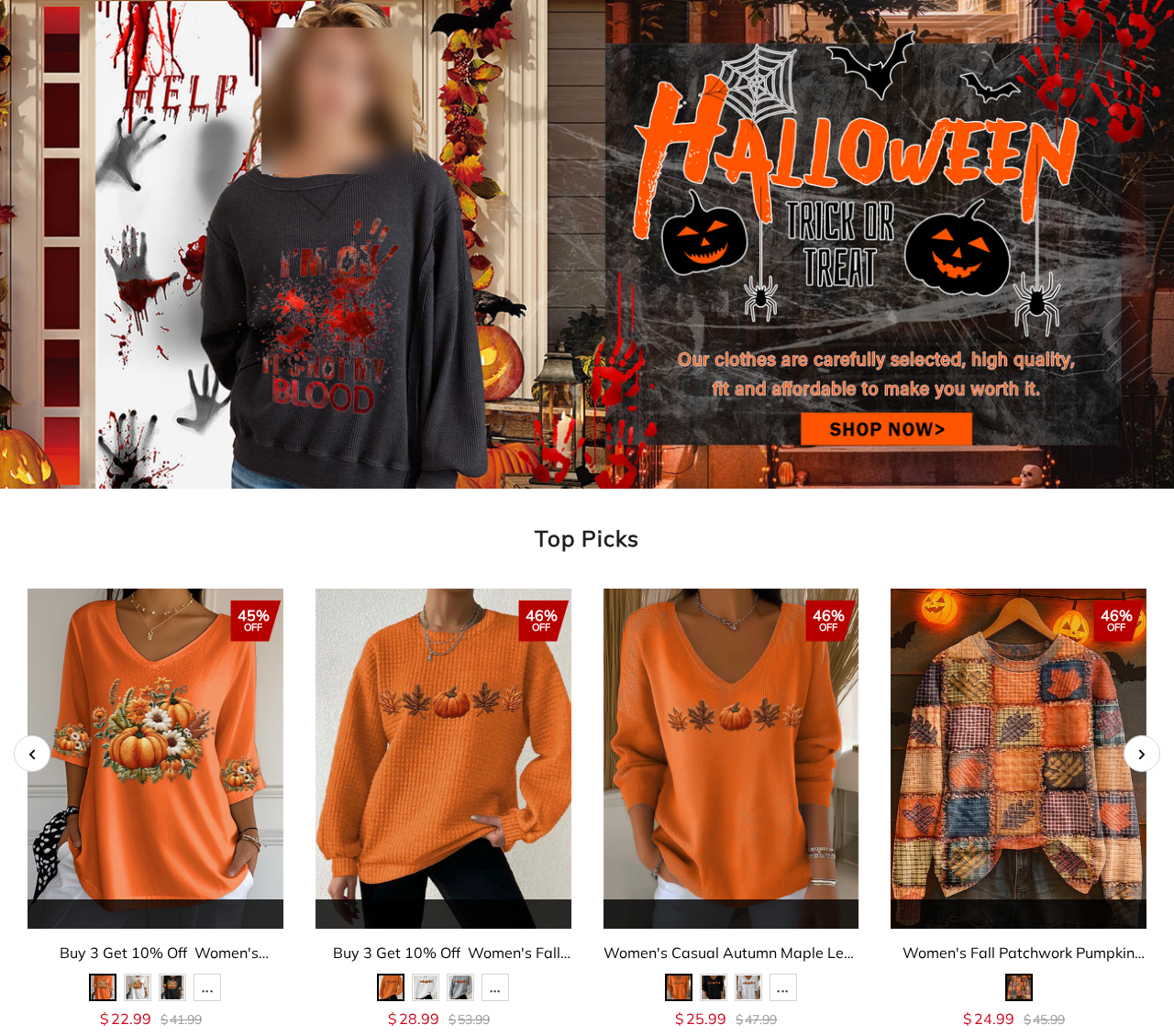
Overview
What BloodyFairy.com Sells
BloodyFairy.com is an online clothing store built around Halloween and fall themes. Its menus include a Blood Moon Halloween Collection, an Enchanted Witch Collection and a Salem Witch Look.
Most items on its homepage and clothing collection are women’s tops, sweaters and leggings at $22.99 to $39.99, plus hats from $9.99. All carry 45% to 50% off badges.
Who Runs It
The store doesn’t say. Its contact page lists only support@bloodyfairy.com, with no company name, street address or phone number.
The domain bloodyfairy.com was registered on July 16, 2025 through Xin Net Technology Corporation, a registrar based in China. Its name servers belong to HiChina, part of Alibaba Cloud.
Our Verdict
Bloody Fairy is a high-risk store. Don’t order from it unless you can accept slow overseas shipping, strict return rules and a 30% fee for canceling.
- The store names no company, address or phone number, only an email.
- Its terms say it is hosted by Shopify, yet the site doesn’t appear to run on Shopify.
- Canceling an order, even moments later, costs 30% of the total under its own policy.
- Product badges show discounts from odd “regular” prices such as $79.18 and $78.78.
- RunicWin, a crypto casino site that no longer loads, has no known connection to Bloody Fairy.
Is Bloody Fairy Legit?
Bloody Fairy appears to be a working store that takes orders, but it gives shoppers very little protection. Its policies put most of the cost and risk on the buyer.
There are no buyer reviews to weigh. Trustpilot has no page for bloodyfairy.com, and every product on its homepage and first collection page shows “(0)” reviews.
That leaves the store’s own pages as the main evidence. Several of them contradict each other or describe terms most mainstream retailers don’t impose.
What Bloody Fairy’s Policies Say
The policy pages are long, but a handful of rules matter most for anyone thinking of ordering.
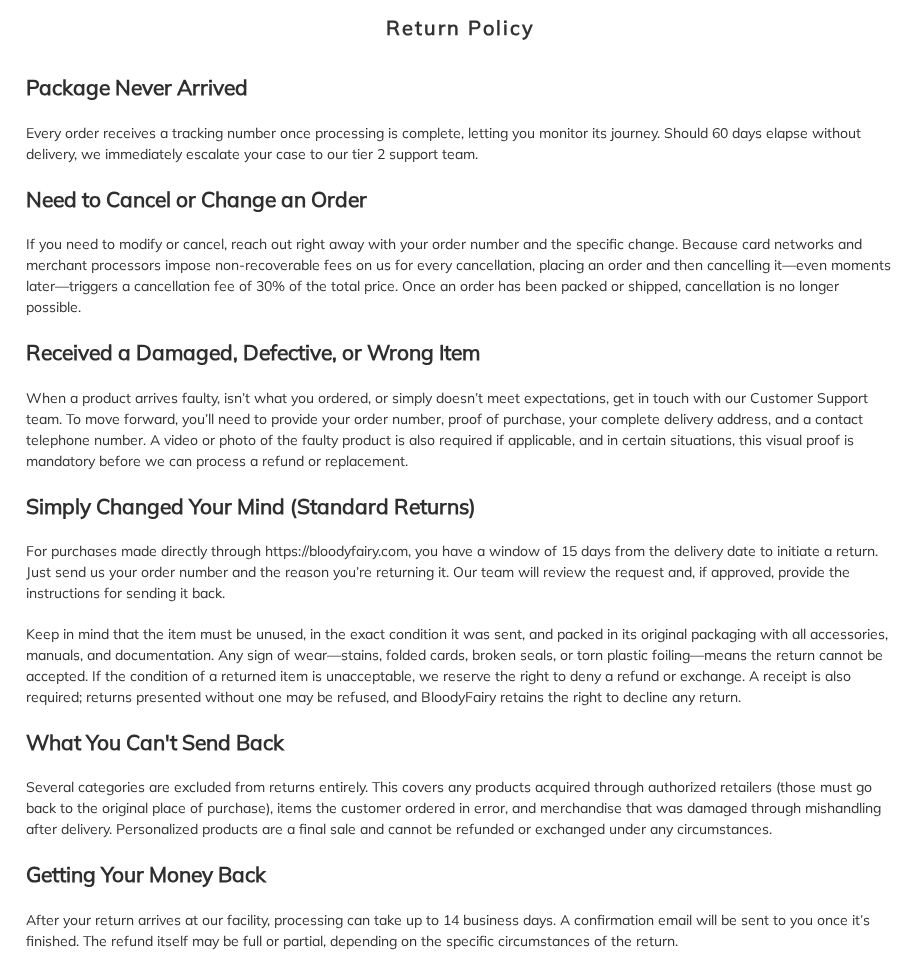
A 30% Fee for Canceling
The return policy says canceling an order “even moments later” triggers “a cancellation fee of 30% of the total price.”
Once an order is packed or shipped, it can’t be canceled at all.
The shipping page goes further. It says an order “becomes final and cannot be changed or retracted” the moment it enters the system.
A 60-Day Wait for Missing Parcels
If a package never arrives, the policy says the store will escalate the case to “our tier 2 support team” after 60 days.
It doesn’t promise a refund at that point.
Sixty days is a long wait. Card dispute windows keep running while you wait, so don’t let a store’s internal timeline delay your own claim.
Returns at Your Expense
Changed-mind returns must be requested within 15 days of delivery, and items must be unused and in original packaging. The store says it can still refuse any return.
Return shipping is the buyer’s cost, and the original shipping fee is deducted from any refund. The policy also says a refund “may be full or partial.”
Overseas Shipping and Customs Costs
The shipping policy says “the origin of most products is overseas.” Import taxes, duties and other customs fees are left to the buyer.
The shipping page also says a delivery that fails because the buyer missed paperwork or follow-ups brings “no refund and no complimentary replacement.”
Bloody Fairy’s Policies Contradict Each Other
The store’s own pages don’t agree on basic terms. That makes it hard to know which rule the store will apply if something goes wrong.
- Return window: the Return Policy allows 15 days from delivery, while the FAQ says 30 days from receiving the order.
- Damaged items: the FAQ gives a 7-day window to report problems, while the shipping policy says 7 to 15 days.
- Refund timing: the FAQ says card refunds are sent within 7 to 10 business days, while the Return Policy says 14.
- Free shipping: the banner says $59, the shipping policy says over $64, and the FAQ excludes discounted items.
The Return Policy also excludes “items the customer ordered in error” from returns. In practice, that leaves the store to decide which mistakes count.
If you do order, save copies of every policy page on the day you buy. If the store later applies the strictest version, those copies support your card dispute.
Red Flags on BloodyFairy.com
Beyond the policies, several details on the site don’t add up.
Shopify Terms Without Signs of Shopify
The Terms of Service say “Our store is hosted by Shopify Inc.”
Yet the site shows no Shopify code, and its product feed doesn’t respond the way a Shopify store’s would.
Instead, the site loads its files from its own theme folders and sets session cookies from a different web framework.
The Shopify line appears to come from a standard Shopify terms template rather than describe how the site runs.
Free Shipping at Two Different Prices
The banner at the top of every page promises “FREE SHIPPING ON ALL ORDERS OVER $59+.” The shipping policy says free shipping applies only to orders “exceeding $64.”
The FAQ adds another catch. It says free shipping “does not apply to discounted, sale, or oversized and overweight products,” yet almost every item shown carries a discount badge.
Discounts From Unusual Prices
Sweaters marked down to $39.99 list “regular” prices of $79.18, $78.78 and $79.58. Those odd figures look calculated to produce a roughly 50% badge rather than set as real prices.
The Same Model in the Same Pose
On the first page of the clothing collection, the same model appears in the same pose and setting in four different sweater listings. Only the sweater design changes.
That makes it hard to judge how the real garments look. Ask for real photos before you buy, and expect the delivered item to differ.
An About Page With No People or Place
The About page talks about “breathable cotton and natural linen blends” and “experienced, trusted partners” in production. It names no founder, no location and no year the business started.
The listings themselves are mostly knit sweaters and printed leggings, and the About page offers no way to check its claims about materials or production.
No Debit Cards, and Orders Can Be Declined After Payment
The FAQ says the store accepts Visa, Mastercard, AMEX and PayPal but not debit cards. It also reserves the right to decline any order “even after you’ve received a confirmation.”
How Bloody Fairy Has Changed Since 2025
Our August 2025 screenshot shows the same Halloween banner and the same model in the blood-splatter sweatshirt. At that time, its currency selector showed CAD.
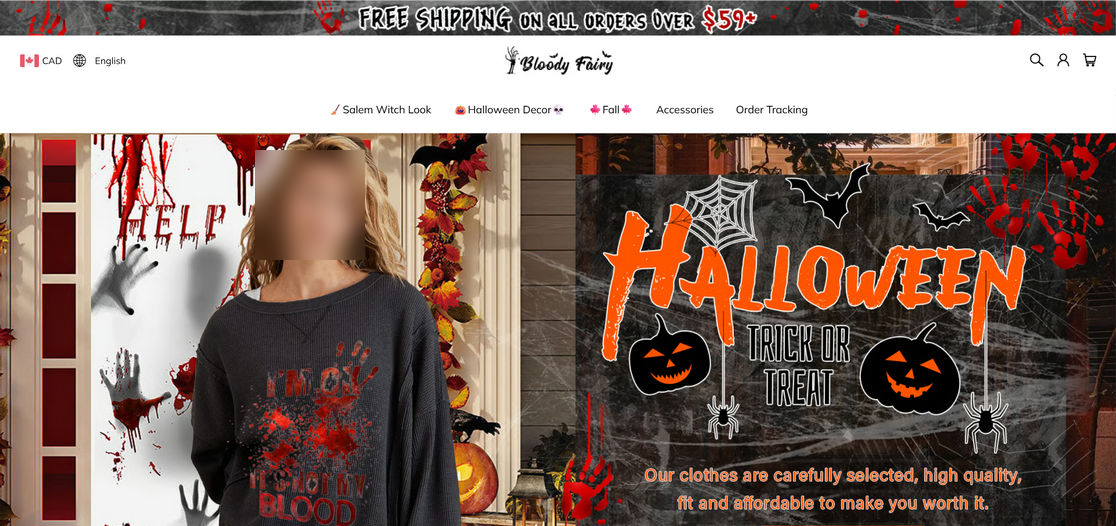
The menu was shorter then, with Salem Witch Look, Halloween Decor, Fall and Accessories. Today it adds themed collections such as Boo Magic, Pumpkin Magic and Witchy Animal.
The currency selector lists more than 20 currencies, but the shipping page says checkout charges in US currency, through PayPal or Stripe. Your bank may add conversion fees.
What Is RunicWin, and Is It Linked to Bloody Fairy?
RunicWin is a different kind of site altogether. Our RunicWin.com report covers it in detail, including the withdrawal problems its users describe.
RunicWin.com presented itself as a blockchain-based crypto casino, according to an archived copy of its homepage from August 29, 2026.
The same page claimed the casino “has been in service since 2017.” Yet the domain runicwin.com was registered only on August 27, 2026, two days before that capture.
Today runicwin.com doesn’t load, because its registrar has placed the domain on hold. Trustpilot says it removed the profile because the business “goes against our guidelines.”
Nothing ties RunicWin to Bloody Fairy. They use different registrars, one in Turkey and one in China, different name servers and different site builders. Neither site mentions the other.
If you found RunicWin through a promotion or a message promising crypto winnings, don’t deposit anything.
A casino claiming service since 2017 on a domain registered two days earlier gives you no way to check that history.
If you already sent crypto to RunicWin, assume it can’t be reversed.
Report it to the FTC or your national fraud service, and ignore anyone offering to recover the funds for a fee.
Why Bloody Fairy’s Domain Details Matter
The public domain record names no business behind the store, only the registrar. Cloudflare sits in front of the site, which hides where the store’s server is hosted.
None of that is unusual on its own. Combined with an email-only contact page and copied terms, though, it leaves a buyer with no company to complain to.
The registration runs through July 2027, but a renewed domain says nothing about delivery or refunds. The store’s own policies remain the main risk.
What to Expect If You Order Anyway
If you still want a Halloween piece from Bloody Fairy, go in with clear expectations based on its own FAQ and shipping pages.
Orders using free shipping go by an “economy service,” and tracking arrives the day after dispatch.
The Terms of Service also warn that taxes of 0% to 30% may apply after you submit an order, depending on your country.
The FAQ asks shoppers to enter addresses in English characters and suggests a residential address to avoid customs delays. Addresses lock once processing starts.
Pay by credit card or PayPal, save copies of the policy pages and photograph your parcel on arrival. Those steps make a dispute far easier if the order goes wrong.
Bloody Fairy Timeline
Public records and our own screenshots show how the store developed:
- July 16, 2025: bloodyfairy.com is registered through Xin Net Technology Corporation.
- August 2025: MalwareTips captures the store, with its currency set to CAD, and publishes its first report.
- July 2026: the domain record is updated, with the registration running until July 2027.
- November 2026: Bloody Fairy remains online with an email-only contact page and a 30% cancellation fee.
How Bloody Fairy Compares With Other Online Clothing Stores
Bloody Fairy isn’t the only store built on seasonal themes and big discounts. Our report on Coral Bloom Boutique Australia covers another store built around a limited-time sale.
Copied policies are common among these stores. Our FaithBlessedWear review covers another overseas clothing store whose policies charge 30% for any cancellation.
Some stores do ship real clothing but make returns painful. Our review of Lassloom shows how strict return terms can trap buyers.
How to Check a Seasonal Clothing Store Before You Buy
Before ordering Halloween or holiday clothing from an unfamiliar site, check these points:
- Look for a company name, address and phone number, not just an email.
- Read the cancellation and return policies, especially any fees.
- Compare the free-shipping threshold on the banner with the shipping policy.
- Check whether “regular” prices look real or oddly precise.
- Search Trustpilot and other review sites for the store’s exact domain.
Fraudulent shopping websites often share common patterns that make them easier to detect once you know what to look for. Before entering personal information or making a payment, take a few minutes to check for these warning signs:
- Unrealistic prices and discounts
If a website offers products at prices far below trusted retailers, it’s often a red flag. Many of these sites advertise luxury or high-demand products at massive discounts to create a sense of urgency. A $300 product listed for $49.99 should immediately raise suspicion. - Recently registered or suspicious domain names
Many fraudulent websites operate on newly created domains that disappear after a few weeks. Look for signs like random characters in the URL, misspellings of well-known brands, or hyphenated domains.
You can check a site’s age with a WHOIS lookup, or run it through our free Scam URL Scanner. - Missing or vague company details
Legitimate businesses clearly display their company name, tax information, phone numbers, physical address, and return policies. Fraudulent sites often provide incomplete, fake, or no company details at all. A lack of verifiable contact information is a major warning sign. - No reliable customer service
Real businesses provide clear ways to contact support—email, phone, live chat, or physical return addresses. Fake stores often list nonfunctional contact forms, invalid phone numbers, or reply with generic automated messages. - Poor website quality and structure
Many fake stores are set up quickly with low-effort templates. Look for poor grammar, spelling errors, low-resolution product images, broken links, or missing legal pages (Terms of Service, Privacy Policy, Return Policy). A sloppy website often signals something isn’t right. - Copied product descriptions and images
Fraudulent sites often lift product listings directly from real retailers or marketplaces. If you reverse image search a product photo and find it on multiple unrelated websites, the listing is likely not original. - Lack of credible reviews or suspicious review patterns
A real store will usually have a mix of customer reviews across different platforms. Warning signs include no reviews at all, obviously fake five-star reviews, or multiple identical reviews posted on the same day. Searching “[website name] reviews” or “[website name] scam” on Google often reveals warnings from other consumers. - Unclear or unfair return and refund policies
Fake stores often use vague language around returns and refunds—or avoid the topic entirely. If you can’t easily find clear instructions for how to return an item or get a refund, proceed with caution. - Aggressive urgency and pressure tactics
Fraudulent websites commonly use fake scarcity (e.g., “Only 2 left in stock!”) or countdown timers (“Sale ends in 10 minutes!”) to push you to buy before you think it through. Legitimate stores don’t rely on fabricated urgency to make sales.
Quick Steps to Verify a Website’s Legitimacy
Before entering payment or personal details on a new shopping website, take a few simple precautions:
- Search for the store’s name along with words like “reviews” or “complaints” on Google and Trustpilot.
- Check the website’s domain registration using Whois.com.
- Use trusted tools to scan for malicious or fraudulent links:
- Malwarebytes ScamGuard – detect scams and unsafe links before they reach you on Android and iOS phone.
- Malwarebytes Browser Guard – block dangerous or fake websites on Windows and macOS browsers.
- Verify the business address on Google Maps to ensure it’s a legitimate location.
- Review the store’s accepted payment methods – credit cards and PayPal are traceable and safer than cryptocurrency or bank transfers.
- Trust your instincts; if something feels off, it’s better not to proceed.
How to Spot Similar Scams on Social Media
Many fraudulent shopping websites rely heavily on sponsored social media ads to draw in large numbers of potential buyers. These ads often promise extraordinary discounts—sometimes up to 90% off—and use emotionally charged language to push users into buying immediately.
They frequently appear on Facebook, Instagram, and TikTok, blending in with legitimate content. However, these ads follow predictable patterns that make them easier to identify once you know what to look for.
Spotting Fraudulent Facebook Ads
Facebook’s advertising platform is a favorite tool for fake online stores because of its massive reach. These ads often feature “unbelievable” offers designed to create urgency and bypass critical thinking. Warning signs include:
- Extreme, unrealistic discounts such as “90% OFF,” “Store Closing Sale,” or “Final Liquidation.” Real retailers rarely discount new products this aggressively.
- Poor grammar, awkward phrasing, or inconsistent language throughout the ad or website, indicating low-effort, mass-produced content.
- Generic stock photos or images with watermarks, suggesting the images were taken from legitimate brands or stolen from other sources.
- Recently created Facebook Pages, which is common for temporary fraudulent campaigns. Check the “Page Transparency” section to see when the page was created.
- Limited or no engagement from real customers. Authentic brands usually have reviews, comments, and visible user interaction.
If an ad raises doubts, search for reviews of the website or reverse image search the product photos to see if they’re copied from elsewhere. Never provide payment information until the site is verified.
Spotting Fraudulent Instagram Ads
Instagram is another major platform used to promote fake shopping sites through eye-catching visuals and short-lived “flash sale” captions. Warning signs to look for:
- New or disposable accounts with few posts and followers, often created just weeks or days before launching ads.
- Lack of tagged users in product posts. Legitimate stores often feature real customers, influencers, or product usage.
- Unsecured checkout pages. If the website linked in the bio does not use HTTPS, do not enter payment information.
- Fake or missing customer reviews. Fraudulent stores rarely have authentic purchase feedback.
- Unclear or restrictive return policies, often hidden or written vaguely to make refunds difficult.
When in doubt, search for independent reviews before buying, and only enter payment details on verified, secure websites.
Catching Fake TikTok Ads
TikTok is increasingly used to promote questionable shopping deals through short, persuasive videos. While many ads look polished, the same red flags apply:
- Links to unknown stores that don’t appear in search results or have no external reputation. Many of these sites are temporary and disappear after a short time.
- No verification badge on the TikTok account. While not every legitimate store is verified, the lack of a badge is one more indicator to check further.
- Aggressive countdown timers or “one-day only” promotions designed to rush decision-making.
- Lack of genuine customer reviews or real user content demonstrating the product in actual use.
- Comment sections filled with complaints or warnings from other users. This is often the first place victims speak up.
TikTok scams often rely on impulse buying. Take a moment to verify the website, read independent reviews, and use trusted browser protection before visiting external links.
What to Do If You Ordered From Bloody Fairy
- Email support@bloodyfairy.com with your order number and keep every reply. Ask for a tracking number if you haven’t received one.
- If your order hasn’t arrived, don’t wait out the store’s 60 days. Card disputes often must be filed within about 120 days of the charge or expected delivery date.
- If the store charges a 30% fee for a cancellation you requested before shipping, ask your card issuer whether you can dispute the fee.
- If an item arrives damaged, wrong or very different from the photos, photograph it and report it within 7 days, the shortest window its pages give.
- Don’t send a return until the store gives you a written return address. Use tracked shipping and keep the receipt, since return postage is your cost.
- PayPal disputes close 180 days after payment, so that window has passed for 2025 orders. Your card issuer may still help if PayPal was funded by a card.
- Ignore anyone who offers to recover your money for a fee. Refund recovery offers are a common follow-up scam.
- US buyers can report a seller that doesn’t honor its terms to the FTC at ReportFraud.ftc.gov. Elsewhere, use your national consumer authority.
Frequently Asked Questions
Is Bloody Fairy legit?
Bloody Fairy is a live online store, but it names no company, cites Shopify hosting it doesn’t appear to use and charges 30% to cancel. Treat it as high risk.
Who owns BloodyFairy.com?
The site doesn’t say. It lists only an email address, and its domain was registered in July 2025 through a registrar based in China.
Are there Bloody Fairy reviews?
Not on the usual review sites. Trustpilot has no page for bloodyfairy.com, and products on its homepage and first collection page show zero reviews.
What is RunicWin?
RunicWin was a crypto casino site whose domain was registered in August 2026. It no longer loads, and Trustpilot removed its profile.
Is RunicWin connected to Bloody Fairy?
Nothing publicly connects them. The two sites use different registrars, name servers and site builders, and neither mentions the other.
Can I cancel a Bloody Fairy order?
Only before it is packed or shipped, and the store charges a 30% fee even if you cancel moments after ordering.
The Bottom Line
Don’t buy from Bloody Fairy. Its 30% cancellation fee, 60-day wait on missing parcels and costly returns put nearly all the risk on you.
The store hides who runs it, and its own pages contradict each other on returns, refunds and shipping.
If you already ordered, keep your emails, push for tracking and contact your card issuer before your dispute window closes.
This article is for informational purposes only and should not be relied upon for financial or business decisions. We identify potential scams using research, user experiences, and expert analysis. However, all claims should be independently verified. Mistakes may occur, and legitimate products could be flagged. We strive for accuracy but make no warranties regarding the completeness or reliability of the information.

If you are the owner of the website or product in question and wish to offer clarifications regarding your business or website, please reach out to us via our Contact form.

Reviews & discussion
0 commentsShare a firsthand experience, or ask a question.
Community reviews
bloodyfairy.com
Moderated reader experiences, not an editorial verdict.
Start the conversation
Have a question or something useful to share? Add the first comment.