Breeze Box AC – Scam or Legit? Don’t Get Burned by This Summer Cooling Hoax
Written by: Thomas Orsolya
Published on:
Every summer, flashy ads on Facebook, Instagram, and TikTok promise miracle desktop “ACs” that claim to cool entire rooms in seconds. The Breeze Box AC is the latest drop‑shipped mini-evaporative fan taking advantage of this hype. But is it a real cooling solution – or a scam that overpromises and underdelivers? Keep reading to uncover the truth behind these viral claims.
Overview
What Is the Breeze Box?
Marketers pitch the Breeze Box as an ultra-compact, high-tech portable air conditioner that can cool rooms up to 500 sq ft in just 60 seconds. They tout features like 99.8% efficiency, Insta‑Frost technology, antimicrobial filters, silent operation, and dramatic savings on electric bills. Users are shown ice, mist, and speedy cooling on display. The price tag? Usually $49.99 after a 50% “limited time” discount from an alleged $99.98 MSRP.
Big Claims, Basic Tech
In reality, the Breeze Box is nothing more than a small evaporative cooler or “swamp cooler.” These devices pull in air through a water-soaked filter and blow it – a method that works only in dry climates and provides minimal temperature reduction. They are nowhere near as powerful as true air conditioners, which require compressors, refrigerants, and heat exchangers. Consider this typical Reddit warning:
“The scam devices are more like swamp coolers than AC… works until you reach humidity saturation… in a dry environment that works.”
Price Discrepancies & Drop‑Shipping
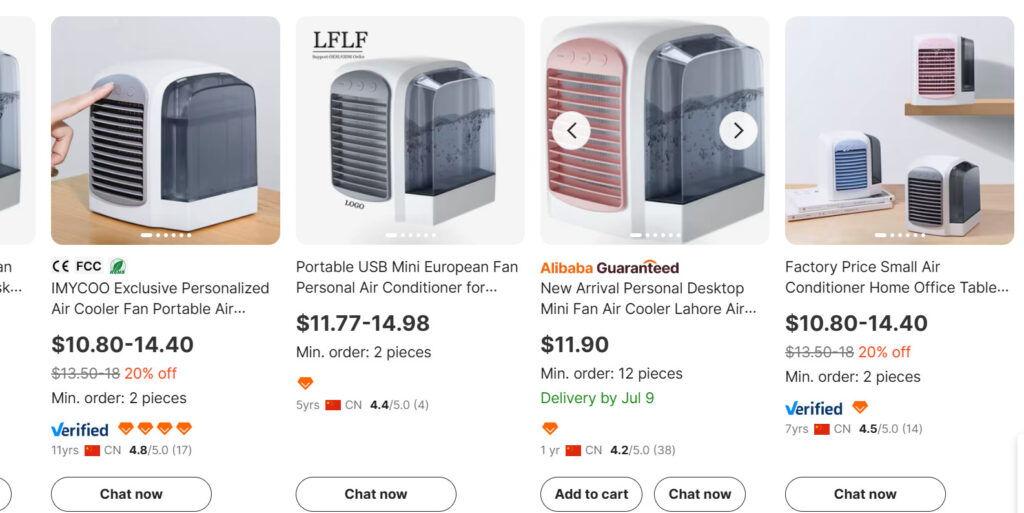
The ads claim big price cuts due to no advertising and no physical stores. But product images and pricing are nearly identical across multiple suspicious websites selling for $10–15 wholesale. The $49.99 retails appear to be margin padding, while actual production cost is far lower. A popular Alibaba screenshot shows these exact units listed for $10–15, with large minimum orders . What you’ll likely receive? A low-cost evaporative fan made in China – a far cry from the audio-visual miracle promised in ads.
Why the Hype Hits Every Summer
The timing isn’t random. Every year, sensational headlines – “SUPER HOT SUMMER AHEAD” – trigger fear and urgency. Scammers tap into climate anxiety:
“The national weather services are reporting that it is going to be a SUPER HOT SUMMER… are you prepared?” Combine that with claims of a $5 billion AC industry disrupted by a startup from 2019 and “almost a million units sold,” and consumers feel they’re getting in early on a revolution.
Signs of a Dropshipping Operation
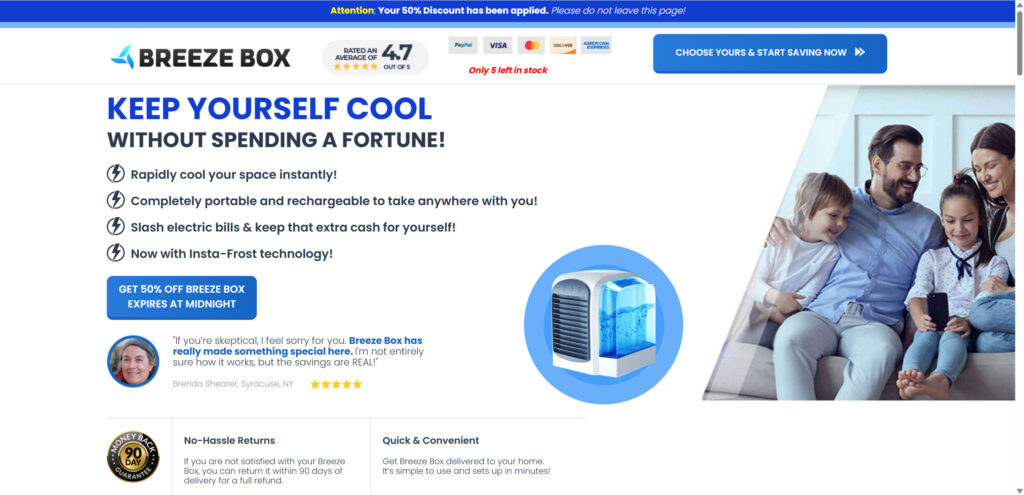
Fake countdowns: “Only 5 left in stock,” “Expires at Midnight.”
Stock images: Reused generic model pics.
No verifiable contact: Site lacks physical address, real phone support.
Returns all to China: So hoops needed, refunds near impossible.
No independent reviews: All reviews come from affiliate-heavy sites or paid influencers.
Customer Reviews & Experiences
Independent sources rarely find a real positive review. A notable article on MalwareTips said:
“Most cite its weak cooling, loud noise, frequent breakages, and issues getting refunds. Finding unbiased positive reviews is extremely rare.”
Reddit users point out:
“They sell something cheap that doesn’t really work as expected… just a shady business practice.” “The units… are just a drop shipping scam.”
Summary
What the Breeze Box offers is modest spot cooling – nothing close to air conditioning. The ads are professionally deceptive, imitating full AC units with compressor tech. Yet, you get a desk fan with a damp sponge inside it. The scam lies in inflated claims, false urgency, overseas returns, and no support.
How the Scheme Works
Step 1: Design and Launch Slick Ads
Scammers make professional-looking promo videos showing happy users, ice pouring, big room cooling. Websites use bold fonts, “Advertorial” labels, badges, fake reviews, and countdown timers to create urgency.
Step 2: Social Media Amplification
These ads target demographics based on heat, interest in deals, or energy savings. They run on Facebook, Instagram, and TikTok between May and July, when summer heat peaks and AC sales spike.
Step 3: Fake Hype About Heatwaves
They cite national weather agencies warning of record-breaking heat – creating urgency to “be prepared.” This primes viewers for clickbait titles like “Super Hot Summer – Buy Now!”
Step 4: The Funnel Site
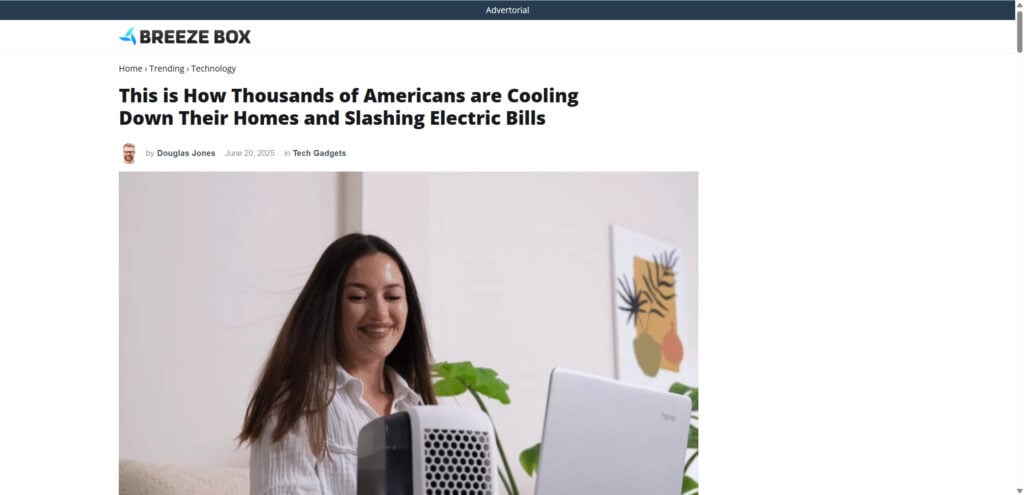
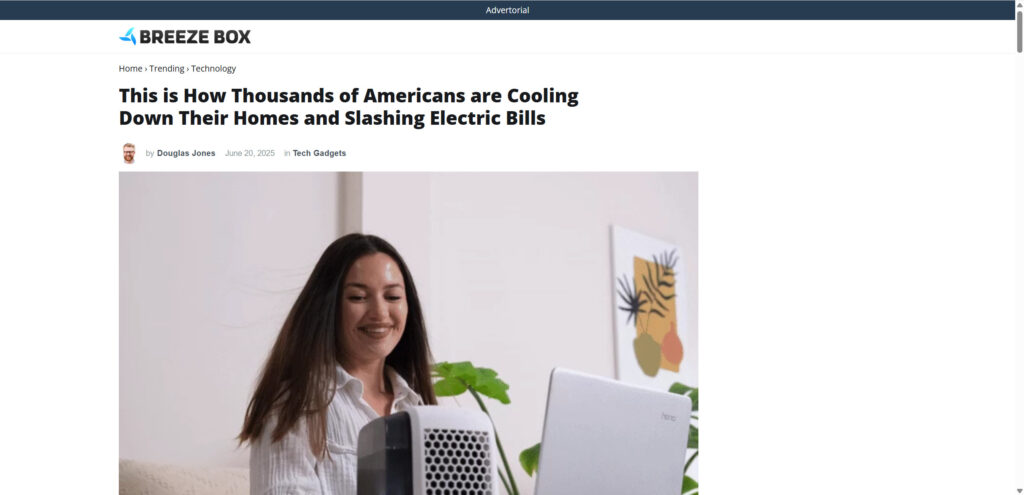
Users land on Buzz‑styled pages that style themselves as news articles (“By Douglas Jones, Tech Gadgets June 20, 2025”), then pivot into a sales pitch. This lends fraudulent credibility.
Step 5: Overstated Specs & Price
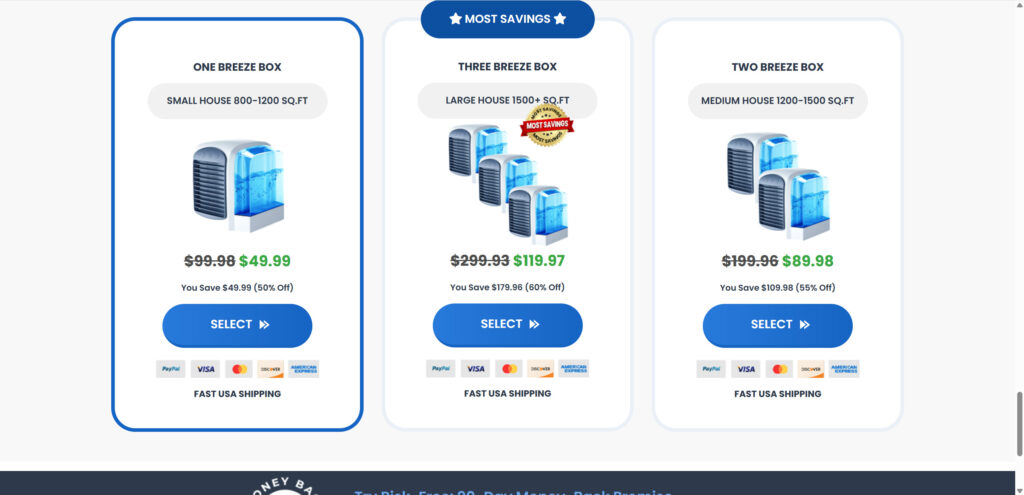
They claim “99.8% efficiency,” “cools 500 sq ft in 60 sec,” “energy saving hundreds” and “ultra‑quiet.” Price is shown as $99.98, cut to $49.99 with 50% discount. They often push upsells: buy 2 or 3 units for house and car.
Step 6: Drop‑Shipping Fulfillment
Orders ship directly from Chinese manufacturers. The product often arrives misrepresented, low-quality, plastic parts, small capacity. Real-world performance is underwhelming.
Step 7: Refund Obstruction
Return policies require sending the product back to China at buyer’s expense. Scammers delay or ignore returns. Credit cards may block refund requests; refunds are rarely granted.
Step 8: Absent Customer Support
Scam sites rarely have verifiable contacts. “Support” is vague email or chat. They ignore follow‑ups and eventually let the site lapse or disappear when complaints pile up.
Step 9: Repeat with New Sites
Once a site loses momentum, they launch a new brand – ChillWell, CoolMist, ArcticAir – with fresh domain, but same product, same scam structure.
Technical Layout
Scientifically:
Evaporative fan cools only a tiny area.
Without exhaust hose, no sensible impact on room temperature.
Works briefly; performance plummets as humid air collects.
Misleading physics: true AC uses compressing refrigerants and venting heat outside – a process these units can’t replicate.
What to Do If You’ve Fallen Victim
Document Everything
Save screenshots of ads, product page, email receipts, and spam.
Note any red flags (no return address, overseas shipping).
Contact Your Bank or Credit Card
File a chargeback citing “goods not as described” or “undeliverable.”
Prioritize Visa/MasterCard – Amex often refunds more easily.
Request Refund Before Charges Post
If the charge is pending, contact bank immediately.
Report to Authorities
For U.S.: Federal Trade Commission (ftc.gov/complaint).
For EU: European Consumer Centre or your nation’s consumer protection agency.
Notify Marketplace Platforms
Report the ad or page on Facebook, Instagram, TikTok to reduce future scams.
Warn Others
Post your experience on forums like r/Scams or r/consumer_reports. Use quotes to help newbies.
Check Consumer Protection
In the EU, consumer laws may allow you to apply your local regulation – even cross-border sales may be covered.
Explore Alternative Solutions
For real cooling: invest in a proper evaporative cooler with pump or a portable AC with vent hose – available locally or from major retailers.
Frequently Asked Questions About the Breeze Box Scam
Is the Breeze Box a real air conditioner? No. Despite being advertised as a portable air conditioner, the Breeze Box is simply a small evaporative fan. It lacks compressor and refrigerant systems required to function as a true AC unit.
Does the Breeze Box really cool a room in 60 seconds? Absolutely not. This claim is false. The Breeze Box cannot significantly lower the temperature of an entire room. It may offer slight cooling when placed close to your face, but it cannot cool spaces like a real air conditioner.
Why are so many people buying it if it’s a scam? The product is heavily marketed on social media using fake urgency, false weather alerts, paid reviews, and misleading demonstrations. Many buyers don’t realize the truth until it’s too late.
Can I get a refund after buying the Breeze Box? Unlikely. Returns are often only accepted if shipped back to China, which is expensive and impractical. Most customers report ignored refund requests or being told to pay high return shipping fees, making it essentially non-refundable.
Is Breeze Box sold in physical stores? No. It’s only sold online, often through fake “review” sites or popup e-commerce stores. This is a hallmark of drop-shipping operations designed to avoid accountability.
How can I check if the product I’m seeing is the same scam? Look for common red flags: countdown timers, fake “tech expert” reviews, vague company info, overblown claims (like cooling 500 sq ft in 60 seconds), and pricing around $49.99. These are often repackaged under different names but are the same product.
Where is the Breeze Box shipped from? Although the website may imply U.S. shipping, most products are shipped directly from China. Delivery can take several weeks, and the quality is often poor upon arrival.
Are there any real positive reviews? Independent positive reviews are rare or non-existent. Most “reviews” online are either paid affiliates earning commissions or fake customer testimonials created by the marketers themselves.
Is it safe to use? The product itself is unlikely to be dangerous, but it’s also unlikely to provide meaningful cooling. Some users have reported leaks or short circuits, so caution is advised.
What should I do if I already bought one? Immediately contact your bank or credit card company to file a dispute. Document your purchase and attempt to get a chargeback. Also, report the scam to the FTC or your local consumer protection agency.
The Bottom Line
The Breeze Box AC is a classic drop-shipped summer scam: polished marketing, dramatic claims, low-cost evaporative fan delivered instead. It fails to deliver on promises – saying it “cools rooms 60 sec” or “replaces AC.” Returns are deliberately obstructed, and refunds often go nowhere. Independent reviews and Reddit users call it shady or ineffective.
If you already purchased one, act now – document your purchase, dispute the charge, report the scheme, and consider real alternatives with verified cooling capacity.
10 Rules to Avoid Online Scams
Here are 10 practical safety rules to help you avoid malware, online shopping scams, crypto scams, and other online fraud. Each tip includes a quick “if you already got hit” action.
Stop and verify before you click, log in, download, or pay.
Most scams win by creating urgency. Verify using a trusted method: type the website address yourself, use the official app, or call a known number (not the one in the message).
If you already clicked: close the page, do not enter passwords, and run a malware scan.
Keep your operating system, browser, and apps updated.
Updates patch security holes used by malware and malicious ads. Turn on automatic updates where possible.
If you saw a scary “update now” pop-up: close it and update only through your device settings or the official app store.
Use layered protection: antivirus plus an ad blocker.
Antivirus helps block malware. An ad blocker reduces scam redirects, phishing pages, and malvertising.
If your browser is acting weird: remove unknown extensions, reset the browser, then run a full scan.
Install apps, software, and extensions only from official sources.
Avoid cracked software, “keygens,” and random downloads. During installs, choose Custom/Advanced and decline bundled offers you do not recognize.
If you already installed something suspicious: uninstall it, restart, and scan again.
Treat links and attachments as untrusted by default.
Phishing often impersonates delivery services, banks, and popular brands. If it is unexpected, do not open attachments or log in through the message.
If you entered credentials: change the password immediately and enable 2FA.
Shop safely: research the store, then pay with protection.
Be cautious with brand-new stores, “closing sale” stories, and prices that make no sense. Prefer credit cards or PayPal for dispute options. Avoid wire transfers, gift cards, and crypto payments.
If you already paid: contact your card issuer or PayPal quickly to dispute the transaction.
Crypto rule: never pay a “fee” to withdraw or recover money.
Common patterns include fake profits, then “tax,” “gas,” or “verification” fees. Another is a “recovery agent” who demands upfront crypto.
If you already sent crypto: stop paying, save evidence (wallet addresses, TXIDs, chats), and report the scam to the platform used.
Secure your accounts with unique passwords and 2FA (start with email).
Use a password manager and unique passwords for every account. Enable 2FA using an authenticator app when possible.
If you suspect an account takeover: change passwords, sign out of all devices, and review recent logins and recovery settings.
Back up important files and keep one backup offline.
Backups protect you from ransomware and device failure. Keep at least one backup on an external drive that is not always connected.
If you suspect infection: do not connect backup drives until the system is clean.
If you think you are a victim: stop losses, document evidence, and escalate fast.
Move quickly. Speed matters for disputes, account recovery, and limiting damage.
Stop payments and contact: do not send more money or respond to the scammer.
Call your bank or card issuer: block transactions, replace the card if needed, and start a dispute or chargeback.
Secure your email first: change the email password, enable 2FA, and remove unfamiliar recovery options.
Secure other accounts: change passwords, enable 2FA, and log out of all sessions.
Scan your device: remove suspicious apps or extensions, then run a full malware scan.
Save evidence: screenshots, emails, order pages, tracking pages, wallet addresses, TXIDs, and chat logs.
Report it: to the payment provider, marketplace, social platform, exchange, or wallet service involved.
These rules are intentionally simple. Most online losses happen when decisions are rushed. Slow down, verify independently, and use payment methods and account controls that give you recourse.
Thomas is an expert at uncovering scams and providing in-depth reporting on cyber threats and online fraud. As an editor, he is dedicated to keeping readers informed on the latest developments in cybersecurity and tech.