

An email claims the U.S. government is paying business owners worldwide $2.7 million each. It asks you to reply with personal and company details so the money can be sent to your bank.
There is no such compensation program. The message is an advance-fee scam that collects identity information first, then introduces taxes, processing charges, and transfer fees for a payout that will never arrive.
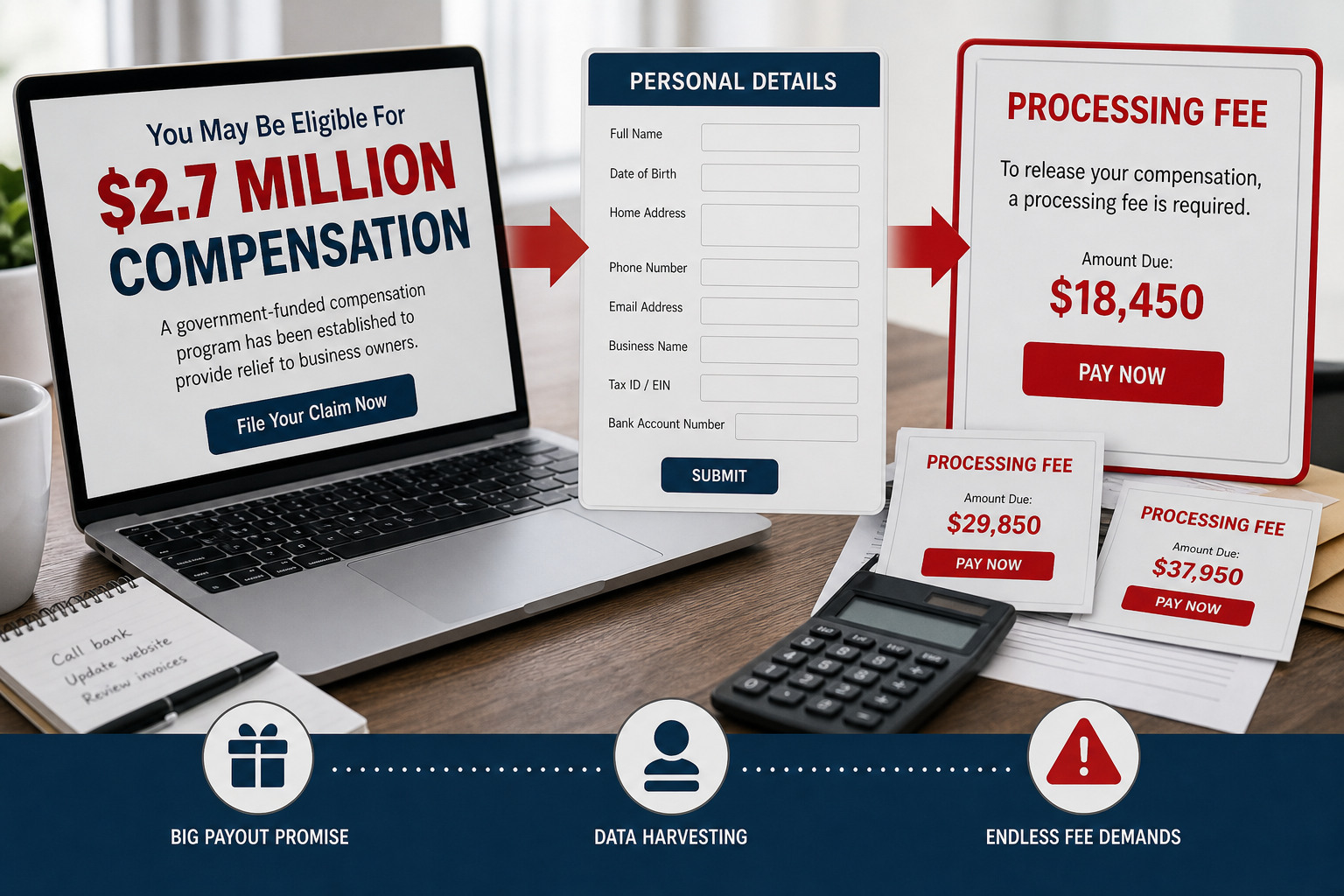
Business Owner Compensation Email Scam Overview
The “Business Owner Compensation” email says that small-business owners, founders, CEOs, school owners, and people injured during an ongoing war qualify for a federal payment. It promises each beneficiary $2.7 million and claims that the program was approved by the Trump administration, supported by the World Bank, and processed through a named U.S. law firm.
Those claims are fabricated. The email is not a government announcement, there is no worldwide $2.7 million fund, and the real organizations and law firm named in the message are not responsible for it. Criminals borrow recognizable institutions, public officials, addresses, and telephone numbers because a recipient may verify that the names exist and mistakenly assume the compensation program exists too.
The first request is for a full name, business name, business address, phone number, and gender. Later replies may seek a date of birth, passport or ID copy, signature, bank account, tax number, or proof of company ownership. Collecting the data before asking for money helps the scammer personalize forged documents and makes the victim feel that an official application is progressing.
After the victim is invested, a supposed recovery officer, lawyer, bank, government department, or international organization introduces fees. The reason can change from processing and tax clearance to anti-terrorism certification, currency conversion, insurance, or courier delivery. Every payment produces a new obstacle because no real fund exists to release.
The loss can continue far beyond one fee. Personal records can support identity theft, banking information can expose accounts, and the victim may be targeted again by fake investigators or recovery agents. A government does not select unknown worldwide recipients through a generic email, promise millions without an application, or require payment to unlock compensation.
How the Fake Business Compensation Scheme Works
Step 1: A mass email announces a huge government benefit
The subject uses terms such as “Compensate Notification” and the message says a new program has begun immediately. Broad eligibility ensures that almost any recipient can imagine a connection to the offer.
The amount is intentionally life-changing. The hope of $2.7 million encourages the recipient to overlook poor grammar, vague legal language, and the absence of a verifiable program page.
Step 2: Trusted names are copied into the story
The email may mention the federal government, a presidential administration, the World Bank, a law firm, and a recovery department. Some of those organizations are real, but they did not authorize the message.
Scammers rely on borrowed credibility. Contacting the real organization through its official website will reveal that the unsolicited program is not genuine.
Step 3: Personal and business information is requested
The first form asks for basic contact and company details. Follow-up forms become more invasive and can request identification, tax records, bank information, or a signature.
Each new request is framed as the next stage of verification. In reality, the criminals are building an identity profile and testing how readily the victim follows instructions.
Step 4: Forged approvals make the payout feel close
The victim may receive certificates, beneficiary letters, transfer schedules, or images of bank portals showing the full amount. These materials are created by the same people demanding money and have no independent value.
Progress messages are designed to create sunk-cost pressure: once the victim has shared documents and spent time, abandoning the claim feels like losing a real opportunity.
Step 5: A fee is required before release
The scammer invents a processing charge, tax, insurance payment, legal bill, or transfer fee. The demand may be described as refundable or as the only remaining obstacle.
Legitimate government compensation is not unlocked with gift cards, cryptocurrency, personal wire transfers, or payments to an unrelated individual.
Step 6: New charges replace the promised payout
After one fee is paid, another department discovers a new requirement. The criminal may threaten cancellation, seizure, or prosecution if the victim questions the process.
The $2.7 million never arrives. The only real transactions are the victim’s payments to the scammers.
Why the Compensation Claim Is Not Credible
- No application was submitted before the multimillion-dollar award appeared.
- The supposed program targets recipients worldwide through unsolicited email.
- Eligibility combines unrelated groups in vague, awkward language.
- Real institutions and a real law firm are named without verifiable involvement.
- Personal details are requested by replying to an unknown sender.
- Upfront fees are introduced before the supposed money can be transferred.
- The sender discourages independent verification or creates an artificial deadline.
What to Do If You Shared Details or Paid a Fee
- Stop replying and block every contact. Do not send more documents or pay a cancellation, refund, or release charge.
- Contact the bank or payment service immediately. Request a fraud review, recall, account monitoring, and replacement of exposed payment credentials.
- Protect government IDs and tax information. Notify the issuing authority and tax agency where appropriate, and follow local identity-theft recovery guidance.
- Secure email and business accounts. Change passwords, enable multi-factor authentication, inspect sessions, and remove unknown forwarding rules.
- Warn employees and business partners. Criminals can use the collected company details to send invoices or impersonate the owner.
- Save the full evidence package. Keep messages, headers, forms, payment receipts, telephone numbers, bank accounts, crypto wallets, and documents.
- Report the scam and expect follow-up fraud. Fake recovery specialists may promise to return the lost money for another upfront payment.
How Legitimate Compensation Programs Differ
A real program has a legal basis, a responsible government department, published eligibility rules, an official application portal, privacy notices, and a defined appeal process. The information is available on a government domain before an applicant receives an award. It does not begin with a generic greeting from an unknown recovery officer.
Payment amounts are tied to documented losses or statutory criteria, not one enormous figure offered to unrelated groups around the world. Applicants may need to prove eligibility, but sensitive records are submitted through official channels after the agency’s identity has been independently established.
Legitimate fees, where they exist, are described in published rules and paid through traceable government systems. A demand for gift cards, cryptocurrency, a personal wire, or money sent to a “lawyer” before funds can be released is incompatible with a genuine federal benefit.
When uncertain, search the relevant government’s official benefits or grants directory and call the agency using a number from that site. Do not rely on search advertisements or a link supplied by the person promising the money, because scammers can also create fake verification pages.
Why Business Owners Are Attractive Targets
Public business registrations, websites, directories, and social profiles reveal owner names, telephone numbers, addresses, and company roles. Criminals can use that public data to personalize a mass email and make the recipient believe they were deliberately selected.
Business owners also handle frequent invoices, grants, tax notices, and funding offers. A scammer exploits that administrative noise, then reuses the submitted company details to impersonate the owner in later supplier or employee fraud.
Frequently Asked Questions
Could a real government compensation program pay a large amount?
Some legitimate programs compensate eligible people or businesses, but they publish official rules, application procedures, legal authority, and contact details on government websites. They do not select unknown recipients by mass email or require an upfront fee to release an award.
Is the offer real because the named law firm exists?
No. Criminals routinely copy the names, addresses, and biographies of real firms. Verify any claim through contact information independently obtained from the firm’s official website, not from the email.
The Bottom Line
The Business Owner Compensation email is a confirmed advance-fee scam. There is no $2.7 million federal payout waiting for the recipient and no legitimate application hidden behind the reply address.
Delete the message. If you engaged, protect your identity and accounts, call the payment provider, warn business contacts, and refuse every follow-up demand for taxes, processing fees, or recovery charges.
Here are signs that this email is a scam, even though it looks like it comes from a company you know — and even uses the company’s logo in the header:- A generic greeting is used in place of a name (eg. “customer,” “account holder,” or “dear”).
- The sender’s email address is not associated with a legitimate domain name
- The email invites you to click on a link to resolve an issue. Most reputable organizations will not ask users to disclose sensitive information (e.g. credit card numbers) by clicking on a link.
- There is a time limit or uncharacteristic sense of urgency
- Poor grammar, spelling, and sentence structure may hint that an email is not from a reputable source.

Join the discussion
0 commentsShare your experience or ask a question about this article.
Discussion
Start the conversation
Have a question or something useful to share? Add the first comment.