

A letter arrives with a solicitor’s name and a life-changing inheritance figure. You have never heard of the deceased, but the document sounds unusually certain.
Before you answer, look at who is really behind the message. The name on the page is only one part of the story.
Overview
The reported inheritance approach
The UK’s Solicitors Regulation Authority published a warning about a letter misusing solicitor Claire-Marie Cornford’s name on September 18, 2026.
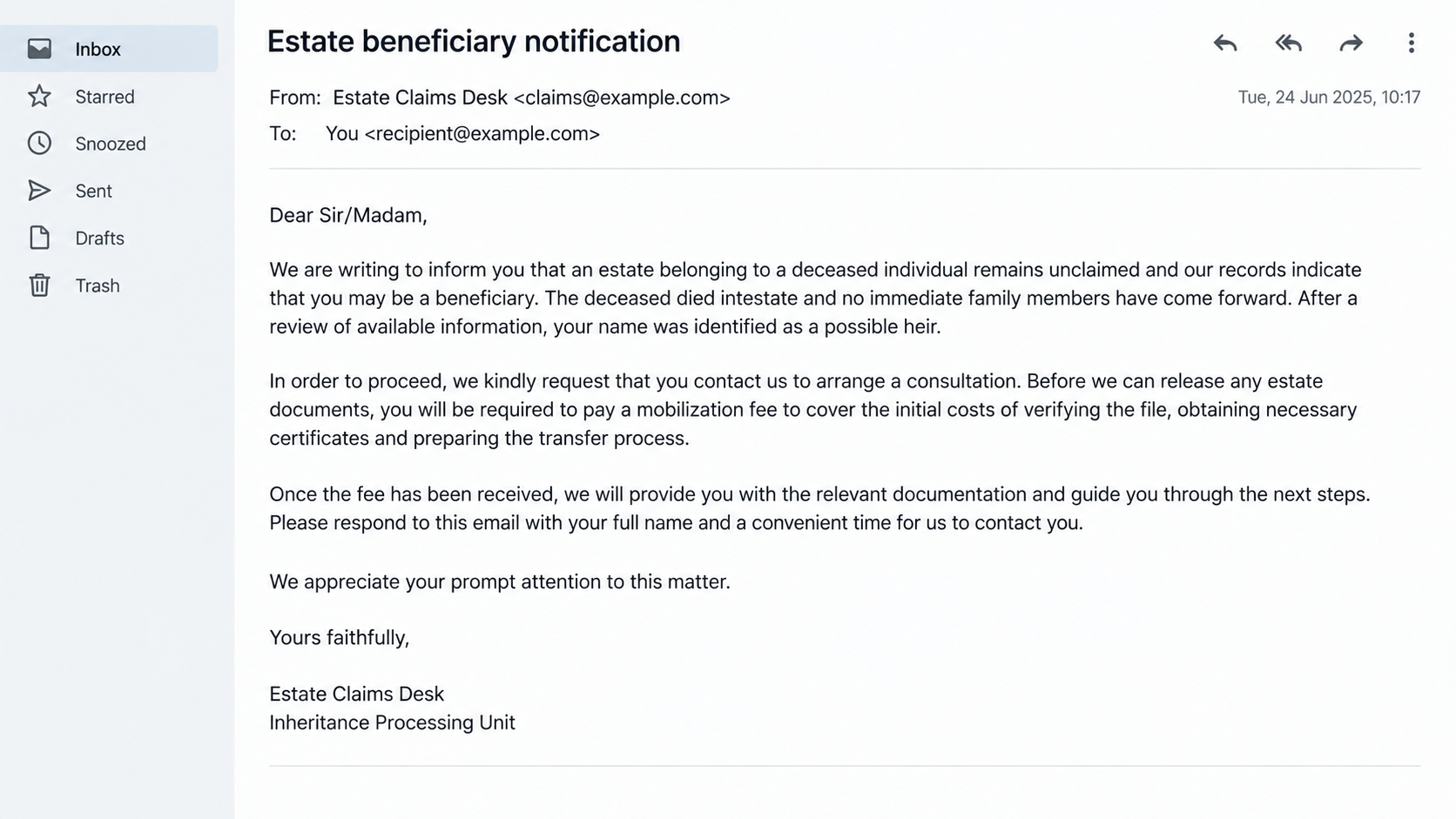
The letter told its recipient they were connected to an inheritance of $10.7 million. It asked for a consultation and mobilization fee before proceeding.
That up-front payment is the central danger. The large inheritance is the promise that makes an unrelated fee seem small by comparison.
A real lawyer, a false connection
Claire-Marie Cornford is a genuine solicitor associated with Irwin Mitchell. The firm’s confirmation to the SRA says it had no connection with the letter.
Her name being real does not authenticate a letter sent by someone else. Professional directories make legal names and affiliations easy to find.
Do not direct complaints at the genuine lawyer for a letter she did not send. The issue is the impersonation of her identity.
What the warning does and does not prove
The regulator identifies the letter and its payment request as a scam. It does not establish how widely the letter circulated or whether anyone paid.
Nor does the warning establish that a real estate exists. Treat the claimed inheritance as an unsupported lure until independent records prove otherwise.
- Claimed benefit: a $10.7 million inheritance.
- Claimed authority: a named UK solicitor.
- Required action: pay a consultation and mobilization fee first.
- Verified fact: the genuine firm disclaimed any connection to the letter.
The exact letterhead and contact details can change. The reliable signal is the mismatch between a promised windfall and a demand for advance money.
How the Claire-Marie Cornford Inheritance Scam Works
Step 1: Present an unexpected fortune as personal news
The opening is designed to feel private and consequential. A recipient is supposedly a beneficiary or related to an estate they did not know existed.
That story invites curiosity before skepticism. If the sum is enormous, the recipient may start mentally planning what it could change.
The reported letter used $10.7 million. The regulator gives no evidence that this estate exists or that recipients have a lawful claim to it.
An unfamiliar deceased person is not proof of fraud by itself. The warning is the combination of unsolicited news, borrowed legal authority, and advance payment.
Step 2: Borrow a solicitor’s professional identity
A named solicitor makes the approach look less like ordinary junk mail. A quick search may even confirm the person is on a professional register.
That search confirms the person exists, not that the person wrote the letter. This distinction is the point on which the impersonation depends.
The sender can add a firm name, address, and formal language without having any relationship with the lawyer or firm.
Irwin Mitchell told the SRA it was not connected to the reported communication. The genuine lawyer’s identity was a prop in someone else’s pitch.
Step 3: Add paperwork and a process that sounds official
Inheritance matters can involve certificates, probate records, and legal correspondence. A scammer uses that complexity to make extra stages sound ordinary.
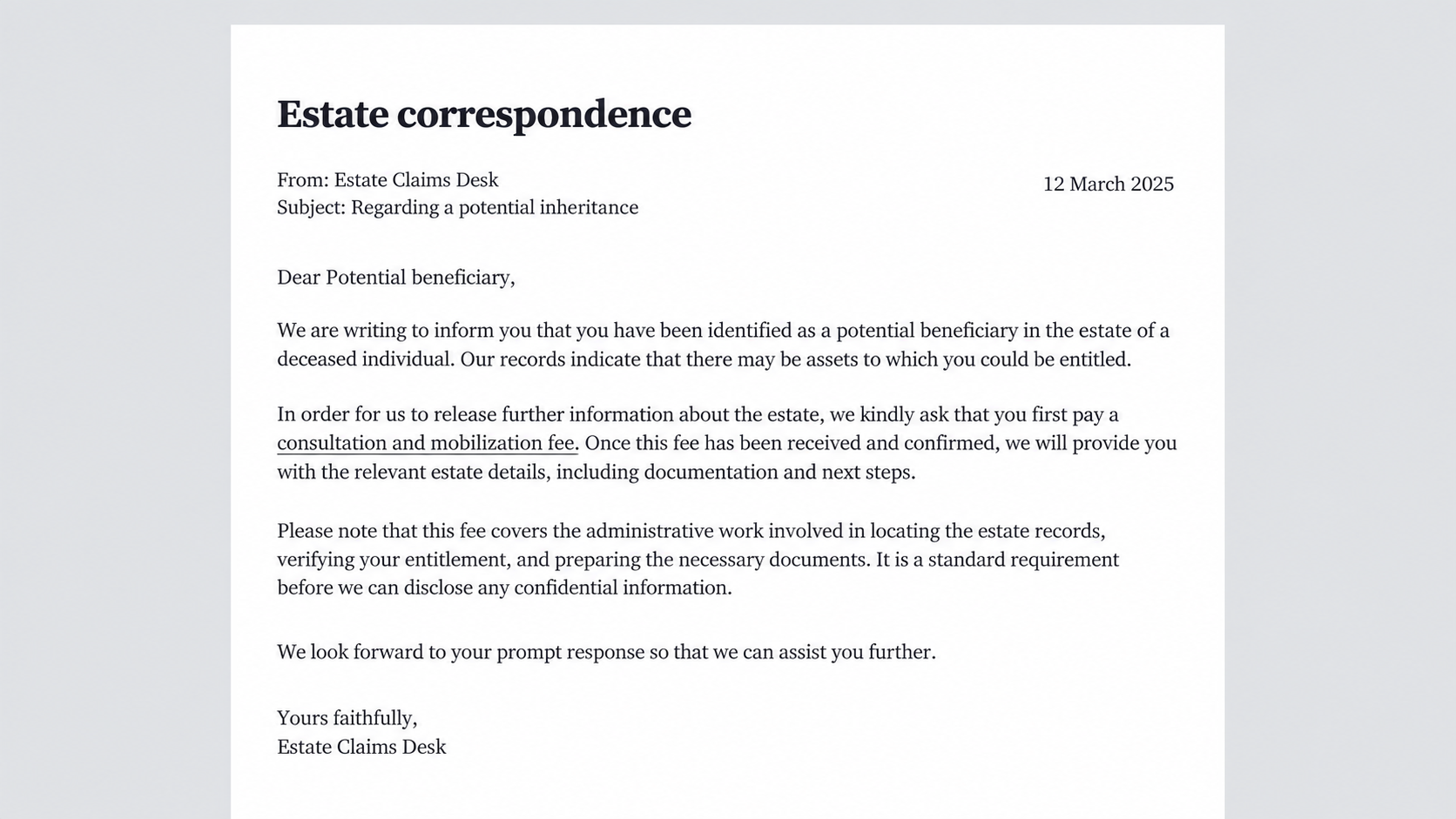
The letter’s supposed consultation and mobilization fee fits this pattern. It presents payment as an administrative step rather than the true objective.
Readers may focus on whether the fee is affordable compared with the promised fortune. The better question is whether any verified legal matter exists.
A genuine estate claim can be examined through independently identified professionals and records. You do not need to trust a surprise sender’s documents.
Step 4: Make the up-front fee appear unavoidable
The demand is framed as the gateway to a larger payout. Until the recipient pays, the promised inheritance remains just out of reach.
This structure reverses how the reader evaluates risk. A smaller immediate loss can seem harmless next to an imagined $10.7 million gain.
The SRA warning names a consultation and mobilization fee. It does not say any legitimate representative requested that fee in this case.
People who question the charge may hear that it covers document preparation or verification. Such explanations still require independent evidence.
Step 5: Collect information as the conversation develops
An inheritance claimant may be asked for identification, a signature, family history, or banking information. These are plausible categories in a real matter.
That plausibility is why disclosure should wait until the lawyer and estate have been verified through channels the sender does not control.
The SRA’s public alert centers on the letter and fee. It does not specify every follow-up question the sender might ask.
Do not assume a document is harmless because no payment has been made. Identity records can be misused in a separate account or impersonation attempt.
Step 6: Replace the payout with new obstacles
Advance-fee scams often explain away delays with another procedural hurdle. A promised transfer may require a tax, clearance, release, or courier charge.
Those possible follow-ups describe the broader scam pattern. The SRA alert does not confirm that the Cornford letter contained all of them.
The first payment is usually the moment to stop, not evidence that the process is moving. An empty promise cannot be secured by sending more money.
If the supposed lawyer discourages direct verification with the real firm, the reason is clear: independent contact would break the impersonation.
What Makes an Inheritance Letter Credible or Suspicious?
Check the solicitor independently
Find the firm’s official website yourself. Call a published switchboard and ask whether the named solicitor sent the letter and handles the claimed estate.
Do not call a number printed only on the letter. An impostor can answer it and provide another convincing confirmation.
If you search a regulator register, use it to identify the legitimate firm and its contact information. Do not assume a matching name validates the sender.
Ask for estate details that can be checked
A credible representative should be able to explain the deceased person’s identity, jurisdiction, probate status, and how you were identified as a beneficiary.
You can request the case reference and details of the executor, then verify them outside the sender’s communication chain.
Be cautious if all supposed proof comes from attachments the sender created. A seal, signature, or official-looking stamp can be copied into a document.
Separate fees from the inheritance claim
Even real estates can involve expenses. That general fact does not validate an unverified request for advance money from a stranger.
Ask who is legally liable for each expense and why it cannot be addressed through the estate’s established process. Get independent legal advice if needed.
If the answer is simply that you must pay now to receive a huge amount later, step away until every part of the claim is independently confirmed.
Why the $10.7 Million Figure Matters
An unusually precise sum can make a fabricated claim feel calculated. It suggests someone has examined records, even when no records are provided.
The amount also sets an emotional anchor. An advance fee may feel tiny next to $10.7 million, encouraging the recipient to discount the immediate loss.
That is a psychological tactic, not a financial calculation. The only money certain to change hands may be the fee you are asked to send.
Do not try to bargain the fee down to test sincerity. A scammer may accept any amount, then create a reason for another payment.
Likewise, a promise to refund the charge later does not make it safe. Refunds from an unidentified sender are only another claim.
How to Investigate an Estate Without Trusting the Letter
Start with the alleged deceased person
Ask for the full name, date of death, jurisdiction, and the basis for your connection. Vague descriptions leave nothing meaningful to check.
Even specific details might come from public records, so treat them as leads, not proof that the sender controls an estate.
Depending on the location, probate records may be available through official registries. Look them up independently instead of opening an attachment.
If there is an executor, verify that person’s role through proper records or a lawyer you selected yourself.
Verify the claimed legal representative
A professional register may show Claire-Marie Cornford’s details. The SRA already warns that her identity was misused in this approach.
Call Irwin Mitchell through its genuine website or directory listing. Ask whether the firm is handling the exact estate and reference.
Do not use a reply-to address printed on the letter. It may be a private mailbox controlled by the person who sent it.
Do not send the suspicious document’s attachments to family members until you have considered whether they contain unsafe links.
Get advice that is accountable to you
If a potential inheritance might be genuine, appoint an independent lawyer in the relevant jurisdiction. That person can explain normal estate procedure.
An adviser you choose has a clearer duty to you than a surprise correspondent promising a large payout.
Ask for written fee terms and the identity of whoever holds estate funds. Those are reasonable questions in any serious legal matter.
Never assume the person who discovered a supposed inheritance is the only professional allowed to process it.
Common Pressure Tactics in Windfall Letters
A sender may say the claim expires soon. That can push a recipient to pay before consulting family, a bank, or an independent lawyer.
Another tactic is secrecy, presented as protection of the estate. In practice, it prevents an outside person from spotting inconsistencies.
Some messages flatter the recipient as a uniquely qualified beneficiary. The compliment can make an implausible approach feel personal.
Others ask for a small fee first and promise larger documentation later. That arrangement keeps meaningful verification behind a paywall.
The SRA alert confirms the consultation and mobilization demand. These other tactics are warning signs to watch for, not claims about that exact letter.
Why Paying Once Can Make the Situation Harder
A first payment may create a feeling that you should continue to avoid wasting what you have already spent. Fraudsters can exploit that instinct.
The next request might be described as the final step, but a series of fees can continue as long as the recipient remains engaged.
Keep the focus on evidence of the estate, not how much has already been paid. Prior payment does not make the underlying story true.
Tell your bank immediately if money has moved. Waiting for the promised inheritance to arrive can reduce the chance of timely intervention.
You can stop at any point, including after sharing information. Continuing is not required to preserve a claim that has never been verified.
What to Do if You Have Fallen Victim to This Scam
- Stop responding and do not pay another fee. Preserve the letter and any replies, but end direct negotiation. Further conversation can expose more personal information.
- Tell your bank or payment provider what happened. Report the transfer as a suspected advance-fee fraud. Provide the beneficiary details and payment references, then ask about a recall or dispute.
- Contact the genuine firm independently. Use Irwin Mitchell’s own published contact route, not a number in the letter. Explain which name and documents were used.
- Protect any identity documents you sent. Ask the relevant issuing authority or credit service what monitoring or replacement steps are appropriate where you live.
- Report the impersonation. Send the letter to the SRA and your local fraud-reporting body. Include envelopes, email headers, payment instructions, and the timeline.
- Watch for a second approach. Anyone promising to release the inheritance or recover your fee for another payment should be treated as a new risk.
If you only read the letter, you do not need to panic. Keep a copy and verify any future approach before sharing details.
If you clicked a link and entered a password, change it through the real service and review recent account activity.
Frequently Asked Questions
Is Claire-Marie Cornford a real solicitor?
Yes. The SRA alert identifies a genuine solicitor whose name was misused. The real firm said it was not connected with the scam letter.
Could the $10.7 million inheritance be real?
The public warning provides no evidence for that claim. Independent probate and legal verification would be necessary before treating any inheritance as genuine.
Why would an inheritance letter ask for a mobilization fee?
In this case, the fee is the requested up-front payment. The formal-sounding label does not establish that a real estate or legal service exists.
Would a genuine solicitor contact an unknown beneficiary?
It can happen in legitimate estate work. The difference is whether the firm, lawyer, and estate can be independently verified before documents or money change hands.
Should I reply just to ask for proof?
It is safer to locate the real firm’s contact details yourself. Replying to the sender may simply confirm that your address is active.
Has anyone definitely lost money in this case?
The SRA alert describes a deceptive letter and payment demand. It does not publish a victim count or confirm a particular financial loss.
The Bottom Line
The Claire-Marie Cornford inheritance letter uses a real professional’s identity to make an unsupported $10.7 million promise look credible.
Do not pay an advance fee or send personal records on the strength of that letter. Verify the lawyer and estate through independent channels first.

Join the discussion
0 commentsShare your experience or ask a question about this article.
Discussion
Start the conversation
Have a question or something useful to share? Add the first comment.