


A footnote beside the words “clinically proven” can make a supplement feel like the easy choice. Then you open the link and find a study with a different name.
Sometimes the connection is simply hard to see. Before you spend more for that bottle, try following one promise from the front label to the page that supposedly supports it.
Overview
What would you actually be paying for?
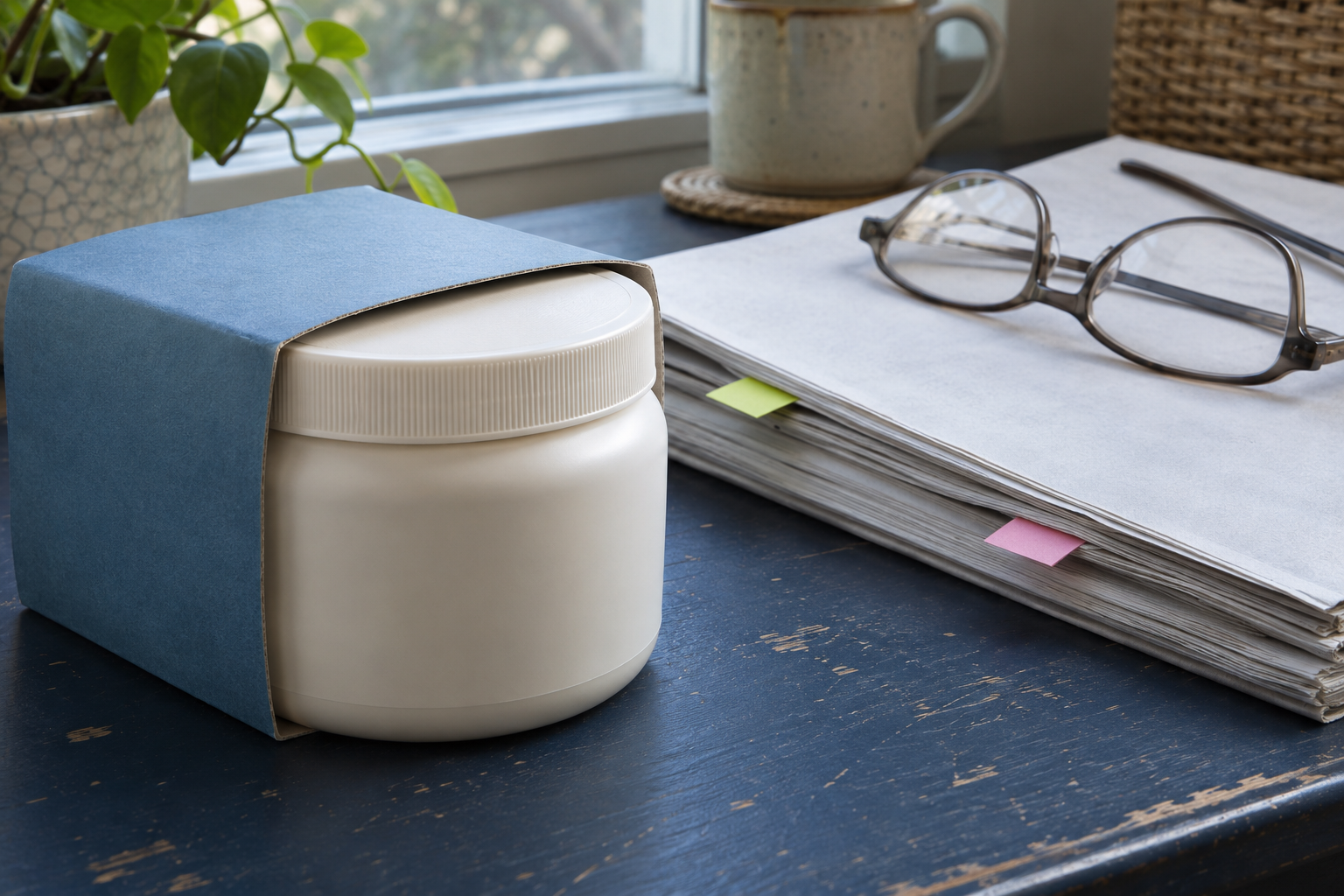
Imagine two identical-looking tubs on a shelf. One costs $12 more because the cardboard sleeve promises fewer interruptions during your first week of sleep.
If you would buy the cheaper tub without that promise, the sleeve has given you a specific $12 question. Keep the wording about interruptions and the first week together.
A study about how rested someone feels the next morning might interest you. It would leave your original question about waking up during the night unanswered.
Give the footnote an address you can follow
Open the footnote attached to that sentence, not just the first link labeled “research.” One bibliography can serve several paragraphs that make quite different claims.
Leave the product page open alongside it. If the number points to a list at the bottom, match that number before opening the paper or study record.
- Copy the promise with any nearby qualification still attached.
- Save the product name and formula version from the package you might buy.
- Write down the study title and its identifier before following another link.
- Leave room for the page or table where you actually find the answer.
Leave a blank where the connection breaks
A link can stop at a conference program naming a speaker. That gives you somebody’s presentation title, not necessarily the figures displayed during the talk.
Use a precise note such as “the program doesn’t contain the results table.” If a full paper turns up tomorrow, you can resume there without starting over.
The FTC’s guidance on health claims makes a useful distinction: credible research can still concern the wrong product, people, or benefit. A citation deserves more than a yes-or-no checkmark.
How to Check a Clinically Proven Supplement Claim
Step 1: Trace the wording to the right paper
Suppose an advertisement has two footnotes. The first follows “mixes in cold water,” while the second follows “fewer interruptions by the seventh night.” Which one would change your purchase?
Opening the mixing reference twice won’t tell you anything about sleep. Follow the second number, then compare its title, authors, and year with the document that opens.
Watch for a small but consequential change of noun. A paper about a team’s research program might lead to several experiments, each involving a different set of volunteers.
If the page offers several papers, write one line beside each title explaining why it might answer your question. Keep the paper that actually contains the comparison in view.
Step 2: Establish which formula reached the volunteers
Picture a fictional study that identifies its powder by the code M4. The shop sells a jar marked M6, underneath a brand name that hasn’t changed.
Different codes give you a question, not an answer. M6 could represent a printing change, or it could identify a different recipe. The names alone don’t distinguish those possibilities.
Look for the code in the paper’s methods or accompanying materials. A dated explanation linking both versions to the same preparation would answer more than a photograph of similar jars.
Turn the problem around if the jar lists an ingredient used in M4. Can you identify M4 itself in the experiment, or only that ingredient bought from another supplier?
There’s a practical difference between finding that a recipe changed and finding no version information at all. In the second case, label the match unknown rather than claiming a reformulation.
Step 3: Read the entry rule before imagining yourself in the group
In our fictional M4 study, everyone starts with at least three recorded interruptions on each of two qualifying nights. The advertisement, however, speaks to anyone who occasionally wakes up.
Consider someone who slept through both qualifying nights but woke twice last Saturday. That person fits the everyday meaning of the advertisement while failing this study’s entry rule.
Even the word “average” could change who qualifies. Four interruptions one night and two the next average three, yet the second night misses the stated minimum.
You don’t need to disclose a sleep history to run this check. Two invented nights are enough to show that the invitation and the research rule describe different groups.
Step 4: Name the alternative in the next column
Read across the row, not just down the column carrying the supplement’s name. A participant can improve from the starting point while someone receiving the comparison preparation improves too.
Suppose one research team compares M4 with plain powder. Another compares M4 plus evening coaching with plain powder alone. In the second setup, two things change between groups.
Even a perfectly legible table cannot tell you how much of that second difference belongs to coaching. An advertisement selling only M4 has left something behind.
Coaching in both groups would change the question again. You could compare the powders alongside coaching, but neither column would show how people fared without that shared routine.
Step 5: Match the measurement to the promised date
Draw a line from the advertisement’s verb to the actual unit. A count of nighttime interruptions is not the number of minutes it takes someone to fall asleep.
Now circle the first scheduled measurement. A questionnaire collected only on day twenty-eight cannot show which changes, if any, had already happened by day seven.
Check the question on that questionnaire as well. Asking about last night at the four-week visit differs from asking how many nights were interrupted throughout those four weeks.
A dated entry for each night could address timing more directly. A single final total, without dated entries, cannot tell you whether the interruptions clustered early or late.
Try Three Claims Against One Study Plan
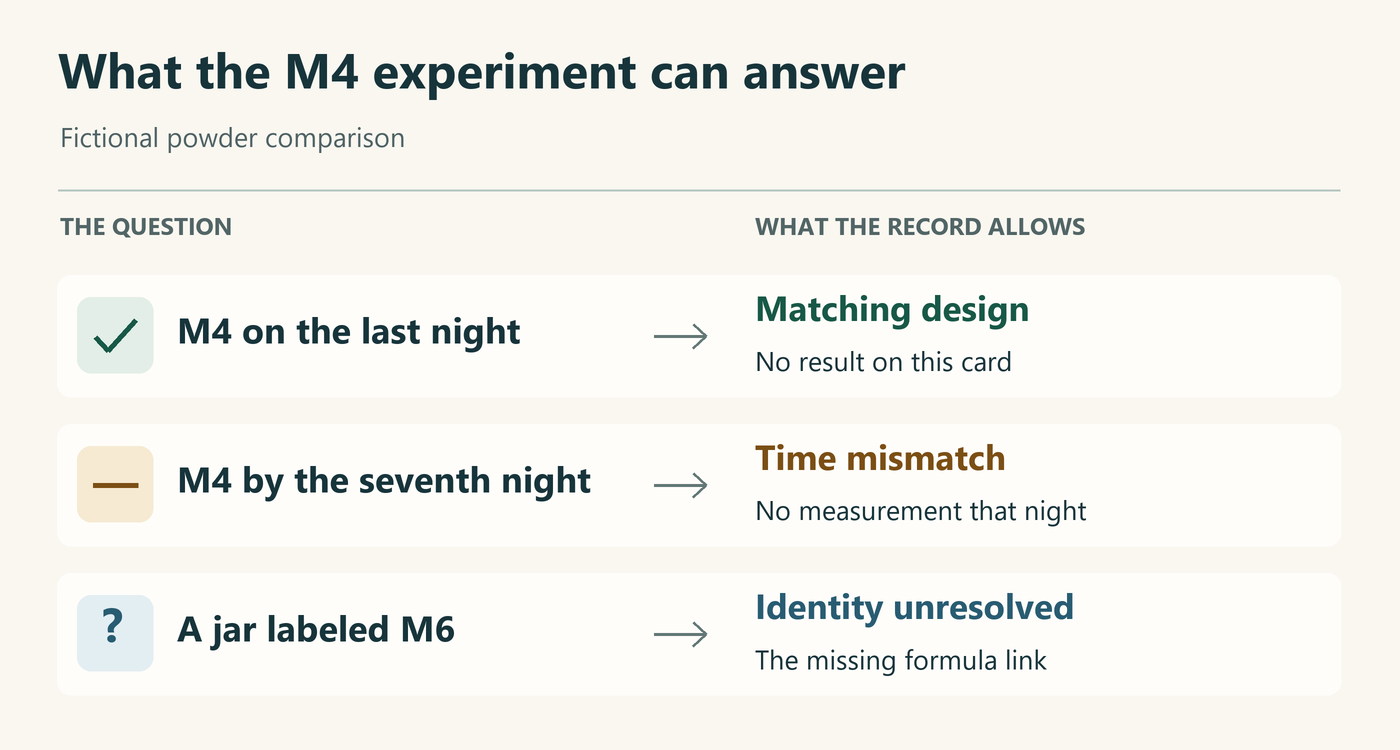
Put the fictional M4 experiment on an index card. Volunteers meeting the two-night entry rule receive either M4 or plain powder. Only the final visit includes a follow-up measurement.
That visit takes place on day twenty-eight. Each volunteer reports interruptions during the previous night. The researcher compares the two groups, but our card contains no results.
| Question on the sleeve | What the M4 card contains | Your decision |
|---|---|---|
| Fewer interruptions with M4 than plain powder on the last night? | Both groups and the requested night | Matching design; no result on the card |
| Fewer interruptions by the seventh night? | No measurement on that night | Missing seventh-night measurement |
| Does this comparison cover the M6 jar? | No document connecting M6 with M4 | Unresolved formula identity |
The first row earns a second reading, not a purchase. Even if nobody benefited, the researchers would still have asked the right question for that limited group.
For the second row, the missing night can’t be recovered by magnifying the final chart. For the third, a formula specification could change your answer without anyone running another experiment.
What a Real Study Record Can Tell You
The National Library of Medicine’s guide to ClinicalTrials.gov explains that sponsors or investigators supply study information. Listing a study does not mean the federal government evaluated it.
Try the public VITAL study record, NCT01169259. In this structured record, search the page for “armGroups” to find the assignments and “primaryOutcomes” to find the questions.
This prevention trial randomized 25,871 people. Men had to be at least 50 and women at least 55, alongside other eligibility requirements.
Researchers crossed vitamin D3 or its placebo with fish oil or its placebo. That makes four groups: both active preparations, either one with the other’s placebo, or both placebos.
One primary measure counted people who developed invasive cancer over five years. Another counted those who experienced a major cardiovascular event during that period.
Primary completion was in November 2018, and results were first posted in January 2020. Estimated overall completion in March 2031 does not mean results are unavailable until then.
Imagine finding that reference below a flavor claim about a new chew. Which assignment names the chew, and which outcome measures flavor? Neither connection follows from the citation.
To learn what happened in a study, move from the description of assignments to the reported results for the relevant comparison. Never read a planned measurement as a favorable finding.
Work the Numbers Before Trusting the Headline
Eight minutes is only one side of this example
Here is a separate, entirely invented exercise. Two groups record the minutes they take to fall asleep. These numbers do not come from VITAL or from an actual supplement trial.
Both groups start at an average of thirty minutes. At the final visit the first group averages twenty-two minutes, while the comparison group averages twenty-five minutes.
| Fictional group | Starting average | Final average | Change in minutes |
|---|---|---|---|
| First powder | 30 minutes | 22 minutes | 8 fewer |
| Comparison powder | 30 minutes | 25 minutes | 5 fewer |
Eight minutes describes the first group’s change. Subtract the other group’s five-minute change and the observed gap between improvements is three minutes, not eight.
Could you tell your partner how many participants fell asleep eight minutes sooner? You couldn’t recover that number from either average, even if both averages were calculated correctly.
For instance, two improvements of eight minutes average eight. An improvement of sixteen minutes paired with no change also averages eight. Only the first pair gives both people eight minutes.
The table includes no estimate of statistical uncertainty. Its arithmetic is enough to spot a misleading subtraction, not enough to decide whether a difference would hold up beyond these groups.
Half as many can mean two fewer people
Start a new fictional comparison with forty people in each group and complete follow-up. Two in one group reported a specified event, compared with four in the other.
Two is half of four, so the first group’s event rate is 50% lower relative to the second group’s rate. Both denominators happen to be equal here.
Put the same figures on a common scale: two out of forty is 5%, while four out of forty is 10%. The absolute gap is five percentage points.
Neither figure says that half the shoppers buying a bottle will notice a benefit. If you see only “50% lower,” look for both counts and both group sizes.
What changes if the groups have different sizes?
Give the first group twenty people and the second forty. Two out of twenty and four out of forty now represent the same 10% rate, despite the different counts.
Find out who disappeared from the percentage
Suppose a separate made-up survey enrolled fifty people but received only thirty completed questionnaires. Eighteen respondents checked a box saying they noticed a difference.
Eighteen out of thirty respondents is 60%. Among the fifty who enrolled, eighteen are known to have checked that box, which accounts for 36% of everyone enrolled.
Don’t quietly count the missing twenty as satisfied or dissatisfied. If none would have checked the box, the full group’s share would be 36%; if all would, 76%.
Those are bounds under two extreme assumptions, not rival estimates of what actually happened. The honest sentence describes the thirty responses and acknowledges the twenty unanswered questionnaires.
When Several References Seem to Fit Together
Consider a fictional brochure with three citations. Paper A describes how a powder dissolves, paper B surveys a group of runners, and paper C describes a four-week experiment.
Each might supply a word in the headline “four weeks of our powder helped runners.” Before accepting the sentence, ask which single comparison placed those runners on that powder.
If paper C enrolled office workers rather than runners, paper B’s population cannot be pasted into paper C’s result. That’s a new sentence about an experiment you haven’t found.
Multiple papers can also report on the same people. If two papers give the same study identifier, don’t add their participant totals until you’ve established whether the groups overlap.
Imagine one paper covers all eighty volunteers and a second describes twenty volunteers drawn from those eighty. Together the papers still describe eighty distinct people, not one hundred.
Bundle and refill warning
A four-week study doesn’t tell you how many bottles the shop will send. Read the selected quantity and the full order total before paying.
A bundle can be a single purchase. Check separately whether the terms authorize later refills, what they cost, and when you would have to cancel.
If you only want one bottle once, leave an unclear selection unpurchased.
What to Do If the Study Doesn’t Answer Your Question
-
Save the sentence that influenced your choice. Keep the whole panel, its footnote, and the formula version together so somebody else can follow the same reference.
-
Write down the smallest missing piece. Ask for the report comparing the two named preparations at the promised time, rather than requesting every paper about the ingredient.
-
Decide what the answer would change. If the promised first-week benefit was your only reason to spend the extra $12, hold onto that money while the link remains unresolved.
-
Keep an order issue in its own file. If you already bought the bottle, compare the receipt with your selection. Use the seller’s written return terms for a return request.
-
Take a personal health question to a clinician. Bring the label and the sentence you’re considering. A reading exercise cannot decide whether a supplement is appropriate for you.
Frequently Asked Questions
What if the study and bottle have different names?
A research code can differ from a store name. Look for a document connecting the exact preparation to the bottle, not just the same logo on both pages.
Does “tested” mean the researchers found the advertised benefit?
A test can produce an unfavorable or inconclusive answer. Find the result for the promised outcome before paying extra on the strength of that word.
Does a better combined score mean every item improved?
Suppose a score adds answers to four questions. One answer can change the total while the other three stay still. Check the item the advertisement singles out.
What if a graph has no labeled vertical scale?
You may see which bar is taller without knowing by how much. Look for the units and numerical table before translating the gap into minutes or people.
Should I count a study summary as a second experiment?
Compare the identifiers, authors, and participant description first. A news summary and the paper it describes can be two places to read about one experiment.
What if a brand only shares an abstract?
Use the details it actually contains. If the abstract combines both groups without showing their separate outcomes, ask for that comparison before treating the summary as your answer.
The Bottom Line
Give a “clinically proven” supplement claim a concrete price test. Would you still buy this bottle at this price if you crossed out the sentence beside the footnote?
If the answer is no, wait for the comparison that earns that sentence. A different recipe, an unanswered survey, or an impressive number without a denominator needn’t cost you anything.
If you already ordered, keep the advertised claim with your receipt. If you want to return the bottle, follow the seller’s written instructions for that order.

Join the discussion
0 commentsShare your experience or ask a question about this article.
Community experiences
Did this happen to you?
Your experience could help someone recognize the same scam. Submit a private report for our team to review.
I experienced this tooReports are reviewed before publication. Sharing publicly is always your choice.
Discussion
Start the conversation
Have a question or something useful to share? Add the first comment.