


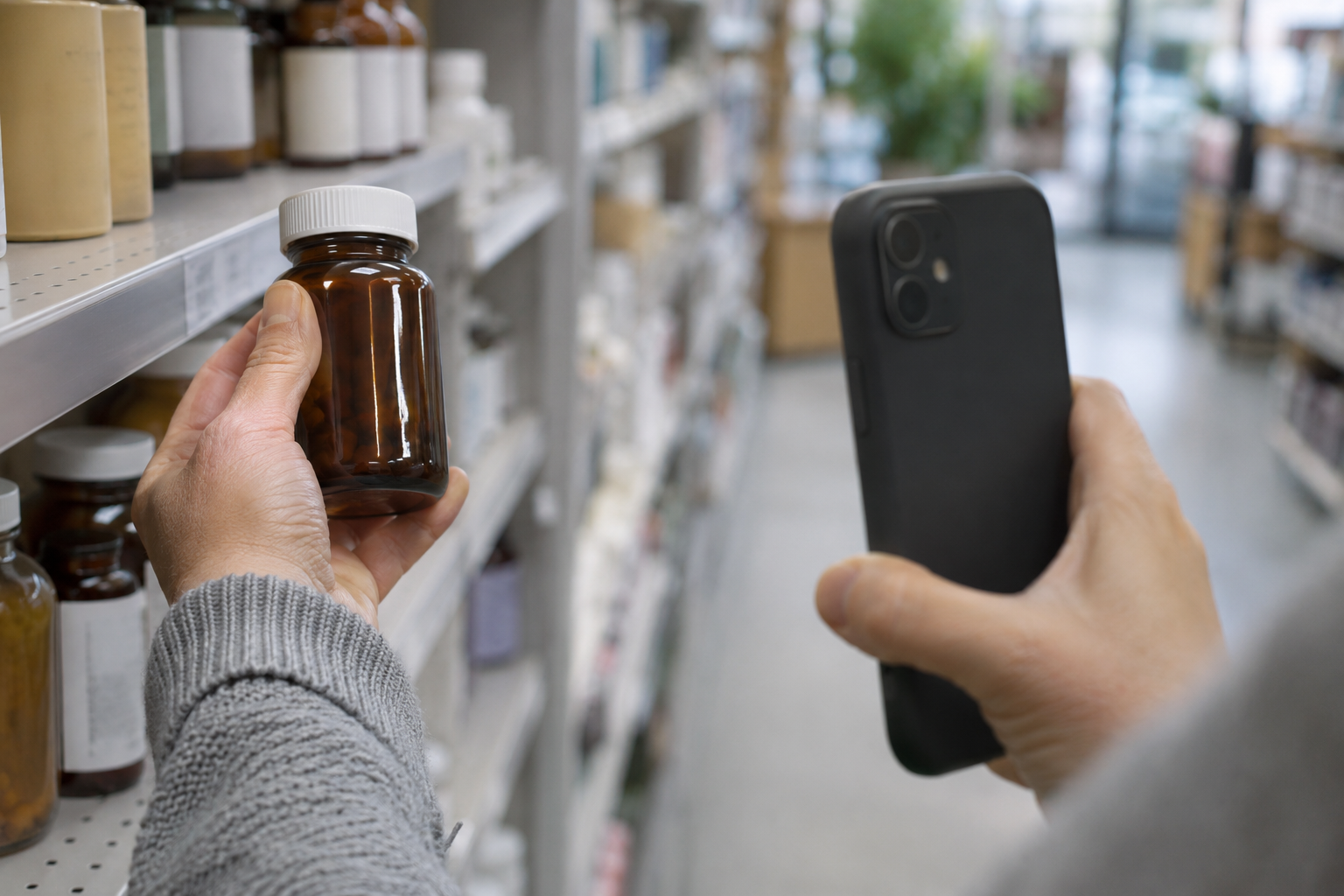
Your sister sends a photo from the supplement aisle and says she couldn’t find a warning about this bottle. What would you tell her before she buys it?
You enlarge the picture to read the bottle. The name on the shelf tag is shorter, and the person who recommended it sent a link with yet another spelling.
Overview
A search result belongs to a particular question
The FDA Health Fraud Product Database contains selected records of problems the agency has identified. It is not an inventory of every potentially hazardous product.
Picture a store listing headed “Evening Pack.” The photograph shows two different bottles bundled together. Searching the promotion’s title alone doesn’t even establish which bottle you looked for.
Separate the item, the finding and the instruction
Use three lines on a sheet of paper. Each should answer a different question, even when one short announcement supplies all three answers.
- Which item can you identify from the package in front of you?
- What does the source actually say happened, and to what?
- What does it ask someone in your situation to do?
Suppose an article about a seller refers to a claim in an advertisement. That gives you a sentence about the advertisement, not a chemical analysis of the powder.
A small discrepancy can change the next call
If you’re shopping, you can leave the item on the shelf. If you’ve already taken it, your pharmacist may need the exact version and the instructions you found.
For serious symptoms, get urgent medical help before researching a label. Don’t change prescribed treatment because of something you did or didn’t find in a database.
For everyone else, start by putting the evidence where you can compare it. A second photograph often helps more than a second person’s guess.
Bundle and refill warning
A search won’t tell you how many bottles the store plans to ship. Compare the full order total with the quantity you actually want.
If the offer includes refills, check what authorizes the next charge, how often it repeats, and how to cancel. Leave an unwanted selection out of your order.
How to Read a Supplement Search Without Guessing
Step 1: Give each name its proper job
Copy the name from the physical label, including any words after the brand. Look on the side or back for the company and its stated role.
A marketplace account might call itself a wellness outlet. The bottle might name a distributor, and the card receipt might name a payment company. Keep those names on separate lines.
A store receipt might show a number beside the word “vanilla.” Before copying that number into the space for a lot, see where else it appears.
If the same number appears beside every flavor you ordered, it may identify an assortment rather than a production run. Keep it under receipt details until you know.
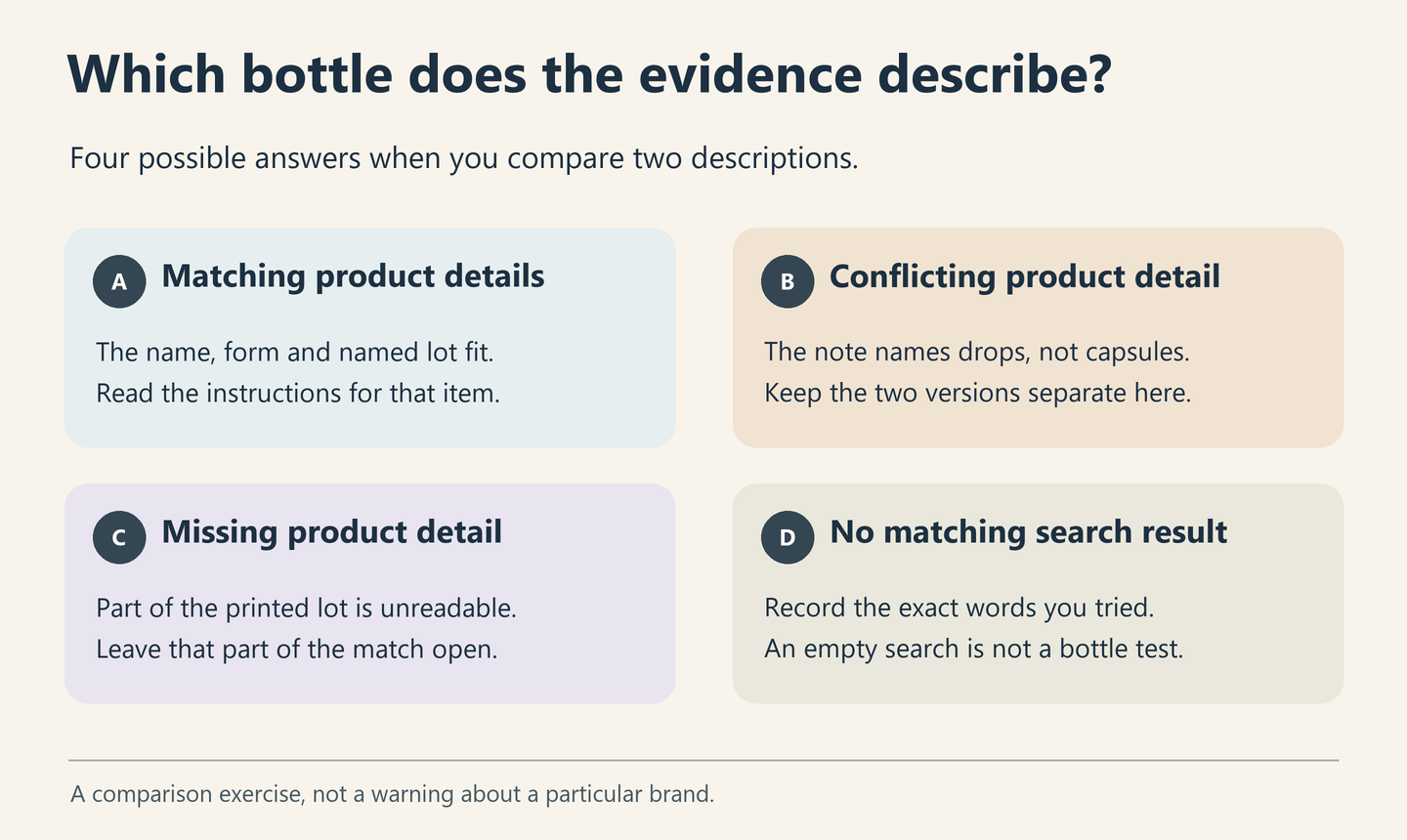
Look closely at punctuation and small type. A hyphen or an accent can suggest another spelling to try; the words “drops” and “capsules” describe a more substantial difference.
Save an uncropped photo for yourself. Before sharing it, cover any shipping label, personal order details or pharmacy information that happens to be visible behind the bottle.
Step 2: Change one part of the search at a time
Keep the original spelling beside the shorter version so you can retrace your steps.
Suppose the title contains four words and the firm name contains two. Trying the firm by itself asks a different question from trying those six words together.
A phone screenshot that cuts off the search wording is hard to interpret later. Save the date, words and page address in the same note as your result.
Distinguish an empty result from a page that didn’t load. If all you have is an error message, record the interruption; you don’t have a completed search to describe.
Step 3: Measure what the notice actually covers
Start with the form, size and firm, then check any lot, date range or other limit the notice specifies.
Here is a fictional sorting exercise you can do without a search engine. Imagine a notice expressly restricted to unsweetened powder in individual sachets marked lot P41.
| What you have | What the comparison supports |
|---|---|
| Unsweetened sachets marked P41 | All three identifying details match in this example. |
| Unsweetened sachets with a rubbed-off code | The form agrees, but you cannot settle the lot from this package. |
| Sweetened powder in a tub marked P41 | The code agrees but the container and version do not. This description points to a different item. |
Notice why the last buyer can’t borrow the first buyer’s answer. A short printed code is meaningful alongside the product description; it isn’t a unique name for everything on earth.
Now change the premise: the notice expressly covers every lot of the unsweetened sachets. The missing final digit no longer prevents an otherwise matching buyer from acting.
Silence about lot numbers is different from an explicit restriction to one lot. Read the full description and directions instead of inventing a missing condition that narrows the warning.
If a seal or fold hides the code, photograph what you can see. Don’t open something you’re trying to return merely to make a more convincing comparison.
Step 4: Identify the action behind the headline
A database row can point to a public notification, a recall or a warning letter. Which one would you send to a friend who still has the bottle?
If an FDA notification advises against buying or using the product you identified, follow that advice.
If you’ve already taken the product, look specifically for directions addressed to current users. Contact a healthcare professional promptly for help with instructions that affect you.
A recall announcement can give buyers particular identifying details and handling instructions. Read the actual announcement before returning a parcel to the address on a routine shopping receipt.
With a warning letter, first look at the recipient and the issue FDA raised. A request for a company response is not an instruction for customers to mail back bottles.
Keep both links when a row contains an additional outcome. Give each a short label so you can find it again without reopening both pages.
Step 5: Put each document on the right date
Start with two dates you can usually tell apart: when you bought the item and when the document was issued. The day somebody forwarded the link is a third date.
Consider a fictional folder with three papers about an advertisement. In March, a letter questions its wording. In April, the business writes that it plans to change the advertisement.
In July, a close-out letter says the correction was verified. Sort the papers by what happened, not by the dates your email program says you downloaded them.
The FDA’s explanation of warning and close-out letters makes an important distinction: a firm’s promise is not the same as a correction FDA has verified.
July settles the advertising issue in our exercise. It neither identifies the contents of a June purchase nor assures you that next year’s products will be safe.
Now suppose the July page refers to a different letter altogether. Even if the company names match exactly, it belongs on another line until you can connect both documents.
Look for the date of the earlier letter in the follow-up. Compare the issue described in each document. Matching both is more persuasive than finding the same company logo twice.
Try the Comparison With an Incomplete Receipt
A friend asks whether she should forward a warning to everyone who bought the same holiday gift set. She has a receipt and one leftover sample, but not the box.
The receipt lists a shop and the words “six-piece sampler.” The individual packet lists a flavor and a packer. Neither identifies the other five pieces.
Before writing to anyone, decide which person could answer which question. The gift recipient can photograph their packet. The purchaser can find the original order and any substitution notice.
Suppose the shop’s confirmation says one flavor was replaced before dispatch. The order page’s original photograph now does less work than the separate substitution email.
Make a private note of the difference. The winter photograph shows a mixed assortment; the dispatch message identifies what the shop said it sent. Neither proves what each recipient opened.
Instead of forwarding a blanket accusation, send the original notice with a specific request: compare your packet’s name and code with the description in that notice.
One recipient reports an exact match. Another still has only the gift note. Help the first find the applicable directions without telling the second that their packet has been identified.
What if nobody kept their packet? Say which piece of evidence is missing. A group of people independently remembering a blue wrapper still doesn’t recover a printed lot number.
What the Label Can Tell a Pharmacist
The FDA’s guide to hidden ingredients explains why an ingredient list has limits. An undeclared substance won’t announce itself on the label and can cause serious harm.
That doesn’t make the label useless. It can help a pharmacist identify the exact version you mean, especially if two different products share the first part of a name.
If the seller points instead to a registered facility, the subject has changed. Facility registration isn’t FDA approval of the supplement you hold, and FDA doesn’t approve supplements before sale.
Imagine you tell a pharmacist you used “the night one.” A photograph of the front, back and lot marking gives that conversation a much better starting point.
Take the relevant notice too, not just a shopping link. If you ordered one version and received another, explain that difference rather than choosing the more familiar name.
A clinician can then ask about what you actually used. You don’t have to identify an ingredient from a symptom or settle the package mystery before asking for help.
What to Do With the Answer You Have
Open a short checklist for your own comparison note
- Write down the full item name and the words immediately following it.
- Identify the company role exactly as the label describes it.
- Record the lot you can read and mark any unreadable characters separately.
- Keep the source link, the issue date and the exact item detail that matched or conflicted.
-
If you’re deciding whether to buy, name the reason you’re considering this particular supplement. Then ask whether anything you found actually supports that reason.
A search for warnings won’t tell you whether an online promise about a better night’s sleep is true. Leave the purchase alone if that’s the only reassurance offered.
-
If the relevant page is on your phone, leave a note beside the package. Someone else in the household may be the next person to reach for it.
Keep a note of which bottles you’ve accounted for. If two remain in different cupboards, checking the first label doesn’t complete the check on the second.
-
If just one identifying detail conflicts, circle that detail. Ask for the information that would resolve it, such as a legible photo of the side panel.
One useful question gets a better answer than sending a seller six screenshots and asking whether everything is fine. Keep any reply separate from the original agency document.
-
If you’re sharing a result, describe your own item and the relevant date. Link to the actual notice so the next person can compare their own package.
Suppose later you discover your photograph was of the outer carton, not the individual pouch. Tell anyone who received the first comparison exactly what changed.
Frequently Asked Questions
What if the expiration date is the clearest number?
Record it as the expiration date, not the lot. If the instructions ask for both, supplying the clearest one twice won’t identify the missing one.
Does the same marketplace seller mean the same manufacturer?
One seller can offer unrelated brands, and one brand can appear through different sellers. Look for a label or document connecting this company to this particular item.
Can I work from a screenshot somebody posted online?
Use it to locate the original, especially if the picture crops out the product name or date. A cropped paragraph may also omit directions immediately below it.
What if the package photo looks completely different?
Check which feature changed before dismissing the notice. Different lighting could explain the shade of a photograph; a different product form requires a better explanation.
Can I tell whether a lot includes mine from the first letters?
Use the published boundaries, not a guess about how a factory numbers batches. If the notice gives a range you can’t interpret, leave that question open and seek clarification.
What if a shop sends me a revised product page?
Save the newer page alongside the one you ordered from. A replacement photograph may answer a question about today’s listing without showing what was packed for last month’s order.
The Bottom Line
Don’t buy or take a supplement just because your FDA search came up empty. If the item matches an official warning, follow the advice directed to you.
If you’ve used a product you can’t identify confidently, bring the package and the relevant notice to a healthcare professional. You don’t need a perfect match to ask for help.

Join the discussion
0 commentsShare your experience or ask a question about this article.
Community experiences
Did this happen to you?
Your experience could help someone recognize the same scam. Submit a private report for our team to review.
I experienced this tooReports are reviewed before publication. Sharing publicly is always your choice.
Discussion
Start the conversation
Have a question or something useful to share? Add the first comment.