


You want to cancel an order you placed last night. You remember hearing something about a three-day cooling-off rule, but the store’s confirmation says nothing about it.
Before spending the morning on hold, take another look at how you came to buy the item. Two receipts that look alike can tell very different stories.

Overview
The delivery address isn’t the place of sale
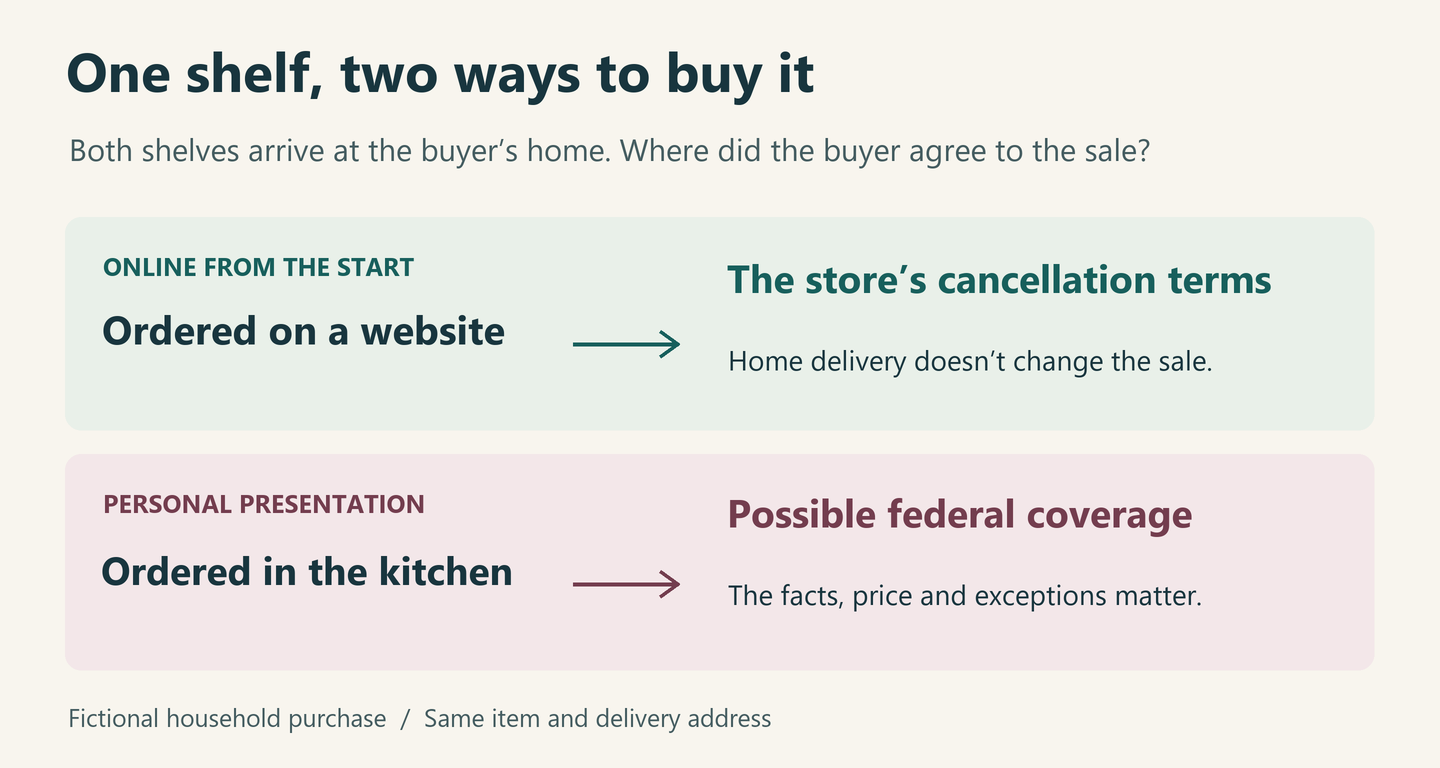
The Federal Trade Commission’s guide to buyer’s remorse excludes purchases made entirely online from its Cooling-Off Rule.
A shipping confirmation describes where a package should go. It says nothing about whether someone visited you, made a sales presentation, or took your order.
That distinction works the other way, too. A salesperson can hand you a tablet in your living room. A receipt arriving by email doesn’t erase the visit.
Which promise are you trying to use?
Pull up the sentence that made you think cancellation was possible. Was it in a notice handed to you, on the store’s order page, or in advice about online shopping?
- A store policy that promises an exchange might help if you want another size. An exchange and a refund aren’t interchangeable.
- If two shelves went into your cart instead of one, identify the unwanted unit. Canceling the whole order might also cost you the shelf you wanted.
- A complaint that the seller sent the wrong item starts with the mismatch between order and delivery, not with how quickly you regretted buying it.
If you find a real promise from the seller, keep its wording. Asking for what the store actually offered gives someone handling your request something concrete to act on.
Reconstruct the moment you agreed to buy
Make a short note while you remember the conversation. If the only slip you have says “balance due,” look for the earlier order it refers to.
Don’t start with the date the charge appeared on your statement. A deposit, a final payment and a bank posting can leave three dates for a single purchase.
You might already have enough information to request cancellation of an ordinary online order. To see which details resolve a less obvious case, compare the three sales records below.
Three Ways to Buy the Same Shelf
Imagine a folding shelf that costs $96. Each fictional buyer wants it for a hallway at home, and each gets an electronic receipt. What differs is the sale itself.
| Purchase record | Cancellation route |
|---|---|
| Website from start to finish | The buyer finds a listing and checks out without meeting anyone. Use the store’s terms for a change of mind. |
| Home presentation and order | A visiting representative pitches the shelf and takes the order in the buyer’s kitchen. On the stated assumptions below, this sale is covered. |
| Visit followed by payment link | The representative visits, but the paperwork shows only a later payment. Find out what the buyer agreed to during the visit. |
In the first case, the delivery driver asks where to leave the shelf. That conversation is about getting an order to the right door, not persuading someone to place it.
In the second case, assume no earlier negotiations at a permanent store and no applicable exclusion. The buyer signs a household purchase agreement in the kitchen after the demonstration.
In the third case, a message saying payment is due could confirm an earlier agreement. A link inviting the recipient to browse might instead be the start of another transaction.
Keep whatever was signed during the visit. If nothing was signed, describe what was said rather than treating the absence of a signature as proof that nothing was agreed.
Did you order the walnut shelf, or did you ask for its dimensions? A note about that exchange can explain a payment link that otherwise has no context.
Now suppose the date on the email doesn’t match your memory. Preserve both versions and explain the discrepancy instead of choosing whichever date leaves more time.
What Counts as a Qualifying Personal Sale?
The federal rule looks for personal solicitation and the buyer’s agreement or offer away from the seller’s place of business.
The price must reach $25 at your residence or $130 at another qualifying location. Use the total price, including interest and service charges, rather than just the first installment.
Imagine two order slips from temporary sales meetings at a hotel. One shows a $20 deposit toward a $160 purchase; the other shows a fully paid price of $20.
Only the first ticket clears the price threshold for that location. If all you kept was a card slip showing $20, look for the agreement showing the balance.
A hotel name alone tells you surprisingly little. A brief sales demonstration in a rented room differs from a visit to a permanent shop inside the same hotel.
Earlier negotiations at the seller’s permanent retail store may matter even if you finished the paperwork at home.
For ordinary goods, what matters is mainly personal, family or household use. Buying a shelf for your hallway is different from ordering a dozen for a commercial stockroom.
Distinguish a repair you requested from an extra service offered during the visit. Identify what you originally asked the technician to fix and when the new offer appeared.
For example, separate a receipt for repairing your vacuum from a later agreement for maintenance on several appliances. A single visit need not answer both questions the same way.
Simply inviting a salesperson to visit doesn’t settle the question either. Put the invitation beside the proposal so you can tell an appointment request from an order.
Why Two Buyers Might Circle Different Days
For a covered transaction, the cancellation deadline is midnight of the third business day after the transaction date. Skip Sundays and federal holidays, but count an ordinary Saturday.
Try the two invented calendars below. Both assume a covered sale with the contract dated the day of the agreement. Neither uses the day a package arrives.
A Thursday signature with no federal holiday
Suppose you agree on Thursday evening. Friday is the first day, Saturday is the second, Sunday doesn’t count, and Monday is the third.
Someone who starts counting on Thursday gets Saturday. Someone who skips the entire weekend gets Tuesday. Neither calendar answers the question on this notice.
A reminder for Monday night might be too late to get a letter postmarked that day. Set your practical reminder for a time when you can actually send the notice.
A Tuesday signature with a federal holiday on Thursday
This time the buyer agrees on Tuesday. Assume Thursday is a federal holiday and no other day that week is a holiday. Wednesday counts as the first day.
Skip Thursday, count Friday as the second day, and count Saturday as the third.
Notice what would happen without the holiday: Wednesday, Thursday and Friday would be the three days. Moving the deadline to Saturday here takes one explicit change to the facts.
On your own copy, mark the contract date separately, then write a number beside each day you counted. If a holiday is uncertain, confirm it rather than borrowing the example.
Give Notice That Can Be Matched to Your Agreement
For a covered sale, look for the dated receipt or contract and two cancellation forms. The agreement should use the language principally used for the pitch.
State your decision in signed, dated writing. The rule’s notice and cancellation provisions describe mailing or delivering notice. You don’t have to explain your change of mind.
Use the cancellation address, which can differ from a warehouse address. If the seller didn’t supply the forms, the FTC explains that you can write a cancellation letter instead.
Keep one complete copy of what you sent. A postal receipt helps establish mailing, but it won’t show whether you asked to cancel or merely asked about a return.
Put enough detail in the notice to identify this transaction. If two orders share a household and a seller, distinguish them by agreement date, order reference and item.
For mailed notice, get the envelope postmarked by the deadline. USPS explains how postmarks work: dropping a letter in a collection box doesn’t guarantee that day’s processing date.
If you’re mailing close to the cutoff, ask the postal clerk for a manual postmark when you hand over the envelope. Keep the mailing receipt and any delivery confirmation.
When somebody directs you to another address by phone, ask them to confirm it in writing. Keep the original address visible while you sort out the difference.
If You Ordered Entirely Online, Use the Store’s Actual Terms
Look for two different words: cancellation and return. One policy might let the warehouse stop an unshipped order; another might let you send an item back after it arrives.
Save the confirmation, the item’s condition requirements and the wording next to any cancellation option. An editable cart isn’t necessarily an editable order.
Suppose a store promises to accept unopened shelves for 15 days after delivery. That promise doesn’t say the warehouse can intercept a shipment before it leaves.
Another fictional policy says the warehouse must receive returns within 15 days. A day-15 postmark answers a different question. Don’t silently substitute one policy’s wording for the other’s.
When contacting the store, identify the order and ask whether it can be stopped. If it can’t, ask for the correct return destination and the event that starts its deadline.
Read any reply for the action actually completed. “We’ve received your request” acknowledges a message; “we canceled order 74” describes a decision about an identified order.
If you ordered a narrow shelf and received a wider model, put the measurements beside the listing. The wrong size is a different complaint from regretting the purchase.
Don’t present a valid purchase as an unauthorized charge to get a quicker answer. Describe the actual dispute and keep the seller’s response if you need further help.
What to Do If You Need to Cancel Now
Check what belongs in your cancellation file
- Keep the agreement that identifies the item, not just a bank statement showing a payment.
- If the salesperson wrote on the back of a page, save both sides so the handwriting stays with the right agreement.
- Keep the notice you actually sent apart from any earlier version you didn’t send.
- Save the tracking number with the mailing receipt so the dates remain tied to the right envelope.
-
Compare seller names and order numbers before using an address copied from another document or a previous purchase.
-
Choose the appropriate request for the facts you know. For an online-only change of mind, ask the store to cancel under its terms and get the outcome in writing.
-
If the sale appears covered and you want out, give timely written notice. Don’t let an invitation to discuss a discount consume the time available to cancel.
-
Save the signed copy alongside evidence of dispatch and receipt. Label each date with what happened, especially if mailing and delivery occurred on different days.
-
Record anything the seller still has, such as a deposit or trade-in, separately from goods still in your possession. Those two lists help you track what remains outstanding.
-
If material facts are disputed, bring the contract, timeline and seller’s response to your state consumer protection office.
What happens after a valid cancellation?
Within ten business days of receiving valid notice, the seller must refund payments and say whether it wants delivered goods back.
Record the seller’s receipt separately from its promised refund date. If someone says a refund was issued, ask for the amount and reference so you can identify the corresponding credit.
Keep goods available at home in substantially their original condition. The 20-day pickup period for those goods starts on the date of your notice.
If you agree to return them as instructed, the seller bears shipping cost and risk. Keep evidence that you actually sent the agreed items.
A silent week isn’t permission to give the item away. Note any missed pickup, including where the item was waiting and who arranged the collection.
Frequently Asked Questions
What if the policy linked from my receipt has changed?
Keep the original confirmation and any terms saved with it. Ask for the version that accompanied your order rather than assuming today’s wording was in effect when you bought.
Does a promise of three days mean the federal rule applies?
A store can choose that number for its own policy. Read whether it promises cancellation, exchange or store credit, and whether its clock starts with purchase or delivery.
What if the receipt and cancellation notice show different dates?
Preserve both documents and the actual sequence of events. Act promptly if you want to cancel, rather than relying on the later date while waiting for someone to reconcile them.
What if the receipt lists only the salesperson’s first name?
Check the header of the agreement, the notice address and the confirmation email for the business name. Keep the presenter’s name separately so you don’t confuse the two.
Does sending the shelf back count as written cancellation?
Don’t rely on the parcel alone to communicate your decision. A warehouse can record a delivery without knowing which agreement you wanted canceled or when you gave notice.
What if the seller sends a cancellation confirmation for the wrong item?
Compare the reference and item description with your notice, then flag the mismatch in writing. Keep the original notice as well as the seller’s correction, if one arrives.
The Bottom Line
Don’t wait three days on an entirely online purchase. Ask the store now whether it can cancel, and use the actual return terms if the order moves ahead.
For a sale that appears covered, count from the agreement date, give written notice on time and keep proof tied to that specific sale.

Join the discussion
0 commentsShare your experience or ask a question about this article.
Community experiences
Did this happen to you?
Your experience could help someone recognize the same scam. Submit a private report for our team to review.
I experienced this tooReports are reviewed before publication. Sharing publicly is always your choice.
Discussion
Start the conversation
Have a question or something useful to share? Add the first comment.