


You’re comparing two supplement powders when the back of one tub mentions wheat. The words on the front are what put that particular tub on your shopping list.
Before you put it back or place an order, read the whole sentence on each side. Then check which flavor those sentences actually describe.
Overview
Start with the words on your shopping list
Someone might request a powder labeled gluten-free. Someone else might ask you to avoid wheat ingredients.
If you’re shopping for someone else, don’t rewrite their instructions as a diagnosis. You can identify what a package says without deciding what that person should consume.
Keep the speaker attached to the statement
A maker can print a claim on a pouch, a store can choose a search category, and a reviewer can describe last year’s order.
Which one supplied the words you’re relying on? If the only answer is a search filter, you haven’t yet found a statement from the maker of the selected item.
Keep the flavor attached to the answer
A vitamin powder might come in lemon, berry, and plain versions. A readable panel for lemon is useful evidence about lemon, even if the seller displays it beside all three.
- Find the words that belong to this exact product.
- Read beyond the prominent print on the front.
- Copy a whole sentence, including any words around the corner.
- Leave a missing detail open instead of filling it from another flavor.
Bundle and refill warning
If selecting a sample changes the basket to a variety pack, check its flavors, quantity, and full price. A photograph of one sachet doesn’t describe everything you’re buying.
Before paying, see whether you’re accepting one shipment or agreeing to refills. Keep the order summary if a later delivery differs from the terms you chose.
How to Read One Supplement Before Comparing It With Another
Step 1: Identify the item the package describes
Turn the container until you can read its product name, flavor, and form. A chewable tablet and a powder aren’t interchangeable evidence just because they share a brand.
On a website, compare the selected option with the product named inside the photograph. Changing a dropdown can change the item in your basket without changing the picture you’re studying.
For instance, suppose the picture still says berry after you select plain. That doesn’t tell you the plain product contains berries. It tells you the photograph answers the wrong question.
Look for a picture showing the complete plain package. If none appears, describe what’s missing as a plain-flavor label, not as a missing ingredient or a misleading health claim.
Step 2: Find the exact words the maker uses
The FDA’s gluten-free rule covers voluntary claims on US supplements.
Gluten-containing grains and derivatives not processed to remove gluten are excluded. Even with processed wheat starch, the finished food must stay below 20 parts per million of gluten.
Less than 20 doesn’t mean zero. You haven’t measured the tub in your hands, and this isn’t a number to use for choosing a serving.
Step 3: Look for the source of the ingredient
Check Supplement Facts and the other ingredients. The FDA’s guidance shows how parentheses can identify an ingredient’s food source.
A separate Contains statement isn’t necessary if those panels already identify all major allergens present.
Consider what happens when you copy a line into a shopping note. If you shorten an ingredient to its first word, you may cut off the very qualifier you needed.
Copy the whole phrase, or keep the legible photograph instead. Mark wording that’s out of view as unreadable, not as something the manufacturer definitely left off the package.
Step 4: Read a manufacturing advisory on its own terms
A statement about a facility handling wheat describes a possible cross-contact circumstance. It is not a declaration that wheat was deliberately added to this recipe.
A truthful facility advisory doesn’t cancel a gluten-free claim or excuse its requirements. Without an advisory, don’t assume a dedicated line.
When you write to the manufacturer, put that question in the subject line. Include the product identifiers so the reply can refer to the right run.
The Tub That Mentions Wheat on the Back
Imagine a plain powder labeled gluten-free with wheat starch marked by an asterisk in its ingredient list.
Here, the label must explain that processing the wheat to remove gluten allows the powder to meet the gluten-free requirements.
One buyer’s list excludes wheat ingredients. For that shopper, this tub is off the list.
Another person needs front-label photographs of powders carrying the requested wording. Include this one with its reverse side, marked plain, so the pair stays identifiable.
Neither shopper measured the contents of the tub. Keep the reason for listing or rejecting it beside its name when you show your notes to a clinician.
Now imagine receiving one photograph taken straight toward the back. You can read the ingredient you circled, but the next few words disappear around the curve.
For the first shopper, the legible wheat entry already answers the stated buying instruction. There is no need to pursue the missing photograph merely to decide against buying this tub.
For the person compiling photographs, request one overlapping shot taken from the side. The common text lets you position the two pictures in the right order.
That request is more useful than asking whether the powder is good quality. A careful answer about quality could still leave the words around the curve completely unknown.
Two Flavors Behind One Wheat-Free Search Filter
Suppose a store filter returns a berry sachet and a plain sachet. You’re choosing a gift, and the recipient specifically asked for an item whose own package says gluten-free.
FDA excludes barley malt extract, which appears on the berry sachet, from foods labeled gluten-free.
The plain photo shows only the top of the pouch. Its flavor is clear, but you cannot read its ingredient list or establish the requested claim from that picture.
Both sachets may stay out of the cart today, for different reasons. You have specific information about berry and insufficient information about plain. Keep that difference in your request.
For berry, another copy of the same photograph won’t change the ingredient you found. For plain, a complete picture of that specific unit could change the buying decision.
Suppose a seller replies with a larger picture. Read the little word under the product name before thanking them: a sharper image of berry still doesn’t fill the plain-flavor gap.
An ingredient search also has a literal limit. Typing the word wheat into a retailer’s description searches those letters in that text, not every panel on an unseen pouch.
If the store removes its filter tomorrow, your saved berry photograph still says what it said. The filter and the package were never the same piece of evidence.
One Facility Statement, Three Different Shopping Instructions
Suppose a lemon tub has both statements described above. The notice names the facility, not the equipment used to make this batch.
One buyer needs to document what the front says. A second buyer’s list excludes facilities that handle wheat. A third buyer has been asked specifically about shared equipment.
| Question about the fictional lemon tub | What the buyer can record |
|---|---|
| Does the package make the requested claim? | Yes, on this particular lemon tub. |
| Does this particular facility also handle wheat? | Yes, the printed notice identifies that facility. |
| Did this production line share any equipment? | The notice doesn’t identify the production line. |
The second buyer can cross lemon off the list. The third can send the printed lot code with the question; an answer for last season might concern another run.
Change the third buyer’s question to whether the product is suitable for a particular person. A factory description, however detailed, cannot give that person individualized medical advice.
Keep the exact wording available for a clinician who knows your circumstances. Don’t taste the powder, take a smaller amount, or ask someone else to try it as a test.
What if the reply names a different facility?
Ask whether that facility made the specific lemon tub you have. A description of an unrelated plant doesn’t resolve your question, even when both belong to the same company.
Count the Flavors Before You Count the Sachets
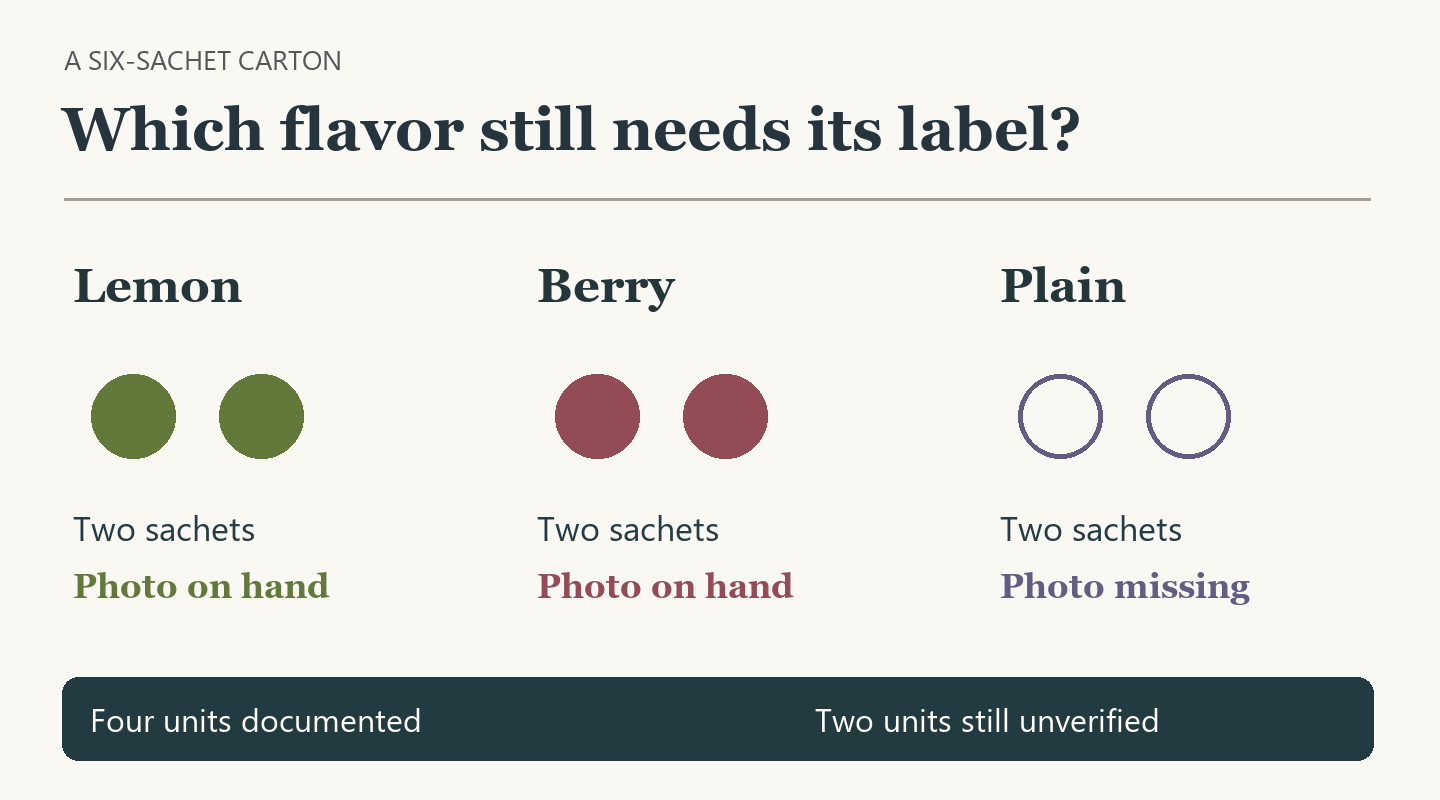
Consider a fictional six-pack with two lemon sachets, two berry sachets, and two plain ones. You have complete photographs for lemon and berry, but nothing showing the plain version.
One plain-flavor label would fill the gap if both plain sachets are the same version. That would document two physical units, not just one.
That distinction matters when someone offers a replacement. Sending two more pictures of lemon would increase your photo count without adding any information about the two plain units.
Suppose the manufacturer’s reply names plain powder sold in a tub. The flavor matches, but the package differs. Ask whether the cited information covers the sachets too.
A manufacturer could answer that the tub and sachet carry the same formulation and wording, or could send the sachet panel itself. Either answer identifies what was actually compared.
Another possible answer is that every flavor starts with the same base. Picture three cups filled from one pitcher before different flavor mixtures go into each cup.
Knowing what went into the pitcher doesn’t identify what went into the berry cup afterward. Ask whether the reply describes the base alone or the finished plain sachet.
A reply saying plain is the company’s most popular flavor does neither. It may explain why the seller stocks that flavor without answering a single question about its label.
If the store sells individual units, order only the ones meeting your written purchasing requirements. You don’t have to investigate every flavor the brand sells.
If the carton is inseparable, judge the proposed order as a carton. You cannot buy six documented units from that listing when the information available covers only four.
Consider the price with those two unknown units left out. Suppose the mixed carton costs $30, while the same shop sells individual sachets for $7 each.
Dividing by all six makes the box look like a $5 bargain per sachet. But four individually selected sachets cost $28, less than the $30 carton.
If you want only the four documented units, that smaller order costs $2 less outright. The value comparison changes without making any finding about what’s inside the other two.
Now change just the shopping list: the recipient wants only lemon this time. Four sachets are still documented, but just two of those four belong on this order.
Two individual lemon sachets cost $14 together. Choosing the $30 carton spends $16 more without adding a single lemon sachet.
Check substitutions separately, especially when buying for someone else. For example, permission to replace an unavailable lemon sachet with another lemon isn’t permission to choose a different flavor.
When the Delivered Label Differs From the One You Saved
Imagine you ordered plain powder after seeing a product photograph marked plain. At home you turn over the tub and find wording you never saw in that photograph.
First establish whether the original image actually showed that side. If it showed only the lid, you’ve discovered new information, not necessarily a change since the date of purchase.
Compare the flavor, package size, and identifying marks. Two versions can share an order-page title. The carton in your hand is the one you need help identifying.
Suppose both versions say plain, but only the delivered one says new recipe. That wording gives the manufacturer something specific to check; it doesn’t tell you what ingredient changed.
Ask which version the saved image described and which stock shipped. The date an email was sent doesn’t identify the formula in the parcel.
If you don’t want the product, leave it unopened while checking return terms. Ask for written instructions explaining which unit or carton the seller expects back.
Don’t describe a whole order as the wrong flavor when only one sachet was substituted. Identifying the affected unit makes it easier to ask for exactly the resolution you want.
What to Do With an Unanswered Label Question
-
Write the requirement in the buyer’s own words. If the instruction is unclear, ask the person who gave it before deciding which item to put in the cart.
-
Save one identifiable set of pictures. Include the product name and the full wording that raised the question. Two disconnected close-ups can make different flavors look like one item.
-
Direct the exact question to the manufacturer. Ask which wording belongs to the flavor and package size in front of you. You don’t need to send a personal medical history.
-
Decide what the answer actually settles. A picture of the requested sachet may resolve a packaging question. Take individual dietary or allergy questions to your clinician with the complete label.
-
Act on the order you actually received. If it doesn’t meet the purchase requirement, set it aside, preserve the receipt, and use the seller’s written process for a return.
Frequently Asked Questions
What if the store calls this its allergy-friendly range?
Ask which exact product and requirement the store means. A range name cannot tell you what the individual package you’re about to buy actually says.
Does a photo of last year’s bottle settle a reorder?
Use it to identify what you bought before. Request the label for the current version, particularly when the online listing mentions a reformulation or a different package.
What if a scan leads to the brand homepage?
Look for an item-specific match before saving the page. A code leading to the right company doesn’t tell you which flavor the company’s answer describes.
What if a removable sticker and the pouch disagree?
Keep both in a single picture before peeling anything off. Ask the manufacturer whether the sticker updates this particular pouch and which wording describes the unit you received.
What if the individual wrappers have already been discarded?
Keep the outer carton and the purchase record. If they don’t identify the individual flavors, tell the manufacturer what’s missing instead of reconstructing a wrapper from memory.
Can a customer review answer for my particular package?
Use another buyer’s photo to spot a question worth asking. Unless it identifies the same version, it cannot establish which wording came on your own unit.
The Bottom Line
Buy only when the specific item answers the shopping requirement you started with. If that requirement concerns wheat, a gluten-free headline alone doesn’t settle it.
If you already ordered and the unit doesn’t match, set it aside and ask about a return using the receipt. Take questions about personal suitability to your clinician.

Join the discussion
0 commentsShare your experience or ask a question about this article.
Community experiences
Did this happen to you?
Your experience could help someone recognize the same scam. Submit a private report for our team to review.
I experienced this tooReports are reviewed before publication. Sharing publicly is always your choice.
Discussion
Start the conversation
Have a question or something useful to share? Add the first comment.