


You ordered two things with your credit card. The first package is on the porch, the second is still coming, and your card activity shows three familiar numbers.
Which number would you circle if you had to explain what the store charged? Start with the receipt in your inbox and the dates beside those amounts.
Overview
First decide whether the purchase is yours
This guide follows a purchase that you or another authorized cardholder actually made with a US credit card. Recognizing the store is not quite the same thing.
Tell your issuer immediately about unauthorized entries, even while pending. Use your banking app or the number on your card.
Separate the date you looked from the date you bought
A screenshot taken Wednesday tells you what Wednesday looked like. It doesn’t necessarily show a new purchase since Tuesday, even if the same figure appears in both pictures.
Write the observation date at the top of each picture. Keep the purchase date beside the receipt; you may need both dates to explain which dinner or delivery you meant.
Know what would answer your question
One receipt can list several items. Two receipts can be copies of one another. Count the purchases you intended before deciding how many unexplained entries you have.
- Check the account that actually funded this purchase.
- Copy the status beside each relevant card entry.
- Save the final receipt, including its payment breakdown.
- Keep separate purchases separate when their amounts match.
How to Read the Entries for One Purchase
Step 1: Start on the card side of the counter
A pending authorization can reduce available credit while processing continues. Capital One excludes it from the posted balance.
Read the heading above the figure you copied. Don’t reconstruct your spending limit from two shopping screenshots.
Imagine that you paid for a desk tray with a personal card and bought a notebook on a work card. A single store email mentions both supplies.
The notebook doesn’t belong in your personal-card total. Use the payment line on the receipt to decide where to look, even if both purchases reached the same email address.
If the receipt shows only one total, ask which portion went to the card you’re checking. A complete merchandise list does not tell you how someone divided payment.
Step 2: Give each observation a column of its own
On a piece of paper, write the date, the displayed status, the merchant description, and the amount. Leave room beside each line for the purchase it might explain.
Use the actual label, not your memory of where the row appeared. A cropped picture showing only a price is missing something that the receipt cannot supply.
One useful trick is to cover yesterday’s picture while copying today’s. Otherwise you might carry a familiar amount forward even though it no longer appears in the current view.
If your card’s wording is unclear, ask the issuer what that particular field represents. Leave the line undecided until you know; an empty space beats a confident guess.
Step 3: Find the receipt that closes the sale
Look for what the buyer accepted, not necessarily the first piece of paper.
For merchandise, use the actual quantities and the total assigned to this card. A list of today’s website prices is not a replacement for yesterday’s purchase confirmation.
Imagine a receipt showing a $44 item and a $4 discount. A posting of $40 matches the paid amount; comparing it with the tag would create an imaginary discrepancy.
Now suppose the $4 applies to another item on the same receipt. You can’t assign it to your item just because doing so makes a figure match.
A basket discount can settle the purchase total without settling each item’s price. Ask how the discount was allocated if one item’s figure matters.
Step 4: Attach each posting to what it pays for
Match the postings to amounts the receipt or payment breakdown actually supports. Neither the number of items nor the number of checkouts settles that comparison.
Suppose you ordered one $100 chair. Your signed order records a $20 deposit and an $80 balance, both payable with the same card.
Two postings for those amounts match the documented split. Two $50 postings also total $100, but that agreement alone cannot explain why neither entry matches the breakdown.
If the seller says the agreed split changed, compare the dated revision with your copy before marking either entry as explained.
When two matches are possible, explain why you chose one. A seller reference that names your specific order is stronger than a date shared by everyone shopping that afternoon.
You can also leave two plausible matches open. Knowing that a total is correct and knowing which charge paid for which item are different levels of certainty.
Read Three Dates Without Paying for the Order Three Times
Target’s authorization-hold guide gives one merchant example. An estimated order hold can appear alongside charges for shipped goods or authorizations for remaining merchandise, particularly with separate shipments or delivery methods.
Here’s a fictional desk order, not a Target purchase. One shelf costs $49 and a lamp costs $34. Those are final prices, with nothing else charged to this card.
Wednesday’s shipping notice identifies the shelf; by Friday both goods have shipped. Read the three rows as separate observations about that same purchase.
| One date at a time | Pending on this date | Total posted by this date |
|---|---|---|
| Monday evening | $83 | $0 |
| Wednesday evening | $34 | $49 |
| Friday evening | None displayed | $49 plus $34, totaling $83 |
Read across Wednesday’s row to the posted total in the last column. Its $49 leaves a $34 difference from the order price, precisely the cost of the lamp.
Friday’s $49 was already present on Wednesday. Adding Monday’s $83 to Friday’s $83 produces $166, but it doesn’t identify a second shelf or a second lamp.
There is a useful halfway check here. If Wednesday’s shipping notice identified the lamp alone, its $34 price would not explain the $49 posting. Ask which item that charge covers.
Don’t silently switch the names to make the columns agree. A correction identifying the shelf could settle the question; a new email saying only “something shipped” would not.
Keep the receipt but change Friday’s postings to $49 and $43. The two entries now add up to $92. The unexplained excess is $9, not the whole $43 charge.
Perhaps another item belongs to the second box, or perhaps the merchant made an error. Neither explanation follows from subtraction; ask for the breakdown of that specific $43.
What if Wednesday still shows the original $83?
Write it in the column matching its displayed status. Keep Friday’s example separate until you have Friday’s actual entries; the illustration cannot supply an unseen bank record.
The Dinner Check That Grows by $8
Consider a different kind of purchase. You recognize a Tuesday dinner for $42 and have your signed copy showing an $8 tip. The authorized total on that copy is $50.
Suppose the $42 appears first as pending. Later you see one $50 posting for that visit. Your documents explain the $8 difference without turning the meal into a $92 dinner.
You didn’t choose eight because it seemed like a reasonable tip. You read what was written beside the total on your own copy.
Change the final posting to $58 but leave the signed total at $50. The amount you cannot explain is $8. It doesn’t follow that anyone deliberately added another tip.
Ask the restaurant for the closed check corresponding to your visit. Give the date and check reference, not a photograph of an entire statement containing unrelated purchases.
If the emailed copy shows a different visit, its perfectly legible tip still answers the wrong question. Match the time and check number before treating it as your missing evidence.
Now imagine two diners paying separately. The entire table’s printed total is $84 before tips, but your signed portion is $50 including yours. The table total isn’t your card total.
Subtracting your friend’s remembered payment from the table total may miss an adjustment. Ask for your own receipt rather than guessing what your friend paid.
When you explain a mismatch, lead with the final figure you actually agreed to. That puts the restaurant’s calculation and the bank’s posting on the same basis.
Two Equal Charges Can Tell Two Different Stories
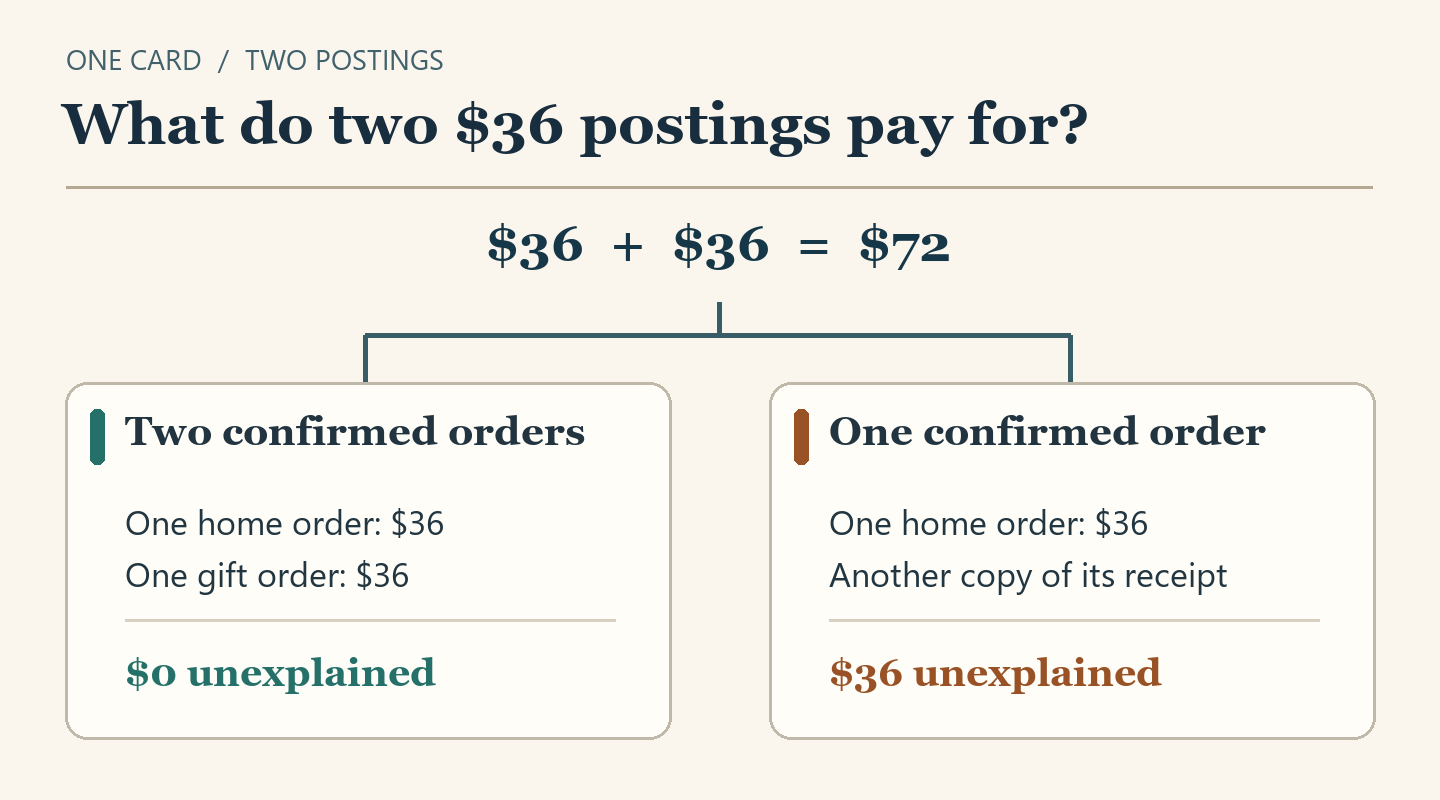
Imagine ordering a $36 set of towels for yourself and another as a gift. Both postings read $36, and both carry the same store name and date.
In the first version, you deliberately checked out twice. Your gift order goes to another address. Two distinct confirmations each show one $36 set charged to this card.
Those separate purchases explain the full $72. Asking for half of that money back because the rows look alike would overlook the gift you meant to pay for.
In the second version, you authorized only the home order. Both emails carry its same order number, and the final receipt shows one set at $36.
There are still two $36 postings. With no second purchase or offsetting credit identified, $36 remains unexplained. Ask which purchase the second posted transaction represents.
A forwarded confirmation can create a false second receipt. Open the order details in each copy and compare the actual order reference, quantity, and amount allocated to the card.
The opposite mistake is easy, too. A single email headed “Your orders” could list both the home and gift confirmations. Count what’s inside, not the number of messages.
Suppose instead that one receipt says quantity two at $18 each. The correct order total is $36, not $72. The number of towels can’t justify two $36 postings.
Conversely, one confirmation for two separately priced $36 sets establishes a $72 order. The two rows may account for the price even without two checkout sessions.
That’s a reason to ask what the second entry bought, rather than announcing that you checked out only once. One checkout and one payable item aren’t interchangeable descriptions.
If a merchant identifies someone else’s order, ask what linked it to your card beyond the matching price. If nobody authorized that purchase, contact your issuer immediately.
When the Statement Ends in the Middle of Your Story
There’s a quieter way to count the same money twice. Suppose you download May’s statement, then open a list of recent activity that also includes the last week of May.
Your May statement contains a $26 bookstore purchase on May 30. Your recent activity includes that May 30 purchase and a separate $19 visit on June 2.
Adding every visible line across both documents gives $71. The two actual visits cost $45. The extra $26 came from your overlapping date ranges, not another bookstore sale.
Keep the statement if you need to discuss what it contained when issued. For the recent activity comparison, mark the May entry as already counted instead of deleting the original.
What if there are two $26 entries within the recent list itself? The date overlap no longer explains both. Look for the order or receipt corresponding to each current row.
A matching date and price alone don’t prove that two exports show the same entry. Here the bookstore receipt and the corresponding transaction detail tie them to one visit.
Also notice the end date you selected. A search ending May 31 cannot show what happened on June 2, however often you refresh those same results.
What to Do With the Charge You Cannot Explain
-
Name the purchase you did approve. Start with its final price, its date, and the part paid by this card. Leave any unrelated transaction outside that amount.
-
Describe the smallest difference that remains. For dinner, give the restaurant the signed $50 total and the $58 posting. Ask it to identify the extra $8.
-
Ask for the missing link by name. Request the order references behind both $36 towel entries. A reply naming one purchase leaves the second question open.
-
Take an unresolved posting to your issuer. For a purchase you authorized, Capital One handles disputes after posting and asks customers to try the merchant first.
-
Correct the record if you’ve already reported it. If the gift receipt turns up, tell the person handling your inquiry which posting it explains. Don’t withdraw a different, still-unexplained concern.
Keep a short note of the answer you actually received. “The second charge belongs to gift order B” can be checked against a document; “the total looks right” cannot.
Share only what’s needed through a verified channel. The date, amount, receipt reference, and item description give the person handling your question a place to start.
Don’t post the statement or your friend’s shipping address in a public review. A gift can distinguish two orders without making its recipient’s personal details part of the complaint.
Frequently Asked Questions
What if I cannot see the status in my notification?
Open the activity in the card account you normally use. If the notification lacks a status, don’t supply one from memory just to finish the comparison.
What if the two receipts have different numbers?
Find out what each number identifies. An order confirmation and a shipping notice can have different numbers while both describe the same purchase.
Does the lower-priced item always post first?
Price alone cannot identify the first item. In the desk example the shelf costs more than the lamp; the dated shipment notice identifies which one left first.
What if part of my order used a gift card?
Use the payment breakdown on your receipt. If a $60 order shows $15 paid by gift card, only $45 belongs in the credit-card comparison for that order.
Can a matching total explain a different guest check?
Two tables can easily spend the same amount. Ask for the date and identifier on your own check before treating someone else’s meal as a match.
What if the merchant says it has corrected the entry?
Ask which amount and purchase reference it corrected. Keep the reply alongside the actual card entry so you can distinguish the merchant’s explanation from what your issuer shows.
The Bottom Line
For a purchase you recognize, count the posted entries against what you bought. Don’t count yesterday’s view again or call two amounts duplicates simply because they match.
If you already questioned the charge, give the merchant or issuer the exact receipt and unexplained difference. Report any genuinely unauthorized activity to the issuer immediately, regardless of its status.

Join the discussion
0 commentsShare your experience or ask a question about this article.
Community experiences
Did this happen to you?
Your experience could help someone recognize the same scam. Submit a private report for our team to review.
I experienced this tooReports are reviewed before publication. Sharing publicly is always your choice.
Discussion
Start the conversation
Have a question or something useful to share? Add the first comment.