

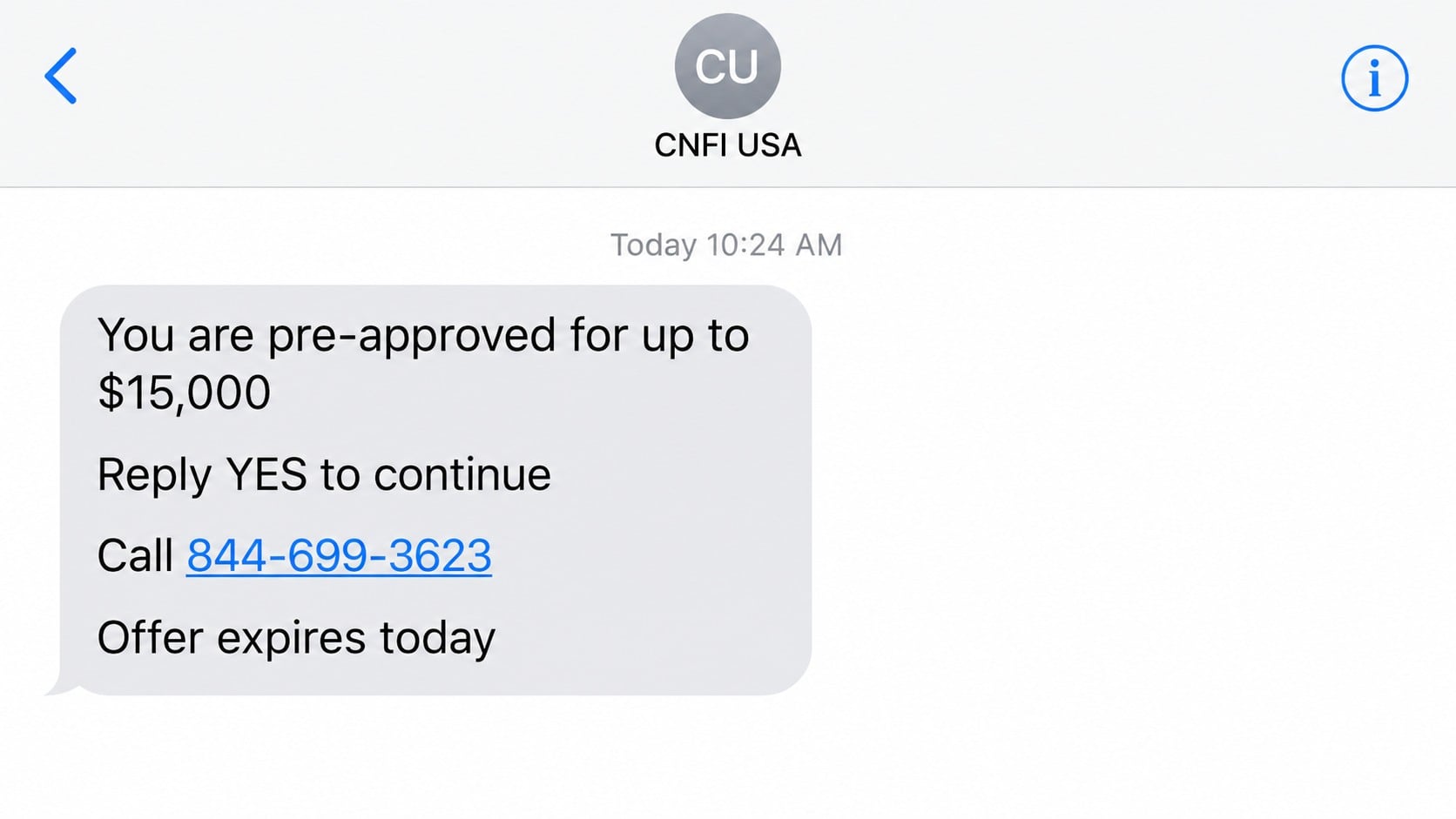
A text says CNFI USA has pre-approved you for as much as $15,000. There is no long application, no credit discussion, and no waiting, just a request to reply “YES” or call 844-699-3623 before the offer expires.
For someone facing an urgent bill, that message can feel like relief arriving at exactly the right moment. The speed is also what keeps the recipient from asking who the lender is and why it already approved a loan that was never requested.
Overview
The text announces approval before a real application
The CNFI USA loan text scam uses an unsolicited approval message to start a conversation. Reported texts direct recipients to reply or call 844-699-3623, even when they never applied to a lender by that name.
A legitimate lender needs information to evaluate an application and disclose loan terms. A message that guarantees easy money without that process is selling urgency and hope rather than presenting a verifiable credit decision.
The next step can collect identity data or an advance fee
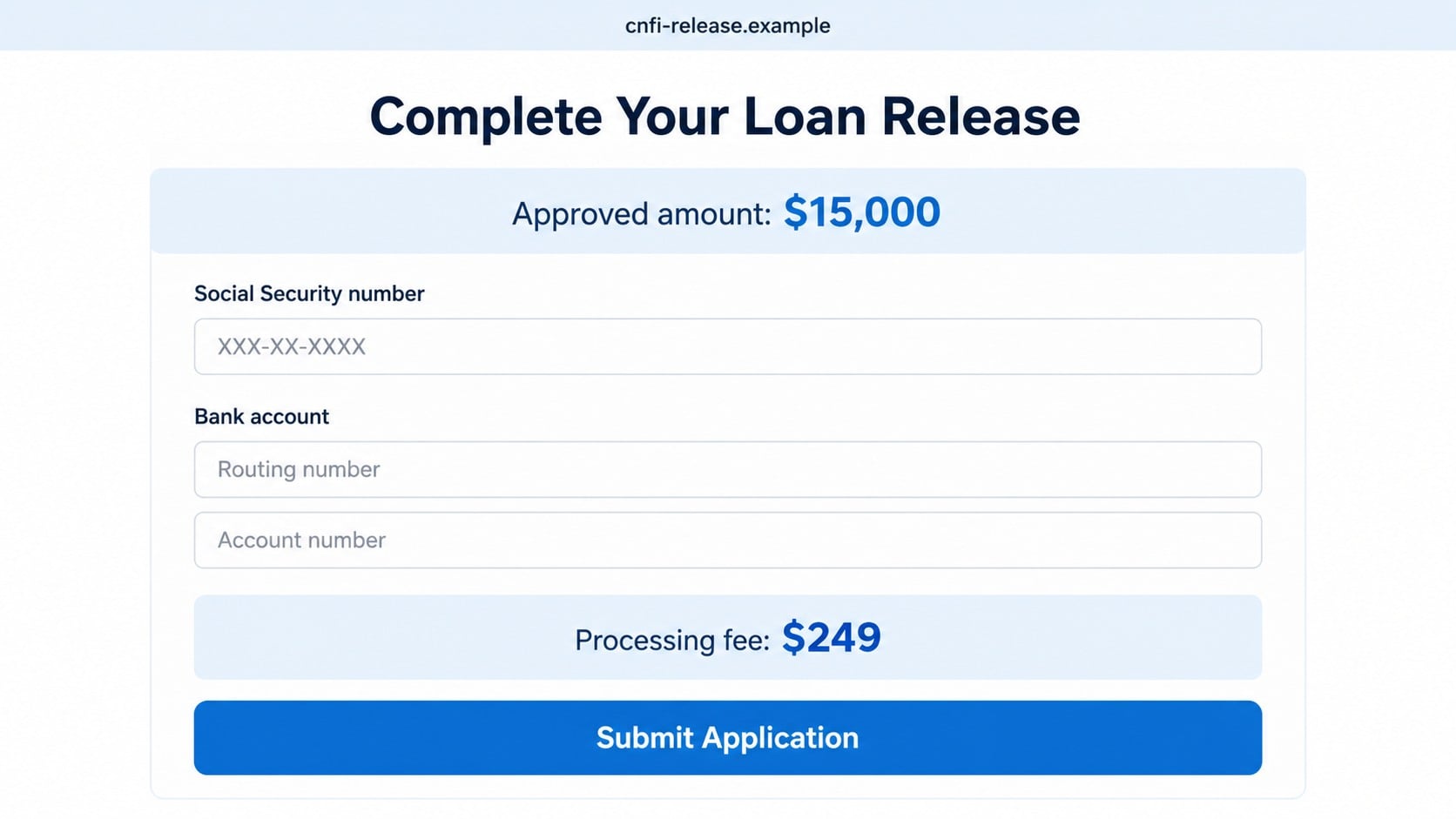
Once the recipient responds, the supposed loan agent may request a Social Security number, birth date, address, employer, income, bank account, routing number, online banking login, or a photograph of identification.
The agent may then invent a processing, insurance, activation, verification, or transfer fee. Payment is described as the final requirement before release, but an advance fee does not turn an unsolicited text into a real loan.
The CNFI USA identity could not be tied to a verified lender
The message itself does not provide enough information to identify a licensed legal lender, physical office, regulator record, or written loan agreement. A name and toll-free number are not substitutes for those checks.
- The recipient did not submit the loan application mentioned in the text.
- The offer promises a large amount with little or no underwriting.
- The message pushes a reply or call before providing full terms.
- Later stages may request bank credentials or an upfront payment.
- Victims can face both financial loss and identity theft.
Why “Pre-Approved” Does Not Mean Money Is Waiting
Marketing can use pre-screened or conditional credit language, but a real offer still identifies the lender and explains important conditions. It does not erase verification, legal disclosures, interest, repayment terms, or eligibility requirements.
Scam messages remove those inconvenient details. They focus on the maximum amount and speed, then postpone every question until the recipient is speaking with an agent who can apply pressure.
People who recently searched for credit may assume the text relates to an earlier form. Lead data can be sold, shared, breached, or used by dishonest marketers, so knowing that someone needs a loan does not prove a legitimate application exists.
If you remember applying somewhere, return to the lender you chose through its original website or paperwork. Do not let an unexplained text supply the company, telephone number, and application route after the fact.
The Upfront Fee Is the Clearest Financial Warning
The Federal Trade Commission explains that advance-fee loan scammers promise access to credit, then demand money for processing, insurance, an application, or paperwork. After payment, the promised loan does not arrive.
A real lender may charge disclosed fees in appropriate circumstances, but nobody legitimate can guarantee that paying a fee will produce a loan. The key warning is a payment demanded to release funds after an easy or guaranteed approval.
Gift cards, cryptocurrency, peer-to-peer transfers, and wire payments are especially dangerous because they provide limited recovery options. A supposed lender that tells you to conceal the reason for payment is trying to bypass fraud controls.
Read the FTC’s official advance-fee loan guidance and verify lenders with your state banking or financial-services regulator before sharing information.
A Loan Agreement Should Arrive Before Any Commitment
A legitimate offer gives the borrower time to examine the APR, finance charge, payment schedule, late-payment terms, total repayment, and identity of the actual creditor. A text containing only a maximum amount and telephone number provides none of that context.
Ask for the legal business name and written disclosures, then verify the license through the appropriate state regulator using contact details found independently. Do not accept a photograph of a certificate or a link sent by the agent as the only proof.
Read every field before signing electronically. Fraudulent forms can hide authorization to debit an account, enroll the applicant in an unrelated service, or reuse a signature on documents the victim has never seen.
Why Bank Login Details Are Never a Loan Requirement
A lender may need routing and account numbers to deposit approved funds or collect agreed payments. That does not require the username, password, security answers, one-time codes, or remote access used to sign into online banking.
Scammers sometimes claim they must “verify” the account by logging in, watching a balance, or asking the victim to read a code. Those credentials can let them add payment recipients, move money, view statements, or gather more identity information.
If an agent says the loan cannot proceed unless you disable bank alerts or keep the transaction secret, end the conversation. Secrecy protects the caller from the bank’s fraud team; it does not protect the borrower.
How the CNFI USA Loan Text Scam Works
Step 1: A broad text campaign looks for people who need credit
The message may be sent to many numbers or to leads associated with loan searches. It opens with an attractive amount, quick approval, and a deadline, allowing recipients to imagine how the money could solve an immediate problem.
No detailed application appears because the first goal is engagement. A “YES” reply confirms that the number is active and the recipient is interested.
Step 2: A supposed loan officer builds credibility
The responder receives a call or message from someone using a professional title. The agent may quote an application number, lender department, approval amount, monthly payment, or interest rate that looks specific.
Specific numbers can be invented in seconds. Ask for the legal lender name, license information, written disclosures, and regulator listing before answering identity questions.
Step 3: The application gathers valuable personal data
The victim is directed to a form or asked questions by phone. The requests may include full identity details, employment, income, bank routing and account numbers, debit-card information, and online-banking credentials.
Some of that information appears normal in legitimate lending. The difference is that the recipient has not independently verified who is collecting it or how it will be used.
Step 4: Approval becomes conditional on a payment
The agent says the funds are ready but cannot be released until a fee is paid. The label may change according to the victim’s objections: insurance, bad-credit collateral, processing, tax, transfer activation, or refundable verification.
The fee is often small compared with the promised $15,000, which makes it seem like a manageable risk. That comparison is part of the pressure.
Step 5: A fake transfer creates another obstacle
After the first payment, a screenshot or portal may show the loan as pending. Then another supposed problem appears, such as an incorrect account number, credit flag, compliance hold, or tax certificate.
Each obstacle requires another payment. The promised balance remains just out of reach while the victim’s real payments continue leaving.
Step 6: Stolen data supports new fraud
If the victim refuses more fees, the operator may disappear or threaten collection for a loan that was never funded. Identity data can later be used for account applications, password-reset attempts, tax fraud, or more tailored credit offers.
Recovery scammers may also contact the victim, claiming to represent a regulator or law firm that can retrieve the fees for one final payment.
Company, Address, and Fulfillment Checks
CNFI USA is a label, not a verified legal identity
Ask for the exact legal entity, state of formation, lender or broker license, and official website. Search regulator records yourself. Do not accept a certificate or screenshot supplied only by the agent as verification.
A listed office must belong to the licensed lender
Check whether the address is a staffed office, mailbox, residence, virtual suite, or unrelated business. Call the building using independently sourced contact details when a large transaction depends on the claim.
A toll-free number can be replaced quickly
The reported 844-699-3623 number does not prove who operates it. Legitimate support should also be reachable through the lender’s verified website, licensing record, and written agreement.
Loan fulfillment means deposited funds and enforceable terms
A portal screenshot, approval code, or pending-transfer image is not a funded loan. The borrower should receive clear disclosures, a signed agreement, and money through a traceable institution without paying invented release fees.
Questions to Ask Before Sharing Loan Information
- What is the lender’s full legal name and license number?
- In which states is it authorized to lend or broker loans?
- Where are the annual rate, finance charge, payment schedule, and total repayment disclosed?
- Why does the company claim approval when no application was submitted?
- Will any fee be deducted from proceeds instead of paid by an irreversible method?
- Can the offer be verified through a regulator-listed telephone number?
A scammer may answer every question fluently. Verify the answers outside the conversation. A professional voice and polished document cannot replace a regulator record and independently confirmed business identity.
What to Do if You Have Fallen Victim to This Scam
- Stop responding and paying. Do not send another fee to release the loan, correct an account number, or qualify for a refund. Save the conversation before blocking the contact.
- Contact the payment provider. Tell the bank, card issuer, wire company, payment app, gift-card issuer, or cryptocurrency platform that the transfer funded an advance-fee loan scam. Ask immediately about recall, dispute, and account-protection options.
- Protect the bank account. If routing, account, debit-card, or online-banking details were shared, call the bank through its official number. Change credentials, replace exposed cards, review linked devices and payees, and ask whether a new account number is appropriate.
- Start an identity-theft recovery plan. If a Social Security number, birth date, license, or identity image was disclosed, report it at IdentityTheft.gov. Consider credit freezes and review credit reports for unfamiliar applications.
- Secure email and mobile accounts. Change exposed or reused passwords, enable strong multi-factor authentication, and review recovery contacts and forwarding. Ask the mobile carrier about an account PIN if enough identity data was shared for a SIM-swap attempt.
- Check for unauthorized loan applications. Review credit reports and messages from lenders. Contact any unfamiliar creditor using details from its official website, not information supplied by the CNFI USA contact.
- Scan devices used with links or files. Run a full Malwarebytes scan if you opened an attachment, installed an app, or visited the loan portal. It can detect malicious installers, remote-access tools, and browser modifications.
- Block repeat malicious pages. AdGuard can filter many known scam destinations, deceptive advertisements, and trackers. It reduces exposure but does not replace checking lender licenses and written disclosures.
- Report the campaign. Give the FTC, state financial regulator, carrier, and messaging provider the number 844-699-3623, message screenshots, payment instructions, websites, and names used by the agent.
- Ignore recovery and legal threats. A caller may demand payment for cancellation or promise to recover the fee. Do not pay. A genuine regulator or lender can be reached through independently verified public contact details.
Frequently Asked Questions
Is CNFI USA a verified lender?
The reported text does not provide enough independently verifiable information to establish a licensed lender behind that name and number. Check state regulator records before sharing data.
Why did I receive the text if I never applied?
The campaign may contact numbers broadly or use marketing and lead data. Receiving a message does not mean an application, approval, or loan account exists.
Can a lender approve $15,000 without checking my credit?
Real underwriting varies, but a guaranteed approval without an application or meaningful review is a major warning. Legitimate lenders assess repayment risk and provide required disclosures.
Is a processing fee always a scam?
Not every disclosed lending fee is illegal. The scam pattern is a promised or guaranteed loan made conditional on paying money upfront, especially through an irreversible method.
What if I replied YES but shared nothing else?
Block the number and expect more loan messages because your number may now be marked active. Do not follow links or confirm identity details in later calls.
Will paying one last fee release the funds?
Do not rely on that promise. Advance-fee scammers commonly invent a new obstacle after each payment. Stop and contact the payment provider about money already sent.
The Bottom Line
The CNFI USA loan text scam puts the reward first: up to $15,000, quick approval, and almost no effort. The missing application and unverifiable lender are the details that matter.
Do not reply to the message or call 844-699-3623. Verify any credit offer through state regulator records and a contact route you found independently, then read every term before sharing identity or bank data.
A legitimate loan gives you enforceable disclosures and funded money. It does not keep the funds behind a growing series of processing, insurance, or release fees.








