


An exchange points to its crypto proof of reserves and says customers are covered. Before treating that as reassurance, ask what the two numbers actually count.
You can learn quite a bit from a reserve report, even when the question you care about most never made it into the assignment.
Overview
Start with the claim behind the percentage
Crypto proof of reserves is often presented as a picture of what a platform holds at a particular time. That picture may include a comparison with certain customer balances.
Imagine a newspaper showing a warehouse full of bicycles. The photograph could accurately show one hundred bicycles without telling you how many customers have paid for one.
An inventory matched to a hundred customer receipts would answer more. You would still want to know whether somebody else had a claim on the same bicycles.
Find the people and products actually covered
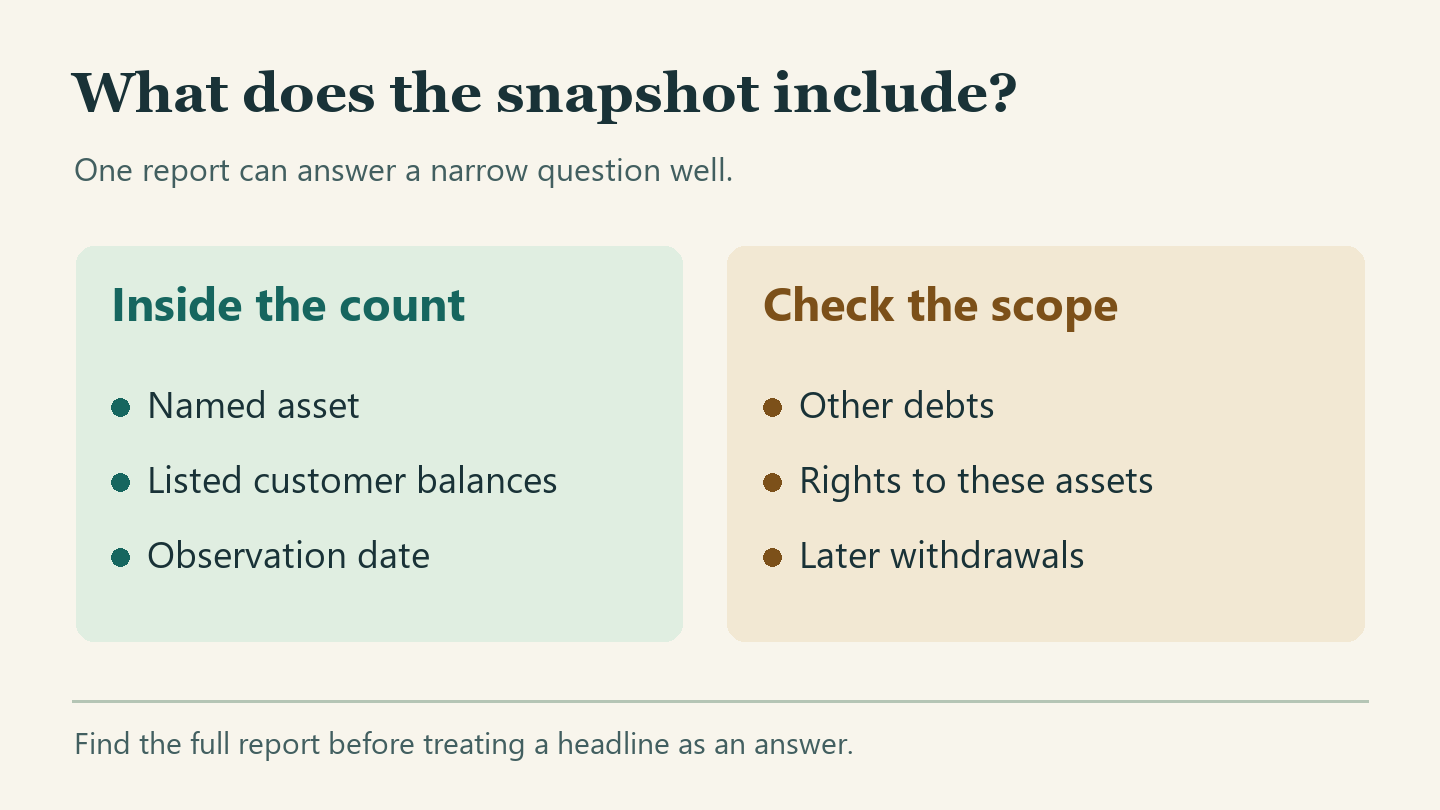
A platform can offer custody, trading and other products under the same brand. Start with the legal entity in your account paperwork, not the name on the homepage.
Look for four details together before deciding whether a report speaks to your balance:
- Which legal entity and products does the document actually name?
- Which assets and customer balances entered the calculation?
- At what date and time were those balances measured?
- Who performed which procedures, and where are their findings?
Two reports can use identical headings while covering different products. Record what each one includes before comparing their percentages or assuming that a later report supersedes an earlier one.
Separate the finding from your practical question
Perhaps you need money for rent and want to know whether a withdrawal will arrive tomorrow. A reserve snapshot was not designed to give you a processing time.
Or perhaps a friend wants you to deposit because an accountant checked the exchange. In that case, the scope of the accountant’s work matters more than the logo.
How to read a crypto proof of reserves report
Begin with the platform’s public documentation, reached independently of a message or advertisement. Look for the underlying report, not just the announcement that a review took place.
Check whether it names the platform entity, the person or firm responsible for the work, and the document date. Keep the observation date separate from the publication date.
Suppose the homepage displays a new article in July describing work conducted in March. July tells you when the article appeared; March tells you when balances were observed.
A third date may belong to you. If you opened an account in April, the March dataset cannot personally confirm a balance you had not yet deposited.
Label each date before you send anyone a copy. A filename such as “March observation, July announcement” keeps the sequence understandable after the headline disappears.
Find the section explaining how assets were selected. A total covering several named coins says nothing specific about a different coin merely because the exchange lists it for trading.
Read the customer side just as closely. Look for the words describing the balances included, not simply the word “liabilities” in a headline or summary.
Make a note of the schedule’s exact name and page. If support refers you back to the announcement, you can request the missing page by name.
Follow one balance through the calculation
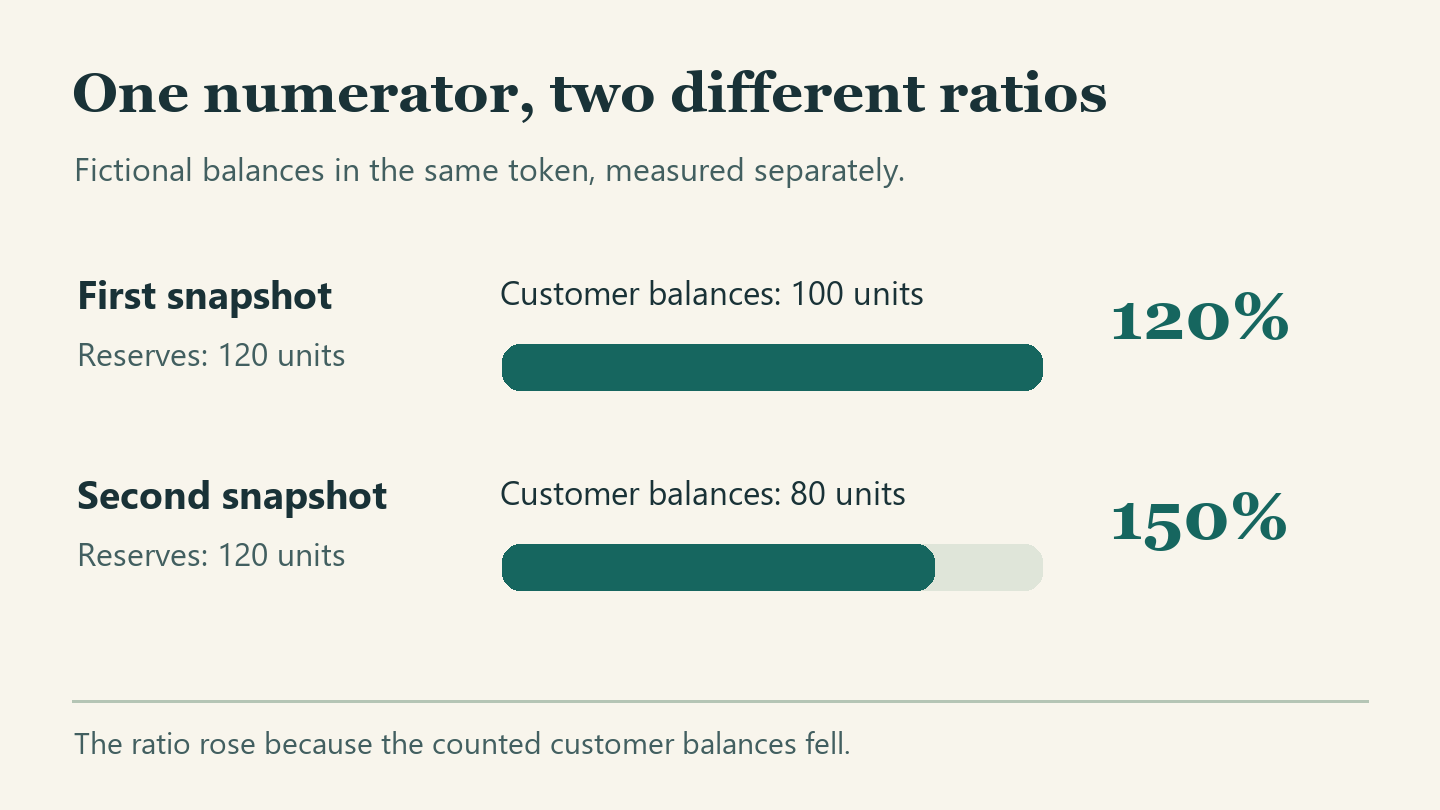
Consider a fictional report about a single token. It describes 120 units in selected wallets against 100 units in included customer balances at noon on Tuesday.
Dividing 120 by 100 gives a reserve ratio of 120%. Both numbers use the same unit and time. Neither number tells you how many people hold those balances.
If one customer held 30 units and seventy customers held one each, the total would still be 100. A customer count would answer a different question.
Now suppose the report does not examine whether 35 of the 120 units were borrowed and must be returned. The published ratio remains mathematically correct under its stated formula.
If that hypothetical obligation existed, the platform would have another claim to meet. You cannot decide from the original ratio whether such an obligation exists.
It would be just as mistaken to announce a 15-unit shortfall as to promise a 20-unit cushion. Either statement makes an assumption about an unexamined obligation.
What a change in the ratio actually tells you
A higher ratio can come from a smaller denominator. If included customer balances fall to 80 while included reserves stay at 120, the result rises to 150%.
There are no additional tokens in that example. A headline celebrating the higher percentage would not, by itself, show that a single new token entered custody.
A falling ratio deserves the same care. Changing the assets or accounts covered can make two reports difficult to compare even when both calculations were performed correctly.
A useful comparison keeps the same entity, asset, definition of customer balances and measurement method. When one changes, note the change beside the result rather than silently combining figures.
Why a combined value can hide an asset mismatch
Imagine half your account is denominated in one token and half in another. A chart expressed only in US currency can obscure what the platform says it holds.
If your agreement calls for returning a particular asset, an equivalent quoted value in another asset is not the same observation as holding the asset you expect.
That distinction does not establish a breach of contract. It gives you a precise question to take to the custody terms instead of drawing a legal conclusion from arithmetic.
Understand what personal inclusion can demonstrate
Some platforms let a customer check whether their balance formed part of a dataset. One common design uses a Merkle tree, a way of committing to many records together.
Think of your record as one leaf. Its link to the published root lets you check membership in that particular set without receiving everyone else’s personal account statement.
That is stronger than an advertisement saying all customers were counted. It can give you evidence about your own entry when the procedure and inputs are genuine.
It does not let you discover which other people were omitted. A collection can include your accurate balance while leaving another customer’s disputed balance outside its scope.
Before comparing a figure with your account, reconstruct the right moment. A trade completed after the snapshot can explain a difference that looks alarming against today’s portfolio.
Check the product description as well. An account might show staked assets separately while a particular report combines certain eligible balances under a stated calculation.
Kraken published its March 31, 2025 snapshot on May 7, 2025. The company named the assets and customer balances covered; it was describing that historical observation.
The useful part for a reader is the opportunity to ask a testable question. Was this asset, in this product, at this date, part of the comparison?
If the answer remains unclear, save the account statement and the report version. Ask through established support which figure should reconcile, without sending account credentials or recovery information.
When a wallet signature answers the wrong question
Suppose a friend sends two documents: a wallet signature and a customer agreement. On a sheet of paper, write the question each document prompted you to ask.
Against the first, write the exact claim the signer made. Against the second, write the legal entity that promises to return the customer’s asset.
A valid wallet signature demonstrates an ability to sign. It does not identify the legal owner of the assets or the company responsible under your agreement.
Now look for the connection between those names. A trading brand in one document and an unexplained subsidiary in the other leave a practical question for customer support.
Frame that question narrowly: “Which document connects my account agreement with the company identified in this report?” A reply repeating the percentage hasn’t identified the missing connection.
The PCAOB investor advocate’s advisory also flags customer rights, borrowing and later availability as unanswered questions. The staff advisory does not accuse any particular platform.
Tell an accountant’s findings from an audit opinion
Begin with the document’s own description of the engagement. A familiar accounting firm can perform several kinds of work, and its name does not turn them into the same service.
Imagine asking an accountant to add eleven figures you supplied. A correct total answers your request even if you accidentally left a twelfth line on another page.
A financial statement audit addresses a different subject and expresses an opinion on the financial statements under the applicable framework. It is not a personalized guarantee about your withdrawal.
The SEC staff investor bulletin explains the difference for investors considering claims about US public-company audit protections. Do not assume those protections apply to every service a registered firm provides.
Look for the actual opinion, the identified statements and the named standards whenever a promoter claims an audit occurred. If those elements are missing, request the document that contains them.
A carefully described procedure can still establish a narrow point without being a financial statement audit. Reject the exaggerated claim without discarding the actual finding.
A worksheet for the report in front of you
Use three short columns on paper: what you need to know, what the report tested, and what remains unanswered. Put only one question on each line.
Read the result you can actually defend
Find the claim that matches your question before relying on a reserve percentage.
The report names a different company
A report about the parent company is not automatically evidence about the subsidiary in your customer agreement. Look for an explicit statement that includes your entity.
Your asset is missing from the schedule
The published comparison does not establish coverage for an asset outside its stated scope. Ask whether a separate dated schedule covers that asset.
The measurement predates your deposit
Compare your first deposit with the observation time. A later publication date does not put a subsequent deposit into an earlier snapshot.
For a real withdrawal question, add the withdrawal reference in a private note. You can then follow up on that request without reopening an argument about percentages.
Leave a cell marked unknown when the report is silent. Writing zero in that cell changes missing information into an apparently measured result, especially in a spreadsheet.
If a report summarizes an exception, copy its meaning alongside the main finding. An exception concerning unavailable records is not interchangeable with an exception concerning a calculation difference.
Suppose a support reply mentions an attachment you never received. Put its name in the unanswered column instead of describing the attachment as though you had seen it.
If a second representative sends a different edition, keep both versions. Check whether the updated page number reflects a new finding or just a change in pagination.
Notice when explanatory material switches entities. A parent company’s results can provide context while leaving questions about the specific subsidiary in your account agreement unanswered.
What to do before relying on a reserve claim
- Keep the original dated report and the exact statement you were asked to rely on. A changing homepage makes it difficult to reconstruct the comparison later.
- Write down what you plan to do and which fact that decision requires. Separate the decision to deposit from a question about an existing withdrawal.
- Match your account entity, product, asset and relevant date to the stated scope. Mark a mismatch before treating the headline number as evidence about your own balance.
- Inspect how the calculation treats customer obligations and other claims. If the document doesn’t answer your question, request a specific clarification through the platform’s established channel.
- If a withdrawal is already delayed, preserve the request, timestamp, status and official response. A reserve report does not resolve the operational problem or supersede your account records.
- Do not send an additional deposit to someone promising to release funds or verify a reserve position. An unsolicited payment request is separate from the original report.
If you’re discussing a discrepancy with support, provide only the information needed to locate the issue inside the authenticated channel. A public comment thread is a poor place for statements.
For a substantial or contested claim, seek appropriately qualified advice in your jurisdiction. The contract, the entity holding your assets and actual proceedings matter more than a displayed reserve percentage.
Frequently Asked Questions
Does a ratio above 100% mean an exchange can repay everyone?
It means the numerator exceeded the denominator under that report’s definitions. Whether every obligation can be met depends on what was included, competing claims and subsequent events.
Can an exchange include customer liabilities in proof of reserves?
Yes, a report may compare eligible customer balances with selected assets. Read the definition before treating a genuine customer comparison as a complete accounting of company debts.
What if my account balance doesn’t match my inclusion result?
Compare the snapshot time, asset and product first. Preserve the discrepancy and ask for reconciliation if it persists after accounting for later activity and stated scope.
What should I save if the report changes?
Keep the original edition, its publication date and the replacement document. Identify which figure changed before asking whether the new version affects your account.
Can two exchanges with the same ratio have different risks?
Identical arithmetic can rest on different assets, debt definitions, entities and observation dates. Until those inputs match, the two numbers do not even measure the same thing.
Is it a warning sign if the full report isn’t available?
You cannot verify an inaccessible report’s scope from a badge. Defer decisions that require the missing information without assuming the absence alone establishes fraud or insolvency.
The Bottom Line
When someone cites crypto proof of reserves, finish this sentence in your own words: this report compared these balances, for this entity, on this date.
If someone wants your money on the strength of a percentage, obtain the report first. If your withdrawal is missing, document that request and pursue it separately.

Join the discussion
0 commentsShare your experience or ask a question about this article.
Community experiences
Did this happen to you?
Your experience could help someone recognize the same scam. Submit a private report for our team to review.
I experienced this tooReports are reviewed before publication. Sharing publicly is always your choice.
Discussion
Start the conversation
Have a question or something useful to share? Add the first comment.