


A crypto platform sends you a registration number and a document bearing the name of a US government agency. The salesperson calls it a license.
You find a matching record on an official website. That feels like an answer, until you ask what the record actually confirms.
Overview
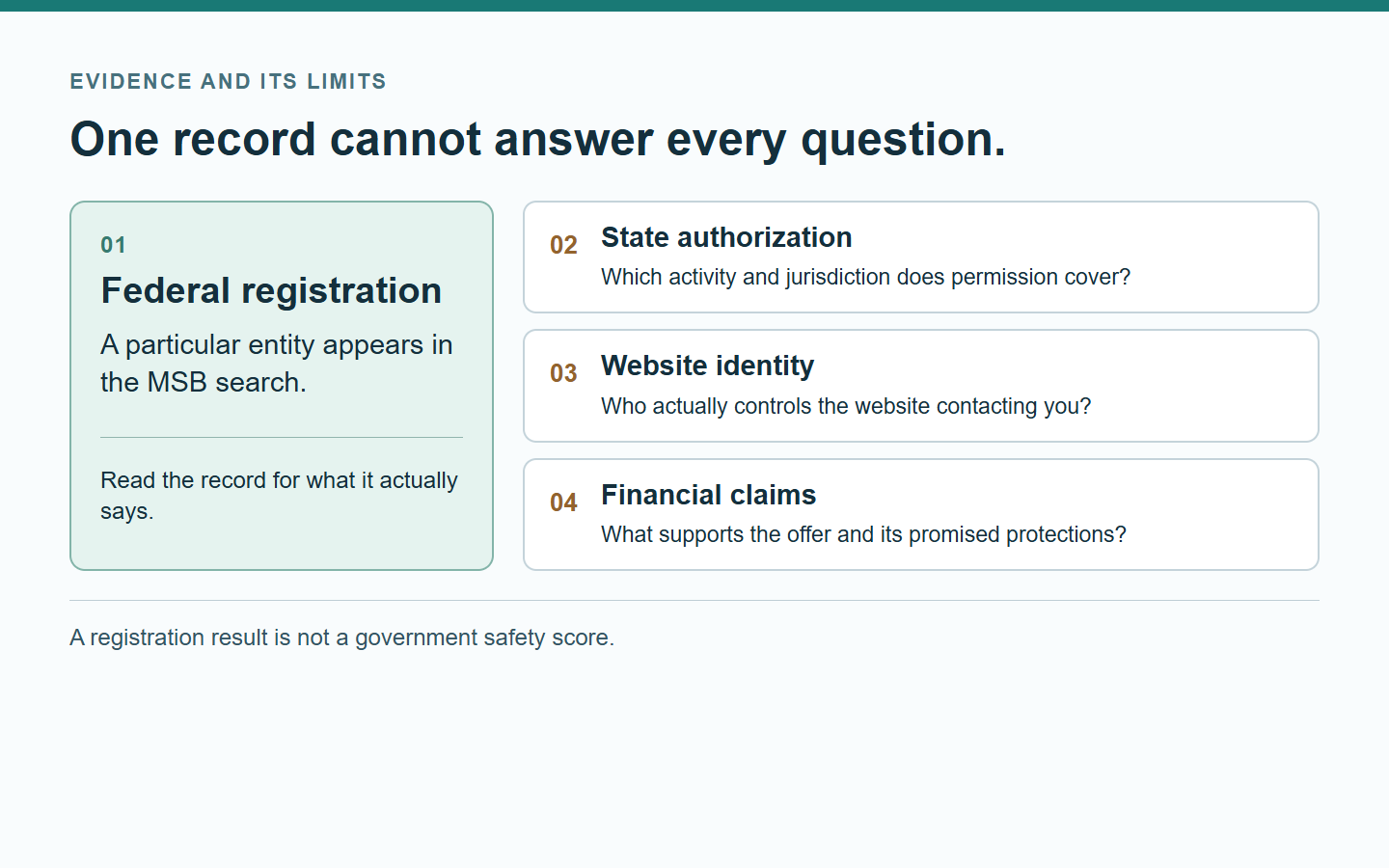
A federal registration is a specific kind of record
FinCEN MSB registration concerns a money services business under federal Bank Secrecy Act rules. It is not a government recommendation to invest.
The current official MSB search explicitly warns that FinCEN does not approve or endorse registered businesses.
The page also says registrants provide the displayed information. Finding a name there is different from finding an independent government assessment of every claim.
State authorization and website identity remain separate
Whether a business needs particular state permission depends on its activities and the jurisdiction. A federal registration result doesn’t settle that analysis.
Another question remains even when the correct entity holds relevant permission: does the website or person approaching you actually represent that entity?
A copied company name or registration number cannot create that connection. Treat the identity claim and the public record as separate evidence.
Your next decision should follow the missing information
Don’t deposit because someone shows a registration result. Identify exactly what is being offered, who offers it, and which permissions apply.
- Separate a federal registration from a state operating license.
- Match the actual legal entity rather than a familiar brand.
- Verify the website and contact through independent channels.
- Keep investment claims separate from administrative registration records.
Why the Word License Changes the Meaning
A registration number sounds reassuring because it is precise. A salesperson can place it next to an official logo and let readers supply the remaining assumptions.
The number might be real while the conclusion is false. A genuine public record doesn’t automatically support the description attached to it.
The FBI’s cryptocurrency MSB alert advises checking registration while explicitly rejecting the idea that inclusion certifies legitimacy.
Those instructions are complementary, not contradictory. A required compliance check can matter without becoming a guarantee that everything else about the business is safe.
Don’t let a promoter convert a useful check into a universal approval badge. Ask what precise fact the record establishes, then stop at that boundary.
Pause when verification returns you to the person asking for funds. Another copy of their paperwork is not an independent answer to your question.
Read the Record Before Reading the Sales Explanation
Open FinCEN independently rather than accepting a screenshot, search-result advertisement, or link supplied by the person asking for money.
The search page currently lists fields for a registration number, legal name, DBA name, address, activities, and other identifying information.
A DBA is a business name used in trade. It may differ from the underlying legal entity, which is why matching only the headline brand is insufficient.
Write down the entity the promoter says will receive or control your funds. Compare that claim with the complete public record.
Don’t overlook a different legal suffix or an unexplained company name on the payment instructions. Small wording differences can refer to different entities.
At the same time, don’t declare fraud because an abbreviation differs. Treat a mismatch as something requiring independent clarification, not an invitation to guess.
Look at the stated activities rather than assuming the record covers anything involving cryptocurrency. A description on a sales page cannot enlarge a registration’s meaning.
Keep your notes factual: the record lists this name, while the offer identifies that name. Avoid replacing those observations with an unsupported accusation.
Four Questions That Need Four Different Answers
| Question | Relevant evidence | What remains unresolved |
|---|---|---|
| Does the entity appear in federal registration records? | Read its current official MSB registration information. | The result doesn’t approve its advertised investment offer. |
| Does the business hold relevant state authorization? | Check the applicable regulator and exact license scope. | Permission elsewhere doesn’t establish permission for your situation. |
| Does this website actually represent that legal entity? | Confirm the contact through an independently established channel. | A copied name doesn’t establish control of the website. |
| Are the promised returns or financial protections credible? | Examine the actual product, agreement, and applicable protections. | Administrative records don’t guarantee performance or prevent losses. |
Think of these as separate questions, not boxes producing a final safety score. An unanswered material question remains unanswered even when several unrelated details match.
For example, finding the correct office address doesn’t tell you whether an investment return is achievable. It also doesn’t identify who controls a deposit wallet.
Similarly, a state license doesn’t transform a sales representative’s promise into a guarantee. Read the agreement and verify the actual service being offered.
This approach avoids two mistakes: trusting every registered business automatically, and assuming registration is worthless simply because it cannot answer every financial question.
A Hypothetical Example of Matching the Right Record
Consider a fictional offer using the label Training Platform A. Its salesperson says a FinCEN record proves that a daily-return package is government-approved.
The displayed registration instead names Training Entity B. Those labels describe an invented teaching example, not an allegation about an existing business.
Your first question is whether Platform A is a documented trade name of Entity B. A similar logo doesn’t answer it.
Your second question concerns the approval claim. Even if the two names are genuinely connected, the federal listing still doesn’t approve the daily-return package.
Your third question concerns the person contacting you. They could be unrelated to both names, despite knowing details copied from a public record.
Suppose the salesperson responds by sending three more copies of the certificate. You have more documents, but none addresses the missing connections.
The sensible decision is to withhold payment while those questions remain unresolved. You don’t need to accuse somebody of a crime to decline an unverified offer.
That distinction is the useful result of the exercise. A real record and a misleading interpretation can exist at the same time.
When the Search Returns No Matching Record
A negative search result deserves attention, but it needs interpretation. It isn’t a reliable shortcut to declaring that every business with that name is fraudulent.
FinCEN’s search instructions warn that spelling and abbreviation variations can affect results. They suggest trying location fields when an initial search fails.
Check whether you searched a marketing name instead of the claimed legal entity. Keep track of the actual terms you used.
The current search page also explains that not every registered entity appears publicly. Nonrenewal and several removal grounds affect what the public list displays.
FinCEN’s registration guidance describes registration requirements and exceptions, including certain businesses acting solely as agents.
That isn’t a loophole for a salesperson to declare themselves exempt. When the explanation matters, seek clarification from the relevant regulator rather than accepting unsupported reassurance.
Don’t improvise a legal classification from a company’s website. The actual activities, entity structure, and jurisdiction determine which rules apply.
You can decide not to proceed while clarification is missing. Declining an unclear offer requires less certainty than publicly accusing its operator.
Why the State Check Needs Its Own Scope
The Utah financial regulator’s money-transmitter page, for example, directs consumers to NMLS Consumer Access for license status.
Utah DFI also says its 2020 amendment excluded “Blockchain Token” from the state’s definition of money transmission. That specific exclusion matters when interpreting a crypto-related listing.
Don’t extend that statement to every crypto business or activity involving ordinary money. Ask the regulator which rules cover the actual service offered.
It also explains that an absent listing can have several explanations, including an application in progress or an exemption. Utah’s guidance is not every state’s rule.
When using a state-linked database, check the jurisdiction, license type, status, and exact entity. Don’t stop after recognizing the business name.
If the interface is unavailable, return to the state regulator’s own contact information. A temporary access problem isn’t proof that a company is licensed or unlicensed.
Ask a concrete question about the activity being offered to a resident of your state. A general crypto description can hide important differences between services.
If the regulator directs you elsewhere, record that referral and the question it concerns. Do not treat a transfer between departments as an approval.
A Certificate Cannot Authenticate Its Own Sender
Public records are available to dishonest people too. A stranger can copy a genuine legal name, registration number, or street address into convincing paperwork.
Verify the communication separately through a route you established independently. Don’t ask the sender to approve their own replacement verification website.
A video call doesn’t resolve that problem. Someone can display a certificate on camera without demonstrating a relationship with the registered entity.
Likewise, a familiar domain word is not a complete destination check. Compare the full website address rather than trusting a brand name embedded within it.
If the purported business tells you its official contact records are wrong, pause. Obtain independent clarification before treating the new details as authoritative.
Keep the specific offer in the conversation. Confirming that an entity exists is less useful than confirming whether it recognizes the person, website, and service involved.
Keep an Independent Contact Check Independent
In the fictional example, you find an independently established contact for Entity B. You ask whether it recognizes Platform A and the specific person approaching you.
Suppose the response confirms Entity B exists but does not answer that connection question. Mark the relationship as unresolved rather than recording a successful verification.
Now suppose the salesperson rejects that response and supplies a different callback number. The new number remains part of the original unverified claim.
Keep the rejected route and the replacement number in your private notes. Do not call the replacement merely to finish a checklist that started independently.
If a genuine response is still pending, the payment decision can wait. You can decline or postpone the offer without turning the uncertainty into a public accusation.
Check the Claim Before Sending More Information
I found a matching federal registration record.
Record what matches, then check state scope and website identity separately. Don’t turn the match into approval of a promised return or deposit destination.
The promoter keeps answering a different question.
Write down the unanswered question and compare it with the reply you received. Repeated paperwork does not resolve a missing connection between the offer and entity.
I cannot find the entity or the names don’t match.
Check spelling, legal identity, and the official search instructions. Seek independent regulatory clarification instead of paying to activate or reveal another certificate.
What to Do If You Relied on a Registration Claim
-
Stop additional deposits and separate your actual payments from any platform balance. A dashboard value isn’t a transaction record showing where your money went.
Don’t send a withdrawal fee merely to test the platform. Preserve the demand and ask your financial provider what options fit the actual transfer.
-
Keep the original offer, messages, claimed registration details, website addresses, and receipts. Record which entity each document names and what the salesperson promised.
Save complete originals privately before preparing redacted public warnings. Avoid publishing unrelated account details, identity documents, or information belonging to another person.
-
Contact the bank, exchange, or payment service involved through its genuine support route. Describe the payment and the concern without guessing a final legal finding.
Ask whether any pending transaction or recipient-related intervention remains possible. Reporting promptly can matter, but neither registration nor a complaint guarantees reimbursement.
-
Report suspected cryptocurrency fraud to IC3 using the FBI’s transaction-record guidance. Include the misleading registration claim alongside the actual payment details.
If the problem concerns claimed state permission, contact the appropriate state regulator independently. Explain the service offered and provide the exact entity information.
-
Assess information exposure separately from the payment. If you sent identification or account records, tell the relevant institutions exactly which details were disclosed.
Ignore unsolicited specialists promising guaranteed recovery. Someone knowing the registration number or your loss history hasn’t established authority to collect another payment.
Frequently Asked Questions
Is FinCEN registration the same as an operating license?
No, the federal MSB registration isn’t a FinCEN license approving the business. Relevant state authorization must be considered separately for the actual activity and jurisdiction.
Does a matching registration prove a crypto platform is genuine?
It doesn’t authenticate the website, sender, or promised return. Match the exact entity and independently verify its connection with the communication you received.
Does a missing result automatically prove fraud?
No, search variations, registration exceptions, nonrenewal, and removal rules complicate that conclusion. Treat unresolved identity or compliance questions as reasons not to proceed.
How should I compare the entity named on payment instructions?
Compare that exact name with the entity identified in the offer and your independent records. Ask for an explanation before treating an unexplained mismatch as acceptable.
Does an NMLS record cover every state and service?
That conclusion requires checking the specific record. Read its jurisdiction, status, and license type, and ask your state’s regulator when the proposed activity remains unclear.
Should I send identification to verify a certificate?
Checking a public registration doesn’t require sending documents to its promoter. Verify the destination and purpose before providing personal records through any separate legitimate process.
The Bottom Line
Use FinCEN MSB registration as one narrowly defined check, not a government safety badge. Separate registration, relevant authorization, website identity, and financial claims.
If you already paid because of an approval claim, preserve that representation and the transfer records. Contact the relevant provider and report concerns without sending more.

Join the discussion
0 commentsShare your experience or ask a question about this article.
Community experiences
Did this happen to you?
Your experience could help someone recognize the same scam. Submit a private report for our team to review.
I experienced this tooReports are reviewed before publication. Sharing publicly is always your choice.
Discussion
Start the conversation
Have a question or something useful to share? Add the first comment.