

A recruiter says Dentsu Group reviewed your resume and wants to move quickly. The remote position pays well, the interview is easy to schedule, and an offer may arrive before you have time to wonder why everything happened so fast.
The recognizable company name makes the opportunity feel safe. The requests that follow reveal who is really behind it.
Overview
A fake recruiter borrows the Dentsu name
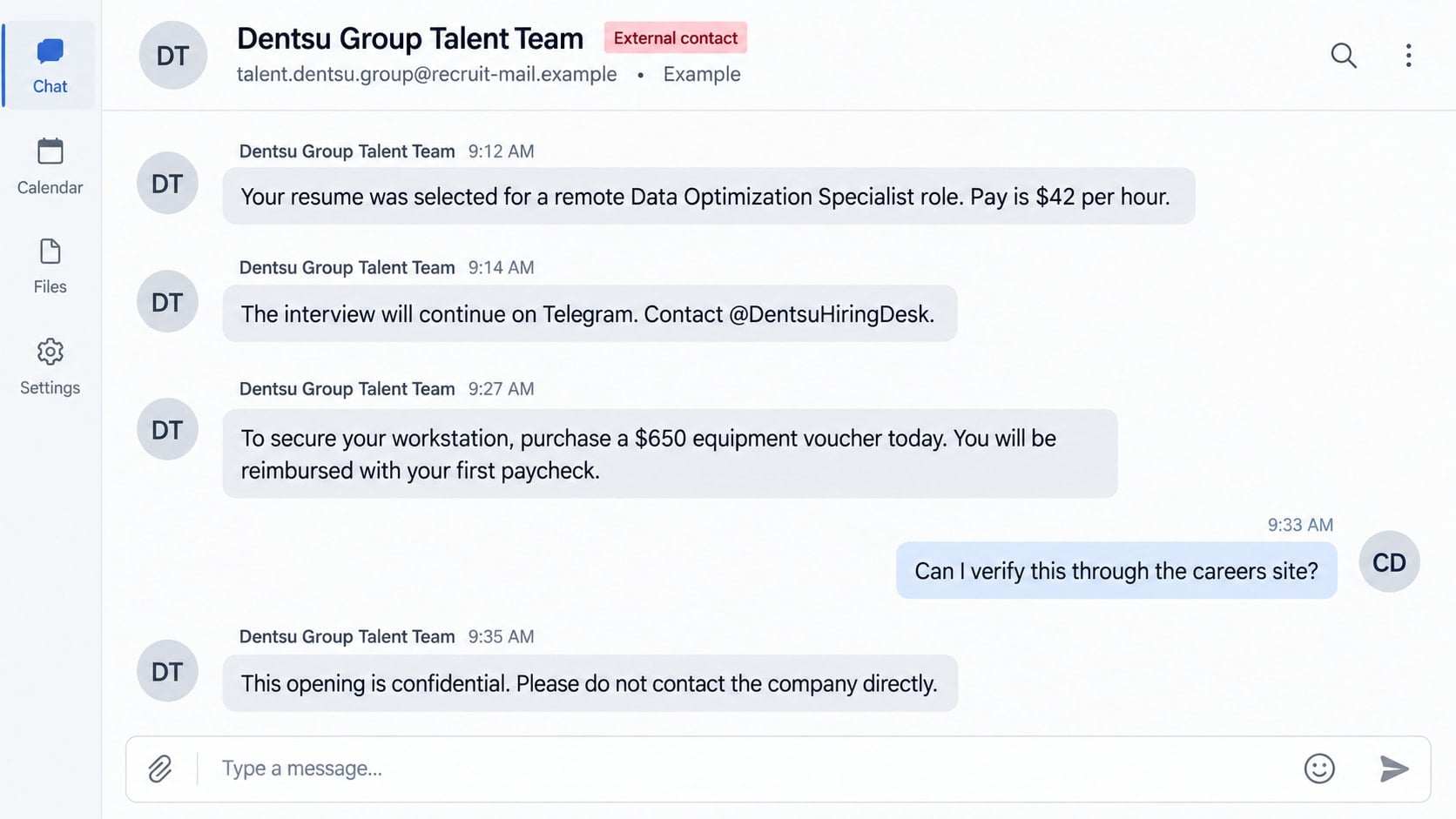
The approach may arrive by email, text, LinkedIn, WhatsApp, Telegram, or a messaging platform. The sender claims to represent Dentsu, Merkle, or a related hiring team.
The job is often remote and broadly described. Roles involving data entry, administration, optimization, customer service, or project assistance can attract applicants from many backgrounds.
The interview avoids normal company channels
The recipient may be moved to Telegram or another private chat for a text-only interview. Questions are generic, and the recruiter appears ready to hire without a video conversation or careful review.
A polished offer letter, employee name, or copied company logo may appear later. Documents can be fabricated, and real employee identities can be impersonated.
The job becomes a route to money or identity data
Victims may be told to buy equipment, purchase vouchers, deposit a check, or pay for training. Others receive onboarding forms requesting Social Security, banking, tax, and identification details.
Dentsu warns that it does not ask candidates to send money or vouchers to secure employment. Legitimate recruitment communication uses corporate addresses such as @dentsu.com or @merkle.com.
- The recruiter contacts you unexpectedly with a high-paying remote role.
- The sender address is not on @dentsu.com or @merkle.com.
- The interview takes place only through text or a private messaging app.
- An offer arrives unusually quickly or without a meaningful interview.
- You must pay an equipment deposit, training fee, or voucher cost.
- Personal and banking documents are requested through an unfamiliar portal.
Why the Offer May Feel Like a Real Corporate Recruitment Process
Job scams work best when the position resembles normal remote work. The duties sound familiar, the salary is attractive but not impossible, and the recruiter uses business language.
The company itself is real. A quick search finds a genuine website, offices, employees, and job listings. Those facts confirm Dentsu exists, not that the person contacting the applicant works there.
Scammers may copy the name and photograph of a real recruiter from a professional profile. They can also reproduce signatures, logos, offer-letter layouts, and descriptions from public career pages.
Applicants are often communicating with several employers at once. An unexpected message can be mistaken for a response to a legitimate application, especially when the supposed role matches a recent search.
The fraud also uses hope. Once someone imagines stable remote income, an unusual request may be rationalized as a modern hiring process instead of recognized as a warning.
How the Dentsu Group Job Scam Works
Step 1: The scammer finds or invents a candidate connection
The first message may say a resume was found on a job board, forwarded by a recruiter, or selected after an application. In some cases, a fake listing was created specifically to collect applicants.
The sender may know the recipient’s job title, city, employment history, or email address from a public profile. That information allows a broad script to sound personalized.
A vague reference to “your application” is useful because many job seekers have applied to multiple roles. The scammer waits for the recipient to fill in the missing context.
Step 2: The conversation moves away from verified channels
The recruiter asks to continue on Telegram, WhatsApp, Signal, or a private chat. The reason may be scheduling convenience, an urgent vacancy, or a claim that the hiring manager works remotely.
Text-only interviews make it difficult to verify a person’s face, voice, location, and company environment. They also allow one operator to manage many candidates with copied responses.
Dentsu notes that real recruiters use corporate email domains. A Gmail address or a domain that merely contains the word dentsu is not equivalent to @dentsu.com.
Step 3: A short interview leads to a rapid offer
The applicant receives questions about availability, software knowledge, and work habits. Answers may be praised immediately, and the recruiter announces that management approved the candidate.
There may be no live interview, no opportunity to meet a supervisor, and no discussion of a specific team. The job description remains broad enough to avoid detailed questions.
An offer letter can arrive within hours. It may include a salary, start date, confidentiality language, and copied corporate details to make the decision look formal.
Step 4: The fake onboarding process collects identity data
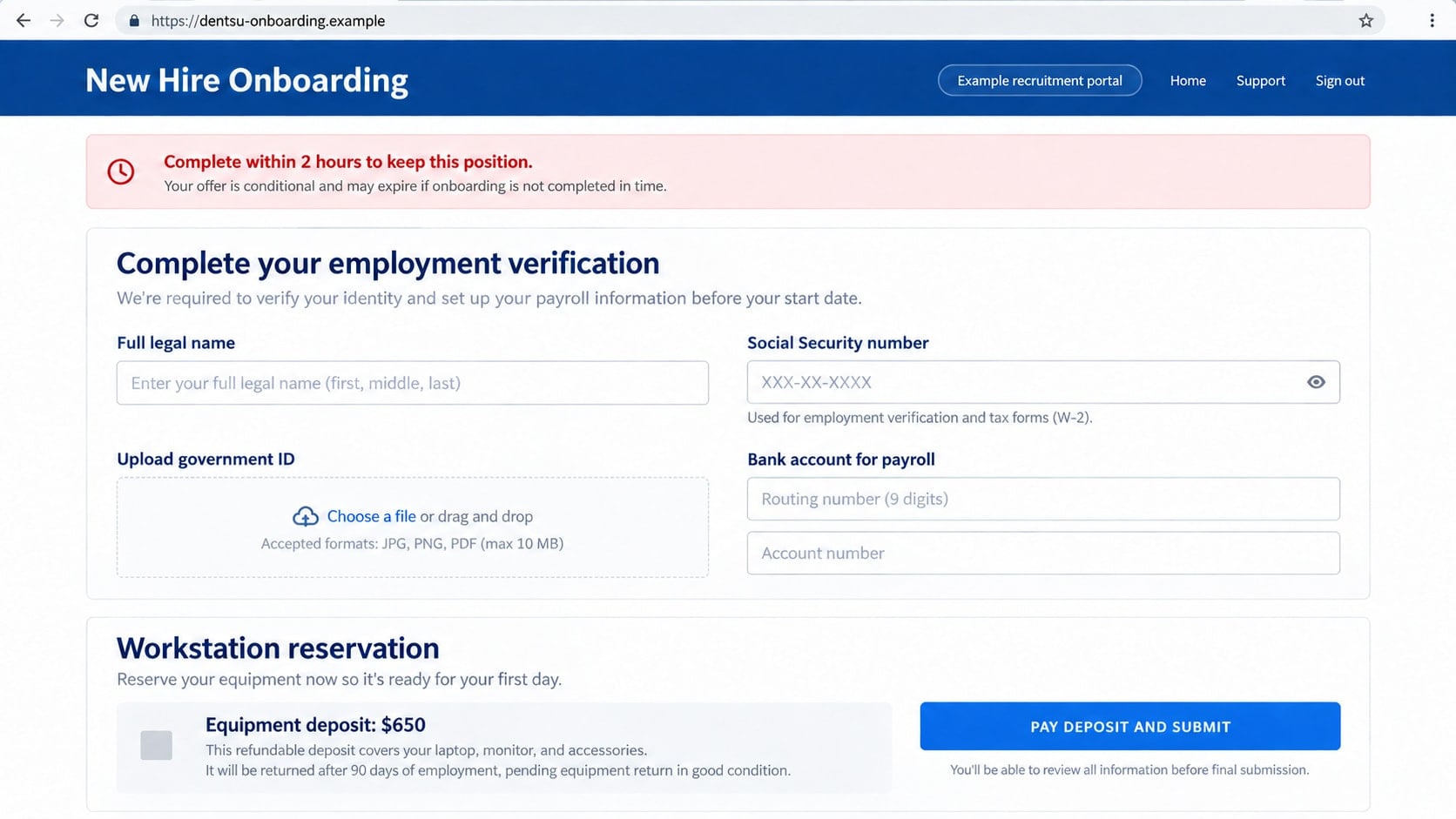
The new hire is directed to a form requesting a Social Security number, date of birth, address, bank details, tax information, and copies of identification. The page may imitate an employee portal.
Real employers do need sensitive information at appropriate stages. The difference is context: the organization, offer, portal, and contact must be independently verified before documents are provided.
Stolen identity information can support account fraud, tax fraud, credit applications, and further impersonation. It remains valuable even if the victim refuses the later payment request.
Step 5: An equipment payment or fake check is introduced
One version asks the candidate to buy a $650 equipment voucher from an approved supplier. The recruiter promises reimbursement in the first paycheck and creates a deadline to keep the position.
Another version emails a check for a larger amount and instructs the victim to deposit it, then pay a vendor for a computer or office supplies. The bank may show provisional funds before discovering the check is fake.
When the check is reversed, the victim owes the bank while the money sent to the fake vendor is gone. A legitimate employer does not require a new employee to route company purchasing through a personal account.
Step 6: The fraud expands or the recruiter disappears
After the first payment, new costs can appear for shipping, insurance, payroll activation, background screening, or tax processing. Refusal may trigger threats that the offer will be withdrawn.
If identity data was collected, scammers may keep using it after the conversation ends. They can also pose as payroll or bank staff and request verification codes.
Victims who complain online may be contacted by recovery services. An unsolicited person promising to recover job-scam losses for a fee should not be trusted.
Identity, Contact, and Payment Checks
Confirm the role on the official careers site
Search Dentsu’s careers site directly rather than using the recruiter’s link. Compare the location, job number, responsibilities, and application process with the message.
A missing listing is not the only warning, but the recruiter should be able to explain the role and connect it to a verifiable hiring process.
Examine the complete email domain
Look after the @ symbol. Dentsu identifies @dentsu.com and @merkle.com as corporate recruitment domains. Added words, swapped letters, or a .example-style domain belong to someone else.
Do not rely on the display name or email signature. Both can contain a real employee’s identity while the message comes from an unrelated account.
Contact the company through a fresh route
Do not ask the suspected scammer to verify themselves. Use contact information from the official company site and provide the recruiter’s name, address, job title, and offer details.
Dentsu accepts reports of suspected recruitment fraud at jobfraud@dentsu.com. Independent confirmation should happen before forms, documents, or bank details are shared.
Refuse every candidate payment
Dentsu says it will not ask candidates to send money or vouchers to secure employment. Treat an equipment deposit, gift card, crypto payment, or check-forwarding arrangement as fraud.
Do not assume reimbursement makes the request safe. The promise of later repayment is how the scam separates the victim from money now.
Real Onboarding Can Request Sensitive Data, So Timing Matters
Employers may eventually need tax forms, proof of work authorization, and payroll details. That reality gives employment scams cover when they request the same information too early.
Before submitting anything, confirm that you applied for the role, met identifiable company representatives, and received documents through verified systems. Navigate to portals independently when possible.
A real onboarding page should use a domain or vendor that the employer can confirm through official contact. A padlock alone only secures the connection to whichever party owns the site.
Ask who your manager will be, which office owns the role, and how the team is structured. A legitimate recruiter should handle ordinary verification questions without demanding secrecy.
Never send a Social Security card, driver’s license, passport, or banking form through an informal chat. When a process feels rushed, pause and verify before the information leaves your control.
What to Do if You Have Fallen Victim to This Scam
- End contact and preserve the conversation. Save emails, chat exports, usernames, phone numbers, offer letters, portal URLs, check images, payment receipts, and job descriptions before blocking the accounts.
- Contact the bank immediately. Explain that the transaction, check, transfer, or card payment is connected to employment fraud. Ask about stopping payment, recalling funds, replacing cards, and protecting the account.
- Do not spend a deposited check. Tell the bank’s fraud department why you believe it may be counterfeit. Provisional availability does not mean the check has finally cleared.
- Protect your identity. If a Social Security number or identification was shared, place credit freezes with Equifax, Experian, and TransUnion. Use IdentityTheft.gov for a tailored recovery plan.
- Secure email and job accounts. Change reused passwords, enable multi-factor authentication, review active sessions, and remove unknown forwarding rules or connected applications.
- Check the device. Remove files or software supplied by the recruiter and run a complete Malwarebytes scan. If remote access occurred, change important credentials from another trusted device.
- Reduce access to malicious pages. AdGuard can help block many known phishing and tracking destinations, but it cannot validate a recruiter or make a fake offer legitimate.
- Report the impersonation. Send the evidence to jobfraud@dentsu.com, report the account to the job or messaging platform, and file reports with ReportFraud.ftc.gov and IC3.gov.
- Watch for follow-up fraud. Monitor credit and financial accounts. Ignore anyone who contacts you unexpectedly and offers guaranteed recovery, another job, or legal help for an upfront fee.
How to Evaluate a Remote Job Offer Before Sharing Documents
Start with the job, not the recruiter’s claims. Find the listing through the company’s official careers navigation and compare its details with what you received.
Search for the recruiter on the company site and professional networks, but do not stop there. A real profile can be copied. Contact the company through a separate channel.
Request a live conversation with the hiring manager and ask specific questions about the team, reporting line, tools, and current projects. Generic answers may reveal that the operator has only copied the public description.
Inspect documents for inconsistent company names, addresses, dates, fonts, and legal language. A polished PDF is not authentication, but errors can quickly expose a forgery.
Most importantly, separate employment from payment. The candidate should not finance company equipment, purchase vouchers, forward check proceeds, or pay to unlock payroll.
Why a Deposited Check Can Look Real Before It Fails
Banks may make some funds available before the issuing bank completes all checks. Scammers describe that temporary availability as proof that the payment cleared.
Days or weeks later, the check can be returned as counterfeit, altered, or unauthorized. The deposit is reversed, and the account holder remains responsible for money already sent out.
The fake vendor is usually controlled by the same fraud group. Buying equipment or sending a refund simply moves the victim’s real money to the scammers.
A recruiter who pressures you to act before the bank’s review is complete is not helping you start a job. Contact the bank directly and do not move any part of the deposit.
Frequently Asked Questions
Does Dentsu recruit through Telegram or WhatsApp?
An informal message should not be treated as proof of recruitment. Dentsu says official communication comes from its recruitment team using corporate email domains. Verify any approach independently.
Will Dentsu ask me to pay for equipment?
Dentsu states that it will never ask candidates to send money or vouchers to secure employment. A deposit, vendor payment, or reimbursement promise is a major scam indicator.
Is a @dentsu.com display name enough?
No. Open the full sender details and inspect the actual address. Display names and signatures can be forged, while a real employee’s name can be impersonated.
What if the check appears in my account?
Do not spend or forward the funds. Availability can be provisional. Tell the bank’s fraud team about the job offer and wait for its investigation.
Can a real employer ask for my Social Security number?
Yes, during verified onboarding for tax and employment purposes. Confirm the employer, role, representatives, and portal independently before sharing it.
Where can I report a fake Dentsu recruiter?
Preserve the evidence and send it to jobfraud@dentsu.com. Also report the account to the platform, notify your bank about payments, and file with the FTC and IC3.
The Bottom Line
The Dentsu Group job scam uses a real company’s reputation to make an unusually fast remote offer feel legitimate. The scheme becomes clear when the recruiter avoids verified channels, rushes onboarding, or asks for money.
Confirm the role and recruiter through Dentsu’s official careers resources before sharing documents. A genuine employer pays its workers; it does not require candidates to buy vouchers, finance equipment, or move check proceeds.

Join the discussion
0 commentsShare your experience or ask a question about this article.
Discussion
Start the conversation
Have a question or something useful to share? Add the first comment.