

The Drivse IonDrops Shower Head is being heavily promoted online as a revolutionary filtered showerhead capable of transforming dry skin, damaged hair, weak water pressure, and even problems associated with hard or contaminated water.
The advertising is polished enough to make IonDrops look like proprietary bathroom technology backed by years of dermatological research. Once the product, checkout, subscription terms, refund policies, and wholesale alternatives are examined more closely, however, that premium story begins to fall apart.
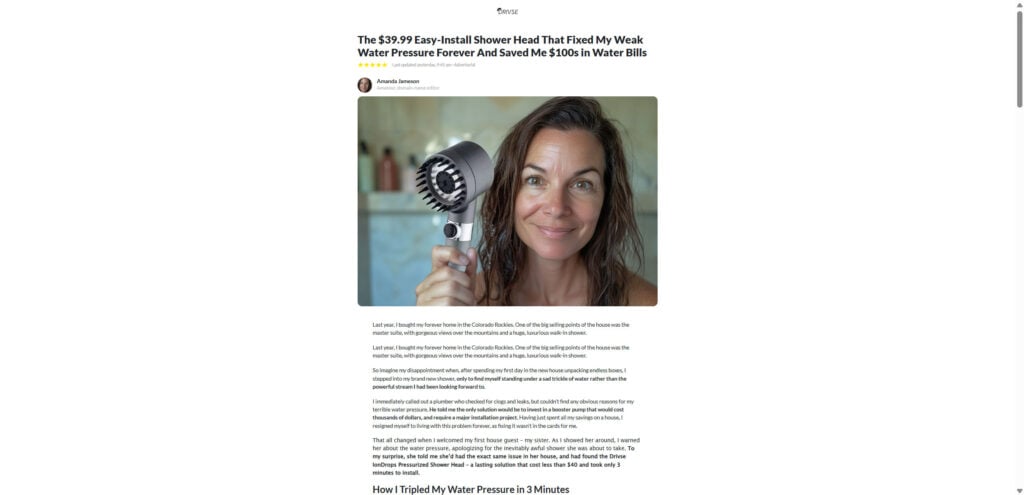
Drivse IonDrops Overview
Drivse does not market IonDrops as an ordinary handheld showerhead with a replaceable filter.
Its advertorials describe the product as a technological breakthrough developed by a dermatologist after years of research. They claim IonDrops can eliminate as much as 96% or 99% of water impurities, increase shower pressure by 200%, improve skin and hair within weeks, reduce hair loss, help with dandruff, and deliver results that ordinary showerheads supposedly cannot match. Some versions of the advertising even describe the device as a “dermatologist approved medical device.”
That positioning matters because it is what allows a relatively ordinary-looking handheld showerhead to be sold as something exceptional.
Drivse repeatedly warns customers not to confuse IonDrops with cheaper alternatives and claims that only Drivse has access to its filtration technology. One current sales page goes as far as saying the product is available only through the official website and that cheaper showerheads sold elsewhere are merely inferior knockoffs.
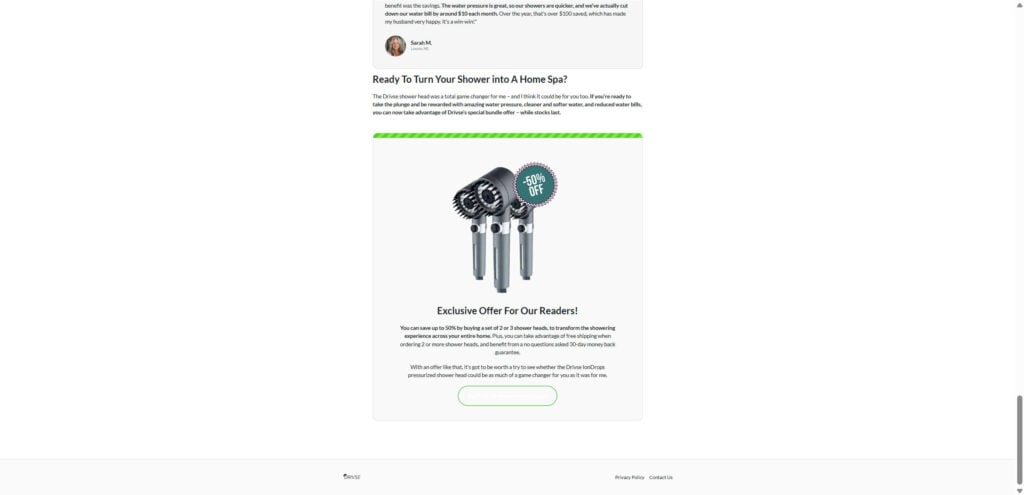
The problem is that the physical product does not appear nearly as unique as the marketing suggests.
Look at the Product — Then Look at Alibaba
The image accompanying this investigation shows multiple handheld filtered showerheads offered by Chinese wholesalers through Alibaba. They share the same unmistakable design language seen in the IonDrops product: gunmetal handheld body, filter cartridge inside the handle, multiple spray modes, silicone massage nozzles, flow controls, and the same general head-and-handle configuration.
The wholesale pricing is equally revealing. The examples shown in the supplied Alibaba results range from roughly $1.18 to $5 per unit, depending on supplier and minimum order quantity.
Alibaba’s current catalog also contains the same class of product described as a “3 Mode Gun Color Filter Hand Shower Head With Silicone Massage Nozzles and Stop Function,” along with other three-mode filtered handheld showerheads using PP cotton cartridges and similar water-pressure features.
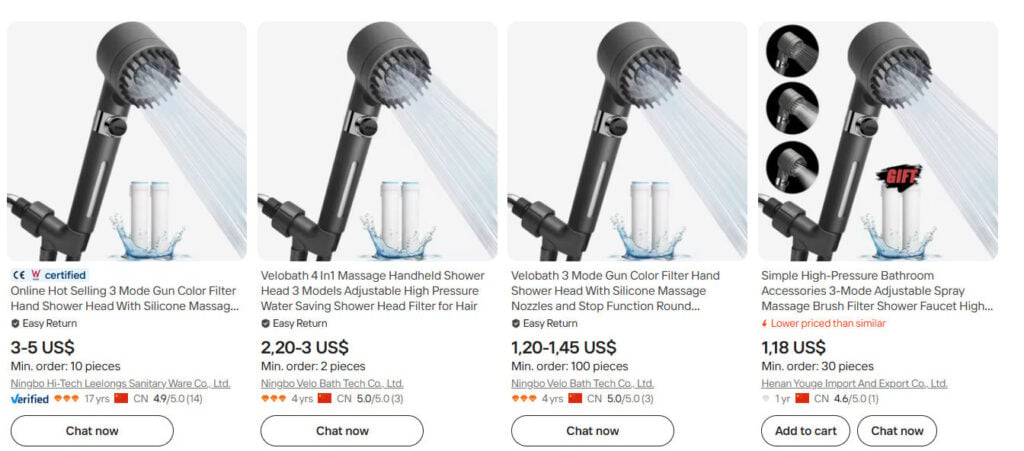
Photographs alone cannot prove that a specific Drivse unit came from one particular Alibaba factory. What they do prove is that this physical concept is not some extraordinary form factor available only to Drivse. Near-identical designs with the same visible features are mass-produced by Chinese bathroom-fixture manufacturers and sold wholesale for a few dollars.
That makes the “don’t confuse this with cheap alternatives” narrative much less convincing.
The Drivse Version Can Cost $100
Now compare those wholesale prices with Drivse.
The current Drivse store lists a single IonDrops unit at $100, while various promotional funnels offer temporary discounts and bundle pricing designed to make customers feel they are receiving a major bargain.
One promotional checkout has offered one IonDrops for roughly $49, two at around $42 each, and three at around $35 each. The larger package is naturally presented as the better deal.
That is classic direct-response pricing.
The $100 reference price makes a $49 or $35 promotional price feel extraordinary. Yet when visually similar mass-market hardware is available wholesale for low single-digit dollar amounts, the discount starts looking very different.
Consumers are not simply paying for the plastic showerhead.
They are paying for the branding, advertorials, paid advertising, subscription infrastructure, testimonials, dramatic health claims, and the story that this particular showerhead represents exclusive filtration technology.
The “Dr. Robert Ballas” Story Is Doing a Lot of Work
A major part of that premium story revolves around a supposed dermatologist named Dr. Robert Ballas.
Drivse advertorials repeatedly say IonDrops was developed by a renowned or well-known dermatologist named Dr. Robert Ballas after extensive research into the effect of shower water on skin and hair. One page claims he spent years developing prototypes and $178,000 on laboratory testing. Another says his breakthrough work appeared in leading medical journals and beauty publications.
Yet searches for this supposed dermatologist primarily lead back to IonDrops promotional pages, affiliate-style content, social-media pages promoting the product, and copies of the same marketing story.
That is not what you would normally expect from a “renowned dermatologist” whose research allegedly produced a revolutionary consumer device.
More troublingly, essentially the same Dr. Robert Ballas origin story has appeared attached to another generic filtered showerhead sold under the name Turbo Shower, using remarkably similar claims about eliminating impurities, increasing pressure by 200%, restoring skin and hair, and using the same supposed dermatologist.
The biography appears to function more like a reusable marketing asset than independently verifiable scientific provenance.
The Ads Make Claims That Go Far Beyond “Cleaner Shower Water”
There is nothing inherently suspicious about wanting to filter shower water.
Chlorine, mineral content, and local water quality can affect the shower experience, and legitimate filtered showerheads exist.
The issue is what IonDrops advertising claims the device can accomplish.
One Drivse promotional page says the product can eliminate acne and bumps, repair damaged skin, boost collagen production, reduce wrinkles, promote hair growth, address hair thinning, improve eczema-related complaints, and provide “instant relief from chronic skin conditions.” The same material describes IonDrops as being 100% more effective than creams or serums.
Other Drivse pages are noticeably more restrained. The current main product page talks about water filtration contributing to softer-feeling skin, healthier-looking hair, and general comfort rather than making the more extreme medical-style promises found in aggressive advertorials.
That gap is worth paying attention to.
The aggressive advertisement sells transformation.
The conventional storefront sells a filtered showerhead.
The “99% Filtration” and “200% Pressure” Numbers Are Presented as Facts
IonDrops marketing repeatedly uses precise numbers because precision makes a claim sound tested.
Depending on which Drivse page you land on, the showerhead is said to remove 96% or 99% of impurities and increase pressure by 200%. Advertorials also talk about “extensive clinical testing,” patented technology, reverse osmosis, physical adsorption, gravity filtration, and other technical-sounding mechanisms.
The website does not prominently provide the kind of independent laboratory report a consumer would need to evaluate those exact performance claims in detail.
Instead, the numbers sit directly inside the sales copy alongside glowing testimonials and purchase buttons.
That distinction matters.
A marketing page stating “99%” is not the same as an independently accessible certification showing what contaminants were tested, at what concentrations, under what flow rate, using which testing protocol, and for how long the cartridge maintained that performance.
If the company wants consumers to treat those percentages as scientific facts, the underlying evidence should be equally easy to inspect.
AI Advertising Adds Another Layer of Deception
IonDrops is also being promoted through social-media-style advertising that can blur the line between genuine testimony and synthetic content.
IonDrops already relies heavily on supposed expert authority, transformation stories, advertorials designed to look informational, and enormous customer-count claims. AI makes it possible to produce those endorsements and testimonial-style videos at scale without needing the person shown or heard in the advertisement to genuinely support the product.
Consumers should therefore be particularly skeptical when they encounter a dermatologist, beauty expert, influencer, or apparent customer enthusiastically describing IonDrops in a social-media video.
A convincing video is no longer evidence that the speaker exists, used the product, or said what appears on screen.
The Real Business Model Starts to Appear at Checkout
The most important part of this investigation is not the showerhead itself.
It is the checkout.
A casual visitor could reasonably believe they are purchasing a one-time bathroom product.
But some Drivse checkout paths explicitly enroll customers into recurring deliveries.
One live checkout states:
“Cancel Anytime | Billed Monthly.”
The same page explains that the Drivse Filter monthly delivery membership automatically renews at $39.99 per month for one IonDrop, $69.94 per month for two, or $74.91 per month for three, depending on the package selected.
Another Drivse checkout is even more explicit. It tells buyers that completing the purchase can authorize another charge every 28 days automatically until cancellation. Depending on the package configuration shown, the recurring amount can be $39.99, $59.98, or $74.97. The same checkout also displays a recurring subtotal of $98 every two months in another section.
That is not a hypothetical subscription risk.
The subscription infrastructure is built directly into Drivse.
Why Would a Showerhead Need a Monthly Subscription?
The answer is the filter.
Drivse’s main site currently recommends replacing the IonDrops cartridge every 30 days, and its FAQ confirms that customers enrolled through auto-ship offers can receive recurring replacement-filter deliveries.
This transforms the economics completely.
The original showerhead gets the customer into the ecosystem.
The filters create recurring revenue.
That is why the subscription terms deserve at least as much attention as the initial price.
A consumer attracted by a discounted showerhead can potentially end up authorizing recurring charges every 28 days or monthly if they do not understand the checkout option they selected.
Drivse’s own Terms of Service confirms that its subscription program continues automatically until canceled and authorizes recurring charges at the frequency shown during enrollment.
Even Drivse Has a FAQ for People Asking Why They Are Being Charged Again
The company’s current FAQ contains an entire billing section addressing recurring transactions.
One question is literally:
“Why am I seeing a recurring charge?”
The answer explains that customers enrolled in subscription auto-ship offers receive automatic recurring billing for replacement filters. The FAQ also provides cancellation instructions and notes that Drivse is still upgrading its self-service subscription portal, meaning customers may need to cancel by emailing support.
That is important context for anyone seeing an IonDrops advertisement that focuses almost exclusively on skin, hair, and water pressure.
The recurring-revenue mechanism may not be the part of the offer receiving the most attention in the ad.
It becomes much more important once the customer’s card is stored.
The Filter Replacement Story Is Not Even Consistent
There is another strange contradiction inside Drivse’s own marketing.
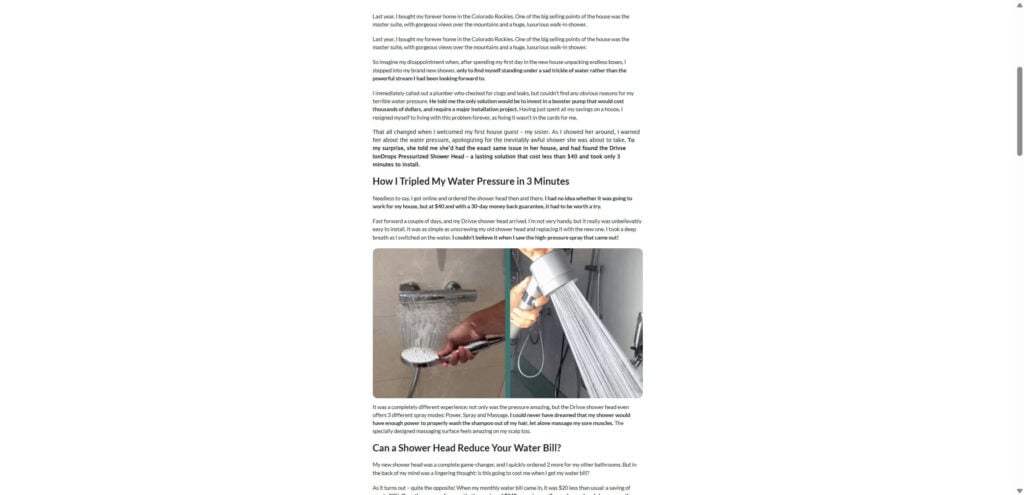
One advertorial tells customers the IonDrops filter can easily be replaced every six months.
The current store says the filter should be replaced every 30 days
One promotional checkout goes even further, saying that for “100% efficiency” the filter should ideally be replaced weekly, although once a month may be sufficient in many areas.
Those are drastically different maintenance schedules.
A filter lasting six months produces a very different ownership cost from one needing replacement every month, let alone every week.
This inconsistency becomes especially relevant when replacement filters are tied to automatic billing.
The Refund Promise Is Even More Confusing
Drivse advertising repeatedly tells buyers the purchase is risk-free.
Some pages promise a 90-day money-back guarantee, with wording suggesting customers can simply email support and receive a full refund with no questions asked.
The current main product page, however, displays a 30-day money-back guarantee
The official refund policy introduces additional restrictions. It says returns must be shipped back within 30 days of delivery, items must be unused and in their original condition, customers must obtain approval before returning anything, tracked shipping is mandatory, and return postage is the customer’s responsibility. More importantly, the policy says that if someone simply changes their mind, Drivse may refuse a cash refund and instead offer store credit or a partial refund at its discretion.
Meanwhile, the Terms of Service separately says first-time purchases receive a 90-day money-back guarantee if the customer is dissatisfied.
That is not a minor wording difference.
A consumer should not need to solve a puzzle to determine whether the guarantee is 30 days or 90 days, whether the product can be used, and whether changing their mind qualifies for a cash refund.
One Drivse Refund Page Is Even More Restrictive
Another refund page indexed on the Drivse domain states that its money-back guarantee is valid only when the product was damaged during shipping or arrived with missing parts.
So within the same broader Drivse web presence, consumers can encounter:
a 90-day “no questions asked” guarantee,
a 30-day guarantee,
a policy requiring products to be unused,
a policy saying change-of-mind returns may receive only store credit or a partial refund,
and another refund statement tying the guarantee to damaged or incomplete deliveries.
That is precisely the kind of inconsistency consumers should examine before ordering rather than discovering after requesting their money back.
Subscription Orders Have Worse Refund Protection
The Terms of Service creates another distinction that becomes important once recurring billing starts.
Drivse says subscription orders are not eligible for refunds after the order has been processed.
The current refund policy also requires customers to cancel before the next subscription cycle if they want to avoid another charge. One version says cancellation needs to occur at least three business days before the scheduled billing date, while the Terms of Service says at least 24 hours before processing or shipment
Again, even the cancellation window is not completely consistent across the company’s own pages.
For someone enrolled in a 28-day refill program, those details matter.
Multiple Charges Can Also Appear on the Card
Another potential source of alarm appears in Drivse’s own FAQ.
The company tells customers that if they see multiple charges on their statement, it may be because each item in an order is processed and billed separately.
That does not automatically mean the company charged for items that were never ordered.
It does mean a bundle purchase can produce a bank statement that looks very different from the simple total a consumer remembers seeing in the advertisement.
Combine separate item billing with recurring filter shipments, multi-unit packages, and upsells, and it becomes especially important to review the actual credit-card statement after ordering.
The “Cheap Knockoffs” Warning Looks Different After Seeing the Wholesale Market
Drivse’s advertising repeatedly tells consumers to avoid cheaper filtered showerheads.
One sales page says knockoffs will not filter water correctly or increase pressure and insists that only Drivse has access to the technology. Another advertorial warns that cheap $20 Amazon alternatives can actually make water worse.
This type of messaging serves an obvious commercial purpose: it prevents customers from price-shopping.
Yet the physical design presented as unique is remarkably similar to mass-produced filtered showerheads available through Chinese wholesale channels.
The supplied Alibaba comparison image is particularly damaging to the exclusivity narrative. The products do not merely belong to the broad category of handheld showerheads; they reproduce the same recognizable combination of a gunmetal cylindrical handle, internal cartridge, circular three-mode spray head, silicone massage tips, flow control, and stop function.
We cannot establish from photographs alone that every IonDrops comes out of one of the factories shown.
We can establish that there is nothing visibly unique about the basic hardware architecture.
This Looks Much More Like Rebranding Than Invention
Once the pieces are viewed together, the premium innovation story becomes difficult to accept at face value.
The physical design exists widely in Chinese wholesale markets.
The product is built around features common to generic filtered showerheads.
The marketing relies heavily on an alleged dermatologist, dramatic before-and-after stories, extraordinary filtration percentages, large customer counts, health transformations, urgency, and warnings that all cheaper competitors are knockoffs.
That does not automatically mean the IonDrops unit cannot function as a showerhead.
It probably sprays water perfectly well.
It may even provide a different spray sensation and some degree of mechanical filtration depending on the cartridge.
The problem is the enormous distance between “inexpensive handheld filtered showerhead” and the product being presented in the advertising.
Consumers are not being sold merely a bathroom fitting.
They are being sold an origin story, a scientific story, a beauty treatment, and a recurring filter ecosystem.
The Huge Review Numbers Deserve Skepticism
Different Drivse pages display enormous customer numbers.
One advertorial claims more than 50,000 five-star reviews. Another says more than 134,000 customers use IonDrops. The current store, meanwhile, displays a rating based on approximately 2,358 reviews.
There is nothing inherently impossible about a company collecting reviews through different systems.
But the changing figures illustrate why seller-controlled social proof should not be treated as independent verification.
If tens or hundreds of thousands of customers supposedly achieved extraordinary transformations, buyers should still ask how those reviews were collected, where the complete dataset can be inspected, and whether negative experiences are represented.
A testimonial placed beside a Buy button is marketing material.
How the Drivse IonDrops Funnel Works
The IonDrops campaign begins by convincing consumers that their ordinary shower water is quietly damaging their appearance. Chlorine, minerals, heavy metals, PFAS, microplastics, and other contaminants are presented as hidden reasons for dry skin, brittle hair, irritation, hair loss, premature aging, and other problems. The solution is then framed not as an ordinary filter but as a technological breakthrough supposedly developed by an expert dermatologist.
Once the viewer accepts that premise, IonDrops is presented as substantially different from inexpensive showerheads available elsewhere. Precise numbers such as 96% or 99% filtration and a 200% pressure increase add scientific authority, while testimonials and before-and-after imagery make the transformation feel proven
The pricing stage creates urgency through “today only” discounts, stock warnings, limited availability, and bundle savings. A product that can be listed at $100 suddenly appears for around half that price, while buying two or three makes the per-unit cost lower still
The most important part comes during checkout. Some funnels connect the purchase with automatic replacement-filter deliveries, turning what looks like a discounted one-time showerhead purchase into recurring billing every 28 days or monthly.
Once the order is placed, getting out can be less straightforward than getting in. Different Drivse pages describe different guarantee periods and return requirements, while subscription purchases have additional restrictions.
That is the complete business model: sell the transformation first, sell the showerhead second, then monetize replacement filters over time.
What to Do If You Already Bought Drivse IonDrops
- Check whether you purchased a subscription. Search your confirmation email for “subscription,” “auto-ship,” “monthly delivery,” “recurring,” or replacement-filter language. Some Drivse checkout paths explicitly authorize automatic charges every 28 days.
- Check your card statement immediately. Drivse says products can be processed and billed separately, so compare every transaction with what you actually intended to purchase.
- Cancel recurring deliveries in writing. Email the seller from the address associated with the order and include your order number. Ask for confirmation that the subscription is canceled and that no future transactions will be processed.
- Do not wait until the next billing date. Drivse’s cancellation deadlines vary across its own pages, so cancel several business days before the next expected payment rather than relying on the shortest stated window.
- Save the advertisement and guarantee you saw. If your landing page promised a 90-day, no-questions-asked refund, preserve a screenshot. The current refund policy contains materially different conditions.
- Contact the seller before returning anything. The published refund policy says unauthorized returns may not be processed, so obtain written return approval and use tracked shipping.
- Contact your card issuer if charges do not match what you authorized. If recurring or additional payments appear that you did not knowingly approve and the merchant does not resolve the issue, preserve your checkout screenshots, emails, and bank transactions and ask your card issuer about the applicable dispute process.
The Bottom Line
Drivse IonDrops is a real handheld showerhead being sold through a functioning ecommerce operation, but the marketing around it dramatically inflates what appears to be a familiar mass-market product design.
The most telling comparison is the product itself.
Visually near-identical three-mode filtered handheld showerheads are available from Chinese wholesale suppliers for only a few dollars per unit. They share the same gunmetal design, internal filter cartridge, massage nozzles, stop control, and multi-mode spray configuration seen in IonDrops. Drivse nevertheless tells customers that its technology is exclusive and warns them not to buy cheap alternatives.
Then comes the advertising story.
IonDrops is presented as a dermatologist-developed breakthrough capable of filtering nearly all harmful impurities, doubling or tripling perceived water pressure, transforming skin and hair, reducing hair loss, improving dandruff, and delivering results superior to conventional skincare products. Some of the most aggressive Drivse pages make claims that are substantially stronger than the language used on the company’s current conventional storefront.
But the biggest warning may be hidden in plain sight at checkout.
Drivse operates an automatic filter-delivery subscription. Some checkouts explicitly authorize another payment every 28 days, while another describes monthly recurring charges based on the number of IonDrops ordered. The company’s own FAQ even includes a section explaining why customers may see recurring charges.
The refund situation is hardly reassuring. Depending on which Drivse page a customer reads, the guarantee can appear to be 30 days or 90 days, “no questions asked” or restricted to unused merchandise. One policy says a simple change of mind may not qualify for a cash refund, while subscription orders have their own restrictions.
For that reason, I would avoid buying IonDrops through these aggressive advertising funnels.
If you genuinely want a filtered handheld showerhead, there is no shortage of straightforward products sold by established retailers where the specifications, price, replacement filters, return terms, and billing model are clear before you pay.
A showerhead should not require a fabricated-looking medical backstory, AI advertising, “50% off today only” pressure, contradictory refund policies, and recurring billing to convince you that it is worth owning.
FAQ
Is Drivse IonDrops a scam?
IonDrops appears to be a real showerhead that customers can purchase and receive, so this is not simply a nonexistent-product scam. The serious concerns are the marketing and sales practices surrounding it: exaggerated health and filtration claims, a product design resembling inexpensive wholesale alternatives, AI-style advertising, recurring filter subscriptions, aggressive bundle pricing, and inconsistent refund information.
Is IonDrops just a cheap Chinese showerhead?
Visually near-identical showerheads with the same general three-mode design, filter cartridge, massage nozzles, control buttons, and gunmetal finish are sold by Chinese wholesalers for roughly a few dollars per unit. The supplied comparison image makes that similarity particularly obvious. Visual evidence alone cannot identify the exact factory producing Drivse units, but it strongly undermines the claim that the basic showerhead design is exclusive proprietary hardware.
How much does Drivse IonDrops cost?
The current Drivse storefront lists IonDrops at $100, although promotional funnels can offer substantially lower prices. One checkout has displayed approximately $49 for one unit, $42 each for two, and $35 each for three.
Does IonDrops have a subscription?
Yes, Drivse operates subscription and auto-ship programs. Some checkout paths explicitly authorize recurring billing every 28 days, while another describes monthly filter-delivery charges.
Why is Drivse charging me every month?
Drivse’s FAQ says customers who enrolled in a subscription auto-ship offer are automatically billed for recurring replacement-filter deliveries
How do I cancel the Drivse subscription?
Drivse currently instructs customers to cancel through its subscription system or by emailing support with the order number or account details. Because its published notice periods are inconsistent, cancellation should be submitted several business days before the next expected charge.
Does IonDrops really remove 99% of contaminants?
Drivse makes filtration claims ranging from approximately 96% to 99% on different pages. Consumers should distinguish those seller-generated claims from independently accessible laboratory certification demonstrating the exact contaminant-removal percentage under specified conditions.
Does IonDrops really increase water pressure by 200%?
Drivse repeatedly advertises a 200% pressure increase. The site attributes this to the nozzle design and small spray holes. That percentage is a company marketing claim and should not be assumed to apply identically to every home’s plumbing system
Was IonDrops invented by dermatologist Dr. Robert Ballas?
That is the story repeatedly presented in Drivse advertising. Searches for the name, however, are dominated by IonDrops promotional material and related sales content rather than an obvious independent medical or academic footprint supporting the elaborate biography used in the ads. The same Dr. Robert Ballas development story has also appeared in marketing for another filtered showerhead called Turbo Shower.
Can IonDrops cure eczema, acne, hair loss or other skin conditions?
Drivse’s aggressive advertorials have made very strong claims involving acne, eczema-related symptoms, hair loss, damaged skin and scalp problems. Its current conventional site uses much more cautious language about supporting the appearance and feel of healthier skin and hair. Consumers should not treat a showerhead advertisement as medical advice or assume it can treat a diagnosed dermatological condition.
Does Drivse really offer a 90-day money-back guarantee?
Some pages do. Other Drivse pages say 30 days, and the published refund policy contains restrictions including unused-condition requirements and limitations on change-of-mind refunds. Anyone ordering should save the specific guarantee displayed at the time of purchase.
Why does one Drivse page say 30 days and another say 90 days?
That is one of the biggest problems with the current customer information. The conventional storefront displays 30 days, promotional funnels advertise 90 days, and the Terms of Service separately refers to a 90-day guarantee for first-time purchases.
Can I return IonDrops if I simply do not like it?
Do not assume that the “no questions asked” wording guarantees a cash refund. Drivse’s current refund policy says a change-of-mind return may result in store credit or a partial refund at the company’s discretion, and standard returns must meet other conditions.
Why am I seeing several Drivse charges?
Drivse says individual items can be processed and billed separately, which can create multiple entries on a card statement. Recurring subscription charges can create additional transactions later.
How often does the IonDrops filter need replacing?
Drivse’s information is inconsistent. One advertorial says approximately six months, the current store recommends around 30 days, and another checkout has suggested weekly replacement for maximum efficiency while saying monthly may be adequate in many locations.
Should I buy Drivse IonDrops?
I would skip the aggressive IonDrops funnel. The combination of mass-market-looking hardware, exaggerated marketing, recurring billing, inconsistent replacement schedules, and contradictory refund terms creates too many unnecessary risks for a product category that can be purchased much more transparently elsewhere.








