

A long textured towel can be genuinely useful for reaching the back and replacing a damp loofah. Alorin turns that simple benefit into something much larger.
The storefront promises antibacterial protection, clearer skin, fewer breakouts, collagen support, and dramatic hygiene improvements. Several parts deserve separation from the sales language.
Overview
What the Alorin Towel Is
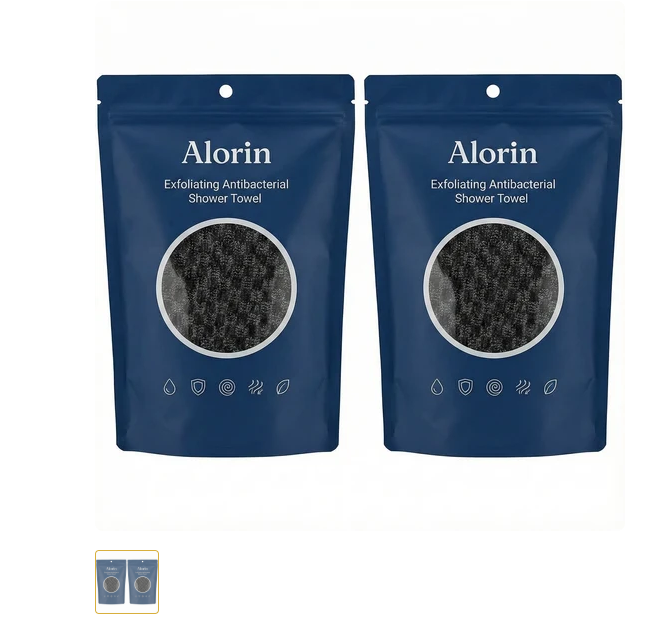
Alorin sells a long exfoliating shower cloth designed to lather body wash, scrub difficult areas, rinse quickly, and hang dry.
The store describes a dual-textured hexagonal weave, bamboo-charcoal fibers, antibacterial silver ions, and a useful life exceeding six months.
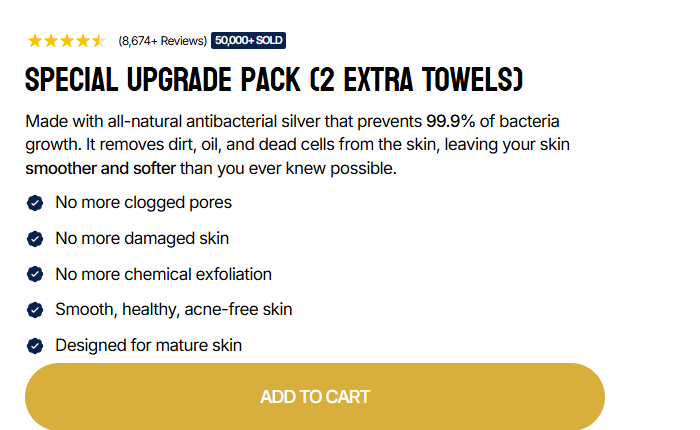
A two-towel upgrade page displays more than 8,674 reviews, over 50,000 units sold, and language promising smooth, healthy, acne-free skin.
Where an Ordinary Towel Becomes a Medical-Looking Offer
The page says its silver prevents 99.9% of bacterial growth and later says the technology kills acne-causing bacteria on contact.
It also promises no micro-tears, fewer ingrown hairs, collagen production, improved absorption, and 90% fewer breakouts for users.
Those are testable claims. They require evidence involving the finished Alorin fabric, not broad information about silver or exfoliation.
Our Assessment
Alorin appears to sell a real physical towel, and independent marketplace reviews show many buyers like this style of exfoliating cloth.
The product may help people reach their backs and remove loose surface skin. That practical value does not validate every antibacterial or acne promise.
Buyers should verify these points before ordering:
- The exact textile composition and amount or type of silver treatment
- A laboratory report supporting the 99.9% bacterial-growth claim after repeated washing
- Whether “dermatologist-tested” involved an independent study and published protocol
- How a used personal-care towel qualifies for the advertised satisfaction promise
- Whether sale pricing makes the order nonreturnable under the written policy
- The legal company, physical business address, and actual return destination
What a Textured Shower Towel Can Realistically Do
Physical exfoliation removes some loose cells and surface debris through friction. It can leave skin feeling temporarily smoother.
A long cloth also reaches areas that short washcloths and handheld sponges cannot cover easily.
Open-weave material may rinse and dry faster than a dense sponge, depending on airflow, humidity, thickness, and how thoroughly it is wrung.
Those are ordinary product benefits. They do not require claims about healing, collagen, bacterial elimination, or preventing future acne.
Friction can also irritate skin when pressure is excessive, the weave is rough, or the same area is scrubbed too often.
People with eczema, active acne, psoriasis, wounds, infection, or recent procedures should ask a clinician before aggressive exfoliation.
The 99.9% Antibacterial Claim
Alorin says all-natural antibacterial silver prevents 99.9% of bacterial growth. Another section says silver ions eliminate bacteria on contact.
A meaningful test report would identify the exact finished towel, organisms, contact time, wash history, test standard, laboratory, and comparison material.
Fresh fabric may perform differently after weeks of soap, oils, rinsing, heat, detergent, friction, and mineral buildup.
“Antibacterial” also does not mean sterile. A towel can still collect skin cells, product residue, moisture, and microorganisms during normal use.
Users should rinse thoroughly, dry completely, wash regularly, avoid sharing, and replace damaged material regardless of marketing claims.
No cloth can create an invisible protective barrier that guarantees future breakouts or body odor will not occur.
Acne, Keratosis Pilaris, and Ingrown-Hair Promises
The product page says the towel clears clogged pores, kills acne-causing bacteria, eliminates ingrown hairs, and improves keratosis pilaris bumps.
These conditions have different causes and do not respond uniformly to stronger scrubbing.
Body acne can involve oil, follicular blockage, bacteria, hormones, medication, sweat, and friction from clothing.
Keratosis pilaris involves keratin plugs around hair follicles. Some people tolerate gentle exfoliation, while others develop redness or worsening dryness.
Ingrown hairs may improve when loose surface skin is reduced, but excessive rubbing can inflame follicles and deepen discoloration.
A claim that users report 90% fewer breakouts needs a defined survey or clinical method. The sales page does not provide enough context.
The same page says the towel stimulates blood flow and cell turnover to boost collagen production.
Temporary redness from rubbing is not proof of healthier collagen remodeling.
Consumers should separate the satisfying feeling of exfoliation from medical improvement that requires objective measurement.
How the Alorin Shower Towel Offer Works
Step 1: Familiar Loofah Problems Create the Contrast
The pitch begins with odor, slow drying, bacterial buildup, hard-to-reach skin, and the cost of replacing ordinary loofahs.
These concerns make a long, quick-drying towel feel like an obvious hygiene upgrade.
Step 2: Simple Fabric Receives Branded Technologies
The page names silver-ion protection, bamboo charcoal, dual texture, hexagonal weave, and “Magic-Dry” performance.
Branding turns common material characteristics into a system that appears proprietary and clinically advanced.
Step 3: Cosmetic Benefits Expand Into Health Outcomes
Smoother skin becomes acne prevention, bacterial elimination, collagen support, ingrown-hair control, and better product absorption.
The expansion encourages buyers to treat one towel as a solution for several unrelated skin concerns.
Step 4: Large Numbers Supply Reassurance
The reviewed page displayed 50,000 units sold and more than 8,674 reviews near the product title.
Elsewhere, the same page showed other totals, including 1,461 ratings and a separate 8,151-review section.
Different widgets may measure different products or imported review sets. The store should explain the source and counting method.
Step 5: Discounts Encourage Extra Towels
The page reviewed was specifically an upgrade pack containing two additional towels, not necessarily the smallest introductory order.
Storewide sale banners and quantity offers can move buyers toward a larger cart before they know whether the texture suits their skin.
Step 6: A Bold Satisfaction Promise Closes the Sale
The page says customers will receive every penny back if they do not immediately feel the difference after their first shower.
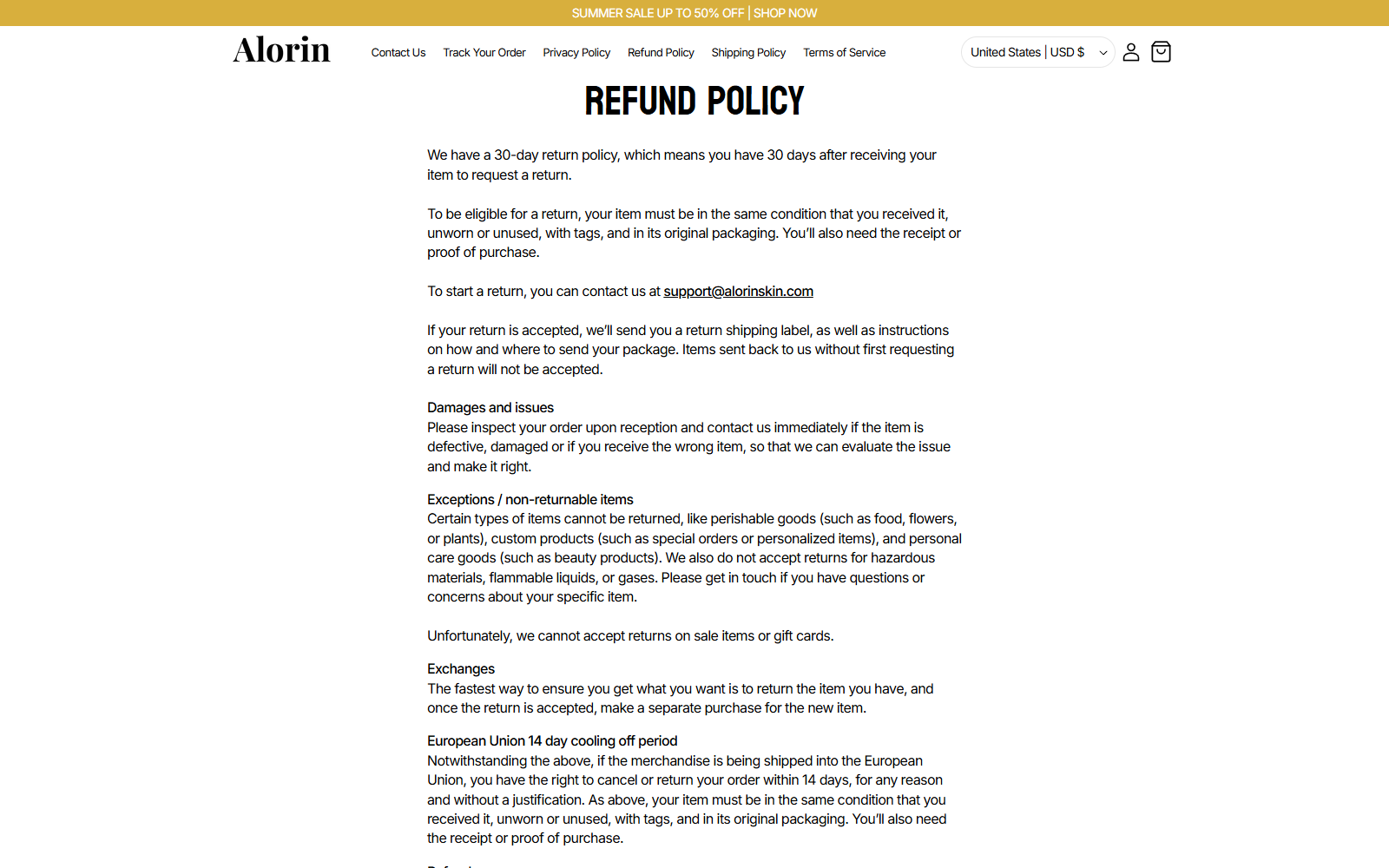
The written refund policy says items must be unworn or unused, excludes personal-care goods, and refuses returns on sale items.
Those conditions appear difficult to reconcile with testing the towel in a shower.
The Guarantee and Refund Policy Conflict
Alorin’s marketing says “no questions” and “no hassle” after first use if the buyer is not impressed.
The legal policy provides 30 days but requires the product to remain in the same condition, unused, tagged, and in original packaging.
It lists personal-care goods among items that may be nonreturnable.
The policy further excludes discounted merchandise, despite a storefront banner promoting a summer sale reaching 50% off.
A consumer cannot both test a shower towel and keep it unused. Support should explain in writing which promise controls.
Ask whether return labels are free, whether opened towels qualify, and whether the discounted item is final sale.
Company, Address, and Fulfillment Checks
The Policies Use the Brand Name, Not a Clear Legal Entity
The reviewed terms repeatedly identify the operator simply as Alorin.
They do not prominently provide the incorporated company name a buyer would use for formal complaints or business-record searches.
No Physical Address Is Prominent
The storefront provides support@alorinskin.com but no clear office or return address in the reviewed refund page.
Customers receive the destination only after a return is accepted, limiting their ability to estimate postage beforehand.
Worldwide Shipping Does Not Reveal Product Origin
The page promises fulfillment within one or two working days and worldwide delivery in four to 12 working days.
That timing does not identify where the towels are manufactured, stocked, or dispatched.
Similar Towels Sell for Much Less
Visually comparable exfoliating towels appear through large marketplaces at materially lower prices.
Similarity alone does not prove identical silver treatment, weave, quality, or warranty, but it makes independent specification evidence important.
Review Numbers and Marketplace Evidence
Alorin’s product page contains several review totals that are not clearly reconciled.
An independent Shop marketplace profile also shows substantial review activity and many favorable comments about reach, lather, and exfoliating feel.
That outside activity supports the conclusion that customers receive and use a real towel.
It does not independently prove 99.9% bacterial prevention, collagen production, or acne elimination.
Reviews are best for assessing texture, size, durability, delivery, and support. Controlled testing is needed for microbiological and medical claims.
Negative feedback on similar products commonly mentions roughness, fraying, odor, and skin irritation, which may depend on technique and individual sensitivity.
How to Use an Exfoliating Towel More Safely
Begin with light pressure and a small area. Wait to see whether redness, burning, itching, or bumps develop.
Do not scrub broken skin, active rashes, painful acne, sunburn, or freshly shaved areas.
Rinse the cloth fully and hang it where air reaches both sides. A folded damp towel dries more slowly.
Wash it according to verified care instructions and let it dry completely before reuse.
Never share personal exfoliating tools. Stop using a towel that develops persistent odor, visible residue, fraying, or rough damaged edges.
If a skin condition worsens, stop exfoliating and seek medical advice rather than increasing pressure or frequency.
What to Do if You Have Fallen Victim to This Scam
- Preserve both promises. Capture the first-shower money-back statement and the legal policy requiring unused, non-sale merchandise.
- Check the exact order. Confirm towel quantity, discount, shipping, warranty, subscription language, and card descriptor.
- Request clarification immediately. Ask whether your opened towel qualifies and which written promise the company will honor.
- Do not send an unauthorized return. Obtain the address, approval number, label terms, deadline, and expected deduction first.
- Document the product. Photograph packaging, material, labels, damage, fraying, stains, and any difference from the advertisement.
- Keep shipment evidence. Use tracked service and retain the receipt until the original payment method receives the refund.
- Dispute material misrepresentation. Contact the card issuer when written guarantees are refused or extra quantities were charged.
- Address skin reactions. Stop use, rinse gently, preserve the product, and obtain medical advice for persistent symptoms.
- Protect the device used for ordering. Run Malwarebytes after suspicious downloads, popups, or browser-notification requests.
- Reduce repeated targeting. AdGuard can limit tracking and similar social ads, although it cannot evaluate skincare evidence.
Questions to Ask Before Buying
- Which independent laboratory tested 99.9% bacterial-growth prevention on the finished towel?
- How many wash cycles were completed before the antibacterial claim was retested?
- What does “dermatologist-tested” mean, and can buyers read the protocol or report?
- Does the first-shower guarantee override unused-item and sale exclusions?
- Which legal company appears on the receipt and payment statement?
- Where is the towel manufactured, and where must a U.S. return be mailed?
How to Judge Durability and Value
A six-month life claim depends on frequency, pressure, detergent, water temperature, drying conditions, and whether the towel catches on jewelry or fixtures.
Ask whether the warranty covers fraying, loose edges, reduced texture, staining, odor, or loss of any claimed silver performance.
Material percentages should appear on a sewn label or packaging, not only in promotional copy.
Compare cost per towel after shipping with established Korean exfoliating cloths, African net sponges, washcloths, and retailer-branded alternatives.
Price can reasonably include support and quality control, but those advantages should be documented rather than implied by packaging.
A thicker weave may feel durable while also holding more water. Drying time should be measured under ordinary bathroom humidity.
Fifteen-minute drying may be possible in ideal airflow, yet a folded towel inside a humid shower can remain damp much longer.
After use, spread the full length rather than bunching it over a narrow hook.
Inspect the first few washes for color release, unusual odor, seam separation, or changes in roughness.
If the texture becomes harsher, use less pressure or stop. Durability is not valuable when the product irritates skin.
Marketing Claims That Need Separate Proof
The site presents silver, charcoal, weave, and drying as one combined technology, but each promise requires a different test.
Microbiology can assess bacterial growth. Textile testing can measure drying, abrasion, composition, shrinkage, and tensile strength.
Dermatology studies would be needed for irritation, acne, keratosis pilaris, ingrown hair, and collagen outcomes.
A result in one category should not be used to imply success in all the others.
For example, faster drying does not prove acne prevention, and exfoliating feel does not establish antibacterial protection.
Request each report separately and check whether it names the finished retail towel.
Clear evidence should make the offer easier to explain, not force buyers to connect unrelated scientific concepts themselves.
Frequently Asked Questions
Is the Alorin Shower Towel a confirmed scam?
No. A real towel appears to be delivered, but evidence for several medical-looking claims and refund eligibility remains unclear.
Does Alorin really prevent 99.9% of bacteria growth?
The seller makes that claim. Buyers should request a finished-product laboratory report covering test method, organisms, and repeated washing.
Can the towel cure body acne or keratosis pilaris?
No towel should be treated as a cure. Gentle exfoliation may help some people, while excessive friction can worsen irritation.
Is Alorin different from cheaper exfoliating towels?
The store claims proprietary silver, charcoal, weave, and drying benefits. Independent specifications are needed to establish a meaningful difference.
Can a used Alorin towel be returned?
The sales page suggests a first-use guarantee, but the policy requires unused goods and excludes personal-care or sale items.
Does Alorin offer subscriptions?
A subscription-management link appears in the footer. Verify the checkout and receipt for renewal frequency before completing payment.
The Bottom Line
Alorin may be a useful long exfoliating towel, and many shoppers appear satisfied with its reach and texture.
The problem is the leap from practical cloth to antibacterial, acne, collagen, and skin-healing promises without accessible product-specific proof.
The first-use guarantee also conflicts with unused-item and sale exclusions. Obtain written clarification or buy a comparable product with simpler returns.

Join the discussion
0 commentsShare your experience or ask a question about this article.
Discussion
Start the conversation
Have a question or something useful to share? Add the first comment.