

Choking is the kind of emergency that makes every second feel unbearable. A device promising one-button rescue naturally reaches people at their most protective.
NovaCare turns that fear into a confident three-second message. Because the product concerns life-saving action, every claim deserves unusually careful scrutiny.
Overview
What NovaCare Advertises
NovaCare sells a handheld suction device intended to remove a complete airway obstruction when someone is choking.
The store calls it the world’s first one-button anti-choking device and promotes 40 kPa suction, reusable construction, and adult and child masks.
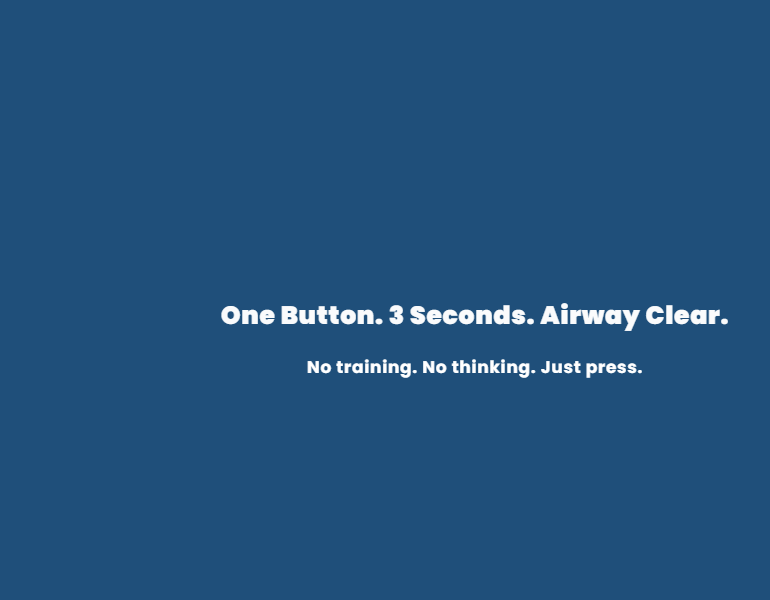
Its central promise is stark: “One Button. 3 Seconds. Airway Clear.” The same section adds, “No training. No thinking. Just press.”
Why Those Words Matter
Emergency advertising can influence what a caregiver does first. A memorable slogan may override training during panic.
The FDA says established choking rescue protocols should be used before an anti-choking suction device because delays can cost critical time.
The agency also says anti-choking devices require marketing authorization in the United States and warns that registration alone does not equal authorization.
Our Assessment
NovaCare appears to be a real product offer from a named distributor. We are not declaring that every device is fake.
However, the store’s simplified three-second promise conflicts with the careful sequence and limitations emphasized by federal safety guidance.
Before treating this product as emergency equipment, verify:
- The exact FDA authorization covering this name, model, manufacturer, and intended use
- Whether the listed authorization belongs to NovaCare rather than another suction device
- Independent performance testing at the advertised 40 kPa pressure
- Mask sizing, age restrictions, cleaning rules, and single-use components
- The standard choking protocol for adults, children, infants, and pregnant people
- Whether local emergency professionals recommend this device for your setting
What the FDA Says About Anti-Choking Devices
In its updated March 2026 safety communication, the FDA directs consumers to established American Red Cross and American Heart Association protocols first.
Those procedures use back blows and abdominal thrusts for adults and children, with age-appropriate methods for infants.
The FDA says standard protocols have a high success rate and can begin immediately without locating, unpacking, assembling, or positioning a device.
If established methods fail, an anti-choking device may be considered as a second option.
The agency specifically warns that using a suction device first can delay critical life-saving action.
Reported device problems include insufficient suction, failure to remove the obstruction, facial bruising, lip injuries, and scratches inside the throat.
That guidance does not mean every authorized suction device has no place. It means no product slogan should replace the proper rescue sequence.
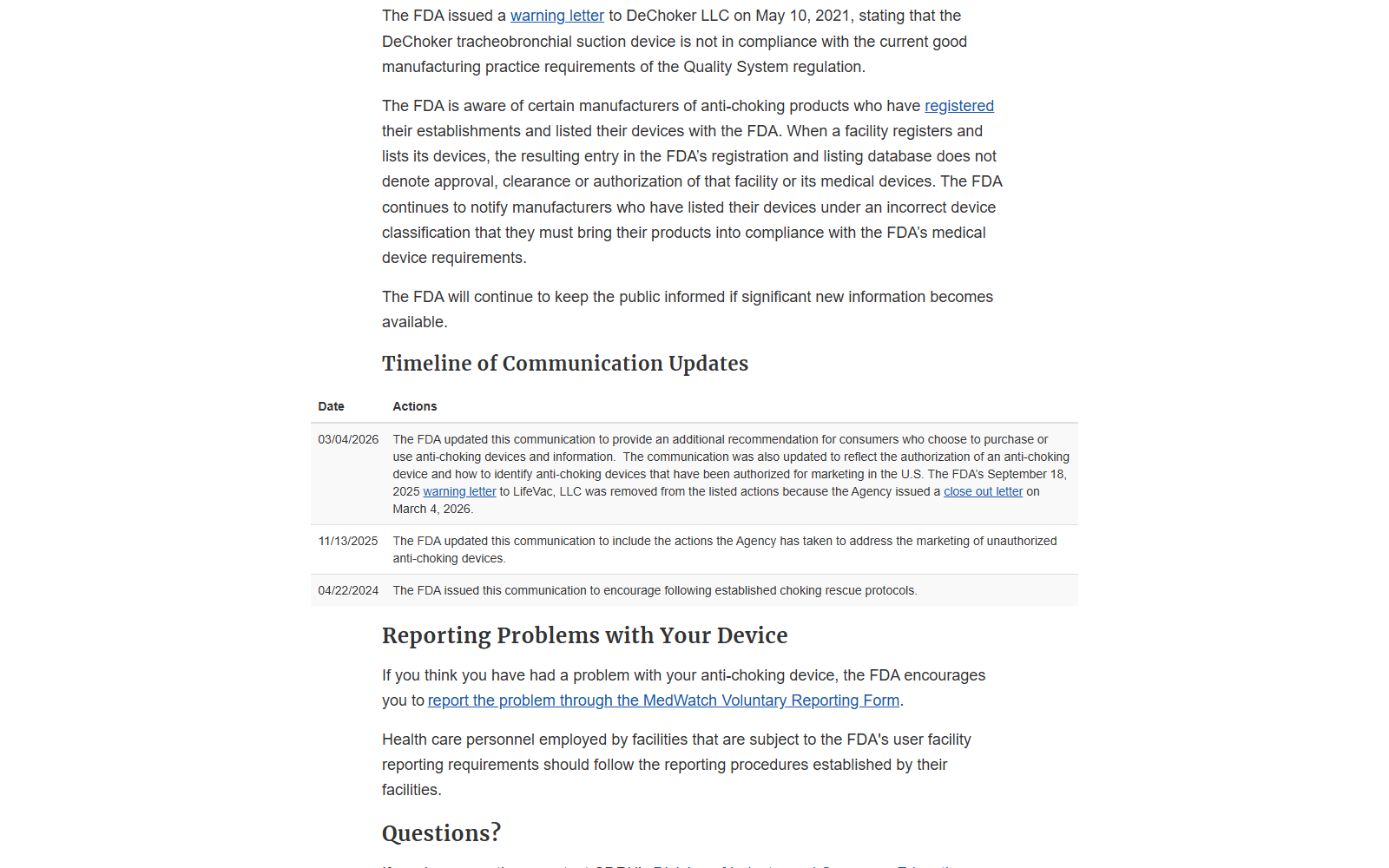
The FDA also explains a commonly misunderstood distinction. Device registration and listing do not prove approval, clearance, or authorization.
A seller should provide an authorization record that matches the marketed device, legal manufacturer, model, and intended use.
As of the FDA’s March 2026 update, one anti-choking device had received U.S. marketing authorization.
Why “No Training” Is a Dangerous Sales Message
NovaCare’s page says the device needs no training and no thinking. That phrase may sound comforting, but emergency equipment always requires preparation.
A caregiver must recognize complete obstruction, distinguish it from partial obstruction, call emergency services, select a mask, position the head, and create a seal.
Using interventions during a partial blockage can worsen the situation. The FDA says rescue protocols should target a complete block or inability to cough.
Anyone buying a device should read its instructions before an emergency, inspect its parts, and practice only as the manufacturer safely permits.
Training also covers what happens after the object moves. A choking victim may still need medical assessment for injury or remaining material.
The Three-Second Claim Needs Context
“Airway clear” in three seconds sounds like a predictable outcome, but real obstructions differ in shape, position, moisture, and how tightly they are lodged.
Victims differ by age, anatomy, consciousness, medical history, and facial fit. A seal that works on one person may fail on another.
An isolated demonstration cannot establish the success rate across emergencies. Buyers need independent testing with defined failure criteria and adverse-event reporting.
The store displays 3,543 reviews, yet an on-site review counter is controlled by the seller.
Review volume cannot substitute for authorization, engineering data, emergency-protocol training, or transparent post-market safety information.
How the NovaCare Anti-Choking Offer Works
Step 1: The Advertisement Activates a Parent’s Worst Fear
The page reminds readers that brain injury can begin within minutes and ambulances may take longer to arrive.
That comparison creates an urgent emotional gap that the product is positioned to fill.
Step 2: One Button Becomes the Simple Answer
NovaCare contrasts panic and complex rescue with a single button. The slogan suggests reliable action without preparation.
In reality, recognizing the emergency and following the correct sequence remain essential, regardless of the device interface.
Step 3: Technical Numbers Create Precision
The store lists 40 kPa maximum suction, 3 liters per second airflow, instant vacuum response, and “German engineering.”
Numbers feel authoritative, but buyers need test standards, laboratory identity, manufacturing records, tolerances, and model-specific reports.
Step 4: Bundles Turn Safety Anxiety Into Quantity
The offer suggests one device for each room and sells packs of one, two, or four.
That framing can make multiple purchases feel responsible before a buyer confirms authorization or clinical suitability.
Step 5: Large Review Totals Reinforce Confidence
Thousands of displayed reviews imply broad real-world validation. The reviewed page also uses “life saved” stories and verification labels.
Testimonials can describe individual experiences, but they cannot calculate failure rates or prove that standard first aid would not have worked.
Step 6: A 90-Day Guarantee Reduces Purchase Friction
The shipping policy advertises a 90-day guarantee on qualifying devices.
The terms add an important limitation: returns generally require the device to remain unused and in its original packaging.
A safety product cannot be meaningfully tested on a real emergency without becoming used, making the guarantee’s practical scope important.
Company, Address, and Fulfillment Checks
Top C Group LLC Is Named as Distributor
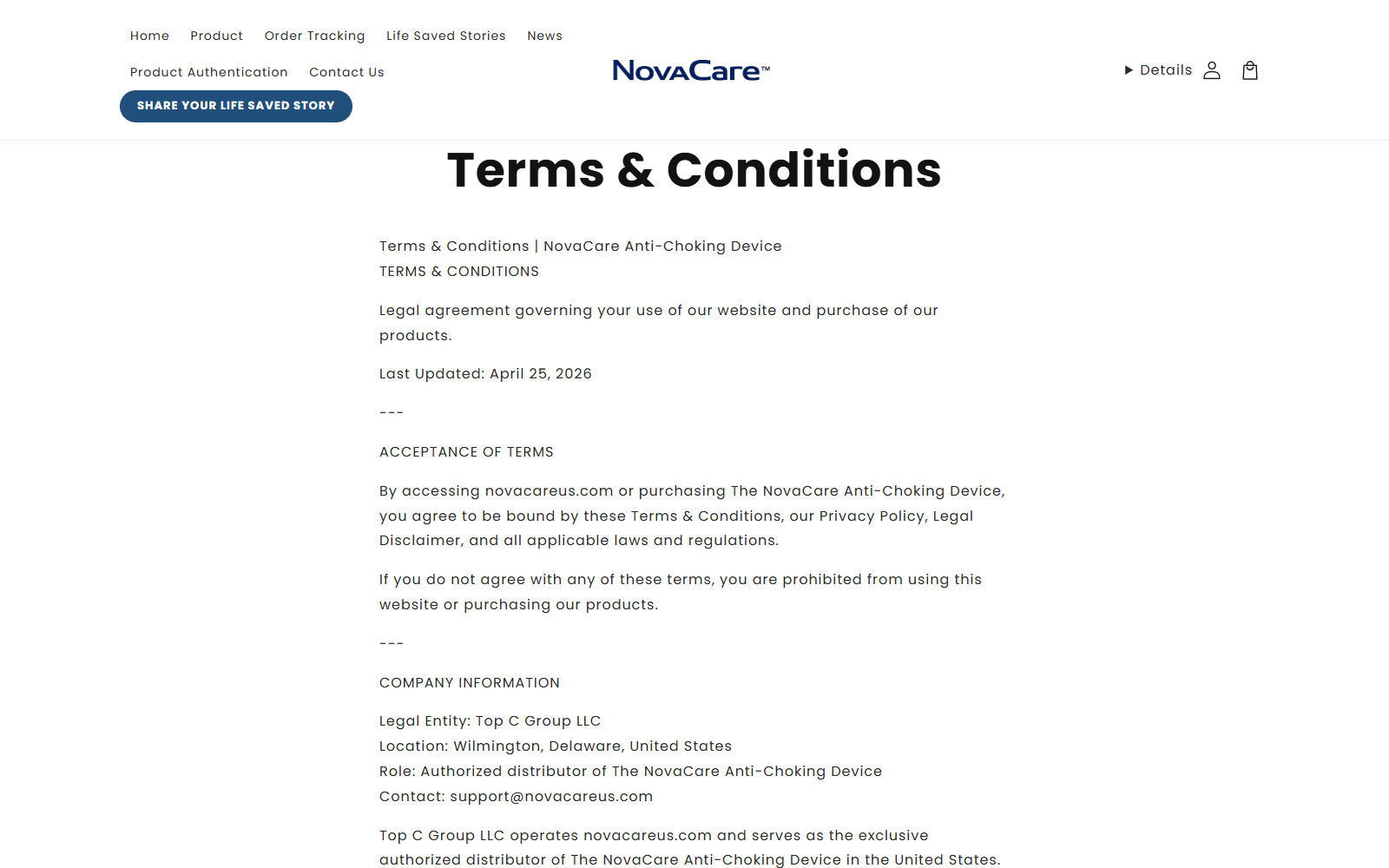
NovaCare’s terms identify Top C Group LLC as the exclusive authorized U.S. distributor operating novacareus.com.
The distinction matters. A distributor is not necessarily the legal manufacturer that designed, tested, and produced the device.
The Wilmington Address Is Not Manufacturing Proof
The seller lists 1007 North Orange Street, Fourth Floor, Wilmington, Delaware 19801.
A corporate address does not confirm where the device is engineered, assembled, quality-tested, stored, or serviced.
Support and Billing Are Identified
The published contact is support@novacareus.com, while the shipping policy says card statements may display SP NOVACARE US.
Save that descriptor. Any different merchant name should be checked with the seller and card issuer immediately.
The Original Manufacturer Needs Verification
The reviewed materials emphasize German engineering but do not make the device’s full manufacturing chain equally prominent.
Ask for the legal manufacturer, factory location, model identifier, lot number, quality certificate, and FDA authorization record before relying on it.
The 90-Day Return Promise Has Limits
NovaCare’s shipping and refund page promotes 90 days for qualifying devices, beginning when the order is delivered.
The terms require the product to be unused, in original packaging, and accompanied by proof of purchase for a standard return.
That condition may be understandable for hygiene and safety, yet it changes the meaning of a risk-free trial.
Consumers should ask whether opening the mask package, assembling the device, performing a dry familiarization, or testing suction affects eligibility.
Get the answer in writing. Do not rely on a chat statement that conflicts with published terms.
How to Check FDA Authorization
Search the FDA’s De Novo, 510(k), and premarket approval databases using the device name, model, manufacturer, and applicant.
Do not stop at an establishment-registration result. The FDA explicitly says registration and listing do not denote authorization.
Compare photographs, intended use, operating principle, model numbers, and manufacturer details with the product offered by NovaCare.
A record for another brand or manufacturer does not automatically cover a visually similar private-label device.
If the seller provides only a registration number, ask directly for the marketing authorization and explain why the distinction matters.
What to Do if You Have Fallen Victim to This Scam
- Do not rely on the device alone. Learn current Red Cross or American Heart Association choking protocols before an emergency occurs.
- Verify the exact authorization. Request the manufacturer, model, and FDA record in writing, then compare them with the device label.
- Preserve the advertising. Save the three-second claim, no-training language, price, bundle choice, receipt, policies, and delivery photographs.
- Request cancellation quickly. Send a dated message before fulfillment when possible and keep the automated acknowledgment.
- Obtain return instructions. Ask whether opening the packaging or testing the mechanism changes refund eligibility.
- Use tracked shipping. Photograph the serial or lot information, package contents, label, and carrier acceptance receipt.
- Dispute material misrepresentation. Contact the card issuer if the product differs substantially, authorization claims cannot be substantiated, or written terms are ignored.
- Report a device problem. Submit injuries, failure, weak suction, or other safety concerns to FDA MedWatch and tell a medical professional.
- Secure the order device. Run Malwarebytes after suspicious downloads or redirects, and change credentials entered on an unexpected domain.
- Limit repeated targeting. AdGuard can reduce alarming social advertisements and tracking, but it cannot replace safety training.
What to Keep in a Real Choking Plan
Post current first-aid instructions where caregivers can find them. Review separate methods for adults, children, infants, pregnancy, and wheelchair use.
Take an accredited first-aid course. Practicing recognition and hand placement is more reliable than trying to learn during panic.
Call emergency services early during a complete airway obstruction. Even successful removal can leave injury or retained material.
Keep any supplemental device assembled, inspected, and accessible only after understanding its authorized role and instructions.
Tell babysitters, relatives, teachers, and caregivers that a suction device must not delay established rescue protocols.
Questions NovaCare Should Answer Clearly
Start with the authorization number. Support should identify the exact FDA pathway and provide a database record matching the sold model.
Ask whether Top C Group LLC is only the distributor and which company is the legal manufacturer.
Request the manufacturing address, quality-system certification, lot traceability, complaint process, and recall notification method.
Ask which independent laboratory verified suction pressure, airflow, seal performance, drop resistance, shelf life, and mask materials.
A test report should name the model, date, standard, sample count, and result. A generic certificate is not enough.
Request evidence supporting the three-second airway-clearance phrase across adult and pediatric simulations.
Ask how often suction fails, how many attempts are permitted, and when users must stop to resume established protocols.
Clarify whether one device may be reused after an emergency and which components must be discarded.
Find out how masks are sized for infants, children, adults, facial hair, dentures, or unusual anatomy.
Ask whether the device has pressure relief and how excessive suction or poor positioning could injure tissue.
Request the complete instructions before purchasing, not after a sealed package arrives.
If support avoids these questions, do not place the device inside a household emergency plan.
What Caregivers Should Practice
Practice recognizing effective coughing versus complete obstruction. A person who can cough forcefully may need encouragement and observation, not immediate intervention.
Learn how rescue methods change for infants, children, adults, pregnancy, obesity, wheelchair use, and unconscious victims.
Rehearse who calls emergency services, who begins aid, who opens the door, and who meets responders.
Keep instructions visible and update training regularly. Skills fade when they are learned once and never revisited.
Inspect any supplemental device for damage, missing masks, blocked valves, degraded seals, or expired components.
Never let ownership create false confidence. Prepared people, rapid calling, and correct first actions remain the foundation.
Place emergency numbers beside the kit, tell every caregiver where it is stored, and review the plan after household routines or medical needs change.
Preparation should make the first response clearer, not add another uncertain decision during a crisis.
Frequently Asked Questions
Is NovaCare a confirmed scam?
We found a named seller and a real offer. Our concerns involve unverified authorization, oversimplified safety claims, and restrictive return conditions.
Should NovaCare be used before back blows?
No. FDA guidance says established choking rescue protocols should come first, with a suction device considered only after those methods fail.
Does FDA registration mean the device is authorized?
No. The FDA explicitly states that registration and device listing do not equal approval, clearance, or marketing authorization.
Can an airway always be cleared in three seconds?
No dependable outcome can be guaranteed across every obstruction, victim, mask fit, device condition, and user response.
What does NovaCare’s 90-day guarantee cover?
The seller advertises 90 days, but its terms generally require an unused device in original packaging. Ask for exact eligibility before opening.
What evidence should the seller provide?
Request the authorization record, legal manufacturer, model number, test reports, instructions, contraindications, adverse-event information, and lot traceability.
The Bottom Line
NovaCare’s one-button design may look reassuring, but its “no training” and three-second language oversimplify a life-threatening emergency.
The FDA’s current message is clear: follow established rescue protocols first and verify that any supplemental device is authorized.
Buyers should demand model-specific evidence before paying. More importantly, every household should learn proper choking response before it is needed.

Join the discussion
0 commentsShare your experience or ask a question about this article.
Discussion
Start the conversation
Have a question or something useful to share? Add the first comment.