

Bleeding, tenderness, and receding gums can make an ordinary morning routine feel worrying. A simple lighted mouthpiece naturally sounds easier than another appointment.
Oralux GumRevive wraps that idea in polished science language, dramatic savings, and several promises. The details become less straightforward when examined together.
Overview
What Oralux GumRevive Is Supposed to Do
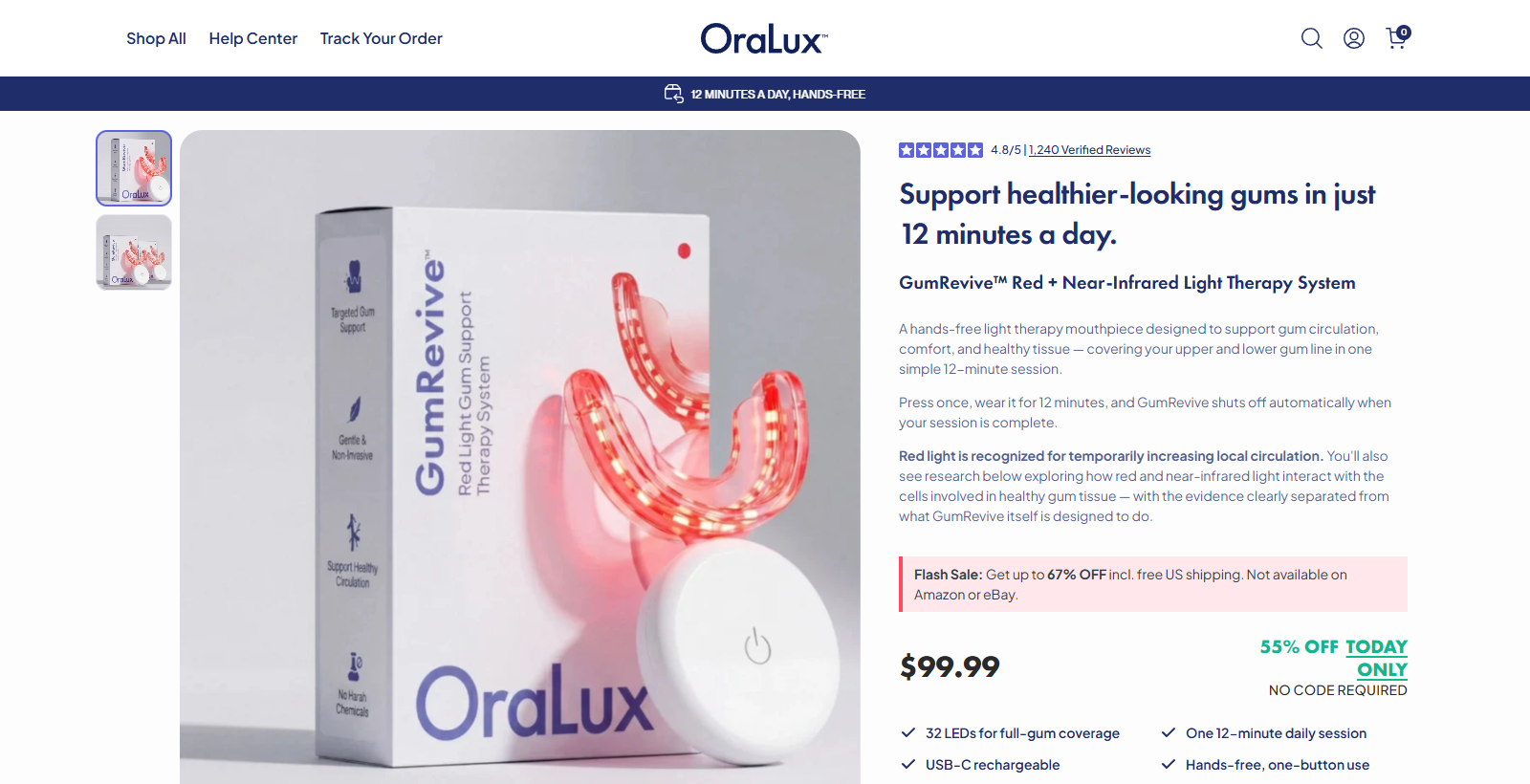
Oralux sells GumRevive as a rechargeable red and near-infrared light device worn over the upper and lower gums for 12 minutes daily.
The sales page says its 32 LEDs support circulation, comfort, and healthier-looking tissue without harsh chemicals or a complicated routine.
It presents the device as dermatologist-designed and connects gum aging with a phrase it calls “Oral Collagen Collapse.”
Why the Offer Deserves Closer Scrutiny
The store combines measured language with dramatic visual explanations, a 67% discount claim, more than 1,200 verified reviews, and repeated urgency.
Its regulatory wording is technically important, yet easy to misunderstand. A product-code classification does not establish that FDA tested GumRevive’s dental benefits.
Most concerning, the website presents multiple refund paths with different deadlines, conditions, fees, and rules for opened devices.
Our Assessment
We are not calling every red-light oral device fraudulent. Photobiomodulation is an active research field, and light can produce biological effects.
However, general research cannot prove this exact device reverses gum problems, replaces professional care, or produces the outcomes suggested by its presentation.
Before spending $99.99, a buyer should independently confirm:
- The exact manufacturer, model number, wavelengths, irradiance, dose, and safety testing
- Clinical evidence involving GumRevive itself rather than unrelated light devices
- Whether opened products qualify under the advertised performance promise
- Which refund page controls when two published policies disagree
- Where returns are sent and who pays postage or restocking costs
- Whether a dentist considers light therapy appropriate for the buyer’s symptoms
The “Oral Collagen Collapse” Story
The page begins with a real idea: gums contain connective tissue, and aging can affect tissue structure, healing, and resilience.
It then introduces “Oral Collagen Collapse” as a simple description for lost structural support beneath the gum line.
That phrase sounds diagnostic, but it is marketing language on the reviewed page, not a standard diagnosis a dentist gives after an examination.
Recession, bleeding, dark spaces, pain, and deep pockets can have different causes. Plaque, periodontitis, brushing technique, smoking, medication, and systemic conditions all matter.
A light device cannot identify which cause is present. Delaying an examination may allow treatable disease to worsen quietly.
What the FDA Language Actually Means
Oralux describes GumRevive as a Class II, 510(k)-exempt device under 21 CFR 890.5500 and product code ILY.
The FDA database identifies ILY as an infrared lamp for therapeutic heating. The classification is Class II and may be exempt from a 510(k) submission.
Exempt does not mean FDA reviewed Oralux clinical trials and approved claims about gums, collagen, recession, bleeding, or periodontal disease.
The cited classification is a device category. It is not a personalized endorsement, certification badge, or finding that this storefront’s specific promises are effective.
Oralux also states that GumRevive supports gum health and is not intended to diagnose, treat, cure, or prevent disease.
That disclaimer sits uneasily beside visuals discussing tissue beneath the gums and changes consumers may associate with dental disease.
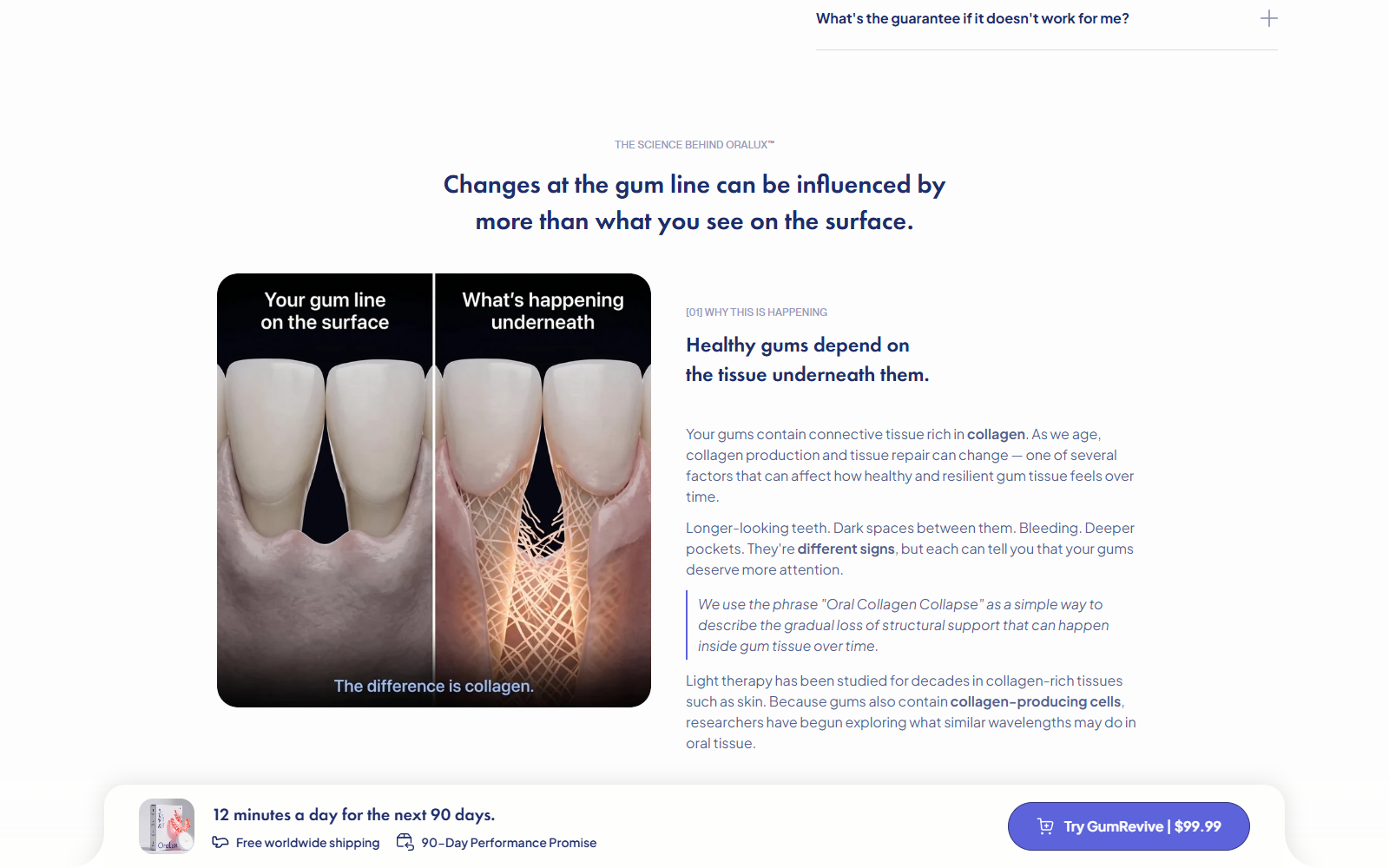
The gap between an advertising story and the legal disclaimer is important. Buyers often remember the illustration more strongly than the limitation.
If a page uses medical-looking anatomy, scientific vocabulary, and a physician’s name, ask exactly which statements are supported by product-specific evidence.
A study about red light, skin collagen, or another infrared lamp does not automatically validate a mouthpiece with different wavelengths, power, placement, and exposure.
Can Red Light Improve Gum Health?
Researchers have studied light-based therapies in dentistry, sometimes as an addition to established periodontal treatment rather than a replacement.
Results depend on diagnosis, wavelength, energy dose, device design, treatment schedule, study quality, and whether professional cleaning occurred simultaneously.
Those variables make broad claims risky. “Red light has been studied” is not the same as “this consumer device will solve your problem.”
Product-specific evidence should identify GumRevive, describe the participants, disclose funding, compare meaningful outcomes, and report adverse events.
Customer testimonials cannot answer those questions. Improvement may reflect better brushing, recent dental treatment, natural fluctuation, or expectation.
How the Oralux GumRevive Offer Works
Step 1: A Common Dental Fear Creates the Opening
The message focuses on signs that make people anxious: bleeding, tenderness, visible spaces, receding gums, and the feeling that teeth look older.
Because dental visits can be expensive or uncomfortable, a home device becomes emotionally attractive before its evidence is considered.
Step 2: A New-Sounding Condition Organizes the Story
The phrase “Oral Collagen Collapse” gives several different symptoms one memorable explanation.
That simplification helps the offer flow smoothly, but it may distract from conditions requiring cleaning, imaging, medication review, or periodontal treatment.
Step 3: Scientific Signals Build Authority
The page uses anatomy graphics, wavelengths, collagen language, regulatory classification, review totals, and a dermatologist attribution.
Each signal may sound reassuring alone. Together, they can create more certainty than the disclosed product-specific evidence justifies.
Step 4: The Routine Feels Effortless
Buyers are told to press once, wear the mouthpiece for 12 minutes, and let it shut off automatically.
Ease matters in real life, but convenience cannot establish effectiveness. A painless routine can still be an expensive distraction.
Step 5: Discounts and Review Counts Reduce Resistance
The reviewed page advertised a flash sale, 55% off that day, and savings reaching 67% on larger offers.
It also displayed a 4.8 rating from 1,240 verified reviews. On-site totals should be treated as seller-controlled evidence.
Step 6: The Guarantee Finishes the Persuasion
A 90-day performance promise suggests buyers can test the device without meaningful risk.
Yet another policy says opened oral devices are generally ineligible for ordinary returns, while used products enter a separate performance process.
The practical question is not whether “90 days” appears. It is what proof, timing, usage history, packaging, and approval the seller requires.
The Refund Policies Do Not Tell One Simple Story
One Oralux refund policy provides a six-hour cancellation window and says cancellations may incur a $20 processing fee.
It describes a 90-day guarantee that requires at least 30 consecutive days of use and compliance with specific claim procedures.
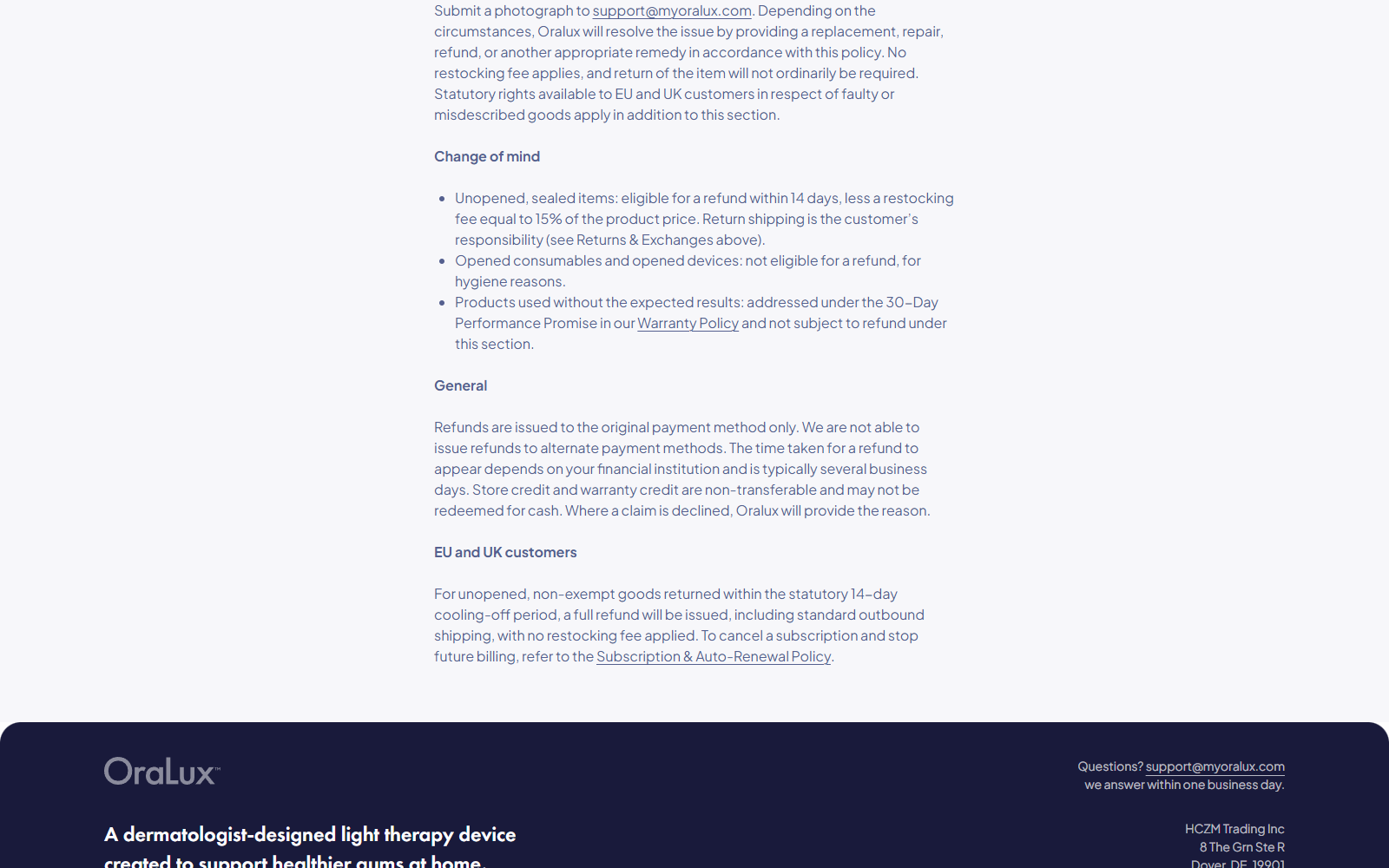
Another return page allows change-of-mind refunds within 14 days only for unopened, sealed items and applies a 15% restocking fee.
That second page says opened devices are ineligible for normal refunds because of hygiene, while performance concerns follow a separate 30-day promise.
A dedicated guarantee page separately describes 90 days and emphasizes that the offer is not blanket or unconditional.
Three overlapping explanations make it harder to know which promise governs a used mouthpiece. That ambiguity should be resolved before checkout.
Company, Address, and Fulfillment Checks
The Store Names HCZM Trading Inc
The reviewed footer identifies HCZM Trading Inc as the business behind Oralux.
A named entity is better than an anonymous footer, but buyers still need a receipt matching that company and a clear merchant descriptor.
The Delaware Address May Be Administrative
The site lists 8 The Green, Suite R, Dover, Delaware 19901.
That address is widely used for company-registration and mail services. It does not establish where GumRevive is designed, tested, manufactured, stocked, or returned.
Support Runs Through One Brand Email
The published contact is support@myoralux.com, and the footer promises an answer within one business day.
Send a specific question before buying. Ask for wavelengths, irradiance, manufacturer, return location, opened-device eligibility, and the controlling guarantee.
The Supply Chain Is Not Fully Explained
The reviewed pages do not prominently identify the original equipment manufacturer or provide a product-specific clearance number demonstrating GumRevive’s dental claims.
A Delaware registration address and a U.S. shipping statement do not prove domestic manufacture. Warehouse location, brand ownership, and factory origin are separate facts.
Warning Signs to Notice Before Ordering
No single detail proves a dishonest sale. The concern comes from how several unresolved issues interact.
- A branded phrase can be mistaken for a recognized dental diagnosis
- Device-class language may look like approval of gum-health outcomes
- Product-specific clinical evidence is not presented with enough detail
- On-site reviews and large discounts create seller-controlled social proof
- Different pages describe 14, 30, and 90-day pathways
- Opened oral devices face stricter rules than the guarantee impression suggests
- The listed corporate address does not reveal manufacturing or returns
What to Do if You Have Fallen Victim to This Scam
- Save the offer immediately. Capture the product page, checkout total, guarantee, refund policies, confirmation, tracking record, and every support message.
- Write a precise refund request. Identify the policy you relied upon, purchase date, delivery date, usage period, and exact remedy requested.
- Ask for the return authorization first. Do not send an oral device to an address found elsewhere without written confirmation tied to your order.
- Keep proof of shipment. Use tracked delivery, photograph the contents and packaging, and retain the carrier receipt until money returns.
- Dispute misleading billing when appropriate. Contact the card issuer if the seller refuses its written terms, ships the wrong quantity, or ignores cancellation.
- Protect exposed accounts. Change reused passwords, enable multifactor authentication, and watch the payment card for unfamiliar merchant names.
- Check the device safely. Stop using it after pain, burns, worsening bleeding, unusual sensitivity, or another unexpected reaction. Seek dental advice promptly.
- Scan suspicious downloads. Use Malwarebytes if the order flow installed software, opened a strange attachment, or redirected through questionable pages.
- Reduce malicious advertising. AdGuard can block many deceptive ad networks and tracking scripts, although it cannot verify medical claims.
How to Evaluate a Light-Therapy Mouthpiece
Ask for the exact wavelength range and irradiance at the gum surface. Dose cannot be assessed from LED count alone.
Look for testing that covers electrical safety, heat, material contact, battery quality, cleaning, and accidental overexposure.
Ask whether the mouthpiece fits dental work, implants, braces, retainers, dentures, sensitivity, active ulcers, or recent surgery.
Show the actual product page to a dentist. A professional can explain whether symptoms suggest gingivitis, periodontitis, trauma, recession, or another issue.
Never use a glowing mouthpiece to postpone urgent care for swelling, fever, severe pain, pus, loose teeth, or rapidly changing gums.
What Stronger Evidence Would Look Like
A trustworthy evidence package would begin with the exact GumRevive model, not a general discussion of red or infrared light.
It would state wavelength, output, exposure time, delivered energy, measurement method, and tolerances across production units.
Researchers would recruit participants with clearly diagnosed conditions and explain whether professional cleaning or other treatment occurred.
A comparison group would help separate device effects from improved hygiene, attention, expectation, and ordinary recovery.
Results should include bleeding scores, pocket measurements, recession changes, comfort, adverse events, and follow-up after treatment ends.
Funding and author relationships should be disclosed. Seller-funded work is not automatically invalid, but readers deserve that context.
Independent replication would matter more than one favorable study. It reduces the chance that a result reflects chance or selective reporting.
The device should also undergo electrical, battery, heat, optical, and material-safety testing for its actual intended oral use.
Cleaning instructions need validation because a reusable mouthpiece contacts saliva and difficult-to-reach surfaces every day.
Clear contraindications should cover photosensitivity, medication interactions, active lesions, recent procedures, and conditions needing professional supervision.
The seller should publish a stable policy identifying which opened devices qualify, what evidence is required, and where returns go.
Until those materials are available, buyers are being asked to bridge important gaps with trust.
Questions to Send Before Checkout
- Which independent laboratory measured the light output and heat at the mouthpiece surface?
- Can support provide a report naming the exact GumRevive model and production batch?
- Which published clinical trial used this device on the gum outcomes shown in advertising?
- Does opening and using the mouthpiece for 30 days preserve full refund eligibility?
- Which of the 30-day and 90-day performance promises controls this purchase?
- What return country, postage cost, restocking deduction, and processing time should a buyer expect?
Frequently Asked Questions
Is Oralux GumRevive a confirmed scam?
We found a real storefront and published company details, but also conflicting refund rules and claims needing stronger product-specific verification.
Is GumRevive FDA approved?
The store cites a Class II, 510(k)-exempt infrared-lamp category. That classification does not mean FDA approved GumRevive’s advertised gum outcomes.
What does “Oral Collagen Collapse” mean?
It is the store’s explanatory marketing phrase. It should not be treated as a diagnosis or substitute for a periodontal examination.
Can red light replace brushing or dental treatment?
No. Even potentially useful adjunctive technology does not remove plaque, diagnose disease, repair cavities, or replace professional treatment plans.
Does Oralux offer a 90-day refund?
A 90-day performance promise appears, but other pages impose opened-product limits, shorter periods, documentation requirements, and possible fees.
What should I ask Oralux before buying?
Request product specifications, manufacturer identity, product-specific evidence, return destination, opened-device eligibility, and written confirmation of the controlling guarantee.
The Bottom Line
Oralux GumRevive is presented more confidently than the available product-specific evidence and refund language support.
The strongest concerns are not that light research is imaginary. They are regulatory implication, a branded medical-sounding story, and inconsistent return pathways.
Anyone with bleeding or receding gums should seek a dental diagnosis first. If GumRevive still interests you, obtain clear written answers before paying.

Join the discussion
0 commentsShare your experience or ask a question about this article.
Discussion
Start the conversation
Have a question or something useful to share? Add the first comment.