


A private message from someone calling himself Elon Musk can turn an ordinary conversation into an extraordinary promise. Sometimes the offer includes help with your bills.
Before treating that offer as proof of a relationship, look at how the contact established trust. The most persuasive detail may deserve the closest examination.
Overview
The contact impersonates a real person to build a private relationship
The Elon Musk romance scam uses the public figure’s identity to approach people privately, develop emotional trust, and create opportunities to ask for money or access.
Surrey Police’s fraud newsletter specifically names Musk among celebrities impersonated in romance fraud. This is documented impersonation, rather than an allegation against Musk himself.
The account may use genuine public photographs or videos of the person it impersonates. Recognizing the face does not identify whoever controls the conversation.
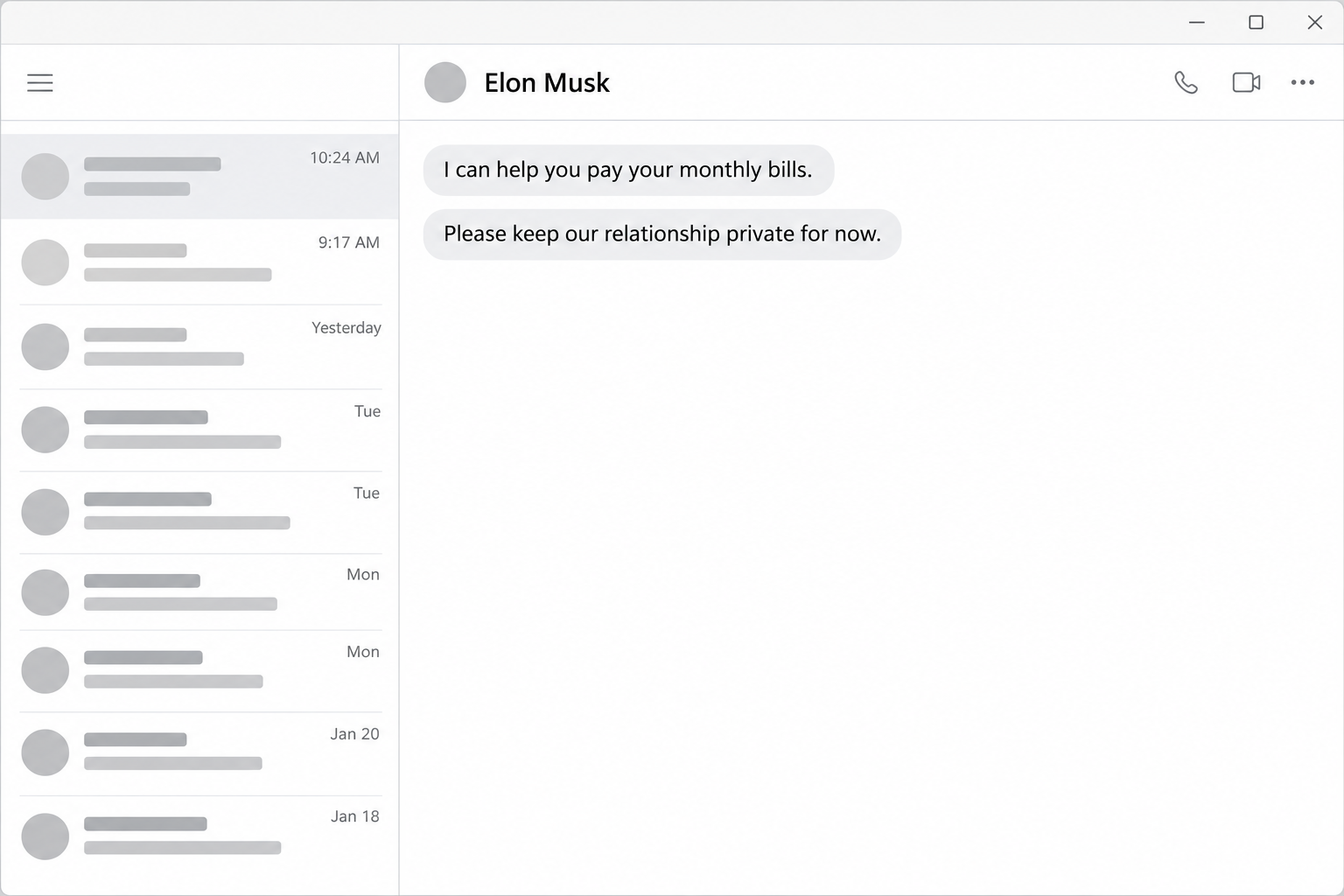
A promise to pay bills can make the story harder to question
Financial help can seem inconsistent with a scammer’s motive. That apparent generosity can persuade someone to trust a stranger with information they would otherwise protect.
However, a payment claim and a person’s identity are different questions. Even a payment confirmed by your provider does not establish that the sender is Musk.
Nor should you assume every claimed payment is fictitious or every payment will reverse. Your own provider must investigate what actually reached the account.
The warning signs concern the relationship and its demands
- An unsolicited private account claims to belong to a famous person seeking a special relationship.
- The conversation becomes secretive, with objections from relatives treated as threats to the relationship.
- Financial promises lead to requests for account access, fees, gift cards, or money transfers.
- The supposed celebrity asks you to trust private explanations instead of independently checking material claims.
The opening image is a fictional reconstruction using invented messages. It illustrates the approach without depicting an actual private conversation or verified payment.
How the Elon Musk Romance Scam Works
Step 1: A private account borrows a public identity
The contact starts with an identity that already carries recognition, wealth, and influence. The victim does not have to discover the person’s reputation from scratch.
Names, profile pictures, and copied public material make the account recognizable. None of those details establishes who is typing or where the messages originate.
A message can arrive through a social platform before the conversation moves elsewhere. Changing apps does not independently verify the person making the invitation.
Look at the claim being made, rather than simply matching the photograph. A public image can accurately show Musk while being uploaded by an unrelated operator.
Step 2: Attention turns the identity claim into an emotional commitment
The conversation becomes personal through regular messages, affection, and future plans. Over time, the account can become part of the victim’s everyday routine.
Surrey Police describes celebrity romance fraud involving prolonged trust building and private messaging. Money requests may arrive after weeks or months of conversation.
Time spent talking does not resolve the original identity question. A long conversation can increase attachment without adding a single independently verifiable fact.
Requests for secrecy can also limit outside scrutiny. Someone who fears losing the relationship may stop discussing troubling details with people they normally trust.
Step 3: Financial help becomes a reason to overlook contradictions
A promise to cover bills introduces something tangible into a relationship built through messages. The victim may interpret that offer as proof of care or extraordinary access.
Separate what was promised from what actually happened. A screenshot supplied by the contact is different from a payment record obtained directly from your provider.
If a provider confirms receiving money, ask it to examine the transaction’s status and method. Do not draw conclusions about clearance from the sender’s explanation.
A payment can require investigation even when the recipient did not send money first. Never supply online banking credentials so a stranger can demonstrate their generosity.
Step 4: The relationship supplies an explanation for a new demand
The contact may eventually ask for money, gift cards, or help moving funds. The request is presented within the relationship rather than as an ordinary transaction.
The celebrity identity can make an otherwise implausible explanation sound exceptional. A supposed business restriction or private emergency becomes a reason to suspend normal caution.
Ask what the requested action would actually do. Buying a gift card transfers value; sharing an authentication code can authorize access regardless of the accompanying romantic explanation.
Do not forward money on the assumption that an earlier payment makes it safe. Ask your own financial provider to review the circumstances first.
Step 5: Doubts are redirected into loyalty tests
When someone questions the story, the contact can characterize hesitation as betrayal. This moves attention away from evidence and onto the victim’s feelings.
A relationship that requires financial secrecy creates practical obstacles to getting help. The victim may hide transactions precisely when an outside review matters most.
You do not need the sender’s permission to ask your bank about your own account. Independent checking is compatible with protecting yourself and your family.
What a Bill Payment Can Actually Establish
Start with your provider’s records, using an account or contact route you already know. Avoid links and telephone numbers supplied by the supposed benefactor.
Ask whether a payment was merely scheduled, received, applied, rejected, or subsequently reversed. Those states are different, even when a screenshot describes all of them as paid.
Ask which payment method was used and whether the provider needs further information. Do not guess that a check, card payment, and bank transfer follow identical rules.
Tell the provider that an unfamiliar online contact arranged the payment. That context matters when its fraud team decides what further review is appropriate.
Do not intentionally repeat a suspicious payment to test it. Preserve existing records and allow the provider to examine the transaction without creating another exposure.
If you were told to reimburse someone or send an excess amount elsewhere, describe that instruction too. The outgoing transfer must be assessed separately from the incoming payment.
There is no universal waiting period that authenticates a stranger. Even a transaction your provider considers complete does not prove the payer’s claimed personal identity.
The useful question is therefore narrower than whether generosity seems believable. Establish what happened financially, then evaluate the account’s identity claims on their own evidence.
Why Photos and Private Calls Do Not Settle the Question
A copied image may be entirely genuine while being used deceptively. Finding the same photograph online can identify its public source without identifying the private sender.
Similarly, receiving a video does not show that it was created for you. The relevant issue is whether the exchange independently authenticates the person involved.
Do not label a particular image or voice AI-generated merely because the account is suspicious. Establishing its production method requires evidence beyond the surrounding story.
You also do not have to solve that technical question before stopping a payment. A money request can be unsafe without a forensic conclusion about its media.
Preserve the original account identifiers and messages if possible. A displayed name can change, while a profile address or platform identifier may help investigators connect reports.
Keep private photographs and conversations out of public arguments about the case. Share necessary evidence through the financial provider’s or reporting authority’s appropriate channel.
What to Do if You Have Fallen Victim to This Scam
-
Stop financial activity connected to the private contact. Do not send another transfer, buy gift cards, forward incoming money, or pay a fee to arrange a meeting.
End the negotiation rather than demanding that the sender prove the story through another transaction. A new payment can increase your exposure without resolving the identity claim.
-
Contact every relevant bank or payment provider promptly. Use its genuine app, an existing statement, or the number printed on your card.
Explain both outgoing transfers and any bill payments the contact arranged. Ask what can be stopped, recalled, investigated, or disputed for those specific transactions.
Record the case reference and follow the provider’s instructions. Do not assume an account balance or a receipt means the institution has already investigated the circumstances.
-
Preserve the conversation before blocking the account. Save profile addresses, account identifiers, payment instructions, receipts, and any request to keep the relationship secret.
Keep the original dates and distinguish your own records from screenshots supplied by the contact. Do not edit a receipt to make the claim easier to explain.
-
Secure any accounts you allowed the contact to access. Replace exposed passwords through the genuine service and review active sessions, recovery information, and authorized access.
If you disclosed authentication codes, tell the affected provider what the code authorized. A password change alone may not address an account setting already altered.
If remote access or an unfamiliar installation was involved, seek device assistance and tell your bank. Do not assume every victim experienced that additional exposure.
-
Report the impersonating profile and the financial deception. Use the platform’s reporting controls and provide the account identifier rather than only its displayed name.
In the United States, the FTC’s response guide for scam victims explains reporting and payment-specific actions. Elsewhere, contact your local fraud reporting authority.
If you shared identity documents, mention that separately and ask about appropriate identity-protection steps. Do not publish the documents in a social media warning.
-
Tell someone you trust what has happened. Practical support can help you gather records, communicate with providers, and resist renewed contact from the same operation.
Be cautious about anyone promising guaranteed recovery for an upfront fee. Your loss does not establish that an unsolicited recovery account can retrieve the money.
If You Sent Gift Card Codes
The FTC’s gift card guidance explains how to contact issuers. Describe the impersonation and ask whether remaining value can be protected.
Keep the physical card or its purchase record, along with the receipt. A picture sent to the impersonator may contain information the issuer needs to identify it.
Do not send those codes to strangers offering help in public comments. They can attempt to use any balance that remains on the card.
If a store employee warned you before the purchase, include that interaction in your own timeline. It can help explain how the payment occurred.
Also preserve any instruction telling you what to say at checkout. Give investigators the actual message rather than recreating it from memory.
The issuer can explain its options, but reporting does not guarantee reimbursement. Stop buying additional cards while that review is underway, whatever explanation the contact provides.
How to Help Someone Who Believes the Relationship
Start with the person’s immediate financial safety rather than an argument about their intelligence. Shame can make someone less willing to show you the messages.
Ask to review one concrete claim together, such as a bill payment or transfer request. Use the real provider’s records rather than the contact’s screenshots.
Keep the question focused on independently checkable facts. Showing that Musk is wealthy does not verify a private account claiming to be him.
Offer to sit with the person while they contact their bank through a familiar channel. They should retain control of the conversation and their account credentials.
If they will not end contact immediately, encourage a pause on financial activity while the account is reviewed. That pause can reduce harm without demanding instant agreement.
Do not secretly message the impersonator as the victim or send a test payment. Preserve evidence already available and discuss further action with the appropriate provider.
If urgent threats or immediate personal danger arise, contact local emergency services. Financial fraud advice cannot substitute for help with an immediate safety crisis.
Frequently Asked Questions
Is this an allegation that Elon Musk runs the scam?
The scam concerns impostors using his identity in private conversations. Surrey Police identifies celebrity impersonation as the problem, rather than participation by the person being impersonated.
Does a payment to my bill prove the contact is genuine?
A provider-confirmed payment establishes a financial event, not the sender’s claimed identity. Ask the provider to review its status and method before acting on further instructions.
Will every payment arranged by an impostor be reversed?
That cannot be determined from the impersonation claim alone. Your provider must assess the actual transaction; payment methods and individual circumstances require different handling.
Can a real photograph establish who sent the message?
A genuine public photograph can be copied into an unrelated account. Its authenticity does not authenticate whoever controls the profile or the private conversation.
Should I keep talking until the sender asks for money?
You do not need to wait for a financial demand before ending an unverified approach. Avoid sharing private information while deciding whether to report the account.
What if a relative refuses to believe the warning?
Offer practical help checking a specific transaction and encourage a pause on payments. Keep communication open so embarrassment does not prevent them from seeking assistance later.
The Bottom Line
Do not send money, account access, or gift cards to a private contact claiming to be Elon Musk. Affection and financial promises do not authenticate that identity.
If you already responded, preserve the messages and contact affected financial providers through genuine channels. Have them examine actual transactions, then report and block the impersonating account.

Join the discussion
0 commentsShare your experience or ask a question about this article.
Community experiences
Did this happen to you?
Your experience could help someone recognize the same scam. Submit a private report for our team to review.
I experienced this tooReports are reviewed before publication. Sharing publicly is always your choice.
Discussion
Start the conversation
Have a question or something useful to share? Add the first comment.