

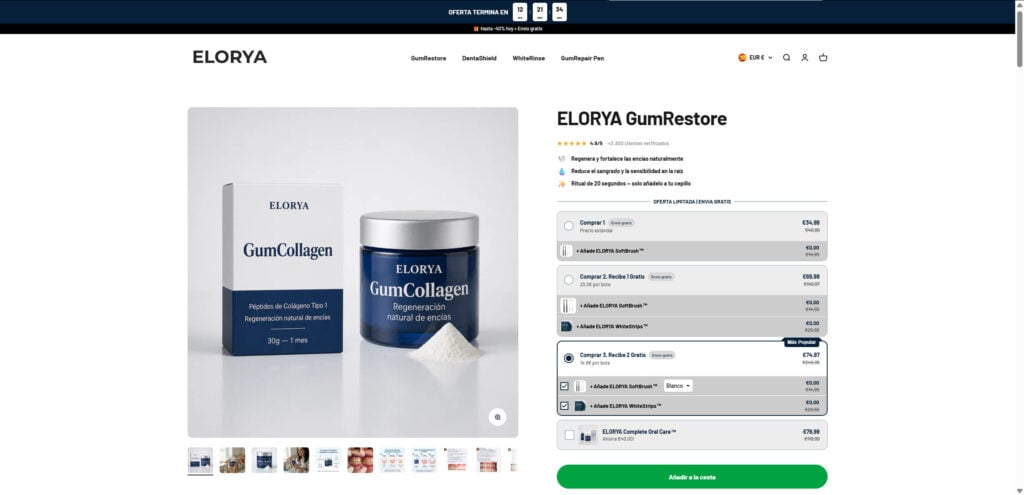
Elorya Gum Collagen, also sold on the site as ELORYA GumRestore, is promoted as a gum-support powder that claims to regenerate and strengthen gums naturally, reduce bleeding, reduce root sensitivity, and improve the appearance of the gum line.
The product page looks polished and convincing, but the claims, recurring-purchase wording, weak company transparency, and template-style storefront raise serious concerns.
This review breaks down what Elorya claims, what the product likely is, and why buyers should be careful before ordering.
Overview
Elorya presents GumRestore as a “GumCollagen” powder that is applied during brushing. The site claims the formula uses type I hydrolyzed collagen, nano-hydroxyapatite, pine bark extract, vitamin C, and xylitol. It says users only need to wet a toothbrush, dip it into the powder, and brush the gums for 20–30 seconds. The page claims visible results in 6–8 weeks.
The product page claims:
- “Regenerates and strengthens gums naturally”
- Reduces bleeding and root sensitivity
- Helps gum tissue become firmer and healthier
- Supports a more even-looking gum line
- Works in a 20-second brushing ritual
- Has 4.8/5 from more than 2,300 verified customers
Those are strong claims for an oral-care powder.
A product can physically exist and still be marketed in a misleading way. The main issue here is not whether Elorya ships a jar of powder. The issue is whether the claims about gum regeneration, bleeding reduction, sensitivity, and collagen penetration are realistic and properly substantiated.
Major Red Flags
1. “Regenerates gums naturally” is a major claim
The strongest red flag is the claim that Elorya can “regenerate” gums naturally.
Gum recession is not a simple cosmetic issue. Once gum tissue has receded, it generally does not grow back on its own. Cleveland Clinic states that receding gums cannot grow back, although steps can be taken to prevent recession from worsening.
That matters because the Elorya page repeatedly gives buyers the impression that a powder applied during brushing can strengthen, improve, or visibly restore the gum line.
A product may support oral hygiene or comfort. But claims about gum regeneration, recession improvement, or tissue repair should be supported by strong dental evidence, not just seller-controlled survey results.
2. “Collagen penetrates directly into gum tissue” sounds questionable
Elorya claims that type I collagen “penetrates directly into the gingival tissue during brushing.”
That is a serious biological claim.
A powder sitting on the gums for 20–30 seconds is not automatically going to rebuild gum tissue or penetrate deeply enough to regenerate damaged tissue. If a company makes that claim, it should provide:
- product-specific clinical testing
- ingredient absorption data
- gum-tissue penetration evidence
- dentist-reviewed studies
- before-and-after documentation from controlled trials
- safety testing for daily gum application
The page does not show that level of proof.
3. Survey percentages are used as proof
The page claims:
- 87% felt stronger and healthier gums in 2 weeks
- 91% noticed less gum sensitivity and discomfort
- 84% saw a better-looking gum line and more even smile
But the site itself says these numbers are based on an internal survey of Elorya users.
Internal surveys are not the same as clinical evidence.
They do not prove that the product regenerates gums, reduces gum recession, or treats gum disease. They are marketing claims unless backed by transparent methodology, sample size details, independent verification, and objective dental measurements.
4. The product is positioned around bleeding and sensitivity
Elorya says GumRestore reduces bleeding and root sensitivity.
That matters because gum bleeding and tooth sensitivity can be signs of real dental problems, including:
- gingivitis
- periodontal disease
- aggressive brushing
- gum recession
- enamel erosion
- exposed tooth roots
- plaque or tartar buildup
- infection
A powder should not be treated as a substitute for a dentist.
Even the Elorya FAQ says users should continue flossing and visiting the dentist normally.
5. Recurring-purchase wording appears on the product page
One of the most concerning details is the recurring-purchase language on the product page.
Near the add-to-cart section, Elorya states in Spanish that the item is a recurring or deferred purchase, and that by continuing, the buyer accepts the cancellation policy and authorizes charges according to the prices, frequency, and dates shown until the order is prepared or canceled if permitted.
That is a major warning sign.
A customer may believe they are buying one jar of gum powder, but the checkout language suggests the possibility of recurring billing or deferred purchase terms.
Before ordering, buyers should check carefully for:
- subscription
- recurring purchase
- auto-refill
- deferred billing
- monthly charge
- next billing date
- cancellation rules
This is especially important because many complaint patterns around similar products involve buyers being charged again or receiving more units than expected.
6. The site has weak company transparency
The Contact page is extremely thin. It shows a contact form but does not clearly provide a full legal company name, business address, phone number, manufacturing details, dental professional team, or direct support infrastructure.
For an oral-care product making gum-health claims, that is not ideal.
A trustworthy oral-health brand should make it easy to verify:
- who owns the company
- where the product is manufactured
- who formulated it
- whether dentists were involved
- whether testing was performed
- how refunds and cancellations work
- how to reach support if there is a problem
Elorya does not provide enough of that information on the visible contact page.
7. The store still has template-style leftovers
The homepage includes a newsletter area with placeholder-style text: “Describe what your customers will receive when subscribing to your newsletter.”
That may sound minor, but it matters.
Template leftovers are common on fast-built Shopify stores. They suggest the site may have been assembled quickly and not carefully reviewed.
When a site sells oral-health products with strong biological claims, sloppy template text reduces trust.
8. Multiple Elorya products use similar strong dental claims
Elorya does not only sell GumRestore. The site also lists DentaShield, WhiteRinse, and GumRepair Pen. Some of these products make similarly strong claims, such as repairing teeth “from within,” repairing gum tissue directly, reducing inflammation and bleeding, or whitening teeth through color correction. (Elorya)
That pattern is important.
The brand appears to be built around aggressive oral-care claims across several products, not just one.
What Elorya Gum Collagen Probably Is
Elorya GumRestore appears to be a topical oral-care powder with ingredients such as:
- hydrolyzed bovine type I collagen
- nano-hydroxyapatite
- pine bark extract
- vitamin C
- xylitol
Some of these ingredients may have oral-care or cosmetic relevance. Nano-hydroxyapatite, for example, is used in some toothpastes. Xylitol is common in dental products. Vitamin C is associated with gum health.
But that does not prove this exact product can regenerate gums, repair recession, reduce bleeding, or rebuild gum tissue.
The realistic expectation is much more modest:
- It may feel soothing.
- It may leave the mouth feeling cleaner.
- It may support a daily oral-care routine.
- It may temporarily reduce discomfort for some users.
- It may act as a cosmetic gum-care powder.
That is very different from gum regeneration.
How This Type of Operation Works
Step 1: Target a real fear
Gum recession, bleeding gums, exposed roots, and tooth sensitivity are common concerns. People do not want dental surgery or expensive treatment.
That makes them vulnerable to products promising an easy at-home solution.
Step 2: Use scientific-sounding ingredients
The product uses ingredients that sound credible:
- collagen
- nano-hydroxyapatite
- vitamin C
- pine bark extract
- xylitol
This gives the page a science-like feel.
Step 3: Make the routine look effortless
The pitch is simple: add powder to your toothbrush for 20–30 seconds and wait for gum improvement.
That is far easier than dental treatment, which is why the offer is appealing.
Step 4: Use survey results and testimonials
The site shows internal survey percentages and customer-style review images.
This makes the product feel proven without presenting clinical proof.
Step 5: Add subscription-style purchase language
The product page includes recurring or deferred purchase authorization language.
That may increase the risk of unexpected repeat charges if buyers do not read the checkout carefully.
Is Elorya Gum Collagen a Scam?
Not necessarily a fake-product scam
Elorya may ship a real oral-care powder.
The product may contain the listed ingredients.
But it is high-risk from a marketing standpoint
The concerns are:
- strong gum regeneration claims
- claims about collagen penetrating gum tissue
- bleeding and sensitivity claims
- internal survey results used as proof
- recurring-purchase wording
- weak company transparency
- template-style leftovers
- no clearly visible independent clinical evidence
The most accurate verdict is:
Elorya Gum Collagen appears to be a high-risk oral-care product marketed with claims that may go beyond what the evidence shown on the website can support.
Should You Buy Elorya Gum Collagen?
For most buyers, caution is warranted.
Reasons to be careful
- Gum recession does not naturally grow back.
- Bleeding gums may signal gum disease.
- The product page does not show strong independent clinical proof.
- The site uses recurring-purchase language.
- Contact and company transparency are limited.
- The claimed results are based on internal survey data.
If you still consider buying it
Treat it as a cosmetic oral-care powder, not a gum-regeneration treatment.
Do not buy it expecting:
- receded gums to grow back
- gum disease to be cured
- root sensitivity to disappear
- bleeding gums to resolve without dental care
- collagen to rebuild gum tissue in weeks
- dentist-level treatment from a powder
What To Do If You Already Ordered
1. Check for recurring billing
Review your order confirmation and payment details immediately.
Look for:
- recurring purchase
- subscription
- deferred purchase
- auto-refill
- next billing date
- cancellation policy
- monthly charge
The product page itself includes recurring or deferred purchase authorization language, so this is important.
2. Save screenshots
Take screenshots of:
- “regenerates gums naturally”
- bleeding and sensitivity claims
- collagen penetration claims
- internal survey percentages
- 30-day guarantee wording
- recurring-purchase language
- checkout total
- order confirmation
- contact page
These may help if you need to dispute a charge.
3. Do not rely on it for gum disease
If you have bleeding gums, gum recession, loose teeth, bad breath, swelling, pus, pain, or persistent sensitivity, see a dentist.
Do not use Elorya as a substitute for:
- periodontal cleaning
- scaling and root planing
- gum disease treatment
- desensitizing treatment
- gum graft consultation
- professional dental diagnosis
4. Inspect the product before using it
When it arrives, check:
- ingredient list
- expiration date
- safety warnings
- country of origin
- manufacturer details
- batch or lot number
- seal condition
- instructions
- whether it matches the product page
Do not use it if the packaging looks incomplete, mislabeled, or unsafe.
5. Stop if irritation occurs
Because the product is applied directly to the gums, stop using it if you notice:
- burning
- swelling
- rash
- worsening bleeding
- gum pain
- mouth sores
- allergic reaction
- increased sensitivity
Contact a dentist or doctor if symptoms continue.
6. Request cancellation or refund quickly
If you did not intend a recurring purchase, contact support immediately.
Use a clear message:
I am requesting cancellation of any recurring purchase, subscription, or deferred billing linked to order #[number]. Please confirm in writing that no future charges or shipments will occur.
For a refund, use:
I am requesting a refund for order #[number]. The product does not match the expectations created by the sales page. Please confirm the refund process and timeline in writing.
7. Dispute charges if necessary
If you are charged again unexpectedly, cannot cancel, receive more units than expected, or the seller refuses to honor its stated policy, contact your payment provider.
Use documentation showing:
- what you ordered
- what the product page said
- the recurring-purchase wording
- what you were charged
- your cancellation or refund request
The Bottom Line
Elorya Gum Collagen is not clearly a fake product. Buyers may receive an oral-care powder.
The problem is the marketing.
The site promotes the product as a gum-regenerating, gum-strengthening powder that can reduce bleeding and sensitivity, while relying on internal survey data, strong biological claims, and recurring-purchase language that buyers may miss.
The safest conclusion is simple:
Elorya Gum Collagen looks like a high-risk oral-care product sold with exaggerated gum-regeneration claims and possible recurring-purchase concerns. Treat it as a cosmetic gum-care powder, not a proven treatment for gum recession, bleeding gums, or periodontal disease.








