


Missed calls, unanswered leads, and another evening spent chasing appointments: EmilyOne pitches an AI team that takes those jobs off a small-business owner’s plate.
Alongside the software plans is a second invitation, to earn by sharing the service. Before choosing either, separate what you would buy from what you might earn.
Overview
EmilyOne advertises business software, not a paid job
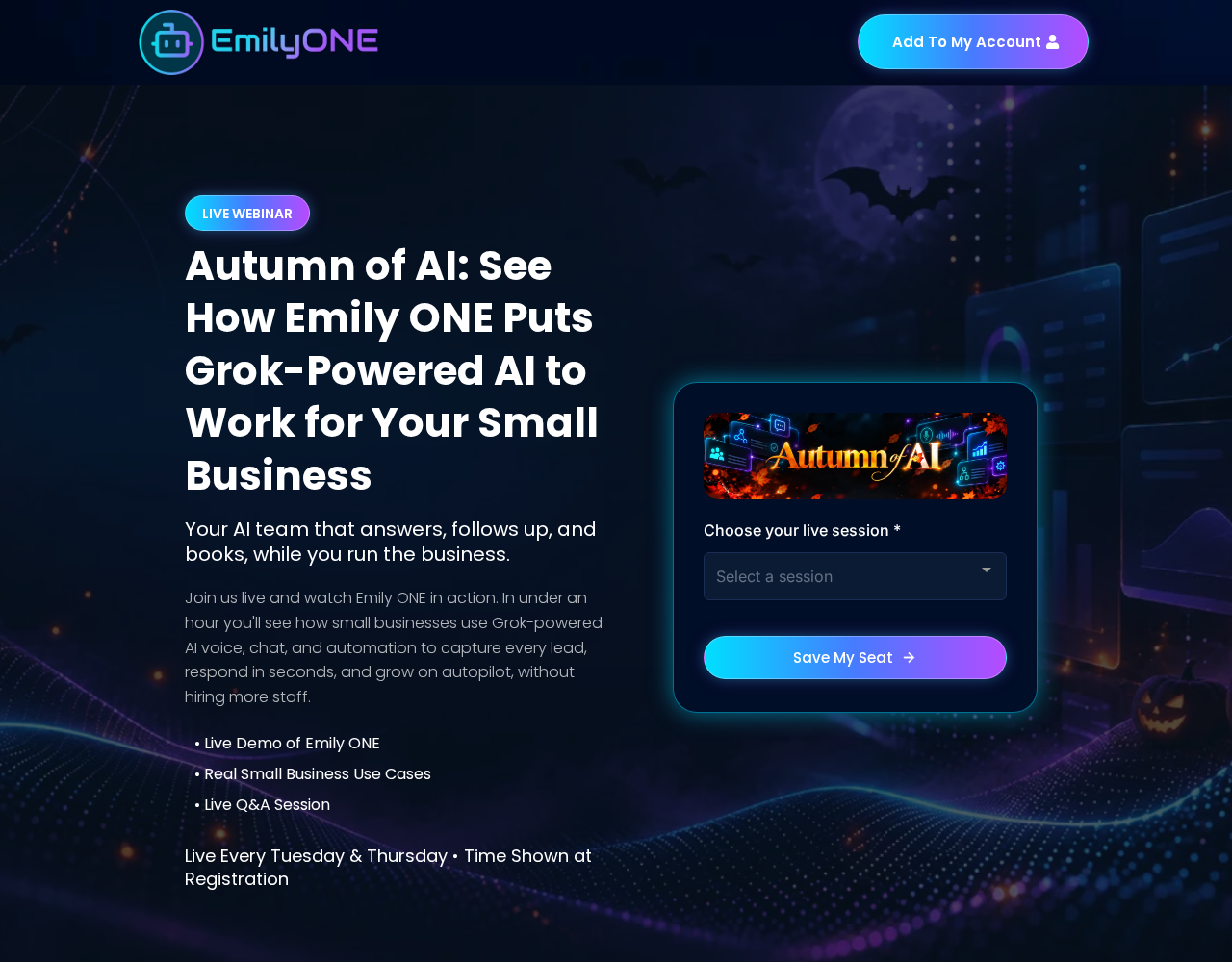
The current EmilyOne website promotes AI voice, chat, lead follow-up, and appointment booking for small businesses. Its webinar is presented as a demonstration of those functions.
Published monthly plans run from $97 to $497, with different seats and usage allowances. These are customer subscription prices, not wages or guaranteed earnings.
Calling the service Grok-powered is a technology claim. It does not, by itself, establish an endorsement, guarantee, or business partnership from the model provider.
The referral offer is a separate financial decision
The page also promotes commissions on referred plan purchases. One tier displays 30% on direct sales; another combines second-tier language with a 10% plus 20% graphic.
That presentation needs a complete written explanation before you rely on it. A commission graphic is not an income disclosure or the full eligibility agreement.
The public page does not resolve every qualification rule, including whether purchasing your own subscription is required for a particular commission role.
The purchase terms need to be accessible
- The website publishes monthly prices, but your full usage costs still need clarification.
- Its registration consent includes marketing messages, calls, and emails, not just access to educational material.
- The linked terms and privacy addresses returned to the webinar registration page during checks.
- The public offer does not establish typical participant net earnings.
- Software performance, integration quality, and support were not tested through a paid account for this article.
This is a buyer-risk investigation, not a finding that every subscription is fraudulent. The concerns involve informed purchasing, accessible terms, and the distinction between software value and referral income.
How the EmilyOne Webinar and Subscription Funnel Works
Step 1: The webinar promises relief from everyday business tasks
The offer begins with familiar frustrations: answering questions, following up with prospects, and turning inquiries into booked appointments. These are real problems for small businesses.
An automated assistant could be useful, but the value depends on what it does in your particular workflow. A broad promise cannot establish that fit.
Before attending a demonstration, identify one task you need solved. Bring a realistic example, including an unusual question or a booking that should require human approval.
Watch what happens when the system does not know the answer. Handling uncertainty may matter more than a polished response to a prepared question.
Step 2: Registration also asks for communication consent
The registration wording includes consent to marketing and non-marketing AI SMS messages, calls, emails, and promotions from EmilyOne.
That is broader than simply receiving a webinar link. Read the actual checkbox text before sharing a phone number.
The page describes reply STOP for text opt-out and HELP for assistance. Those instructions concern messaging; they should not be assumed to cancel a paid subscription.
If you only want product information, decide whether the requested communication arrangement suits you. A free event can still involve a meaningful personal-data decision.
Step 3: The monthly plans make the service look easy to compare
Platinum is listed at $97 per month, Elevate at $297, and Dominate at $497. Higher plans display more seats and larger message allowances.
Other listed units include companies and video minutes. Those labels need definitions before you can translate the package into actual work.
Ask whether a company means an available business record, a customer account, or something else. Do not assume thousands of companies means thousands of interested buyers.
Also distinguish a seat for a human user from an AI agent or business workspace. The same familiar word can describe very different allowances.
Step 4: The referral option introduces an income expectation
The page invites visitors to share a link and earn on plan purchases. It refers to monthly and annual sales and offers more than one referral tier.
Before joining, obtain the compensation agreement. It should explain eligibility, commission calculations, payment timing, cancellations, refunds, and any reversal of commissions.
Do not assume the larger software plan creates larger or easier earnings. Product allowances and compensation qualifications are different questions.
If the main reason to subscribe is that you expect referrals to cover the bill, calculate the risk of having no referrals at all.
Step 5: Activation creates ongoing costs and responsibilities
A business assistant may need access to customer conversations, calendars, or other systems. Those permissions deserve review before activation, not after a problem.
Understand who configures the assistant, who checks its responses, and how to pause it. Automation does not remove the business owner’s responsibility to customers.
Separately, know when billing renews and how to cancel. An attractive demonstration should not leave you unable to identify the agreement covering the purchase.
Do not supply payment details or real customer records while those essentials remain unresolved.
EmilyOne’s Operator, Billing, and Data Questions
Identify the business taking the payment
The brand name on a presentation is not enough for your accounting records. Establish the contracting legal entity, support address, and expected merchant descriptor.
These details matter if the service fails, a bill is disputed, or you need a business invoice. Keep them with the order confirmation.
A webinar presenter or referral contact may help with setup, but that does not necessarily make them the contractual service provider.
The linked policies did not provide a readable agreement
Links labeled Privacy Policy and Terms of Service pointed to dedicated addresses. During checks, both led back to the webinar registration destination instead of those documents.
This is a specific access problem, not proof that no policies exist anywhere. It still leaves an important gap for someone deciding whether to pay.
Request the actual documents before purchase. Save a copy of the version offered, rather than accepting a verbal assurance that standard terms apply.
Calculate the price of your actual usage
The monthly headline does not answer every operational question. Clarify what counts toward each allowance, what happens at the limit, and whether other services cost extra.
Ask specifically about voice usage, phone numbers, messaging, integrations, setup assistance, and data export where relevant. These are questions, not claims that every item carries a fee.
A browser-visible booking widget also advertised a separate $100 done-for-you session. Do not assume optional setup assistance is included in every subscription.
Protect customer information before connecting systems
An assistant handling real conversations may receive information your customers did not expect to enter another service. Understand that flow before connecting a live account.
Ask what is stored, who can access it, how long it remains, and how it can be exported or deleted. Request the relevant written data terms.
Test with non-sensitive sample information first. Do not upload a complete customer database merely to find out whether a demonstration works.
What the Monthly Price Means Without Referral Income
Budget for the subscription standing on its own
Twelve monthly payments at $97 total $1,164. At $297, they total $3,564; at $497, $5,964. These are arithmetic examples, not quoted annual-plan prices.
They exclude discounts, taxes, optional services, and any usage charges. Your actual agreement would determine the final bill.
Compare that expenditure with measurable benefits: hours genuinely saved, inquiries answered correctly, or appointments that would otherwise have been missed.
A larger allowance is not automatically better value. Paying for capacity you do not use can erase the savings the automation was supposed to produce.
A commission rate is not a net profit
For illustration, 30% of a $97 sale is $29.10. Four such commissions would total $116.40 before expenses, taxes, refunds, or other adjustments.
That is a hypothetical calculation using the displayed direct-sales rate. It does not establish your eligibility, the number of buyers you can find, or actual payment.
Marketing time, advertisements, training, and your own subscription may all affect the economics. Include the costs you actually incur rather than comparing gross commissions alone.
If nobody buys through your link, would you still want the software at the agreed price? That question keeps the product decision grounded.
Recruitment concerns need evidence, not labels
The FTC’s MLM guidance explains that compensation structures require fact-specific scrutiny. Neither a real product nor referral payments alone settle the legal question.
For EmilyOne, the public page leaves eligibility and the second-tier calculation insufficiently clear. Do not fill those gaps with a promoter’s most optimistic interpretation.
There is no need to declare a criminal scheme to decline an agreement you cannot read or an earnings claim you cannot substantiate.
How to Evaluate the AI Service Itself
Use a demonstration that resembles your business
Ask the assistant an ordinary question, an ambiguous question, and a question it should not answer. Check whether it hands uncertainty to a person.
Test a changed appointment, an unavailable time, and a request outside your policies. A smooth initial booking is only one part of the workflow.
Confirm how you review activity and correct mistakes. If you cannot pause an unwanted automation quickly, an apparently convenient feature can become a customer-service problem.
Ask what the service can take with it when you leave
Before connecting a business number, calendar, or customer records, understand what remains yours and what happens when the subscription ends.
Check whether you can export contacts, conversation history, and settings in a usable format. Do not assume a screen showing your data guarantees an easy export.
This is ordinary supplier due diligence. It is especially important when the sales journey emphasizes effortless automation more than the practical details of operating it.
What to Do If You Registered or Subscribed to EmilyOne
- Separate webinar registration from a paid order.
Check your receipt, bank statement, and account confirmation. Attending a free presentation is not the same as authorizing a software subscription or setup session.
Record exactly what you selected and what, if anything, was charged. Do not assume a charge exists merely because you supplied contact information.
- Obtain the agreement covering your purchase.
Ask for the service terms, cancellation instructions, refund conditions, and billing schedule. Mention if the published policy links return to the registration page.
Keep the response and the purchase-date documents. A later change to the website should not be your only record of the original offer.
- Stop an unwanted subscription through the billing route.
Make a clear written cancellation request and ask when it takes effect. Save the confirmation and check the next statement.
Opting out of promotional texts is a separate matter. Do not rely on a STOP reply as proof that subscription billing ended.
- Contact the payment provider about unresolved charges.
Explain whether the issue is unauthorized payment, a canceled renewal, or service materially different from what was promised. Provide the relevant records.
Ask about applicable deadlines and evidence requirements. Do not describe an authorized purchase as stolen-card fraud simply because you regret it.
- Review any connected business systems.
If you connected calendars, mailboxes, or customer tools, identify the permissions granted. Pause unnecessary automations before removing access through those services’ established controls.
Preserve the records needed for your business first. Deleting an integration and canceling its subscription may require different actions.
- Keep referral claims within what you can document.
Do not promise passive income, guaranteed commissions, or that the software will pay for itself. Distinguish personal results from what another buyer should expect.
If you referred someone under a mistaken understanding, correct it promptly and share the actual written terms you have.
- Control future contact and protect your records.
Use the stated messaging opt-out if you no longer want promotional texts. Keep a record if contact continues after your request.
Report specific deceptive conduct through the appropriate consumer-protection channel, such as ReportFraud.ftc.gov in the US. Include facts, not speculation about the software’s origin.
Frequently Asked Questions
Is EmilyOne a job that pays me to use AI?
The public offer advertises paid software subscriptions and a referral option. It is not presented as an employment agreement or a guaranteed wage.
Does Grok-powered mean the model provider guarantees the service?
No. A statement about underlying technology does not establish an endorsement or guarantee. Evaluate the actual service, operator, agreement, and demonstrated functions separately.
Are the listed monthly prices the complete cost?
They are the published plan prices. Clarify usage limits and any optional services before paying; do not assume every possible operational cost is included.
Does the referral offer prove EmilyOne is a pyramid scheme?
No. That determination requires more than a commission graphic. The immediate concern is obtaining complete eligibility and payment terms before relying on an income claim.
Why do the policy-link redirects matter?
They prevented the linked documents from being read through those routes during checks. Obtain accessible copies before consenting to billing or sharing business data.
What should I do if I want to leave?
Cancel through the subscription channel, preserve confirmation, review connected-system access, and export needed records. Handle marketing opt-out separately from billing cancellation.
The Bottom Line
Do not subscribe to EmilyOne for promised referral income or pay while the contract and cancellation rules remain inaccessible. Judge the software by demonstrated business value.
If you already joined, get the governing terms, review billing and connected permissions, and cancel unwanted services in writing. A commission pitch should not control that decision.

Join the discussion
0 commentsShare your experience or ask a question about this article.
Discussion
Start the conversation
Have a question or something useful to share? Add the first comment.