

The Energy Revolution System is being pushed through social media ads as a “buried Tesla blueprint” that can help you build a DIY device, slash your electric bill by up to 80%, and even reach “energy independence.” The ads route people through rotating domains like theenergyrevolution.net and energyrevoloutionsystem.com, then lock them into a long sales video and urgency popups.
This article breaks down what the offer claims, how the funnel works, what buyers typically receive, and why the “free electricity” story is a major red flag.
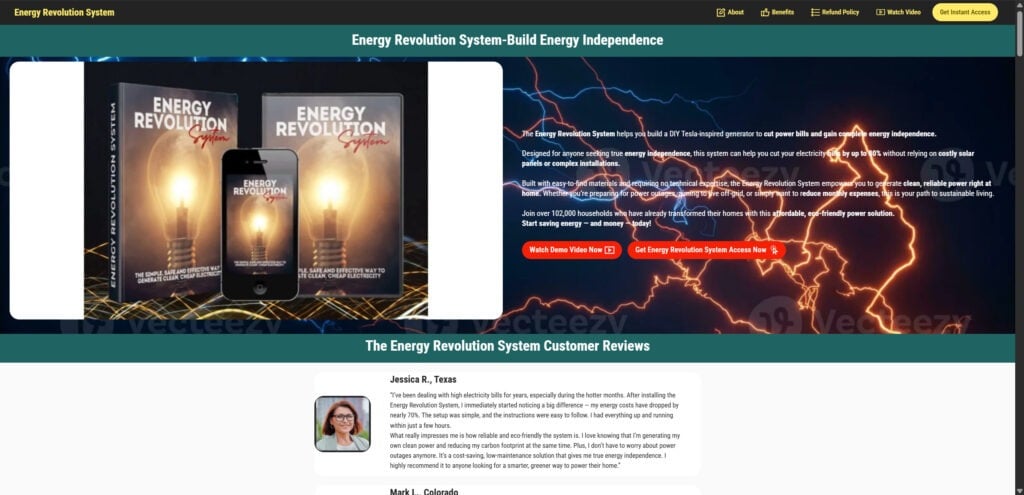
Scam Overview
The Energy Revolution System is marketed as a DIY, Tesla-inspired path to “energy independence.” On the surface, it looks like a polished digital product: a branded cover, buttons for “Watch Demo Video,” “Benefits,” and “Refund Policy,” plus an access button that leads you deeper into the funnel.
But when you slow down and read what is actually being promised, the red flags stack up fast.
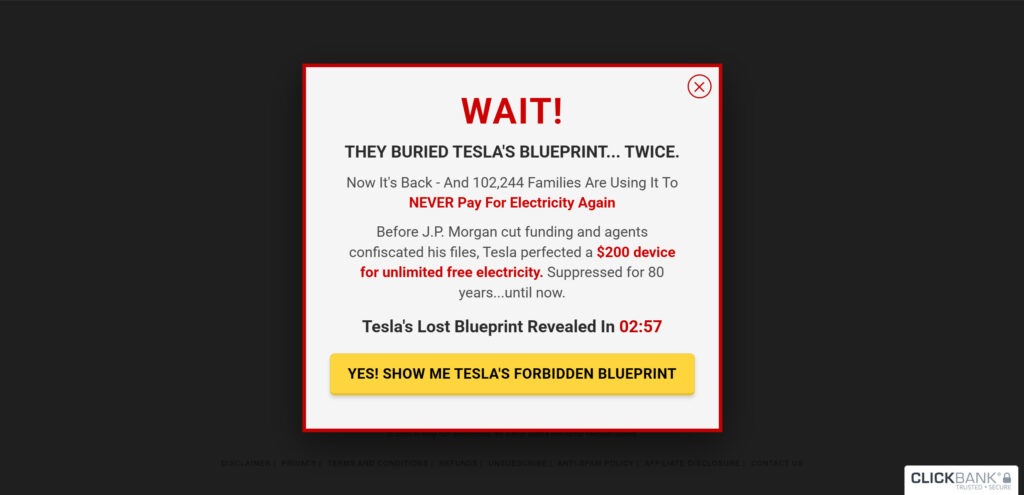
What the Energy Revolution System claims to do
Across the versions of this funnel, the core promise stays consistent:
- You can build a DIY Tesla-inspired generator at home
- It will cut your power bills by up to 80%
- It will help you reach complete energy independence
- It uses easy-to-find materials
- It requires no technical expertise
- It does not rely on costly solar panels or “complex installations”
- It is already used by over 102,000 households (a number presented as proof)
That is the pitch in plain language. And it is designed to hit people where it hurts most: monthly bills, uncertainty, and the feeling that utility costs are out of control.
The problem is that the promise is framed like a near-miracle.
A small, beginner-friendly DIY build that produces reliable power for a household, cuts bills by 80%, and does it without solar, fuel costs, permits, grid-tie complexity, or real electrical know-how is not a realistic claim. It is marketing.
The “buried Tesla blueprint” storyline is the hook
This scam format almost always uses a dramatic origin story to make the offer feel forbidden, urgent, and revolutionary.
In this case, the theme is:
- Tesla created a device or method
- Powerful interests suppressed it
- The blueprint was “buried” or confiscated
- Now it has resurfaced, and you can get it today
- If you leave, you might miss your chance
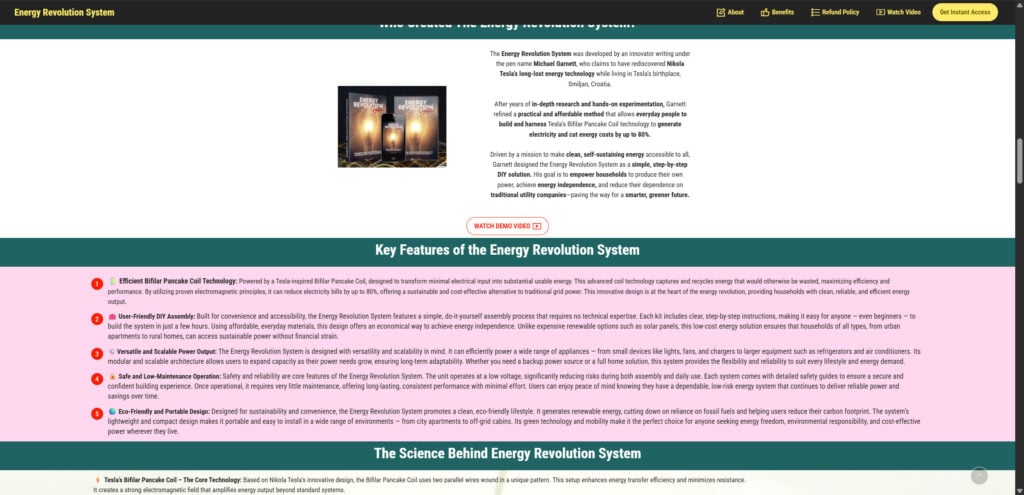
One version uses a popup-style interruption that screams urgency with language like “WAIT,” “Tesla’s forbidden blueprint,” and a countdown timer. It is the same trick used across many digital grifts: make the viewer feel like leaving equals losing a once-in-a-lifetime secret.
It is not education. It is pressure.
“Tesla-inspired” does not mean “Tesla-approved,” and it definitely does not mean “free power”
Tesla was a real inventor who worked on real electrical systems. Scammers love his name because most people recognize it instantly, and because the legend of “lost Tesla inventions” is easy to dramatize.
But using Tesla’s name in a sales script does not make the underlying claim true.
A “Tesla-inspired generator” is still a generator. Generators need an input energy source. They convert energy, they do not create it from nothing.
If the pitch implies “unlimited electricity” or “never pay again” from a small DIY device, you are looking at the oldest trick in the book.
The pseudo-science language is meant to sound technical, not to be testable
The funnel leans on scientific keywords to build credibility. Common examples include:
- “electromagnetic induction”
- “advanced capacitors”
- “efficiency” and “recycled energy”
- “smart energy monitoring”
- “control unit linked to your electrical panel”
- “intelligent sensors”
- references to Tesla coils, including the bifilar pancake coil
Here is what matters: none of those words automatically equal a working home power system.
Real home power solutions are measurable. They list:
- input source (solar wattage, wind turbine rating, generator fuel consumption)
- inverter capacity and safety certifications
- battery chemistry and storage capacity (kWh)
- installation requirements
- whether it is off-grid or grid-tied
- permits and inspection requirements
- realistic output limits and use cases
This funnel avoids that level of clarity because it would force the claim to face reality.
A major tell: copy-paste content that does not even match the product
One of the clearest red flags appears when you scroll deeper.
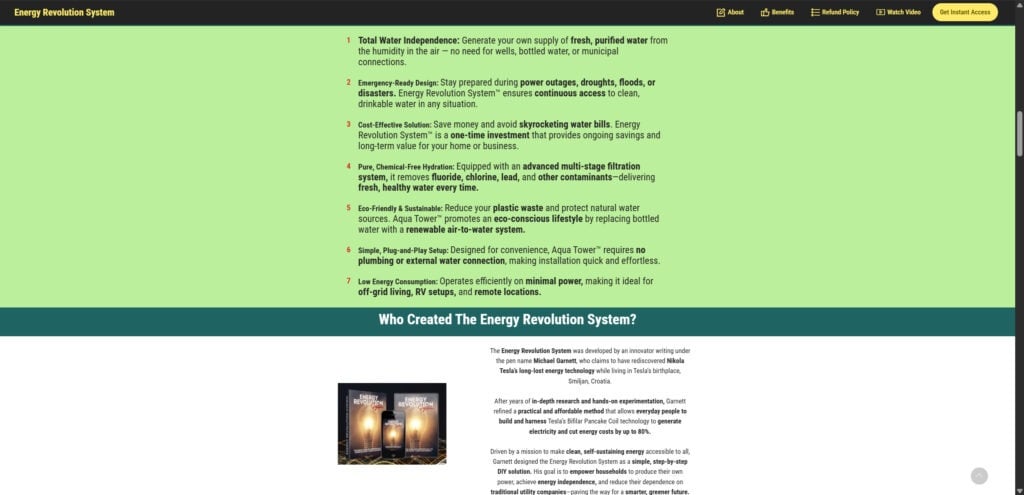
A section labeled “Why Energy Revolution is Unique?” suddenly shifts into claims that have nothing to do with an electricity generator, including:
- “Total Water Independence”
- producing “fresh, purified water from the humidity in the air”
- “multi-stage filtration” removing fluoride, chlorine, and lead
- “Aqua Tower” mentioned by name
- “no plumbing or external water connection”
That is not a small mistake. That is a template problem.
It strongly suggests the page was built by reusing sections from another unrelated pitch, likely an atmospheric water generator style product, and swapping branding at the top.
When a page cannot keep its own story straight, you should not trust it with claims about powering your home.
The “creator story” is vague and hard to verify
Another section describes the system as developed by someone using a pen name, presented as Michael Garnett (spelling variations show up), claiming a connection to Tesla’s birthplace in Smiljan, Croatia.
That kind of biography is carefully chosen:
- it sounds romantic and credible
- it avoids verifiable credentials
- it gives the funnel a “lone inventor” hero figure
- it discourages buyers from asking hard questions
A legitimate energy product does not need a mysterious pen name and a dramatic location tie-in. It needs evidence, test results, and clear specifications.
Why the main promise collapses under simple common sense
You do not need an engineering degree to spot the mismatch between the marketing and the real world.
Start with basic questions the funnel never answers clearly:
- What is the energy input? If it is not solar, not wind, not fuel, and not grid power, what is it using?
- How much output power does it produce? Real systems are measured in watts and kilowatts.
- Can it run a refrigerator, HVAC, or a water heater? For how long?
- How is it safely connected to a home electrical panel? That is not a beginner project.
- Is it certified and code-compliant? Home electrical systems have rules for a reason.
- Where are the independent tests? Not testimonials. Not “families are using it.” Real tests.
Now look back at the marketing claims:
- “no technical expertise”
- “built with easy-to-find materials”
- “cut bills by up to 80%”
- “complete energy independence”
- “reliable power right at home”
- “without costly solar panels”
That combination is the giveaway. It is selling a fantasy: a shortcut around physics, safety rules, and real costs.
What buyers typically receive
Based on how these offers are structured, most buyers end up with some variation of:
- a digital guide (often PDFs)
- basic diagrams or parts lists
- generic “energy saving” advice mixed in
- bonus files designed to increase perceived value
- upsells offered after purchase
Even if the materials contain some real electrical concepts, that does not make the headline promise true. It just means you paid for information packaged like a breakthrough.
And because the pitch encourages people to think about connecting something to their home power setup, there is also a safety concern. A poorly built DIY device connected improperly can cause electrical shock, fire risk, damaged appliances, or worse.
How The Scam Works
This scam is less about one specific website and more about a repeatable machine. The branding changes, the domains change, the story changes slightly, but the funnel structure stays the same.
Here is the step-by-step playbook.
Step 1: The ad targets high bills and frustration
These campaigns often target people who are:
- angry about rising utility costs
- worried about outages
- interested in off-grid living
- searching for “Tesla generator,” “free energy,” or “cut electricity bill” solutions
The ad does not lead with details. It leads with emotion.
It suggests there is a hidden solution, and that ordinary people are finally getting access to it.
Step 2: You get routed through multiple domains
You might start on one domain and end up on another, like:
- theenergyrevolution.net
- energyrevoloutionsystem.com (and similar variations)
This is common in scam-style affiliate funnels. Domain rotation helps with:
- tracking campaigns
- avoiding ad platform crackdowns
- sidestepping bad reviews tied to one domain
- keeping the operation running even if one site gets flagged
Step 3: The landing page pushes you into a long sales video
Once you arrive, you are guided toward a video.
The page is designed to keep you watching, because the longer you stay, the more emotionally invested you become. The video usually mixes:
- dramatic Tesla mythology
- “suppressed invention” storytelling
- vague technical language
- fear of staying trapped under utility bills
- hope that this is the breakthrough you have been waiting for
Step 4: Big promises are presented as if they are already proven
This is where claims like up to 80% savings show up.
Notice how it is framed:
- it is not “here is a test report”
- it is not “here is a certified product with rated output”
- it is “this can help you cut your bills by up to 80%”
That phrasing is marketing-friendly because it is hard to pin down. It implies huge results without proving them.
Step 5: Social proof floods the page
You will see:
- “Join over 102,000 households…”
- testimonials with names and locations (example formats like “Jessica R., Texas” and “Mark L., Colorado”)
- claims that it is easy, fast, and already working for thousands
This is meant to shut down skepticism.
But high-quality proof in the energy world looks different. It is measured output, documented installs, independent reviews, and consistent technical specs.
A paragraph testimonial does not power a home.
Step 6: The page borrows scientific terms to sound legitimate
This is where “electromagnetic induction,” “capacitors,” and Tesla coil references show up.
A common trick is mixing real words with impossible outcomes.
Yes, electromagnetic induction is real.
No, that does not mean a DIY coil gives you nearly free home power.
The pitch also tends to contradict itself. In one section it downplays solar, and in another it mentions converting “motion and sunlight” into energy. That kind of inconsistency is common when the goal is persuasion, not accuracy.
Step 7: The funnel uses urgency popups to stop you from leaving
The “WAIT!” popup style is designed to catch you as you try to exit.
It usually includes:
- a dramatic claim about suppressed Tesla files
- a countdown timer
- a bold button like “YES! SHOW ME TESLA’S FORBIDDEN BLUEPRINT”
This is an emotional ambush. It is not there to inform you. It is there to keep you from thinking clearly.
Step 8: Checkout is often handled through affiliate marketplaces
Some versions show indicators consistent with ClickBank-style checkout flows. That matters because ClickBank is a popular platform for affiliate digital products.
Not every ClickBank product is a scam.
But ClickBank has long been used by aggressive funnels because it is easy to recruit affiliates, scale ads quickly, and move from one offer name to another when the heat rises.
Step 9: After purchase, the “breakthrough” becomes a download
This is the moment many buyers feel the drop.
The marketing builds the expectation of a real-world solution, something that changes your energy situation.
Instead, the delivery is usually digital content, sometimes generic, sometimes padded with bonus reports, sometimes stitched together from recycled material.
And if the content encourages risky electrical work, the buyer is now holding the bag: the seller has your money, and you are left deciding whether to attempt something unsafe.
Step 10: Refund friction and support runarounds
Most of these funnels advertise a refund policy, but the experience can vary widely.
Common complaints across this style of offer include:
- slow support responses
- confusing instructions for refunds
- being redirected between “vendor” and “platform”
- delays that push buyers past refund windows
Even when refunds are available, the process can feel like a slog. That is why documentation matters.
What To Do If You Have Fallen Victim to This Scam
If you bought the Energy Revolution System and now feel misled, focus on a clean, practical response. The goal is to get your money back if possible, limit further charges, and avoid safety risks.
1) Save your proof while everything is still accessible
Take screenshots of:
- the landing page claims (especially the 80% savings and “energy independence” language)
- the checkout page
- your receipt or confirmation email
- any upsells you were shown
- the refund policy page, if available
Also download what you received, even if it is useless. It helps prove “what was delivered.”
2) Request a refund in writing and keep it short
Send a simple message through the support channel listed on the receipt or site:
- state you want a refund
- say the product was marketed with claims that do not match what you received
- include your order ID and transaction details
- set a clear expectation for timing (example: “Please confirm my refund within 48 hours.”)
Avoid long arguments. Short, clear, and firm works best.
3) If you paid by card, be ready to dispute the charge
If support stalls or refuses, contact your bank or card issuer and ask about a dispute for:
- “product not as described”
- misleading marketing claims
- digital goods that do not match the advertising
Provide your screenshots and receipts.
4) Check for extra charges or recurring billing
Review your statements for the next few weeks.
Look for:
- additional charges from the same merchant name
- memberships you did not knowingly accept
- small “test charges” followed by larger ones
If you see anything suspicious, contact your payment provider immediately.
5) Stop before trying anything risky with your home electrical system
If you were tempted to build and connect something to your electrical panel, pause.
Do not connect DIY devices to household wiring unless a qualified electrician has reviewed it. Bad wiring can cause shock hazards, damaged equipment, and fire risk.
Even if the PDF includes diagrams, that is not a substitute for real electrical expertise and code compliance.
6) Lock down your email if the spam starts
These funnels often lead to aggressive follow-up marketing.
You can reduce the annoyance quickly:
- mark emails as spam
- filter messages containing the product name and domains
- avoid clicking unsubscribe links if the sender looks shady (sometimes they confirm your address is active)
7) Report the ads and the landing pages
If you found it through social media, report the ad for misleading claims.
If you want to go a step further, you can also report to consumer protection agencies relevant to your country. In the US, people often use the FTC complaint portal and state consumer offices. Outside the US, look for your national consumer protection authority.
8) If friends or family were about to buy, warn them with specifics
The most helpful warning is not “it’s a scam.”
It’s details like:
- “It promises up to 80% savings with no solar and no expertise.”
- “It uses Tesla mythology and a suppression story.”
- “The page even includes copy-paste sections about pulling drinking water from air.”
- “It’s mostly a download, not a real engineered system.”
Specifics stop the next person from getting pulled in.
The Bottom Line
The Energy Revolution System is marketed as a “buried Tesla blueprint” that can deliver energy independence and cut power bills by up to 80% with simple DIY materials and no technical expertise.
That promise does not hold up.
Between the unrealistic outcomes, the pressure-heavy funnel tactics, the rotating domains, and even the copy-paste page sections that drift into unrelated “Aqua Tower” water claims, this reads like a recycled affiliate operation built to sell hope, not a proven energy solution.
If you want lower bills and real resilience, stick to solutions that publish real specs, real limits, and real safety guidance. If a page promises a near-miracle device that “they” tried to hide from you, it is almost always a sales story designed to separate you from your money.
FAQ
What is the Energy Revolution System?
Energy Revolution System is a digital product promoted online as a DIY “Tesla-inspired” method to build a home power device and cut electricity costs, sometimes claiming savings up to 80%. It is usually sold through a long sales video and a download-based “instant access” offer.
Is the Energy Revolution System legit or a scam?
Based on the marketing style and the claims shown in the funnel, it fits the pattern of a misleading “free energy” blueprint scam. The pitch leans on Tesla mythology, suppression stories, and huge savings promises that are not backed by clear specs, independent testing, or real-world proof.
Does it really let you “never pay for electricity again”?
No. That claim is a major red flag. Any device that powers your home needs a real energy input (solar, wind, fuel, grid-tie, batteries). A small DIY build cannot create unlimited electricity.
Can it actually cut your power bill by 80%?
The funnel uses “up to 80%” as a hook, but it does not provide the kind of hard evidence you would expect for a real energy solution, like measured output, certified components, installation requirements, and verified case studies. Treat that number as marketing, not proof.
What do you get after you pay?
In most cases, you get downloadable files (often PDFs) and “bonus” content. Some versions include upsells. The “breakthrough device” is not shipped to you. You are paying for instructions and marketing claims, not a finished power system.
Why does the site mention Tesla coils and “bifilar pancake coil”?
Those are real concepts used to make the pitch sound technical. But using real scientific words does not make the overall claim realistic. The core issue is output and energy input, and the funnel avoids clear, testable numbers.
Why do these offers use multiple domains like theenergyrevolution.net and energyrevoloutionsystem.com?
Rotating domains is common in aggressive affiliate funnels. It helps them track ads, avoid bad publicity tied to one site, and keep running if a domain gets reported or flagged.
I saw weird sections about making drinking water from air. What’s that about?
That is one of the biggest red flags. It suggests the page was built from a reused template and parts of it were copied from an unrelated “water from air” pitch. When a sales page cannot keep the product straight, you should not trust its claims.
Is it safe to follow the instructions and connect anything to my home electrical panel?
Be very careful. Anything involving your electrical panel, wiring, or grid connection can be dangerous and may violate code. Do not connect DIY devices to your home’s electrical system without a qualified electrician.
What should I do if I bought it and feel misled?
Save screenshots of the claims and your receipt, request a refund in writing, and if they stall, contact your bank or card issuer about a dispute for “product not as described.” Also watch your statements for extra charges or add-ons.
How can I spot similar “buried blueprint” scams next time?
Watch for these patterns:
- “Forbidden” or “suppressed” invention story
- Tesla name used as a credibility shortcut
- Huge promises with no specs or tests
- Long video that delays basic details
- Countdown timers and exit popups
- Lots of testimonials, little measurable proof
- Rotating domains and constant rebranding









I’m a Tesla fan and researched his available patents years ago. I studied electrical, electronic, and instrumentation engineering technology and have had open discussions and emails with other researchers. This clearly is a scam and a warning to anyone who wants to connect this to their grid. DON’T!! Test any power generating device Off-grid first. Get a qualified electrician or engineer to evaluate your device first. Use common sense and safety.
You’re right. Thank you
You are very welcome, Rob. I am glad the warning was useful. Claims involving a hidden invention, guaranteed savings, or a limited-time system should always be checked against independent evidence before paying.
Thank you! I watched almost the whole video, but with reservations. I had a bad experience with ClickBank previously with their “BrainHoney” scam. (BrainHoney was nothing but tumeric with a fancy name.) $313 and a big fight later, I got the money back.
Thank you – and the ClickBank detail is worth other readers seeing, because you have identified the machinery rather than just one product. That platform hosts the payment processing and affiliate network behind a very large share of these supplement and “discovery video” campaigns. The brand name changes every few months, the video is re-cut, and the same funnel runs again; turmeric under a new name is close to a template. It also explains why one operator can vanish and the next appear within days.
The useful part is that the platform is a genuine company with a refund policy, which is why your $313 came back after a fight – and why anyone else in that position should push. Refund requests go through the platform rather than the “brand”, the customer service link on your receipt is the route, and if that stalls, a chargeback with your card issuer as not as described usually settles it. Complaints to the platform do accumulate against a vendor account.
That you watched most of the video with reservations and still had to think about it is not a failing, incidentally – they are optimised against exactly that resistance. Nice work getting the money back; most people never do.