


An email from a bank or attorney can seem like independent reassurance when someone you already trust says your money will soon be returned.
The Eric James Stone case follows a relationship in which outside messages seemed to answer the questions a worried person would naturally ask.
Overview
A trusted relationship came before the fraudulent emails
Eric James Stone used his position as a financial advisor to befriend a 75-year-old woman and solicit money from her, according to federal prosecutors.
The relationship gave his explanations a starting point that an unfamiliar online contact would otherwise have needed to build through repeated conversations and promises.
A known person can still introduce false documents or identities, even when the victim has legitimate reasons to recognize and trust their name.
Fake bank and lawyer emails kept the payments moving
Stone sent fraudulent emails purporting to come from attorneys, banks and other websites to persuade the victim to continue sending him her money.
He persuaded her to make more than 600 transactions totaling over $2 million, according to the Justice Department’s sentencing announcement describing the three-year scheme.
The apparent existence of outside correspondence therefore did not provide an independent check on the person who wanted the payments to continue.
The fraud was admitted and punished in court
Stone pleaded guilty in March 2026, receiving an 80-month prison sentence in August for wire fraud and money laundering connected with the scheme.
The court ordered restitution of $2,037,103, while prosecutors said most of the victim’s money was spent on foreign gambling websites.
- A familiar advisor’s explanation should not determine how you verify a supposed bank or attorney who appears to support that explanation through email.
- A new message demanding costs before repayment deserves its own verification, even when earlier payments and a long relationship make stopping feel difficult.
- Keep the original transactions separate from promises of repayment, so another proposed payment cannot hide the amount that has already left your control.
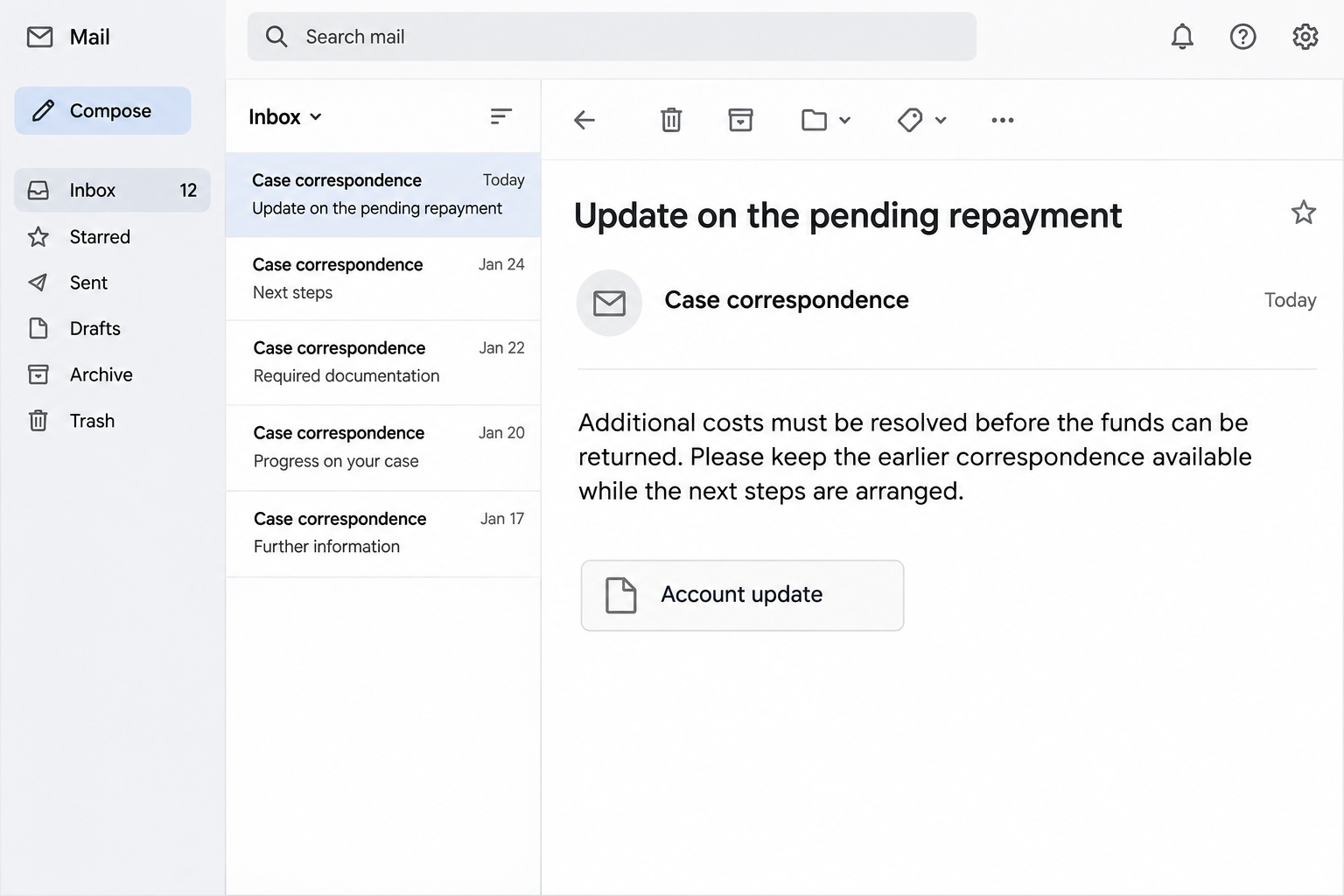
The image is a reconstruction of the fees-before-repayment pretext, not an original email from Stone, a bank or an attorney involved in the case.
Why a Familiar Advisor Can Make a False Paper Trail Convincing
People often assess an unfamiliar message differently when someone they already know explains why it arrived and what they are supposed to do next.
The trusted person can interpret every new document, leaving the recipient with several apparent sources but only one explanation of what is happening.
Stone used fraudulent correspondence to exploit that weakness, making messages apparently supplied by outside organizations part of his effort to obtain more money.
Separate the relationship from the verification process, allowing the named institution to answer through a contact route the advisor did not supply or control.
You can recognize a former advisor while refusing a payment until the claimed bank or attorney independently confirms the reason for the request.
An existing relationship does not require accepting a new email address, different beneficiary or explanation that makes repayment depend on another payment from you.
Ask what evidence comes from the institution itself, rather than what the person requesting money says it has supposedly decided about returning your funds.
If every answer returns to the same person, several organizations appearing in the conversation may provide less independence than the volume of emails suggests.
How the Eric James Stone Scam Works
Step 1: The advisor relationship creates access and confidence
Stone befriended the victim through his position as a financial advisor, then used that relationship to solicit money over approximately three years.
The case involved deliberate exploitation of trust, rather than a stranger sending one unsolicited message to someone who had never previously heard of him.
A relative trying to help may therefore find the victim defending a relationship as well as assessing the latest demand for another payment.
Ask what the next payment will accomplish and which independent record confirms its purpose, without attacking the person’s earlier decision to trust the advisor.
A calm review of the transaction and promised outcome can create room to pause before another demand becomes part of the continuing payment history.
Step 2: A promise of repayment develops new conditions
An earlier DOJ summary describes loans and promises of repayment, with claims that investigation costs or fees needed payment before money could be returned.
Those conditions made another outgoing payment appear to be a step toward recovering funds the victim had already sent, rather than another potential loss.
Ask whether the supposed cost is independently verified, rather than deciding based on whether paying feels like the fastest way to recover earlier losses.
Establish who is owed the money, what creates the charge and which organization can confirm it without involving the person who requested payment.
Do not make another payment merely because refusing it is described as the reason an earlier repayment will remain delayed or unavailable to you.
Step 3: Fraudulent emails make the explanation look supported
Stone sent false bank and attorney correspondence that appeared to supply outside support, helping him keep money moving from the victim despite his deception.
Several messages can look like corroboration when they name different organizations, even though the underlying identities and explanations belong to the same fraudulent scheme.
An email’s design or signature cannot establish that the named organization sent it, and replying to that message will not provide an independent check.
Find the institution through contact information established separately, then describe the repayment condition and ask whether it recognizes the correspondence or charge being claimed.
Keep the original message for the genuine organization to assess, rather than relying on a summary from the person who is seeking further payments.
Step 4: Repeated transactions turn one deception into a continuing loss
More than 600 transactions occurred over about three years, showing how repeated instructions sustained the loss well beyond the first request for money.
Checking only the latest payment can miss earlier transfers and explanations that shaped the victim’s expectations, making another demand seem necessary for eventual repayment.
Build a timeline from actual statements and receipts, recording each payment’s date, recipient and stated purpose alongside the message or conversation that prompted it.
Record promised repayments separately from money received, so a reassuring statement cannot reduce the apparent loss unless funds genuinely returned to the victim’s control.
Step 5: Money goes toward the operator’s spending
Prosecutors said Stone spent most of the money on foreign gambling websites, while correspondence continued supporting the false explanations used to obtain further payments.
That finding concerns Stone’s spending, rather than establishing that every gambling operator, bank or attorney named in his correspondence knowingly participated in the scheme.
Stopping further transfers and preserving their destinations matters more immediately than tracing every later purchase, which investigators can examine using the financial records.
Do not let an explanation about where money went become another reason to pay a supposed charge before anyone will help you recover it.
How to Check a Supposed Bank or Attorney Without Using the Fake Route
Choose a contact route independent of the disputed email and the person requesting money, even when reaching the actual institution takes a little longer.
For your own bank, use an established app, statement or physical card and explain that you received correspondence supposedly issued by the institution.
For another organization, find its public contact independently and ask whether it can verify the named person, matter and payment through its normal process.
Describe the condition directly, including any claim that previously sent money cannot be returned until you pay fees or satisfy another supposed charge.
If the institution cannot recognize the matter, do not seek a replacement number from the original contact and restart the same closed verification loop.
Record whom you reached and what they confirmed, without sending financial records to a new email address simply because its appearance seems professional.
The table tests independence and actual money movement, rather than treating the number of messages as proof that a repayment arrangement deserves your trust.
| What seems reassuring | What remains unverified | Useful next action |
|---|---|---|
| An advisor you recognize | Authority for this particular payment | Ask the actual institution independently |
| An email signed by an attorney | The sender’s identity and connection to the matter | Use the firm’s independently established contact |
| A bank message about a delay | Whether the bank issued that explanation | Describe the message through your verified banking route |
| A promise that repayment is close | Whether money has actually returned | Compare the promise with your own statements |
| Another charge before release | A genuine reason and authorized recipient | Pause payment while checking the demand |
Helping Someone Review Hundreds of Payments
A long payment history can be difficult to face when the person still hopes one last transfer will resolve everything that happened before it.
Begin with something manageable, such as identifying today’s scheduled payments or finding the statement showing the most recent outgoing transfer and its recipient.
Organize older transactions in order, leaving uncertain details clearly marked instead of requiring perfect recall before the bank or investigators can be contacted.
Use statements instead of combining payments into a guessed total, because accurate references help providers locate transactions and assess the options remaining for each.
Record genuine repayments if any occurred in your situation, without assuming that one incoming payment establishes the honesty of the entire arrangement.
Establish what the person controlled, what left and what returned, making the next decision clearer without blaming them for trusting someone who deceived them.
What to Do if You Have Fallen Victim to This Scam
-
Pause additional payments and stop treating a promised release or repayment as a reason to satisfy another charge supplied through the same disputed contact.
Identify pending transfers first, then list money already sent using statements and receipts rather than relying on the advisor’s description of the payment history.
Ask a trusted person to help organize the records if the history feels overwhelming, while keeping control of your accounts and private financial information.
-
Contact each relevant bank or payment provider through its normal support route and explain that fraudulent correspondence persuaded you to make the identified transactions.
Ask about stopping pending payments and investigating completed transfers, supplying dates, amounts and recipient details so the provider can assess each transaction accurately.
Describe payments made under deception honestly, because providers need the actual circumstances rather than an account changed to fit an assumed category for refunds.
-
Preserve emails, attachments, requests and statements in a secure folder, retaining original sender details and dates rather than saving only cropped pictures of messages.
Keep a timeline linking each payment to its stated purpose, and distinguish promised repayment from money that actually appeared back in your own account.
Keep old correspondence after discovering a false identity, because the changing explanations may help investigators understand how the deception continued through many separate payments.
-
Independently contact any bank or law firm named in a disputed demand and ask whether it recognizes the matter, sender and condition for repayment.
Use contacts found separately from the messages, recording the response without assuming that a real organization’s name proves its involvement in the underlying fraud.
If it cannot verify the demand, preserve that answer and refuse a new payment to a different recipient supplied by the same original contact.
-
At IC3, select File A Complaint, read the terms and describe how the relationship, false identities and payment requests developed in your situation.
Include communication methods and recipient details, retaining the confirmation so later bank or investigator follow-up can be connected with the account you initially submitted.
Keep the report factual and identify uncertain details, rather than guessing how a bank, attorney or website became part of the correspondence you received.
-
Reject advance-fee compensation offers, particularly when a new person uses your earlier loss to explain why another payment must happen before money is recovered.
The FTC recommends contacting the actual payment provider about recovery options, which is different from paying an unsolicited specialist who promises a guaranteed result.
Continue reviewing scheduled activity and provider responses, seeking verified case assistance instead of trusting someone who introduces another condition for returning money already sent.
Frequently Asked Questions
Was Eric James Stone’s conduct confirmed in court?
Yes, Stone admitted wire fraud and money laundering, receiving an 80-month prison sentence and restitution order for the confirmed fraud described in this case.
That outcome concerns Stone’s deception, rather than establishing responsibility by a former employer or treating an ordinary dispute with a financial professional as fraud.
Did the case involve one payment or repeated transactions?
The announcement describes more than 600 transactions over approximately three years, with the victim sending over $2 million during the course of the scheme.
That extended history makes it important to review statements and pending payments together, rather than treating the latest demand as an isolated financial decision.
Were genuine banks and attorneys necessarily involved in the messages?
Stone’s fraudulent emails claimed to represent outside sources, so an institution’s name appearing in a message did not establish that it sent the correspondence.
Verify the sender and underlying payment condition independently, and keep accusations attached to the confirmed impersonation rather than assuming every named organization knowingly participated.
What if another fee is supposedly needed before repayment?
Do not pay because earlier money remains outstanding, and ask the actual organization to verify the demand through a contact route you establish separately.
Assess any new condition independently, rather than accepting it as an unavoidable final step toward recovering money sent under a false explanation.
Does the restitution order mean the victim has already been repaid?
The order creates a restitution obligation without establishing that the full amount has already been recovered and distributed to the person who lost it.
Keep provider decisions and actual repayments separate from promises made by someone offering compensation for another fee, even when they know genuine case details.
How can a relative help without making the person feel blamed?
Help pause the next payment and organize recent statements, offering practical support while the underlying claims are checked through contacts independent of the advisor.
Build the longer timeline together, making clear that preventing another transfer matters more than defending every earlier decision to trust someone they already knew.
The Bottom Line
Do not pay another supposed bank or attorney fee because an email says money already sent to an advisor cannot be returned without it.
Stone used false outside correspondence to sustain a trusted person’s deception, turning repeated reassurance into hundreds of transactions and a substantial loss of savings.
If you recognize the pattern, pause payments, reach the providers independently and preserve the correspondence alongside transaction records so the history can be reported.

Join the discussion
0 commentsShare your experience or ask a question about this article.
Community experiences
Did this happen to you?
Your experience could help someone recognize the same scam. Submit a private report for our team to review.
I experienced this tooReports are reviewed before publication. Sharing publicly is always your choice.
Discussion
Start the conversation
Have a question or something useful to share? Add the first comment.