


An unfamiliar vehicle purchase can be difficult to explain when the paperwork appears to carry your identity and you never contacted the dealership.
The Michael Calvin case began with online car deals, and the records behind those purchases explain why an unfamiliar dealership deserves your attention.
Overview
Real people’s information supported false buyer identities
Michael Calvin obtained stolen personal information and a Missouri driver’s license template through the dark web, then created false licenses and identification cards.
He used those details and documents to buy five vehicles online across several states, according to the Justice Department’s sentencing announcement.
The problem involved deliberate identity deception, rather than a legitimate customer disputing the condition of a car they had knowingly agreed to purchase.
The purchases crossed several states
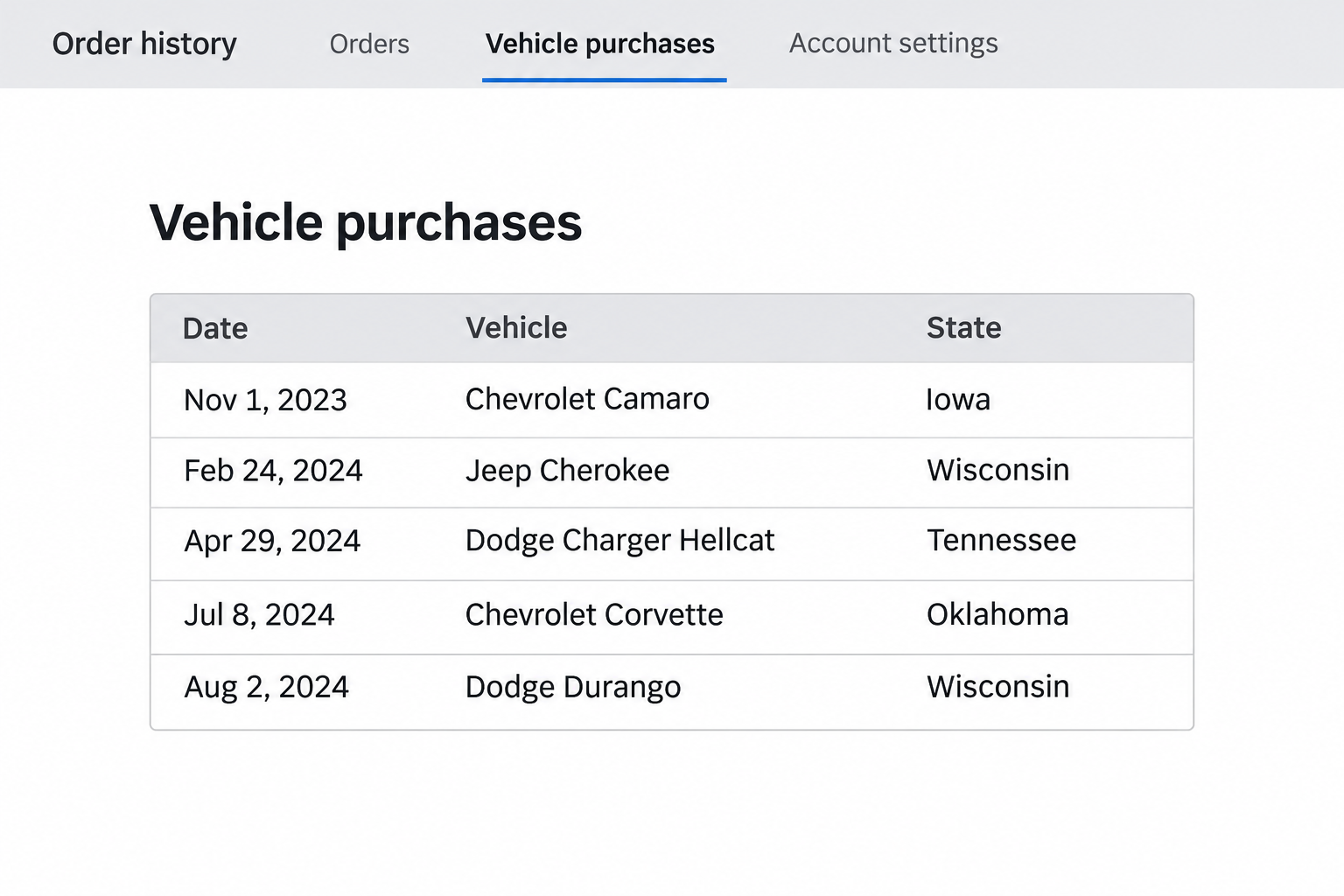
The vehicles included a Chevrolet Camaro, Jeep Cherokee, Dodge Charger Hellcat, Chevrolet Corvette and Dodge Durango, bought between November 2023 and August 2024.
The dealers were in Iowa, Wisconsin, Tennessee and Oklahoma, showing why suspicious purchase paperwork can come from somewhere the victim has never visited.
The image reconstructs the reported transaction pattern in an order-history view; it is not a recovered dealership screen or a victim’s private account record.
A guilty plea led to prison and restitution
Calvin pleaded guilty to wire fraud and aggravated identity theft, receiving a 51-month prison sentence and $193,000 restitution order in September 2026.
The vehicles were worth more than $333,000, with some unrecovered and dealers also facing costs when retrieving others obtained through the scheme.
- A document displaying your personal details does not establish that you approved the purchase, signed the agreement or communicated with the dealer involved.
- An unfamiliar transaction deserves direct verification through the real business, without replying to an unverified message that demands money or additional identity documents.
- Credit protections can reduce some future exposure, while existing false records still need a separate investigation by the relevant business and reporting agencies.
What This Case Establishes About Online Car Identity Fraud
Stolen personal information, fabricated identification and completed purchases connected the deception to real losses, providing evidence beyond an unexplained contact from a dealership.
The announcement does not describe every financing arrangement, so each purchase should not be assumed to involve an identical loan or credit account.
Your response depends on the record actually involved, because an inquiry, application, contract, account and demand for payment can require different dispute processes.
Ask the genuine business what record it holds and why your identity appears, rather than accepting a caller’s explanation as the final answer.
You can alert the dealer to an unauthorized purchase before establishing where a criminal first obtained the personal details used in the transaction.
The announcement identifies the dark web as Calvin’s source, but that finding does not establish which breach or disclosure exposed every individual victim’s information.
Avoid guessing which breach caused the exposure, because accurate reporting helps the business separate what you know from what still needs investigation.
Focus on the unfamiliar transaction and the information actually used, allowing the institutions involved to assess those records through their own fraud processes.
How the Stolen Identity Car Purchase Scam Works
Step 1: Stolen information supplies an apparent customer identity
Calvin purchased stolen personal details online, obtaining information associated with real people whose identities could be used for transactions they had never requested.
Accurate details can make a record look plausible, even when the person supplying them has no authority to act as the individual named.
Recognizing your name in unfamiliar paperwork is a reason to investigate the transaction, rather than accept immediate responsibility for a purchase you never made.
Do not send an unverified caller another identity document to check the first one, because that creates another opportunity to misuse your information.
Reach the actual business independently and ask its fraud team how to dispute the record and provide any necessary verification through a secure process.
Step 2: Fabricated identification supports the deception
Calvin created fake licenses and identification cards using a Missouri license template and the stolen information he had purchased through the dark web.
A picture resembling a government document cannot establish whether the person using it is the genuine individual named in the paperwork being supplied.
A business assessing a remote purchase needs to consider the document alongside the transaction, rather than treating its familiar appearance as sufficient verification.
If a business says identification was supplied in your name, ask it to preserve the records and explain how to dispute that identity claim.
Keep communications factual and avoid guessing which fields were altered unless the business or investigators provide information confirming those changes to the document.
Step 3: Online purchases reach dealers in other states
Calvin used false identification to buy the vehicles online, connecting the stolen identities to actual property and losses at dealerships across several states.
You may hear from a dealer you have never visited, so do not dismiss the possibility of fraud simply because its location seems unfamiliar.
Find the dealer’s main contact independently, then ask whether it holds a genuine record connected with the name or reference in your message.
If the business cannot recognize that record, preserve its response and consider whether the message itself is an impersonation attempt demanding your attention.
Keep the initial inquiry limited until you know you are speaking with the organization responsible, since either situation requires care when sharing personal information.
Step 4: Recovery creates a separate task from identity correction
Some vehicles remained unrecovered, while dealers incurred costs retrieving others, according to the sentencing announcement describing the consequences of Calvin’s scheme.
Recovering a vehicle does not establish that every affected record, inquiry or account was corrected for the person whose identity was misused.
You need an answer about your own records, including whether a business still associates you with an agreement you never authorized or requested.
Track the vehicle investigation and identity dispute separately, retaining both references so an update about recovered property does not obscure an unresolved identity problem.
Restitution is a court-ordered obligation, rather than proof that every victim’s records were repaired or that all losses have already been repaid in full.
First Establish Which Record You Are Disputing
Identifying the record behind a suspicious vehicle message helps you approach the organization responsible and request the investigation or correction appropriate to that issue.
An unfamiliar credit inquiry differs from an open account, while a dealership contract may involve records missing from a basic account statement.
Reach the claimed organization independently and ask it to explain the record, keeping the reference and date without accepting an unverified payment demand.
If a lender is involved, tell its fraud department that the transaction was not yours and request its process for disputing identity theft.
For a dealership record, ask management or its fraud contact to preserve the application and identification records while the disputed transaction is reviewed.
Do not sign a replacement agreement or promise payment because someone claims that doing so is necessary to obtain copies or stop further correspondence.
Keep written confirmation of the response and required steps, then follow up if the disputed record remains associated with your identity after the investigation.
How to Place a Free Credit Freeze by Phone
A credit freeze restricts access to your credit report, helping stop new credit accounts while leaving existing fraudulent records to be disputed separately.
The FTC explains that freezes are free, remain until lifted and must be placed separately with Equifax, Experian and TransUnion to cover three files.
Use the official contacts below and request a security freeze, rather than a paid monitoring package or a product described as a credit lock.
| Credit bureau | Official freeze phone route | Primary contact reference |
|---|---|---|
| Equifax | 800-685-1111 | Equifax security freeze contact |
| Experian | 888-397-3742 | Experian freeze support |
| TransUnion | 888-909-8872 | TransUnion phone instructions |
Call each bureau, choose its security-freeze option and complete the identity checks needed to match your credit file and establish your authority to act.
Keep the confirmation and credentials provided, then check that the freeze is active before assuming the request succeeded or contacting the next bureau.
If the automated process cannot verify you, use that bureau’s official support to resolve the mismatch instead of answering an unsolicited request for documents.
Before applying for legitimate credit, ask which bureau the lender uses, arrange the temporary lift and restore protection when access is no longer needed.
An initial fraud alert is another free option; contacting one bureau requires it to notify the other two, according to the FTC’s guidance.
The alert tells lenders to check identity before extending credit, which differs from blocking access to the reports held by all three bureaus.
What to Do if You Have Fallen Victim to This Scam
-
Preserve the unfamiliar order, inquiry, account notice or collection demand, recording when you received it before responding through details supplied in that message.
Refuse an unverified release or cancellation charge, and do not send identification simply because someone claims it is required to resolve the transaction.
Find the genuine dealership, lender or reporting agency independently so the next conversation concerns an actual record, rather than another possible attempt at impersonation.
-
Tell the business you did not authorize the transaction, request its identity-fraud investigation process and ask it to preserve the application or agreement records.
Obtain a case reference and written next steps, keeping the business’s actual name separate from unfamiliar names supplied in the original message you received.
If the business cannot find the transaction, retain its response and report the message without assuming you owe money for an unrecognized agreement.
-
Use the bureau contacts and procedure above to freeze all three files if you want to restrict access for future credit applications.
Store the freeze confirmations separately, because protecting future access does not remove an existing inquiry, application or account created through misuse of your identity.
Review your credit information and contact the organization responsible for each disputed item, rather than assuming every record concerns the same dealer or incident.
-
Document which information was used, keeping correspondence and any verified explanation from the dealer or provider about the records associated with your identity.
Share sensitive documents only through the confirmed investigation process, recording what you supplied so you can assess later requests against the case already underway.
If a government identity document was misused, ask its issuing authority about fraud reporting and replacement requirements through the genuine official website.
-
Report the fraud through IC3, starting with File A Complaint and reading the terms before describing the identity misuse and documented vehicle transaction.
Provide verifiable dates, business details and references, retaining the confirmation so you can connect later requests with the account you originally submitted for investigation.
You can seek a personalized recovery plan through IdentityTheft.gov, the FTC service identified in its guidance for people whose identities have been misused.
-
Follow up using your case references, asking what was corrected and what remains unresolved rather than assuming a recovered vehicle resolved the identity dispute.
Retain correction notices and account decisions, and decline unsolicited offers to remove records for an advance fee or obtain guaranteed compensation on your behalf.
If you receive a legal notice or deadline, obtain independent advice promptly instead of trusting someone who promises to make the paperwork disappear.
Frequently Asked Questions
Was Michael Calvin convicted of identity-related fraud?
Calvin received a 51-month sentence after admitting wire fraud and aggravated identity theft, with restitution also ordered in the September 2026 criminal case.
The confirmed scheme involved stolen details and fake identification for online purchases, rather than an ordinary customer accidentally supplying inaccurate information to a dealer.
Did every purchase necessarily create an auto loan?
The sentencing announcement describes online purchases without identifying every financing arrangement, so it does not establish that each transaction created an auto loan.
If your information appears in unfamiliar paperwork, establish which record exists before choosing a dispute process and asking the responsible business to investigate.
Does a fake document carrying my name prove I approved the deal?
No, the contents need to be assessed alongside the disputed transaction, because this case involved real people’s stolen details presented through fabricated identification.
Tell the business the purchase was not yours and preserve the records through its verified investigation process, rather than accepting an unverified payment demand.
Will a credit freeze correct a vehicle deal already recorded?
A freeze restricts future credit access, while an existing disputed agreement, inquiry or account needs separate attention from the business or reporting agency responsible.
Obtain confirmation of both the freeze and any correction, because protecting a credit file does not settle the dispute over a transaction already recorded.
Do I have to pay for credit monitoring to freeze my file?
No, placing and lifting freezes are free, according to the FTC, and each bureau provides an official route for protecting your credit file.
Choose the security-freeze process and keep its confirmation, rather than assuming you must buy monitoring or a differently named locking product to obtain protection.
Does the restitution order prove all the vehicles were recovered?
No, some vehicles remained unrecovered and dealers incurred recovery costs, while restitution imposed an obligation to compensate for losses identified in the case.
Follow your disputed record and verified provider updates, rather than treating a sentence or headline as proof that every problem connected with it ended.
The Bottom Line
Do not accept responsibility for an unfamiliar vehicle purchase because paperwork carries your identity, or send documents or money through an unverified contact.
Calvin used stolen details and false documents for real purchases, showing why accurate personal information cannot establish that its user has authority to act.
If your information was misused, contact the business, preserve the records and protect your credit while pursuing correction of transactions you never authorized.

Join the discussion
0 commentsShare your experience or ask a question about this article.
Community experiences
Did this happen to you?
Your experience could help someone recognize the same scam. Submit a private report for our team to review.
I experienced this tooReports are reviewed before publication. Sharing publicly is always your choice.
Discussion
Start the conversation
Have a question or something useful to share? Add the first comment.