


A page called EtherLens says you might qualify for an Ethereum reward just by holding assets you already own. The eligibility threshold looks simple enough to check.
The most comforting part of the offer is what it promises not to ask you to do. That’s worth keeping in mind as you read the page.
Overview
The offer starts with a $100 balance, not a purchase
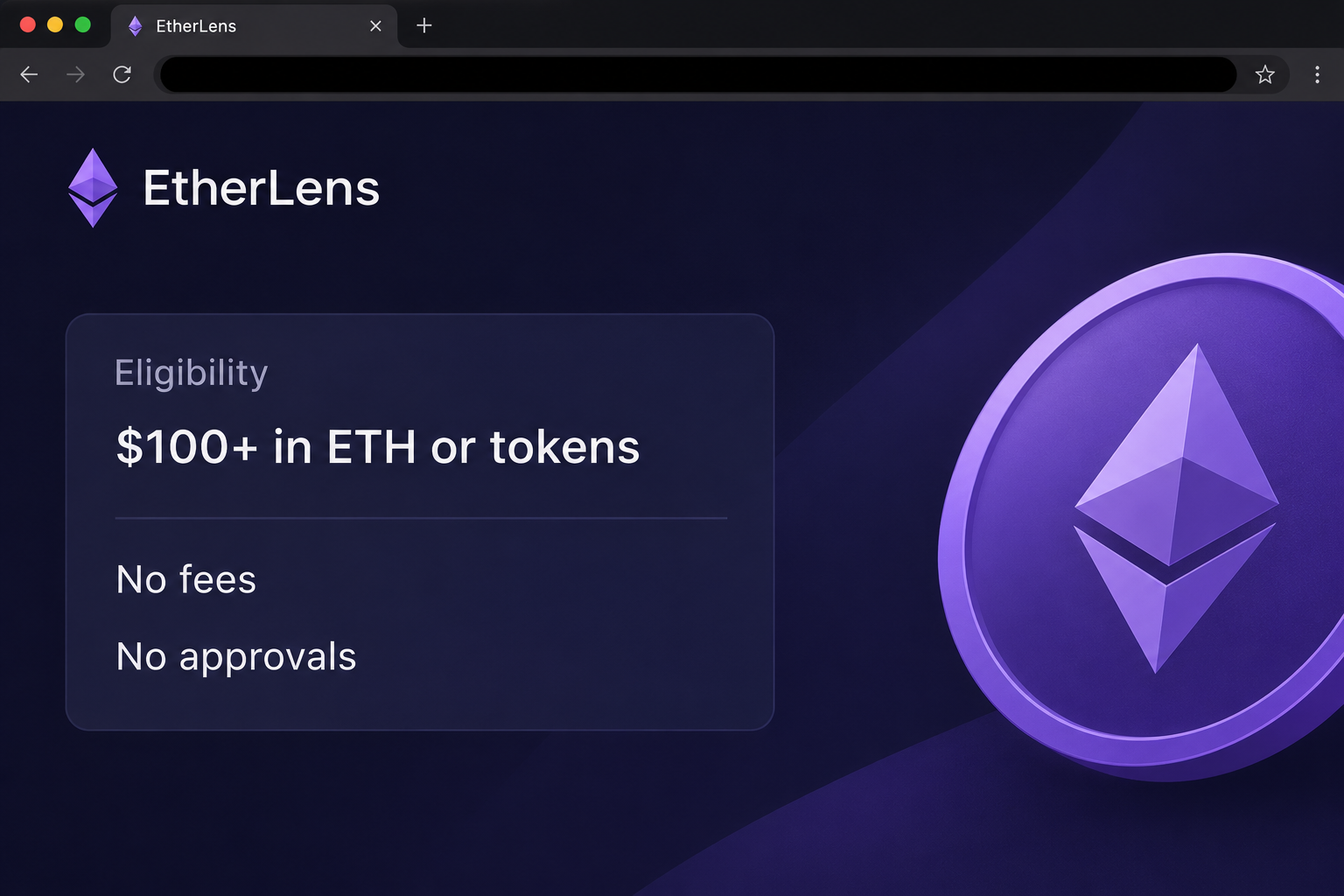
EtherLens Rewards presents itself as a giveaway for people who hold at least $100 worth of ETH or tokens. The sample used the address ethpeak[.]io.
The advertised idea is that the page can check your balance and deliver something straight away. There is also a rewards calculator in the page’s navigation.
The image recreates the eligibility line and its neighboring promises. It is not a screenshot of an Ethereum service or a record of anyone receiving an allocation.
The page uses Ethereum imagery, but no Ethereum organization or existing project is shown to back this specific offer. A logo is much easier to find than a genuine sponsor.
The words “no approvals” don’t settle what your wallet does
The promotion says there are no fees, approvals, or transactions. A wallet selector appears when you start the process, so the page still wants your wallet to get involved.
The recorded view shows the offer and provider choices. It doesn’t show a verified reward, completed authorization, or outgoing transfer from an identifiable victim.
Connecting a wallet can reveal a public account to a site and let it send requests to your wallet. That initial action is not itself a transfer.
A signature or transaction is a different decision. If one appears, read your wallet’s own description rather than relying on the phrase “no approvals” elsewhere on the page.
The balance doesn’t have to be connected to be readable
Balances on public Ethereum addresses are generally visible through network records. Someone reading a public address doesn’t need the secret that controls its funds.
That makes the promise worth questioning. If it’s only measuring a public balance, why would it need spending rights, a signature, or a transaction?
Here are the distinctions that matter if you reached the page:
- The $100 figure is the eligibility claim, not a verified reward or a minimum payment you owe.
- A calculator estimate is a number on the site, not an asset credited to your wallet.
- A wallet connection, a message signature, and an on-chain transaction are separate actions.
- A sponsored network fee can cost you nothing upfront while the request still has consequences.
- A recovery phrase is never needed to look up an Ethereum balance.
What the Offer Means by a $100 Threshold
If you already hold ETH, a threshold can sound like a loyalty rule. You aren’t being asked to buy an unfamiliar token to get started.
The offer also mentions other tokens, which widens the pool of people who might think they qualify. It doesn’t tell you who funded the distribution.
Compare that with what people can check independently. If you know a public address, you can look up its history without giving the site the ability to sign.
You can learn the approximate value of the assets you already hold through a tool you trust. Doing so tells you nothing about whether EtherLens owes you a payment.
The calculator is especially easy to misunderstand. It can make an estimate look precise before you’ve seen a single documented payout or found out where the reward would come from.
If the page says you’re just under the threshold, don’t buy or transfer more crypto to meet it. The threshold comes from the site, not a verified program.
The same point applies if the site shows a larger bonus than you expected. A promising result on a calculator is not a reason to expose a second wallet.
A legitimate promotion would need an identifiable operator and independently available rules. The figure at the front of this offer doesn’t supply either one.
How the EtherLens Rewards Scam Works
Step 1: Ethereum imagery frames the offer as a network benefit
The page uses an Ethereum-style diamond and talks about rewards in ETH. That combination can make an unfamiliar name look like it belongs inside the Ethereum ecosystem.
Ethereum is a public network, not a single promotions department. A site can use the network’s imagery without permission to make a reward sound official.
The address in the archived example had no verified connection to a sponsor. It’s safest to treat the promise as coming from the page, not from Ethereum itself.
Step 2: A balance test gives you a reason to keep going
The pitch invites you to find out whether you hold enough to qualify. By talking about assets you already own, it avoids an obvious demand for an initial payment.
The page describes delivery as immediate if the balance qualifies. It does not provide an independent record of where that promised ETH would come from.
Reading the amount in your own wallet is enough to answer what you currently hold. You don’t need the rewards site to prove you have ETH.
Step 3: The reassurance makes a wallet prompt feel harmless
“No approvals” sounds like a reason to skip scrutiny. The offer also describes the connection as view-only, which encourages readers to interpret everything that follows as harmless verification.
The archived view opens a selector with familiar wallet names. Those names don’t show that the service is endorsed by any of their providers.
If your wallet opens, check whether you’re being asked to share an address, sign data, grant an allowance, or submit a transfer. Don’t interpret the request from the site’s slogan.
Step 4: An authorization can matter even when no fee is visible
A zero-fee or no-gas message is not a guarantee of safety. Some signed authorizations have a purpose other than sending a transaction from the signer at that instant.
Ethereum’s security guidance explains why a signature deserves scrutiny. If the request is unclear or unrelated to something you decided to do, reject it.
An allowance can also outlast the session that produced it. Someone who approved something has more to check than someone who simply saw the page.
Step 5: Only your independent records show what happened afterward
A banner claiming that eligibility was checked does not tell you whether a transaction succeeded or failed. Check the wallet on the network involved for that information.
Look at which address was connected, and which assets or account permissions are associated with any unfamiliar activity. A portfolio overview can hide details you may need.
The browser page may close or change while the network record remains. Don’t return to the promotion just to recreate the message if your own wallet can answer the question.
Why Disconnecting Is Different From Revoking an Approval
A disconnected site can still be associated with a prior permission
Removing the site from a wallet’s connected list ends its connection to the wallet interface. It doesn’t automatically take back a spending permission that was already granted.
MetaMask’s token approval guidance explains the difference. Use your wallet provider’s approved route to check current allowances on the chain where you interacted.
Pay attention to the token and network. An approval on one network doesn’t explain the same token’s activity elsewhere.
If you can’t tell what was signed, avoid trusting a stranger who messages you with an alleged revoke page. Get instructions from the wallet through a route you already know.
A disclosed recovery phrase is a wider problem
If you shared a phrase or a private key, disconnecting and reviewing allowances are not enough. Someone else can potentially operate the affected account without your original browser session.
Use a trusted device and follow your wallet provider’s official steps to create a fresh wallet and protect remaining funds. Don’t restore the old secret into it as a substitute.
If you don’t remember entering a secret, look at what you can establish from the session. Approving a request and typing recovery words are different paths with different remedies.
What to Do if You Have Fallen Victim to This Scam
-
Close EtherLens if you only looked at the page. Don’t go back to check the calculator or match its amount against a second wallet.
If you have a safe screenshot, keep it with the address you visited and the time. Avoid sending the live page to other people as a warning.
-
Remove an unwanted connection through your wallet. Select the account you used and review its connected sites from inside the wallet rather than from the advertisement.
Seeing a selector isn’t the same as using it. If you’re unsure whether you connected, check the saved session list without reopening the offer.
-
If you signed something, review authorizations and transactions promptly. Identify the wallet, network, token and request type before choosing a remedy.
Revoke any genuinely unwanted allowance using the wallet provider’s verified instructions. A confirmed outgoing transaction is a separate matter and cannot be undone by revoking a permission.
-
Protect remaining assets if you disclosed wallet secrets. Assume the corresponding wallet may be exposed even if its balance looks unchanged.
The wallet’s official help can explain how to replace a compromised wallet. Keep the new recovery phrase offline and never send either phrase to anyone offering support.
-
Record any confirmed transfer and contact relevant parties. Keep the transaction hash, asset, amount, public addresses, time and chain for each unexpected entry.
If an exchange handled a related payment, contact it through its established support route. For US reports, the FBI’s crypto fraud guidance lists helpful evidence.
-
Ignore recovery solicitations that follow the incident. Someone who knows the network or amount may be reading public data, not working on your case.
Do not pay for an unlock or hand over a wallet phrase. Use support channels you reached yourself to evaluate any recovery option.
What to Save if the Reward Page Disappeared
Start with the records you can still reach
An offer can disappear without changing what the wallet did. If you need to explain a loss, start by finding the activity associated with the affected address and chain.
Take a note of the wallet provider and roughly when you first saw the offer. That can help you date a request after the page disappears.
Do not assume every unfamiliar token entry is an outgoing transfer. A wallet can receive unsolicited tokens, and their names may describe a reward you never asked for.
Keep those entries separate from actual spending permissions and transfers. A receive event, an allowance and a confirmed payment represent different things even when they mention the same token.
Leave monetary estimates separate from the token record
Record the amount in token units before estimating its cash value. That lets you separate the actual amount sent from the price shown on EtherLens or in another screenshot.
If your app gives you a value in local currency, label that estimate with the time you checked it. Don’t confuse a later price change with another movement of assets.
If a friend wants to help you look up a transaction, share a public identifier rather than a secret. Public records suffice without exposing the wallet.
If a review tool shows more than one similarly named token, don’t assume they’re identical. Match the asset and network with the original activity before reporting it.
Keep an eye out for any unsolicited follow-up that mentions the same threshold. Someone repeating the offer’s exact terms has not proved they are the operator or can help you.
Your timeline might contain both a connection and a later wallet alert. Record them separately rather than guessing that the alert proves what the earlier page did.
Frequently Asked Questions
Is EtherLens Rewards an official Ethereum airdrop?
Nothing in the offer shows an authorized distribution by Ethereum or another identifiable sponsor. The ETH branding and the displayed eligibility calculation don’t authenticate it.
What does the $100 amount actually mean?
It’s the page’s claimed balance cutoff for eligibility. It is not a verified payout, a fee charged by Ethereum, or an amount you should deposit.
Can I trust a wallet request if it has no gas fee?
The request can still have a security consequence. A message signature may authorize something that does not look like an immediate fee or payment from you.
Can a public address reveal my recovery phrase?
A public address can expose balance and transaction activity, but that address does not reveal the phrase. Never enter a wallet secret just to provide proof of a balance.
Should I revoke permissions if I never approved anything?
Start by checking what you actually did. Merely viewing the site or wallet list does not create a token allowance that needs to be revoked.
Is disconnecting enough if a token was already taken?
Disconnecting stops the site session, not a transfer already recorded on-chain. Review permissions and preserve the transaction record before reporting the loss.
The Bottom Line
Do not connect to EtherLens to check the $100 threshold or sign anything to collect its reward. The advertised safety promises come from the same page asking for access.
If you already used the site, check what your wallet actually recorded. Deal with unwanted permissions, exposed secrets, and any completed transfers as separate problems.

Join the discussion
0 commentsShare your experience or ask a question about this article.
Community experiences
Did this happen to you?
Your experience could help someone recognize the same scam. Submit a private report for our team to review.
I experienced this tooReports are reviewed before publication. Sharing publicly is always your choice.
Discussion
Start the conversation
Have a question or something useful to share? Add the first comment.