

Scammers are preying on unsuspecting shoppers with a new viral scam promoting an unbelievable deal on the EW-14 Four Wheel Recreational Scooter. Facebook, TikTok and Instagram ads claim this mobility scooter is on sale for just $49 as part of an Amazon bankruptcy liquidation, warehouse closing, or going-out-of-business sale. Don’t be fooled – this “deal” is nothing more than a fraudulent scheme designed to steal your money. In this article, we’ll reveal how this scam works, what to do if you’ve fallen victim, and how to protect yourself from similar scams in the future.
Scam Overview
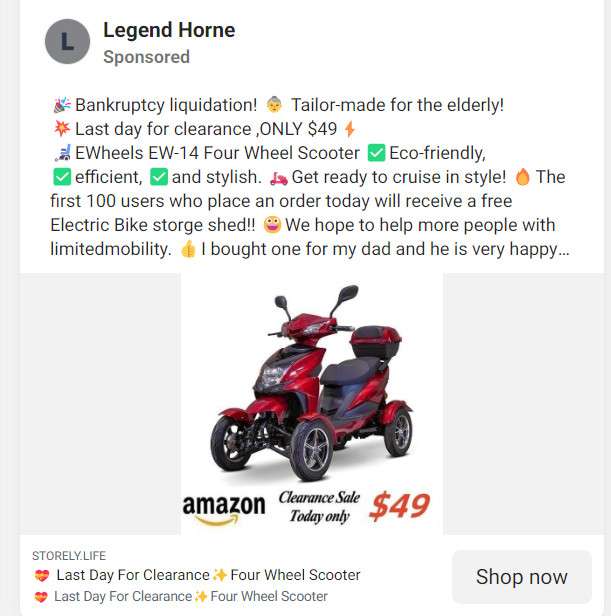
The EW-14 Four Wheel Scooter $49 Amazon Scam is a fraudulent scheme that has recently been making the rounds on popular social media platforms such as Facebook, Instagram, and TikTok. Scammers are using these platforms to promote fake advertisements claiming that the high-end EW-14 electric mobility scooter, normally retailing for over $3000, is being sold at an unbelievable price of just $49. These ads often use attention-grabbing headlines and images to lure potential victims into believing they’re getting an amazing deal.
The scammers behind this scheme employ various tactics to make their fake promotions appear legitimate. They may claim that the heavily discounted price is due to an Amazon bankruptcy liquidation sale, a warehouse closing sale, or even that Amazon itself is going out of business entirely. Some variations of the scam also claim that the EW-14 scooter is being sold at a steep discount as part of a limited-time offer or clearance event.
To further entice potential buyers, the fraudulent ads often use persuasive language and false promises. For example, they may claim that the EW-14 scooter is “tailor-made for the elderly” or that it’s an eco-friendly and stylish way to improve mobility. Some ads even promise bonus gifts, like a free electric bike storage shed for the first 100 customers who place an order.
Here are what these ads read:
👵 Tailor-made for the elderly! Elevate your mobility!
🎉Bankruptcy liquidation! 👵 Tailor-made for the elderly!
💥Last day for clearance ⚡
🦼EWheels EW-14 Four Wheel Scooter ✅Eco-friendly, ✅efficient, ✅and stylish. 🛵Get ready to cruise in style! 🔥The first 100 users who place an order today will receive a free Electric Bike storge shed!! 😀We hope to help more peop
💥Last day for clearance ,ONLY $49⚡
However, all of these claims are completely false. The scammers have simply stolen images, product descriptions, and other content from legitimate EW-14 product pages to create their convincing but fake ads and websites. Their goal is to make everything seem as realistic as possible so that people will feel confident making a purchase without stopping to question the unrealistic price or research the company behind the sale.
In addition to the stolen content and false promises, the scammers also use fake customer reviews and testimonials to establish social proof and credibility. They may post fabricated 5-star reviews from fictitious buyers claiming to have purchased the discounted EW-14 scooter for an elderly relative who is thrilled with the product. This tactic is designed to make the deal seem more legitimate and trustworthy, as many people rely on reviews and ratings when making online purchasing decisions.
It’s important to note that the fraudulent websites used in this scam are not genuinely affiliated with Amazon, EWheels, or any other legitimate retailer. Instead, they are counterfeit sites explicitly created to resemble official platforms. Scammers often create multiple versions of the fake site across numerous domain names and URLs. They may have names similar to Amazon or EWheels but often contain additional words, typos, or other slight changes to the legitimate brand.
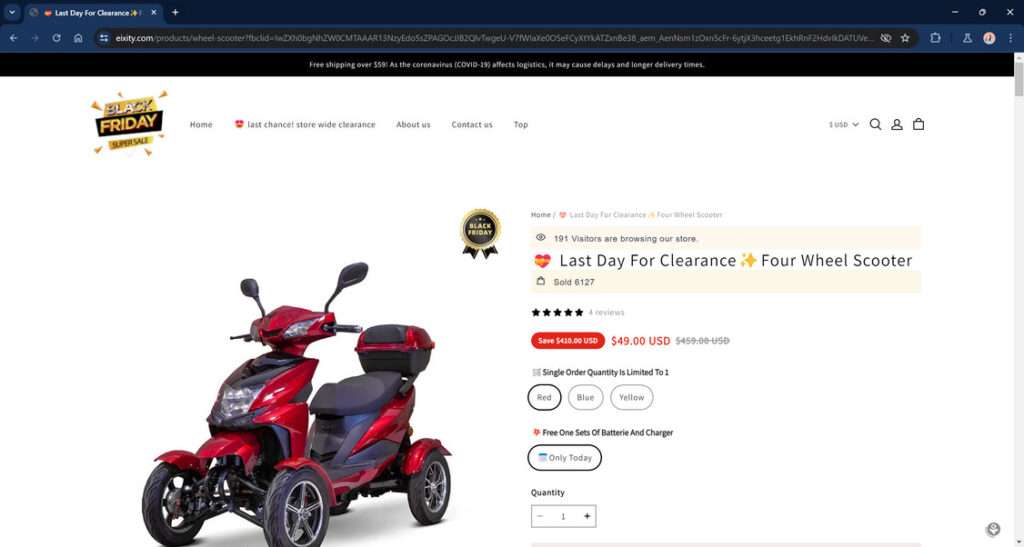
When investigating the scam websites more closely, several red flags usually become apparent. For instance, the domain names are often recently registered, sometimes just a few days before the scam begins. The sites also generally lack any verifiable contact information, such as a company phone number or physical address. In many cases, the only way to get in touch is through an online contact form that emails a mysterious, unresponsive address. The layouts of the fake sites, while convincing at a glance, often contain small design errors, broken links, spelling mistakes, and other signs that they are fraudulent.
Unfortunately, by the time victims realize they’ve been scammed, it’s often too late. The scammers will typically shut down the fake websites and disappear without a trace shortly after receiving payments, leaving customers with no way to contact them or request a refund. In some cases, the scammers may even use the stolen credit card information to make additional fraudulent purchases or sell the data to other criminals on the dark web.
Ultimately, the EW-14 Four Wheel Scooter $49 Amazon Scam is a prime example of how scammers exploit people’s desire for a great deal and the trust they place in familiar brands and platforms. By using stolen content, false promises, fake reviews, and high-pressure sales tactics, these fraudsters are able to convince many unsuspecting shoppers to hand over their hard-earned money and sensitive personal information.
To protect yourself from falling victim to this scam or others like it, it’s essential to be cautious and skeptical of any deal that seems too good to be true. Always take the time to thoroughly research a company or website before making a purchase, and be wary of any site that lacks verifiable contact information or pressures you to buy immediately. By staying informed and vigilant, you can help protect yourself and your loved ones from becoming victims of online shopping scams.
How the Scam Works
Here’s a step-by-step breakdown of how scammers execute this fraudulent scheme:
Step 1: Create fake ads with stolen content
The first step is to create enticing ads that will grab people’s attention and stoke their desire. Scammers steal official product photos, videos, and descriptions from the real EW-14 product pages. By using stolen content, their ads look convincingly legit at first glance.
Step 2: Make outrageous claims about limited-time deals
Next, the ads make wild claims about the EW-14 scooter being 90% off as part of a liquidation sale, store closing sale, or going-out-of-business sale. Scammers amplify the urgency with countdown timers and warnings that limited quantities are available.
Step 3: Direct traffic to convincing but fake sales pages
When someone clicks on the ad, it takes them to an official-looking sales page. The page is a near-identical clone of real Amazon or EWheels pages, complete with reassuring trust symbols, glowing customer reviews, and FAQ sections. At a glance, the page looks totally legitimate – unless you know what to look for.
Step 4: Pressure victims into making uninformed impulse buys
Using the power of scarcity and urgency, the fake sales pages pressure visitors to act fast on this “limited-time deal” or risk missing out. Victims are pushed to make snap decisions without researching the company or reading reviews. That’s intentional – any real research would expose the scam.
Step 5: Steal financial information and shut down
Scammers steal credit card numbers and personal info entered on the page. They may also infect your device with malware to steal even more sensitive data. Then, they shut the whole operation down, disappearing without a trace before they can be caught. The victim is left with an empty bank account and no way to get their money back.
What to Do If You’ve Fallen Victim to This Scam
If you made a purchase from one of these scam EW-14 sale sites, here are steps you should take immediately:
- Contact your bank or credit card company and dispute the fraudulent charges. Request a chargeback and cancel your card.
- Report the scam to the FTC, your state attorney general, and your local consumer protection office. This helps authorities build cases against scammers.
- Warn your friends and family about the scam. Share this article to spread awareness and prevent others from being victimized.
- Delete any software that may have been installed on your device by the scam site. Run a malware and virus scan with reputable security software.
- Change your passwords, enable two-factor authentication, and sign up for identity theft monitoring. Scammers may try to use your stolen info to hack your other accounts.
Frequently Asked Questions About the EW-14 Four Wheel Scooter $49 Amazon Scam
Q1: Is the EW-14 Four Wheel Scooter really on sale for $49 on Amazon?
No, the EW-14 Four Wheel Scooter is not legitimately on sale for $49 on Amazon or any other retailer. This is a scam designed to trick people into thinking they’re getting an incredible deal on a high-end mobility scooter. In reality, the scammers are just trying to steal your money and personal information.
Q2: How can I spot a fake EW-14 scooter sale online?
There are a few key things to look out for that signal a fake EW-14 scooter sale:
- Unrealistically low prices, often 90% or more off the retail price
- Pressure to act fast and buy now, using countdown timers or warnings about limited stock
- Vague or nonexistent contact information, like a missing phone number or physical address
- Poor website design with spelling errors and low-quality images
- Recently registered domain name (check the site’s WHOIS data to see when it was created)
If a sale seems too good to be true, has any of these red flags, or just feels “off”, trust your instincts. Scammers are skilled at making their fake sales look convincing, but there are usually telltale signs that something isn’t right.
Q3: Who is behind the EW-14 Four Wheel Scooter $49 Amazon scam?
These fake EW-14 scooter sales are run by scammers who are intentionally hiding their identities to avoid detection and prosecution. They register their fake websites anonymously, often using stolen personal information, and disappear without a trace after stealing money from their victims. Tracking them down is difficult, which is why it’s so important to be proactive in spotting and avoiding these scams.
Q4: What should I do if I see an ad for a suspiciously cheap EW-14 scooter sale?
If you encounter an ad or website promoting an EW-14 scooter for an unbelievably low price, do not engage with it. Don’t click any links, provide any personal information, or attempt to make a purchase. Instead, report the ad or website to the platform you found it on. You can report scam ads on Facebook, Instagram, Google, and most other major websites and social networks. Reporting scams helps protect other people from falling victim.
Q5: How can I get a real EW-14 Four Wheel Scooter?
If you’re interested in purchasing a genuine EW-14 Four Wheel Scooter, the best thing to do is buy directly from the official EWheels website or an authorized retailer. Buying from a verified source ensures you’re getting a legitimate product and protects you in case anything goes wrong with your order. It also supports the real company behind the EW-14 instead of scammers trying to profit off their brand name.
Q6: Can I get my money back if I bought a scooter from a fake EW-14 sale site?
If you paid with a credit card, you may be able to get your money back by disputing the charge with your credit card company. Call the number on the back of your card and explain that you believe you were the victim of a scam. Ask to open a dispute and request a chargeback. The credit card company will investigate and may be able to refund your money if they find evidence of fraud.
If you paid with a debit card, wire transfer, or other method, getting your money back will be more difficult. Contact your bank to report the fraudulent charge and ask about your options. You can also file complaints with the FTC, your state attorney general, and local consumer protection agencies. While there’s no guarantee you’ll get your money back, reporting the scam may help prevent others from being victimized.
Q7: Will I get in trouble for accidentally buying from a scam EW-14 site?
No, you will not get in trouble if you unintentionally purchased from a fraudulent EW-14 scooter sale site. As the victim of a crime, you did nothing wrong. It’s the scammers who are breaking the law by stealing people’s money and information. However, it’s important to take steps to secure your accounts and personal information after realizing you’ve been scammed. Contact your bank, change your passwords, and monitor your credit report for any suspicious activity.
Q8: How can I protect myself from online shopping scams like fake EW-14 sales?
Here are some tips to avoid falling for online shopping scams:
- Only shop on websites you know and trust. If you’ve never heard of a site before, research it before making a purchase.
- Be wary of deals that seem too good to be true. Heavily discounted prices are often a sign of a scam.
- Check for contact information like a phone number and physical address. Legitimate businesses will have a way for you to get in touch if there’s an issue.
- Use a credit card instead of a debit card or bank transfer. Credit cards have better fraud protections and make it easier to dispute scam charges.
- Read reviews from previous customers. If all the reviews are negative or there are no reviews at all, that’s a red flag.
Remember, if something seems fishy or just doesn’t feel right, trust your gut. It’s better to miss out on a “deal” than risk giving your money and information to scammers.
The Bottom Line
The EW-14 Four Wheel Scooter $49 Amazon Scam is a prime example of “if it seems too good to be true, it probably is.” Scammers exploit people’s desire to save money by promoting unrealistic deals designed to steal financial information. As a smart shopper, always be skeptical of prices that are significantly lower than retail. Do your research and only buy from reputable sites. If you do fall victim, act quickly to secure your accounts and stop scammers in their tracks. Stay safe out there!

Join the discussion
0 commentsShare your experience or ask a question about this article.
Discussion
Start the conversation
Have a question or something useful to share? Add the first comment.