

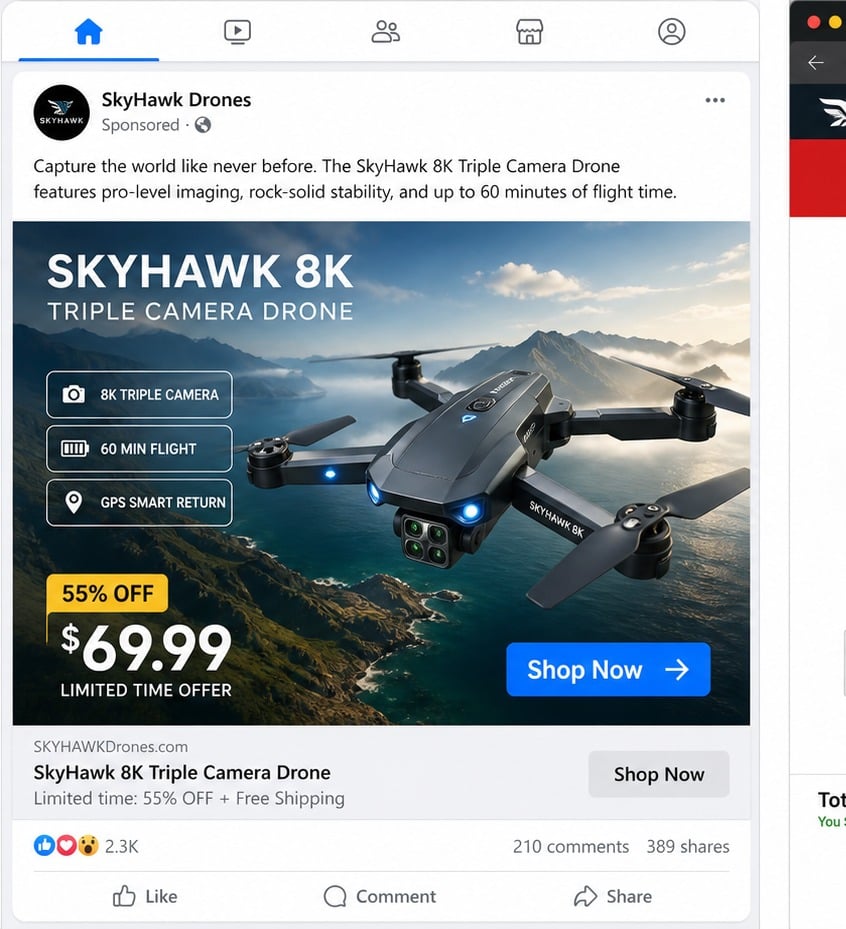
The video glides over a coastline with the smoothness of professional equipment. Then the price appears: an 8K triple-camera drone, 60 minutes of flight time, and a five-year warranty for only $69.99.
That is the moment the fake 8K drone clearance scam becomes persuasive. The viewer is not comparing two drones. They are comparing premium footage in the ad with a price low enough to trigger an impulse purchase.
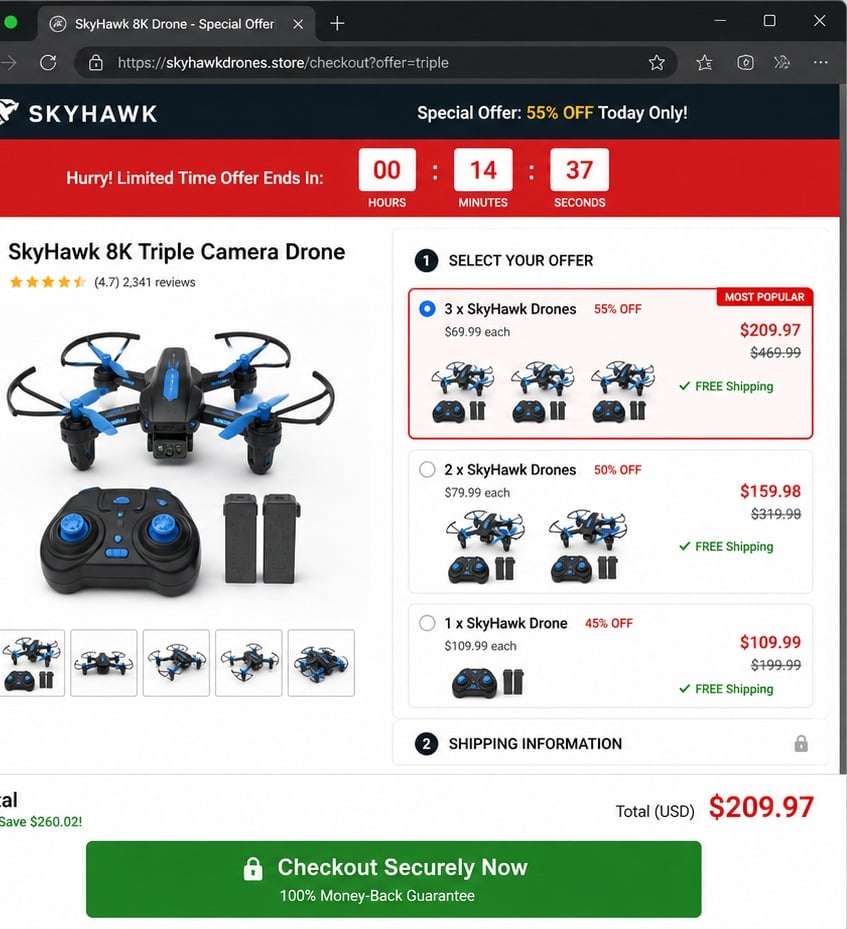
The landing page continues the illusion with technical icons, glowing reviews, and a crossed-out price. A bundle for two or three drones may already be selected, quietly turning a $69.99 expectation into a much larger total.
The product that arrives, when one arrives at all, can be a small generic toy that bears little resemblance to the professional folding drone shown in the promotion. Its camera, battery, controller, and stability may all be different.
The brand name is disposable. The same sales script can return with a new logo, a new domain, and the same borrowed footage once complaints catch up with the old version.
Overview
The ad sells the performance of a different class of drone
A historical campaign used video and photos resembling a DJI Mavic 3-class product while marketing a much cheaper device under another name. The page claimed 8K video, three cameras, obstacle avoidance, long flight time, and easy beginner controls.
Those features are not established by a printed badge. They require a verifiable model number, camera sensor specifications, battery capacity, flight tests, app documentation, and a manufacturer that can be held accountable.
When a $69.99 page uses footage from equipment normally costing far more, the viewer is being shown a performance level that the checkout item is unlikely to match.
The checkout can enlarge the loss before delivery
Per-unit pricing and preselected packages are common in aggressive direct-response funnels. A card may show three drones as the most popular choice even though the advertisement emphasized one low price.
Shipping protection, extra batteries, extended warranties, and accessory packs can appear as additional boxes. Some pages make the decline option less visible than the add button.
The buyer should stop before entering payment details and calculate the exact final charge. A timer, low-stock message, or claim that the page will disappear does not create a real technical reason to hurry.
Delivery does not prove the advertising was honest
A parcel containing a drone may make the seller argue the order was fulfilled. The important comparison is whether the delivered item matches the model, specifications, images, accessories, quantity, and warranty promised at checkout.
A cheap generic quadcopter can fly and still be materially different from an advertised premium camera drone. That distinction matters when requesting a refund or disputing a charge.
Buyers should preserve the packaging label and photograph the unopened parcel, the contents, serial markings, manual, camera, batteries, and controller before attempting a flight.
- Professional aerial footage creates a performance promise the seller may not own.
- Technical badges replace a verifiable model number and test data.
- The landing page uses a steep discount to make comparison shopping feel unnecessary.
- A multi-unit bundle can be selected before the buyer reviews the total.
- The delivered product may be a low-cost H12-style toy drone or another generic model.
- Returns can become expensive or impossible when the seller identity is unclear.
The Premium Footage and Cheap-Drone Mismatch
One widely documented version promoted a so-called triple-camera 8K drone for a sale price of $69.99. The ads and store pages displayed a professional folding drone and claimed a 60-minute battery life.
Closer inspection showed visual material associated with a premium DJI product. The checkout name, however, did not identify that DJI model or an authorized DJI seller.
A low-cost product associated with the offer resembled the H12 mini drone sold through wholesale marketplaces. Listings for that class of device appeared at prices far below the supposed original retail value shown by the ad.
This is a classic bait-and-switch risk. The ad borrows the appearance of an expensive product, while the seller retains room to ship a generic item described only by broad phrases such as 8K, triple camera, or obstacle avoidance.
The word 8K can be especially misleading on low-cost devices. A seller may refer to an interpolated image size, a still-photo setting, or a marketing label rather than genuine stabilized 8K video captured by a suitable sensor.
Flight-time claims also need context. Sellers may combine several batteries, measure hovering under ideal conditions, or publish a number that the included battery cannot reach in normal wind and recording use.
What the Seller Trail Reveals
The campaign moved visitors between more than one domain. The address shown in the ad did not always match the clickable destination, which is a warning because the advertiser can distance the public-facing name from the store processing orders.
Historical domain records linked one address to registrant information pointing toward Vietnam. An About page on another part of the operation named a company in China and listed a different managing identity.
Those records do not prove every detail was false, but the inconsistency makes accountability difficult. A buyer should be able to identify one legal seller, one return address, and one support channel before payment.
The store's marketing did not establish that it was an authorized reseller of the premium drone whose imagery appeared in the ads. Authorization matters because genuine warranties, firmware, batteries, and replacement parts depend on the manufacturer recognizing the product.
The cheap comparison listings also showed why a delivered parcel is not the end of the investigation. A generic toy can be rebranded and marked up while the advertising continues to display a far more capable drone.
A refund policy is only useful if it identifies the return destination, deadline, condition requirements, shipping responsibility, and company that will issue the refund. A five-year warranty badge without those details is advertising, not protection.
How the Fake 8K Drone Clearance Scam Works
Step 1: Premium footage creates the desire
A Facebook, Instagram, or short-video ad shows cinematic mountains, coastlines, vehicles, or city scenes. Smooth tracking and high dynamic range imply the promoted drone recorded everything shown.
The ad may also display a professional folding drone in close-up. Viewers rarely pause to compare the body shape, logo placement, camera gimbal, or controller with the product name on the store.
A claim such as suitable for beginners lowers another concern. The buyer is told advanced results require no training, registration knowledge, or careful setup.
Step 2: An implausible clearance price forces urgency
The price drops from a fictional three-figure amount to $69.99 or less. Copy explains the discount as warehouse surplus, a contract ending, an anniversary, or a direct-to-consumer breakthrough.
A countdown and low-stock number suggest the buyer cannot research the model. The timer may reset when the page reloads, revealing that the deadline is a script rather than inventory data.
Free shipping and a long warranty make the offer appear risk-free. Neither promise identifies who pays for a return to another country or whether warranty support exists.
Step 3: The product page replaces specifications with badges
Instead of publishing sensor size, lens details, battery watt-hours, aircraft weight, radio range, and supported app stores, the page relies on icons reading 8K, GPS, obstacle avoidance, and smart return.
Stock reviews may praise image quality without showing original files, serial numbers, or a verified purchase trail. Repeated names and generic portraits are additional warnings.
The same photos can appear on unrelated stores under different product names. Reverse-image searching the drone and screenshots can expose that reuse.
Step 4: A larger bundle is placed in the order path
The most popular option may contain three drones, while the one-unit choice costs more per device and sits lower on the page. This design nudges the buyer toward a total they did not plan to spend.
Accessory upsells can follow immediately after the card is submitted. Buttons may read Continue or Complete Order while actually adding batteries, cases, or replacement coverage.
The buyer should treat every confirmation screen as a financial document. Screenshot the selected quantity, total, shipping promise, and refund terms before leaving the page.
Step 5: Tracking delays the dispute window
The seller may provide a tracking number that shows label created for days or routes through several logistics partners. Long delivery estimates encourage buyers to wait rather than contact the card issuer.
Customer service may answer with scripted messages asking for patience. Each delay can make evidence harder to gather and move the buyer closer to payment-dispute deadlines.
A tracking update proves a parcel is moving, not that it contains the advertised drone. Keep the original order page and advertisement alongside the shipping record.
Step 6: A cheap substitute makes refunds difficult
If a generic toy arrives, support may offer a small partial refund and allow the buyer to keep it. That proposal reduces the seller's cost while avoiding a full admission that the product was misrepresented.
A full refund may require tracked return shipping to an overseas warehouse. The cost can approach or exceed the original charge, and the seller may refuse packages without a return authorization.
Do not ship the item until the seller provides written instructions and the card issuer explains what evidence it needs. An expensive return made too early can weaken the buyer's position.
Step 7: The same assets return under a new drone name
When reviews expose one store, the operator can replace the domain and label while keeping the professional footage, discount, technical badges, and generic fulfillment source.
The next campaign might claim military development, a canceled retailer order, or a television endorsement. These stories are interchangeable wrappers around the same low-cost product funnel.
Searching the story rather than only the brand is more protective. Phrases such as 8K triple camera drone $69.99 scam can reveal older versions even when the current bottle-style name is new.
Company, Address, and Fulfillment Checks
The label on the drone is not the legal seller
A product name printed on a landing page may be invented for that campaign. Compare it with the merchant on the receipt, card statement, terms, privacy policy, and parcel label.
If five different names appear, ask which entity accepted the order and which one provides the warranty. A support agent should be able to answer without vague references to a warehouse team.
Brand rotation is especially easy for generic electronics. The same aircraft can receive a new sticker, box, and web address without changing the factory source.
The return address may be only a fulfillment depot
A warehouse can receive returned parcels for hundreds of unrelated stores. Its address does not make it the designer, manufacturer, headquarters, or party responsible for the advertising.
Search the address before ordering. Look for a mailbox, residential location, shared suite, freight forwarder, or unrelated logistics operation.
If the only return location appears after purchase and sits overseas, the refund promise was not meaningfully disclosed when the buyer made the decision.
Support may negotiate instead of solving the mismatch
Test the phone number and email before ordering. Generic agents who cannot identify the exact drone, manufacturer, battery, or warranty process are not technical support.
After delivery, support may cycle through requests for more photos, repeated forms, and small partial-refund offers. Keep every reply and insist on a written resolution tied to the advertised specifications.
A disconnected number, unanswered inbox, or agent serving many unrelated brands is a strong sign that the seller is designed for short campaigns rather than long product support.
The electronics supply chain must be traceable
A drone should identify its manufacturer, model, battery type, charger input, radio compliance, app developer, serial markings, and safety instructions. These details matter more than the country printed on a shipping label.
Low-cost electronics can be mass-produced in China or elsewhere. Country of origin alone is not a safety verdict, but an unnamed factory, unverified charger, and missing battery documentation create real uncertainty.
Do not charge a swollen, damaged, unlabeled, or incompatible lithium battery. If the product lacks clear instructions and compliance markings, seek technical advice before using it indoors.
How to Check a Drone Offer Before Paying
Start with the exact model number. Search it on the manufacturer's official website and compare the aircraft body, controller, camera, battery, weight, app, and included accessories.
Capture a frame from the advertisement and run a reverse-image search. If the footage belongs to a premium model or another creator, the ad is not demonstrating the checkout item.
Look for original sample files rather than compressed social clips. Genuine camera specifications should include sensor size, resolution at a stated frame rate, bitrate, stabilization method, and supported storage.
Read aviation and registration rules for the buyer's location. A page that promises anyone can fly anywhere may be ignoring weight, airspace, remote identification, or local restrictions.
Finally, calculate whether the economics make sense. A complete aircraft, controller, several motors, camera, battery, charger, shipping, support, and warranty cannot be evaluated from a fictional crossed-out price.
Warning Signs to Watch For
- The advertisement shows a premium drone but the store never names that exact model.
- An 8K claim appears without sensor, frame-rate, bitrate, or sample-file details.
- A $69.99 price is justified by a timer or vague warehouse story.
- The clicked domain differs from the address printed inside the advertisement.
- Three units are selected even though the ad focused on one drone.
- The company name changes between the terms, receipt, statement, and parcel.
- The return address is hidden until after payment or points to a fulfillment depot.
- Support offers only a partial refund for a materially different product.
A real bargain survives model verification and comparison shopping. An offer that collapses as soon as you ask who made the drone, which model appears in the video, and where returns go is not a bargain worth chasing.
What to Do if You Have Fallen Victim to This Scam
- Save the advertisement and complete order page. Capture the video, product photos, specifications, quantity, total, countdown, warranty, refund policy, domain, and confirmation email. These records show what the seller promised before the page changes.
- Ask for cancellation in writing immediately. Email the seller from the address used for the order and clearly state that you cancel the transaction. Request confirmation that the order, upsells, and any future charges have been stopped.
- Contact the card issuer without waiting indefinitely. Explain whether nothing arrived, the amount was wrong, or the delivered item was materially different. Ask about the issuer's dispute deadline and the evidence required for a merchandise-not-as-described claim.
- Document the parcel before using the drone. Photograph the shipping label, sealed package, unboxing, model markings, manual, controller, battery, and accessories. Avoid crashing or modifying the item before the dispute is assessed.
- Do not return it to an unverified address. Obtain written return authorization and confirm the destination with the seller and card issuer. Keep the receipt and full tracking history if a return is required.
- Monitor for extra charges. Review the final checkout total and card statement for bundle additions, warranties, or later merchant names you did not authorize. Report unfamiliar transactions promptly.
- Scan the device used for checkout with Malwarebytes. This shopping funnel normally targets payment rather than installing software, but run Malwarebytes if the page downloaded a file, requested an extension, or triggered suspicious browser behavior.
- Use AdGuard to reduce repeat exposure. AdGuard can block many malicious ads, tracking redirects, and known scam storefronts. Continue verifying the seller because no filter can catch every newly registered domain.
- Report the seller and resist recovery offers. Report the social ad to the platform and the transaction to the FTC. Ignore anyone who promises a guaranteed refund for an upfront payment or asks to take remote control of your device.
Frequently Asked Questions
Can a $69.99 drone really record stabilized 8K video?
A price alone cannot answer that, but the claim requires verifiable sensor, frame-rate, bitrate, stabilization, and sample-file evidence. Generic badges are not enough.
Why does the ad look like a DJI drone?
Some campaigns reuse premium product imagery or footage to imply performance. Check the exact body, model, logo, camera, and controller against the item named at checkout.
What if I received a drone, but it is much cheaper?
Photograph everything and compare it with the saved advertisement. Contact the seller, then ask the card issuer about a merchandise-not-as-described dispute if the mismatch is material.
Should I accept a 20% refund and keep the item?
That is your choice, but calculate whether it fairly resolves the difference. Ask the card issuer how accepting a partial refund could affect a later dispute.
Is an overseas return address automatically a scam?
No. The concern is whether the destination and cost were disclosed, whether the legal seller is identifiable, and whether the return process is practical and documented.
Can the drone or battery be unsafe?
Any unverified electronics can create uncertainty. Do not use a damaged or unlabeled battery, and stop charging immediately if it swells, overheats, leaks, or produces an unusual odor.
The Bottom Line
The fake 8K drone clearance scam sells professional results first and identifies the real product later, if at all. A delivered toy does not make stolen footage, inflated specifications, or a preselected bundle honest.
Ignore the timer and verify the model, manufacturer, seller, battery, return address, and exact total. If those facts remain unclear, close the page.
If you already ordered, preserve the advertising trail and act before dispute deadlines expire. Good documentation is often more valuable than another week of scripted support replies.

Join the discussion
0 commentsShare your experience or ask a question about this article.
Discussion
Start the conversation
Have a question or something useful to share? Add the first comment.