

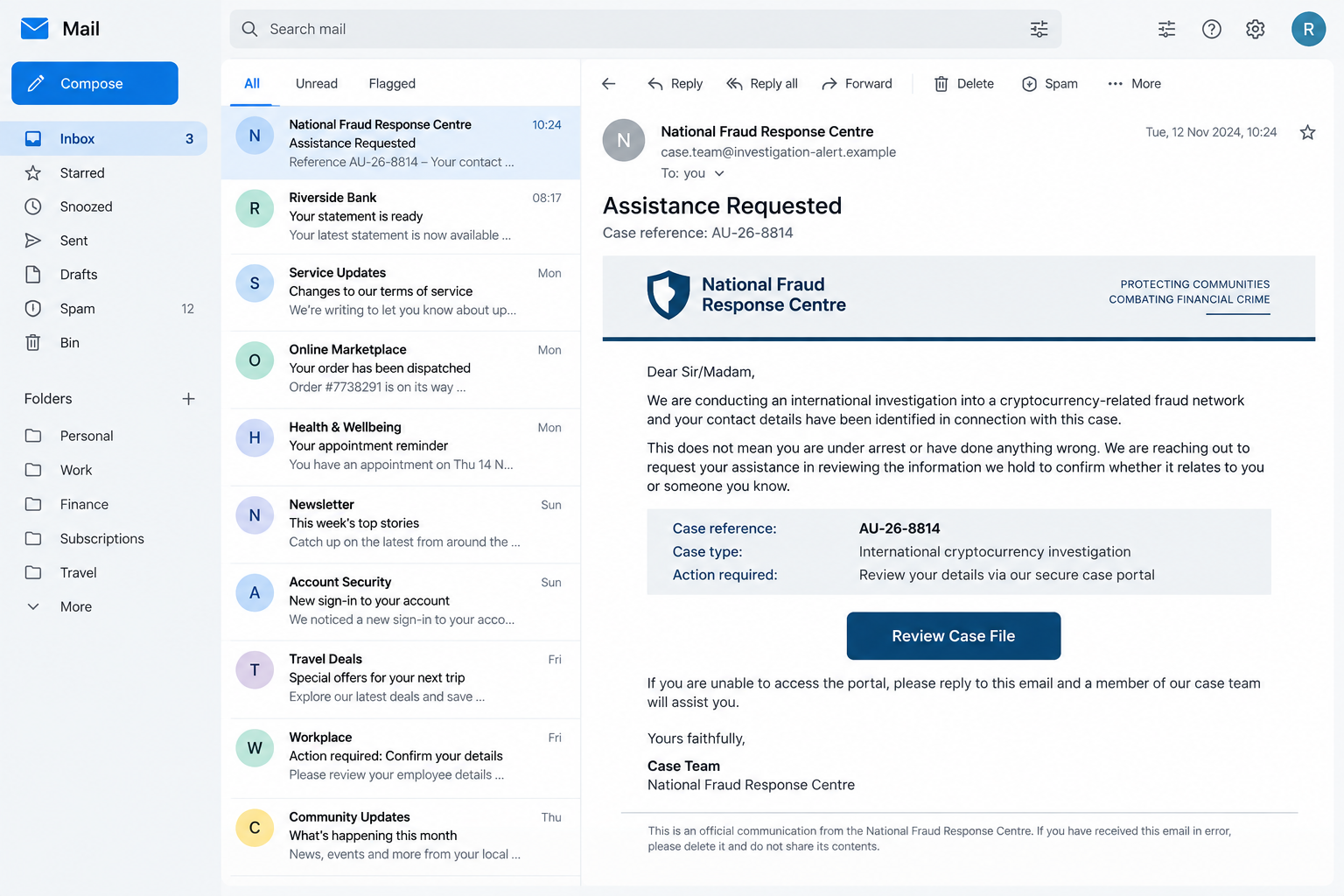
An anti-scam centre email sounds safer than an ordinary scam message because it claims to come from the people who stop scams. It says your details surfaced during an international cryptocurrency investigation and asks for your help.
The case number, agency language, and promise of protection make the request feel official. What follows can turn a reassuring warning into a second attempt to take money from the same people already at risk.
Overview
The message borrows authority from real fraud investigators
An anti-scam centre email scam impersonates a police unit, national fraud agency, cybercrime investigator, bank liaison, or victim-support office. The sender says the recipient’s information was discovered in a criminal database, seized device, cryptocurrency list, or active investigation.
The approach does not always accuse the recipient of wrongdoing. It may say the person is a potential witness or victim and that the agency wants to return stolen funds, protect an account, or verify evidence.
That supportive tone is the hook. Someone who would ignore a prize email may respond to an apparent warning from investigators.
A case file becomes a route to identity theft or payment
The message asks the recipient to reply, open a portal, download a document, join a call, or contact a named officer. The next step collects personal information under the label of identity verification.
Later, the impersonator may request a refundable bond, account validation transfer, tax, legal fee, crypto payment, or temporary movement of money to a supposedly protected account.
Real investigators do not require a victim to pay before receiving help. A professional-looking case portal does not change that rule.
Authorities have warned that criminal groups reuse victim data
On August 17, 2026, Australia’s National Anti-Scam Centre said it contacted more than 10,000 Australians whose details were identified during a United Kingdom investigation into organized crime targeting cryptocurrency exchange and hardware-wallet users.
The same alert warned that scammers were impersonating both the National Anti-Scam Centre and the Australian Federal Police. The impersonators invited people to assist with investigations before trying to steal money and sensitive information.
Warning signs include:
- an unexpected case notice from an agency you never contacted;
- a sender address that only resembles a government domain;
- a link, attachment, or callback number supplied inside the message;
- requests for identity documents, banking logins, or one-time codes;
- instructions to keep the investigation confidential;
- a promise to recover cryptocurrency or reimburse an earlier loss;
- a bond, tax, deposit, or transfer required before funds are released;
- pressure to act before a case is closed or assets are forfeited.
Why This Message Can Feel More Credible Than an Ordinary Phishing Email
The criminal may already know that the recipient owns cryptocurrency, reported a previous scam, used a hardware wallet, or shared details with an investment platform. That knowledge can come from breached databases, earlier scam forms, purchased marketing lists, or information passed between fraud groups.
A real fact does not prove the sender’s identity. It only proves that someone obtained the fact.
The message often contains enough detail to sound researched. A case reference, officer name, agency address, legal phrase, and familiar logo can be copied in minutes.
Search results can add another layer. Scammers may choose the name of a real investigator or direct the target to a genuine agency page while keeping the conversation on a fraudulent email account.
The recipient’s previous loss also changes the emotional calculation. A person who wants closure may be more willing to complete verification if the sender appears to know what happened.
Confidentiality language isolates the target. The impersonator may claim that discussing the case could alert suspects, compromise an asset freeze, or violate a court order.
How the Anti-Scam Centre Email Scam Works
Step 1: The email announces an investigation
The recipient is told that contact details, wallet information, or a prior transaction appeared in an international inquiry. The message may describe the person as a victim, witness, claimant, or account holder.
A reference number and deadline make the contact appear procedural rather than promotional.
Step 2: The recipient is directed to a case officer
The email provides a reply address, telephone number, encrypted chat account, or case portal. The supposed officer answers quickly and uses reassuring language.
Moving the conversation to a private channel prevents the real agency, email provider, or platform from interrupting the exchange.
Step 3: Identity verification collects valuable data
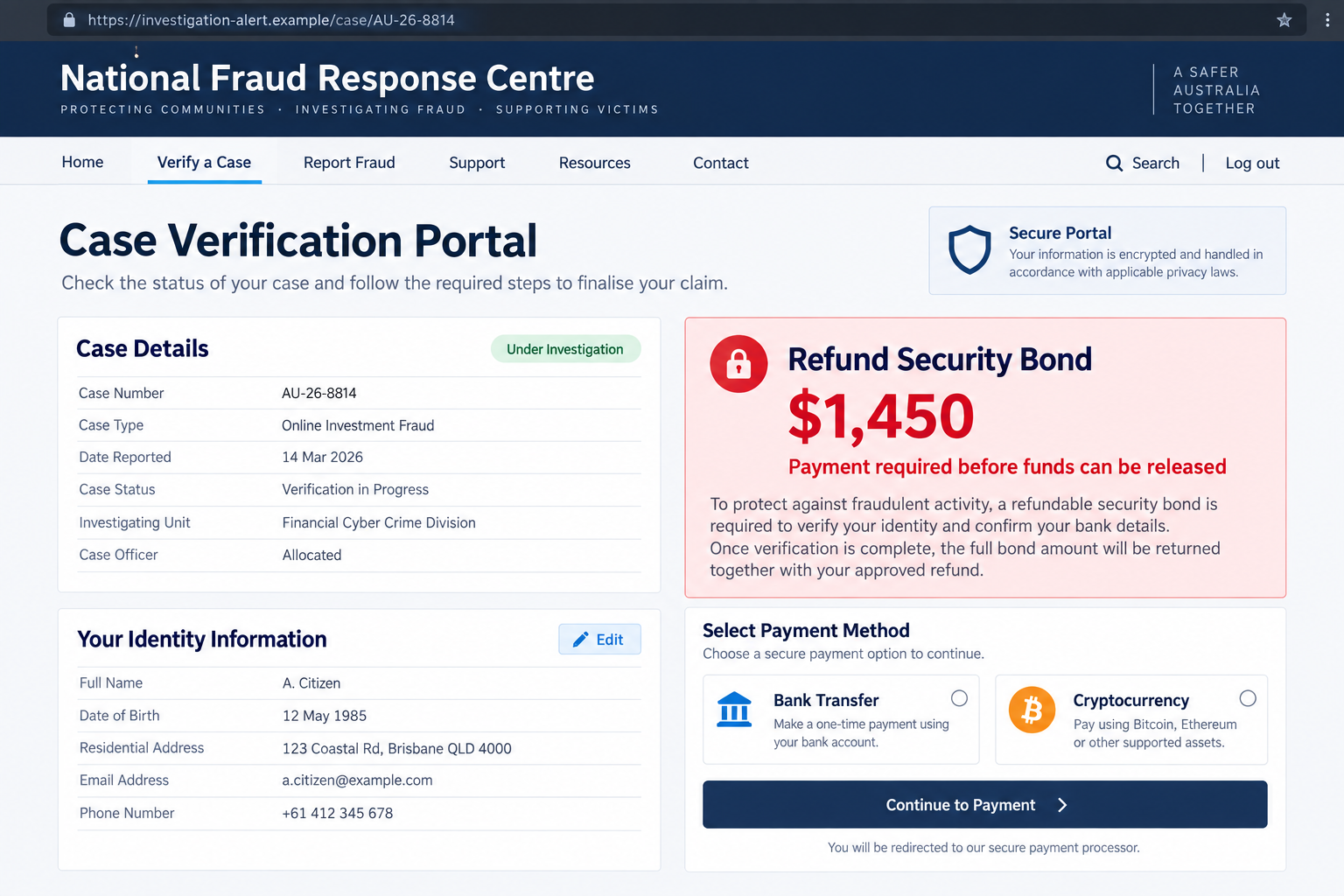
The portal may request a passport, driver’s license, address, date of birth, bank details, wallet addresses, or a selfie. The officer may ask the victim to read out a one-time code.
These details can support account takeover, new credit applications, SIM swaps, or more convincing impersonation attempts.
Step 4: A recovery or protection story introduces money
The officer claims that seized funds can be returned or that the recipient’s savings must be protected. A payment is described as a bond, tax, clearance charge, legal deposit, anti-money-laundering test, or temporary transfer.
The label changes, but the payment moves to an account or wallet controlled by the scammer.
Step 5: Fake documents answer every objection
The target receives letters carrying official-looking headers, signatures, badges, court references, or transaction tables. A video call may show a staged office or an AI-generated official.
Documents produced by the same person requesting payment are not independent proof.
Step 6: The first payment creates another requirement
After the transfer, the portal reports a compliance hold, exchange fee, currency conversion, insurance charge, or identity mismatch. The officer says one more payment will complete the release.
No payment resolves the case because the recovered balance was never real.
Step 7: The operation switches to recovery again
When the victim stops, another person may claim to be an oversight officer, lawyer, bank investigator, or tracing specialist. This new contact promises to correct the first officer’s misconduct for another fee.
The names and domains change while the stolen data keeps the cycle alive.
A Real Investigation Does Not Need a Refundable Security Bond
Government investigators may ask questions, preserve evidence, or request a formal statement. They do not make assistance conditional on a wire transfer, crypto payment, gift card, or payment-app transfer.
A request to move savings into a safe account is especially dangerous. There is no special category of bank account that becomes protected merely because a caller describes it that way.
One-time passwords approve access or transactions. They are not identity questions for an investigator, and no official needs the code delivered to your device.
A real asset-recovery process may involve courts, insolvency administrators, regulated lawyers, or documented claims. Fees are disclosed through verifiable channels and are not demanded through an unsolicited private message.
Cryptocurrency recovery cannot be guaranteed. Anyone promising a certain result while requesting an upfront transfer is creating a new financial risk.
If an agency genuinely needs to reach you, independently finding its published switchboard will not damage the case. A legitimate officer can be verified through that channel.
How to Verify the Case Without Using the Message
Do not click the link, open the attachment, reply, or call the number in the email. Treat every contact method inside the message as part of the unverified claim.
Type the agency’s official web address yourself or use a trusted government directory. Find its public telephone number and ask whether the case reference and officer exist.
Compare the complete sender domain, not the display name. Extra words, swapped letters, free mailbox services, and newly registered domains are important warning signs.
Ask the agency how it normally contacts affected people. For example, the National Anti-Scam Centre says it will never request money or sensitive information, or send a text containing links, attachments, or a callback number.
Check the message headers if you know how, but do not treat a familiar-looking From field as decisive. Display information can be spoofed.
If the contact refers to a previous report, log into the reporting portal through a bookmark or independently typed address. Do not use credentials on the page supplied by the sender.
Pause when secrecy is demanded. Speak with your bank, a trusted family member, the real agency, or local police before moving money.
What a Genuine Victim Notification Should Let You Do
A real warning should survive independent verification. You should be able to close the email, locate the agency yourself, and confirm the notification without losing a refund or missing an artificial deadline.
The agency should explain why it is contacting you without requiring passwords, wallet seed phrases, full card details, or remote access to a device.
If documents are required, the submission route should be published on an official domain or confirmed through a public switchboard. The email itself should not be the only proof that the portal belongs to the agency.
Legitimate investigators can describe reporting options, privacy handling, and the next procedural step. They should not promise a guaranteed financial outcome.
A notification may contain a case reference, but urgency does not remove your right to verify it. Taking time to call the real organization protects both you and any genuine investigation.
Be cautious if the sender becomes angry when questioned. Pressure, secrecy, and resistance to outside confirmation are social-engineering tools, not evidence of official authority.
Company, Address, and Fulfillment Checks
The agency name must match an official government domain
A display name and copied crest are easy to reproduce. Verify the organization through an official government directory and compare the complete domain character by character.
A real agency does not become genuine because a scammer links to one of its public pages.
The office address must connect to the named unit
Search the address independently. Fraudulent letters may use a real headquarters, an unrelated building, a mailbox, or a slightly altered street name.
Send documents only through a submission method confirmed by the official agency.
The officer must be reachable through the public switchboard
Do not let the person transfer your call to a supposed supervisor. End the contact and start a new call to the number on the agency’s official website.
An officer who refuses independent verification should not receive information or money.
The payment path must withstand outside scrutiny
A personal bank account, crypto wallet, payment-app username, or gift card is not a government recovery channel. Ask your bank to review any payment request before acting.
Words such as refundable, insured, protected, or court authorized do not make a transfer safe.
What to Do if You Have Fallen Victim to This Scam
- Stop all contact and payments. Do not send the bond, tax, compliance fee, or another transfer to recover what was already paid.
- Call your bank immediately. Use the number on your card or statement. Ask the fraud team whether a transfer can be recalled, frozen, or traced.
- Contact the cryptocurrency provider. Share wallet addresses, transaction hashes, amounts, and timestamps. Ask the exchange to preserve records and flag the destination.
- Preserve the complete case file. Save the original email with headers, portal URL, documents, messages, telephone numbers, payment instructions, and screenshots.
- Protect your identity. If you supplied identity documents, place appropriate fraud alerts, review credit reports, and follow the identity-theft process in your country.
- Reset exposed accounts. Change email and financial passwords from a clean device, remove unknown sessions and recovery methods, and enable phishing-resistant multifactor authentication where available.
- Scan devices used with the portal. If you opened an attachment or installed anything, disconnect the device and run a full Malwarebytes scan. Seek professional help if the file executed or security settings changed.
- Reduce repeat exposure. AdGuard can block many known malicious domains and deceptive ads. It cannot make a fraudulent case portal safe or reverse a completed payment.
- Report both impersonation and payment. Notify the real agency, email provider, domain registrar, local police, and your national fraud-reporting service.
- Expect a second recovery approach. Do not pay anyone who contacts you unexpectedly and claims to have found the missing funds.
Frequently Asked Questions
Can a real anti-scam agency contact victims by email?
Yes, an agency may send a genuine notice. Verify it through contact details you find independently before replying, opening files, or sharing information.
Why does the sender know about my earlier crypto loss?
Your information may have been stolen, sold, shared by another scam group, or identified in an investigation. Prior knowledge does not authenticate the sender.
Is a refundable security bond normal?
No. An unsolicited investigator should not require a bank transfer or cryptocurrency payment before providing help or releasing funds.
Does a case number prove the investigation exists?
No. A case number can be invented. Confirm it through the agency’s official switchboard or reporting portal.
Should I send identity documents to prove I am the victim?
Only use a submission route independently verified with the real agency. Do not upload documents to a portal supplied by an unverified sender.
Can a private recovery expert guarantee my money back?
No legitimate professional can guarantee recovery. An upfront fee, seed-phrase request, or promise of certain crypto recovery is a major warning sign.
The Bottom Line
A fake anti-scam centre email turns the language of protection into a route for identity theft, account takeover, and advance-fee payments.
Verify the agency outside the message. Real investigators will not object when you hang up, find the official number yourself, and confirm the case before sharing anything.








