

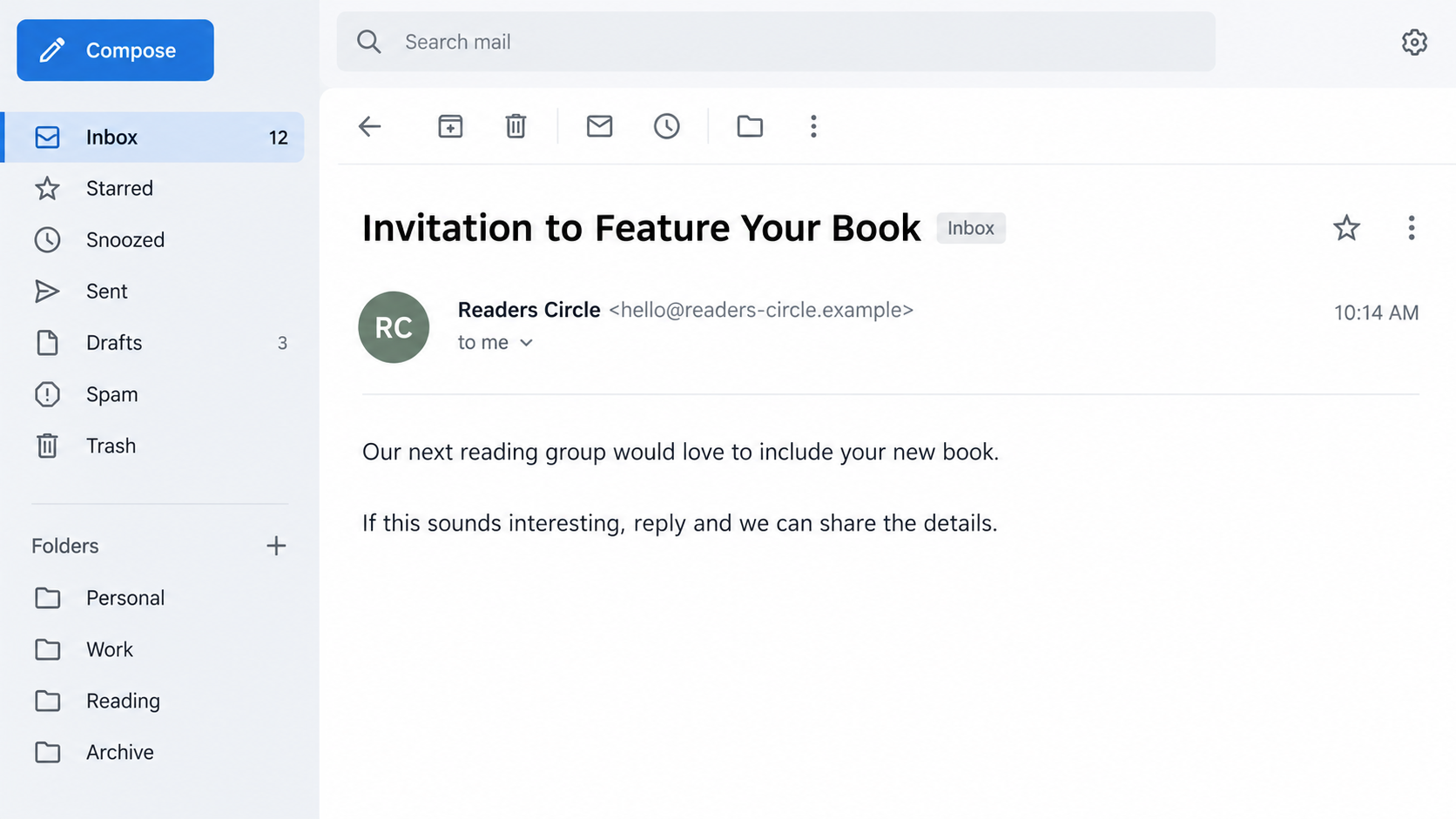
A book club invitation to feature your work arrives from a group you have never met. The note sounds warm, specific, and surprisingly well timed.
Before you imagine the discussion, take a moment to learn who sent it. The first friendly email may not show the whole arrangement.
Overview
The invitation borrows the excitement of being discovered
Writers often welcome book-club invitations. A genuine group can introduce a title to new readers and create a meaningful conversation.
That is precisely why fake invitations work. The initial approach sounds like appreciation, not a sales pitch.
The Authors Guild warns that scammers impersonate book clubs, reviewers, hosts, and producers when contacting authors.
The money request may arrive later
According to the Guild, the sender may build a conversation before asking for a fee in the hundreds for a supposed book-club appearance.
Other invented opportunities can involve larger amounts. This is an advance-fee scam when the promised access or affiliation is fraudulent.
One writer says they received more than 30 suspicious approaches. That is their experience, not a measured campaign total or a confirmed loss for every contact.
Verify the audience before paying for it
- Find the group or host through a source other than the invitation.
- Ask what members will read, when they meet, and who organizes the event.
- Check whether any fee was disclosed in the first message.
- Do not pay a personal account to secure a supposedly prestigious feature.
The emails shown here are fictional reconstructions. Their sender and $295 example fee illustrate a documented pattern, not a captured conversation with a named real club.
Not every paid marketing service is fraudulent. The concern is a false identity, invented audience, or misleading promise used to obtain money from an author.
Why Authors Are a Natural Target
Publishing a book takes years of work. Once it is available, getting people to notice it can feel like another full-time job.
A flattering invitation offers relief from that pressure. It suggests that readers are already interested and someone else will organize the exposure.
Indie authors may receive routine outreach from reviewers, podcasts, promoters, and event organizers. That steady background noise helps an impostor blend in.
A traditional publishing deal does not make a writer immune. The pitch is about access and visibility, not only about who printed the book.
Scammers can pull a title, cover description, genre, and author biography from retail listings. Mentioning those details does not prove anyone read the work.
Some messages are more sophisticated. The Authors Guild says current approaches can sound as though the sender has actually read the book.
That makes old advice about spotting bad grammar less useful. Smooth prose and correct details can coexist with an invented opportunity.
The emotional hook is especially strong when a message describes a reading group that sounds like the book’s ideal audience.
A writer may reasonably want to reply. The goal is not to stop genuine outreach, but to avoid converting an unverified compliment into a payment.
How the Fake Book Club Invitation Scam Works
Step 1: The sender presents a personal invitation
The first message may say a group wants to feature your new release or invite you to speak with its members.
It may mention a character, theme, or recent launch. Those details create the impression of a real person selecting your book.
A single personalized sentence is easy to produce from a synopsis. Treat it as conversation, not proof of a real audience.
The sender may sign as an organizer, producer, reviewer, or representative. The title can sound credible even when the organization cannot be found.
Step 2: Friendly questions keep you engaged
Instead of asking for money immediately, the contact asks about your availability, discussion topics, or preferred event date.
This creates an apparent plan. The more you contribute to it, the harder it may feel to walk away later.
The Authors Guild specifically warns that scammers have learned to delay the fee request because an immediate demand alarms authors.
As the conversation continues, ask for concrete information. A real organizer should be able to explain the group’s format and history.
Step 3: A paid requirement appears
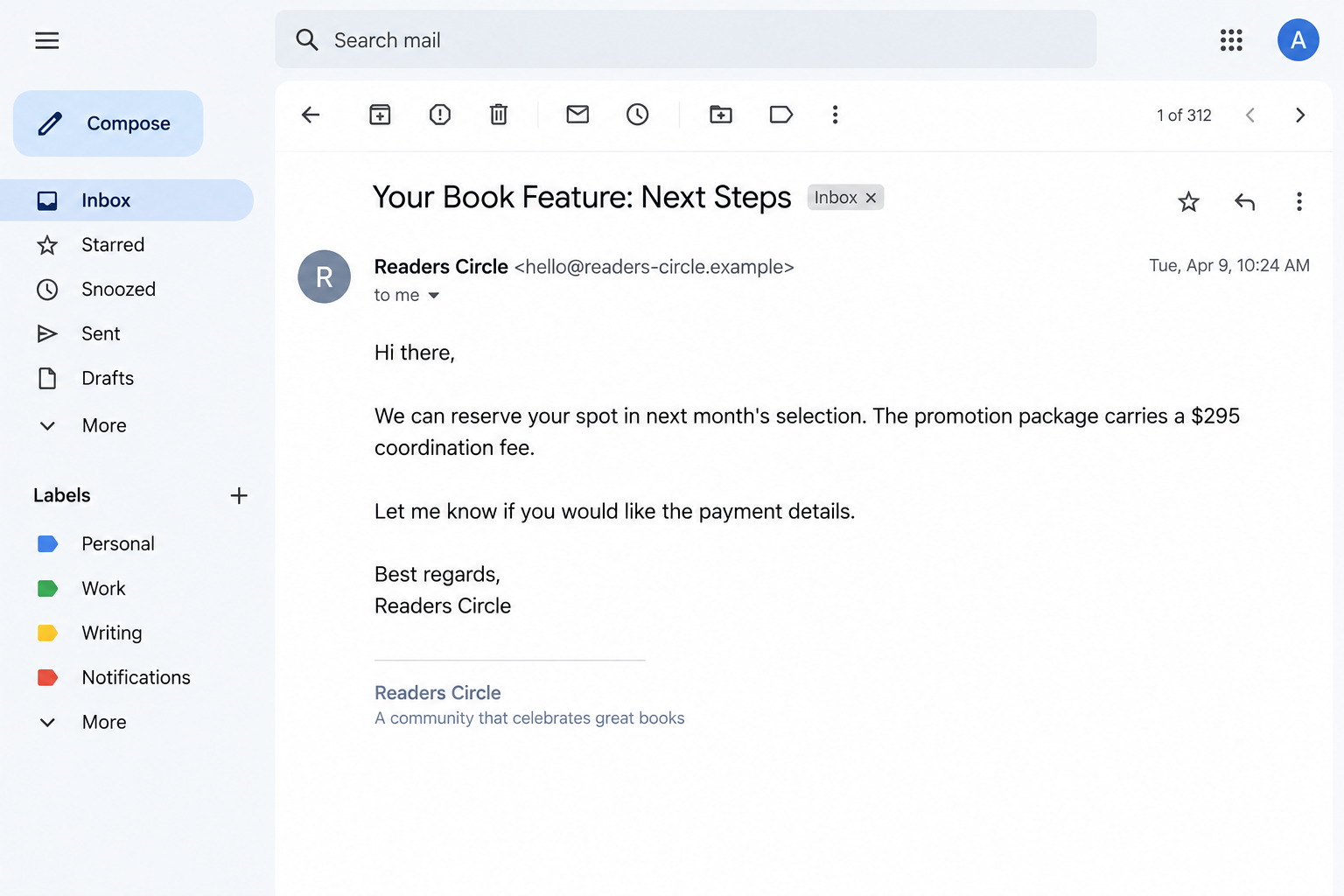
The fee may be described as coordination, placement, promotion, or booking. Its name makes a payment sound like ordinary event administration.
In one pattern described by the Guild, the fee can reach several hundred for a claimed book-club appearance.
The $295 in our illustrative screen is fictional. It should not be read as the amount charged by a specific real sender.
At this stage, ask what the payment buys, who receives it, and what evidence confirms the audience exists.
Step 4: The promised exposure becomes hard to measure
A vague promise of “reader engagement” can be difficult to challenge after money moves. The organizer may not guarantee attendance or any meaningful feature.
That ambiguity is useful to a dishonest operator. They can point to a minimal action while the author expected a substantial event.
Our concern here is not that every small event has uncertain results. It is the false affiliation or fabricated opportunity behind the request.
If the sender cannot identify a verifiable club, meeting, and organizer, the claimed audience should not be treated as established.
Step 5: Another offer may follow the first payment
Once someone pays for one promised feature, a scammer may pitch a larger package or a special connection to a media figure.
The Authors Guild warns that other purported services and opportunities can involve four-figure fees. It does not say every fake club uses an upsell.
Do not let a previous payment become the reason to send more. A second charge will not make the original opportunity real.
What a Real Invitation Should Be Able to Explain
A genuine reading group does not need an impressive website. Small groups can be informal. It should still be possible to understand who is inviting you.
Ask when the group meets and how its members choose books. The answer should fit the claimed invitation.
Ask whether the group has discussed other books and whether past authors can confirm their participation through independent channels.
Do not rely on screenshots of glowing testimonials supplied by the sender. Images can be copied or invented.
Look for an organizer whose public history predates the current solicitation. A new social account is not conclusive, but it deserves extra checking.
Clarify whether members purchase the book themselves. A claim that the organizer will buy hundreds of copies should be verified before sharing payment details.
If there is a fee, request a written description of deliverables, dates, refund terms, and the legal person or business receiving payment.
Those questions are normal business diligence. A legitimate promoter may have answers even when no outcome can be guaranteed.
An impostor may instead say the slot will disappear unless you pay immediately. A tight deadline is not a substitute for verifiable facts.
Pay attention to the route of payment. A personal wallet or unrelated account makes a purported organizational fee harder to reconcile.
Do Not Confuse Promotion With a Reader Invitation
Authors sometimes buy advertising or event services on purpose. Those transactions can be legitimate when the seller and deliverables are honestly identified.
A fake book-club invitation is different. It first presents itself as organic reader interest, then converts that interest into a required fee.
The change matters because the author may have accepted the conversation under a false premise. A paid placement is not the same as a club choosing a book.
Some honest clubs may charge for venue costs or ticketed events. The fee alone is not proof of fraud.
Look at the whole claim. Is the sender impersonating a known person? Does the group exist? Was payment disclosed clearly and early?
Can the promised activity be confirmed without relying on the person asking for money? These questions separate a normal negotiation from a fabricated invitation.
A real promoter might disclose a small audience, a modest event, and an uncertain result. Honesty about those limits is more valuable than a grand promise.
An invented book club may offer impressive reach while withholding the basic facts that would let you see whether its readers exist.
Ask yourself what would remain of the offer if the sender’s flattering language disappeared. You should still be able to identify a concrete activity.
If the answer is only “visibility,” request specifics. Will there be a live discussion, a newsletter mention, a recorded interview, or something else?
Each format has different evidence. A meeting has a date and organizer; a newsletter has an archive; a recorded interview has previous episodes.
These checks do not guarantee a marketing return. They establish whether the advertised activity has a real structure before you make a decision.
The safest response is often brief: thank the sender, ask for verifiable details, and pause until those details check out.
You are not obligated to defend your skepticism. The burden of proving the opportunity belongs with the person selling it.
If the Sender Claims a Famous Host Is Involved
A celebrity name can make a minor fee seem like a bargain. The Authors Guild reports approaches impersonating well-known hosts and producers.
Do not infer an endorsement from a forwarded email, social profile, or cropped image. Confirm participation through the person’s official channels.
Real media opportunities usually have production staff, schedules, and contact paths that can be checked independently.
Be cautious if every question routes back to the same stranger who initiated the pitch. That leaves the original claim untested.
A professional-looking agreement is also insufficient. A document can describe a nonexistent audience as easily as an email can.
Check the identity first, then evaluate whether the proposed promotion is worth its price. Those are two separate decisions.
When a Fee Is Paid, Keep the Evidence Specific
A payment receipt alone may not show what was promised. Save the message where the organizer described the group, event, and expected audience.
Keep the version of any agreement you accepted. If terms later change, the earlier copy can help explain the discrepancy to a payment provider.
Note the account name that received your money. If it differs from the claimed club or agency, ask for an explanation before sending more.
Do not send an identity document to strengthen a refund request made inside the same suspicious conversation. Use the payment provider’s official process instead.
Authors sometimes feel embarrassed after paying. The hesitation is understandable, but early reporting gives the provider a clearer timeline and more options.
What to Do if You Have Fallen Victim to This Scam
- Stop paying and pause contact. Do not send a second fee to “release” the feature or recover the first payment.
- Contact the payment provider quickly. Explain that the promised organizer or opportunity may have been misrepresented. Ask what dispute or recall options apply.
- Save the entire conversation. Keep original emails, headers, invoices, payment receipts, names, account details, and any promised event date.
- Check the claimed organization independently. If a real club, host, or agency was impersonated, notify it through its published contact details.
- Protect any account you connected. Change passwords if you used a link to sign in, and review unfamiliar sessions or app permissions.
- Report the solicitation. Use the email or social platform’s abuse controls and report financial fraud to the relevant consumer authority.
- Warn colleagues carefully. Share the verified pattern and sender indicators without accusing an unrelated legitimate club.
If you opened a document or installed a tool from the contact, scan the device with trusted software such as Malwarebytes.
If you clicked an unfamiliar promotional link, AdGuard may help block known malicious destinations. Neither tool replaces a bank dispute or identity check.
If you merely replied, there may be no account to recover. Stop engagement and watch for follow-up approaches using the information you disclosed.
A payment dispute is time-sensitive. Do not wait for the promised event date if the organizer’s identity has already failed verification.
Frequently Asked Questions
Are all unsolicited book-club invitations scams?
No. Real groups invite authors. Verify the organizer and audience before sharing sensitive information or paying a fee.
Why would a fake organizer wait to ask for money?
A friendly conversation creates trust. The Authors Guild warns that delayed payment requests have become part of these impersonation approaches.
Is a promotion fee automatically fraudulent?
No. The deception lies in a false identity, invented opportunity, or misleading deliverables, not simply the existence of a paid service.
Can someone really know details about my book and still be fake?
Yes. Public listings supply titles, summaries, genres, and author biographies. Even accurate references do not prove the sender organized a real feature.
What if I paid but the event has not happened yet?
Preserve the agreement and contact your payment provider promptly if the organizer or promised audience cannot be verified.
Should I trust a celebrity name in the invitation?
Not without independent confirmation through that person’s official channel. Names, images, and signatures can be copied into an email.
The Bottom Line
Fake book club invitations exploit a real author’s desire to reach readers. The scam is the invented invitation or impersonation used to extract a fee.
Enjoy genuine interest in your work, but verify the organizer before paying for access to an audience you cannot confirm.
If you already paid, act quickly with the payment provider, keep the messages, and alert any person or group whose identity was misused.








