

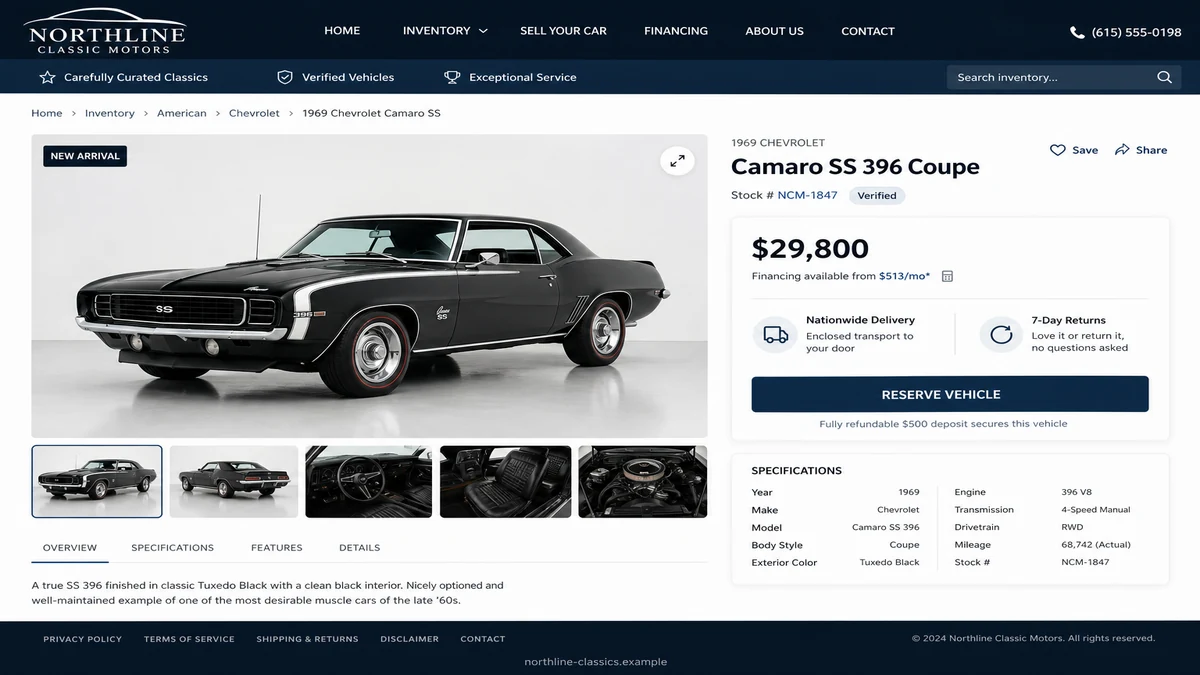
A hard-to-find car appears online at a price that is good, but not so low that it looks impossible. The listing has dozens of photos, a stock number, financing language, a delivery promise, and a dealer name that survives a quick search.
The salesperson answers quickly and seems to know the vehicle. A refundable reservation is offered before another buyer takes it.
That polished journey is what makes the fake car dealership website scam so expensive. The page can look complete while the seller, the car, and the payment destination tell three different stories.
Overview
The website can be copied from a real dealership
Scammers build bogus dealership sites by copying names, logos, inventory photos, vehicle descriptions, addresses, and policy language from genuine businesses. The FTC warned about this exact pattern on September 1, 2026, after buyers paid for cars that the real dealers had never offered them.
AI tools make cloning faster, but the deception does not depend on AI. Ordinary copying can reproduce a convincing inventory page in minutes. A real vehicle identification number, or VIN, may be lifted with the photos, allowing the fake salesperson to answer basic questions with genuine data.
The scam site may also display customer testimonials, a detailed delivery process, financing badges, inspection claims, and a generous return policy. Those elements are only page content until the dealer independently confirms them.
The car may be real while the sale is completely fake
Classic cars, rare trims, work trucks, recreational vehicles, and unusually clean used models make effective bait. Buyers expect to shop outside their local area, so a remote transaction and enclosed delivery do not feel unusual.
The photographs may show a real car currently listed by another dealer, sold years earlier, or advertised by a private owner. The scammer does not need the vehicle. The goal is to collect a reservation, down payment, shipping charge, or full wire before the buyer reaches the real owner.
A valid VIN proves that a vehicle with that identity exists. It does not prove that the person sending the invoice owns it, controls it, or has authority to sell it.
The payment request reveals the real transaction
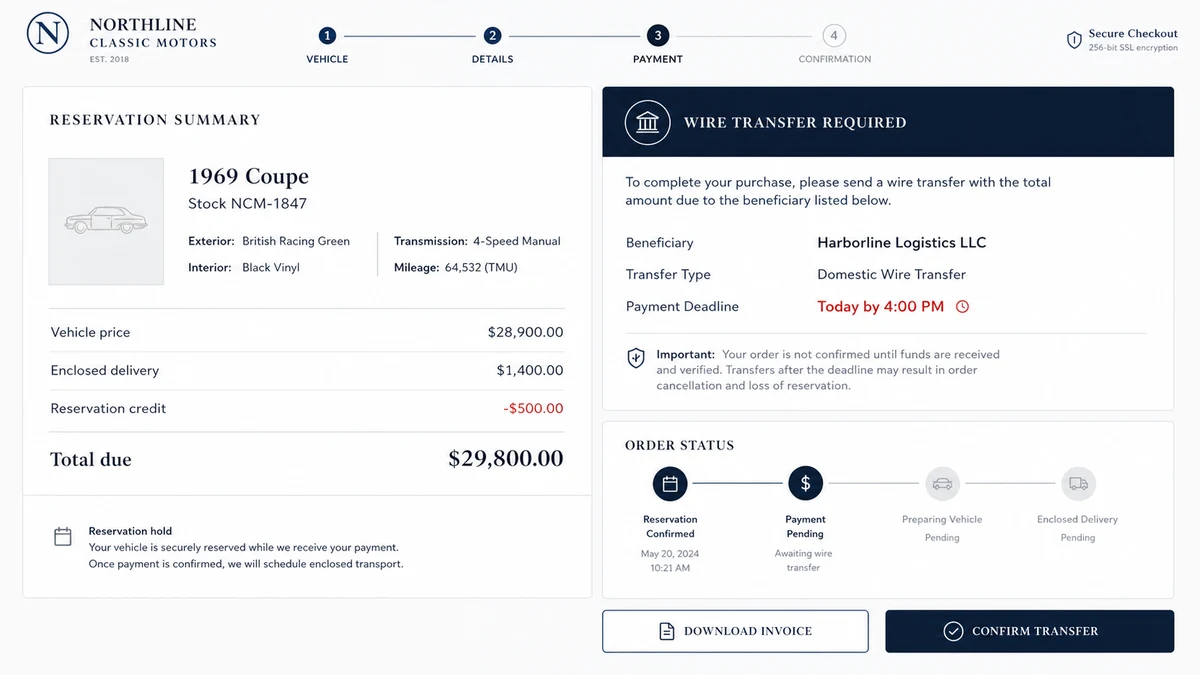
The fake dealer often moves from friendly sales talk to a bank wire. The beneficiary may be a logistics company, holding company, individual, or business whose name does not match the dealership.
A deadline is attached to the payment. The buyer may be told the vehicle has multiple interested parties, a truck is ready to collect it, or the reservation will expire that afternoon.
Common warning signs include:
- The dealer will not allow an in-person or independent inspection.
- The same vehicle photos appear on another website.
- The advertised price is substantially below comparable listings.
- The salesperson uses a different domain from the dealership.
- The wire beneficiary does not match the seller on the purchase agreement.
- A complete payment is required before the vehicle can be seen.
- The return policy promises safety but provides no accountable process.
- The real dealership cannot find the vehicle or salesperson in its records.
Why a Cloned Dealer Website Can Pass a Quick Check
A buyer may search the dealership name and find years of positive reviews, a matching street address, and photographs of a real lot. That research feels reassuring because the business being impersonated is genuine.
The problem is identity binding. Search results about the real dealer do not prove that the website, email address, invoice, and bank account in front of the buyer belong to that dealer.
Scammers benefit when a victim searches only the visible name. The legitimate company absorbs the scrutiny, while the criminal controls a lookalike domain, a different phone number, and the payment instructions.
A copied website can even include the real dealer’s phone number on some pages. The payment page or email signature may quietly switch to a number controlled by the scammer.
Reviews create another trap. A cloned website may link to the real dealership’s review profile or copy favorable quotes. Those reviews describe transactions with the legitimate business, not with the person requesting the current wire.
Verification has to follow the transaction from beginning to end. The dealer name, domain, salesperson, vehicle, contract, payment beneficiary, and pickup location must all connect through sources the seller did not provide.
How the Fake Car Dealership Website Scam Works
Step 1: Scammers copy a real dealer and desirable inventory
The criminals select a dealership with a credible history, recognizable inventory style, and enough public material to copy. They register a lookalike domain or build a site under a generic automotive name.
Vehicle photos, VINs, equipment lists, staff names, policy pages, and testimonials are copied from real listings. Some pages may come from several dealers, creating a showroom that never existed in one place.
Step 2: Search results and advertisements bring in buyers
The fake listing may appear in paid search, vehicle marketplaces, social media ads, enthusiast groups, or classified posts. Rare cars and nationwide delivery give buyers a reason to consider a remote sale.
The domain may be new, but a professional design hides that fact. Search engines can display the page before complaints or warnings have had time to accumulate.
Step 3: A responsive salesperson creates confidence
The buyer receives prompt answers through email, text, or phone. The scammer can repeat facts from the copied listing and may send extra photographs already available elsewhere.
Questions that require physical control are avoided. A live walkaround is delayed, the showroom is supposedly closed, or the vehicle is said to be stored at a separate secure facility.
Step 4: A reservation deadline limits verification
The salesperson says another buyer is interested and offers to hold the car with a refundable payment. The amount may feel small compared with the vehicle price, making the first transfer easier to justify.
Once the buyer has paid something, the scammer can use that commitment to request more. Shipping, insurance, tax, title processing, or the remaining balance may follow.
Step 5: Professional documents make the sale feel final
A purchase agreement, invoice, odometer disclosure, shipping schedule, or copy of a title may arrive. These documents can contain accurate vehicle data and still be forged.
The buyer is encouraged to focus on formatting and signatures instead of verifying who issued the documents and whether the seller has legal title.
Step 6: The money goes to an unrelated beneficiary
Wire instructions identify a person or company that may have no visible relationship with the dealer. The mismatch is explained as a transport partner, accounting processor, parent company, escrow provider, or recently updated account.
A legitimate transaction can involve third parties, but each role should be documented and confirmed through the dealer’s independently verified contact. A verbal explanation from the same salesperson is not independent confirmation.
Step 7: Delivery delays replace the missing vehicle
After payment, the buyer may receive a tracking page, transport update, or request for another fee. Weather, carrier scheduling, insurance, customs, or title processing becomes the reason the car has not arrived.
Eventually the website, salesperson, and tracking page disappear. The buyer may learn the truth only after calling the real dealership or traveling to the copied address.
The Checks That Matter Before Any Deposit
Call the dealership using a number obtained from a trusted business record, manufacturer directory, state dealer-license lookup, or a previous verified relationship. Do not use the number in the advertisement, email, invoice, or suspicious website.
Ask the verified employee to confirm the exact stock number, VIN, price, salesperson, and domain. A legitimate dealer should be able to locate the vehicle in its own inventory system.
Request a live video walkaround at an agreed time. Ask the employee to show the VIN plate and a simple detail chosen during the call. A prerecorded video does not prove current possession.
If the car is too far away, hire an independent mobile inspector that you select. The FTC specifically advises remote buyers to request an inspection. A refusal is a strong reason to leave the transaction.
Search several distinctive listing phrases and use reverse image search on the photographs. Another listing with a different seller, location, or price may reveal the source.
Compare the VIN across the listing, title, invoice, inspection report, and vehicle. MalwareTips has also documented the separate fake vehicle history report scam, where a supposed buyer pushes a seller toward an untrusted VIN website.
Check the state dealer license under the exact legal entity on the contract. Then compare that entity with the bank beneficiary. If the names differ, stop until the verified dealer explains and documents the relationship.
Do not treat a padlock, polished checkout, or return promise as escrow. HTTPS only encrypts the connection to the site. It does not identify the person operating it.
What an Independent Vehicle Inspection Should Prove
An inspection is most useful when the buyer, not the seller, chooses the inspector. Search for a licensed or established mobile inspection service independently and call it through its published number.
The inspector should confirm that the vehicle is physically present at the stated location. Ask for the full VIN from the vehicle, not only the number supplied in the listing.
Request current photographs that show the VIN plate, odometer, title-relevant identifiers, engine bay, body panels, interior, and any known damage. The files should come from the inspector’s own visit.
Condition is only one question. Ask who provided access, which business controls the keys, and whether the person offering the sale was known at the location.
A scammer may agree to an inspection but direct the buyer to a different vehicle, storage lot, or cooperative third party. Match the inspection location and VIN with the contract and dealer record.
Do not use an inspection company selected through a link supplied by the salesperson. A fake dealer can operate a second website that pretends to be an inspector, shipper, or escrow service.
For high-value classics, consider a marque specialist who can evaluate identity, modifications, and documentation. A VIN can be valid while a trim, engine, restoration claim, or historical description is inaccurate.
The inspector should send the report directly to you through a channel you established. A PDF forwarded by the seller can be edited or borrowed from an older sale.
Inspection does not replace title verification. Confirm ownership, liens, state requirements, odometer disclosures, and transfer paperwork with qualified local professionals before releasing funds.
Finally, call the verified dealer after the inspection. Confirm that the employee who opened the vehicle, the legal seller on the contract, and the beneficiary receiving payment all belong to the same documented transaction.
Keep the inspector’s invoice and original media. If the online seller later changes the VIN, location, price, or payment recipient, those records establish exactly what was verified and what changed.
A seller who objects to independent documentation is asking the buyer to trust the sales story more than the vehicle. That is the wrong order for a remote purchase.
Company, Address, and Fulfillment Checks
The copied brand is not the seller
Compare the legal company named on the purchase agreement with the state dealer license, tax documents, website terms, and bank beneficiary. A logo or trade name alone does not identify the party taking payment.
If a real dealer is being impersonated, make clear that the genuine business is also a victim. The fraud belongs to the operator of the copied site, not automatically to the company whose identity was stolen.
The address must lead to the actual lot
Open an independent map listing and call a nearby business if necessary. Confirm that the dealership operates at the stated address and that the advertised vehicle is physically there or at a documented storage site.
A real street address copied from another website does not connect the scammer to that location. Do not travel based only on directions supplied in the sale email.
Support must survive an independent call
Compare phone numbers and email domains across the state license, manufacturer listing, trusted map profile, and prior customer records. Ask for the salesperson by name through the main switchboard.
A number answered as “vehicle sales” without naming the dealer proves little. Generic mailboxes, recently created domains, and pressure to keep all communication in text deserve extra scrutiny.
The vehicle and delivery chain must be traceable
Request the carrier’s legal name, motor-carrier details where applicable, pickup location, insurance information, and a contract that identifies the same vehicle. Verify those details directly with the carrier.
A tracking dashboard controlled by the seller is not evidence that a truck has collected the car. The safest proof is an independent inspection followed by payment arrangements that preserve meaningful recourse.
What to Do if You Have Fallen Victim to This Scam
- Contact the sending bank immediately. Ask for the wire fraud or recall team, explain that the beneficiary received money through an impersonation scheme, and request an urgent recall or hold. Speed matters, but recovery is never guaranteed.
- Notify the receiving bank. Give it the transfer reference, beneficiary, amount, date, and police or IC3 report number when available. Use contact information from the bank’s official website.
- Stop every further payment. Shipping insurance, title release, storage, customs, and refund fees may be attempts to increase the loss. Do not pay to unlock a refund.
- Preserve the complete transaction. Save the advertisement, URLs, page copies, emails with headers, text messages, invoices, wire instructions, phone numbers, VIN, and all tracking pages. Take screenshots before sites disappear.
- Call the real dealership. Tell it which name, address, inventory, and staff identities were copied. Its records can help establish that the seller and car were not connected to the business.
- Report the fraud. Submit the details to the FTC at ReportFraud.ftc.gov, the FBI’s IC3, local police, the listing platform, and the state agency that licenses vehicle dealers.
- Protect exposed identity documents. If you sent a driver’s license, Social Security number, finance application, or insurance record, follow a recovery plan at IdentityTheft.gov and consider a credit freeze.
- Secure email and financial accounts. Change reused passwords, enable multi-factor authentication, review forwarding rules, and remove unknown recovery methods or signed-in devices.
- Scan any downloaded file. If the dealer sent software, a compressed archive, or an unusual document, disconnect the device if it behaves strangely and run a full Malwarebytes scan. Malwarebytes can help detect malware that arrived with the fake sale paperwork.
- Reduce exposure to follow-up sites. AdGuard can block many known malicious domains, deceptive ads, and tracking requests before they load. It cannot verify vehicle ownership, so keep using independent dealer and VIN checks.
- Expect recovery scammers. Anyone promising guaranteed retrieval for an advance fee may be targeting the victim list. Work directly with banks, law enforcement, insurers, and a qualified attorney when needed.
Frequently Asked Questions
Can a fake dealership use a real dealer’s address?
Yes. Names, addresses, phone numbers, reviews, and inventory can be copied. Call the real dealer through an independently sourced number and confirm the exact domain, salesperson, stock number, and vehicle.
Does a valid VIN prove the online sale is legitimate?
No. A VIN identifies a vehicle, not the authority of the person offering it. The number may have been copied from a genuine listing.
Is a refundable reservation deposit safe?
Not by itself. “Refundable” is only a promise unless the accountable seller, payment recipient, terms, and dispute process have been verified.
Should I wire money after an independent inspection?
An inspection confirms the car’s condition and location, but you must still verify title, seller identity, contract terms, and beneficiary. Ask your bank or attorney about a safer closing method.
Why would the wire go to a logistics company?
A scammer may use logistics or escrow language to explain a mismatch. Do not accept that explanation without written documentation and confirmation from the verified dealer and third party.
What if the real dealership has excellent reviews?
Those reviews may be genuine and still irrelevant to the copied site. Confirm that the current website and salesperson actually belong to the reviewed business.
The Bottom Line
A fake car dealership website scam succeeds by borrowing enough real material to make one dangerous leap feel reasonable: sending money before proving who controls the car.
Do not let a rare vehicle or same-day deadline replace verification. Confirm the dealer through independent records, inspect the exact car, connect the contract to the legal seller, and make sure the payment beneficiary belongs in that chain before transferring anything.

Join the discussion
0 commentsShare your experience or ask a question about this article.
Discussion
Start the conversation
Have a question or something useful to share? Add the first comment.