

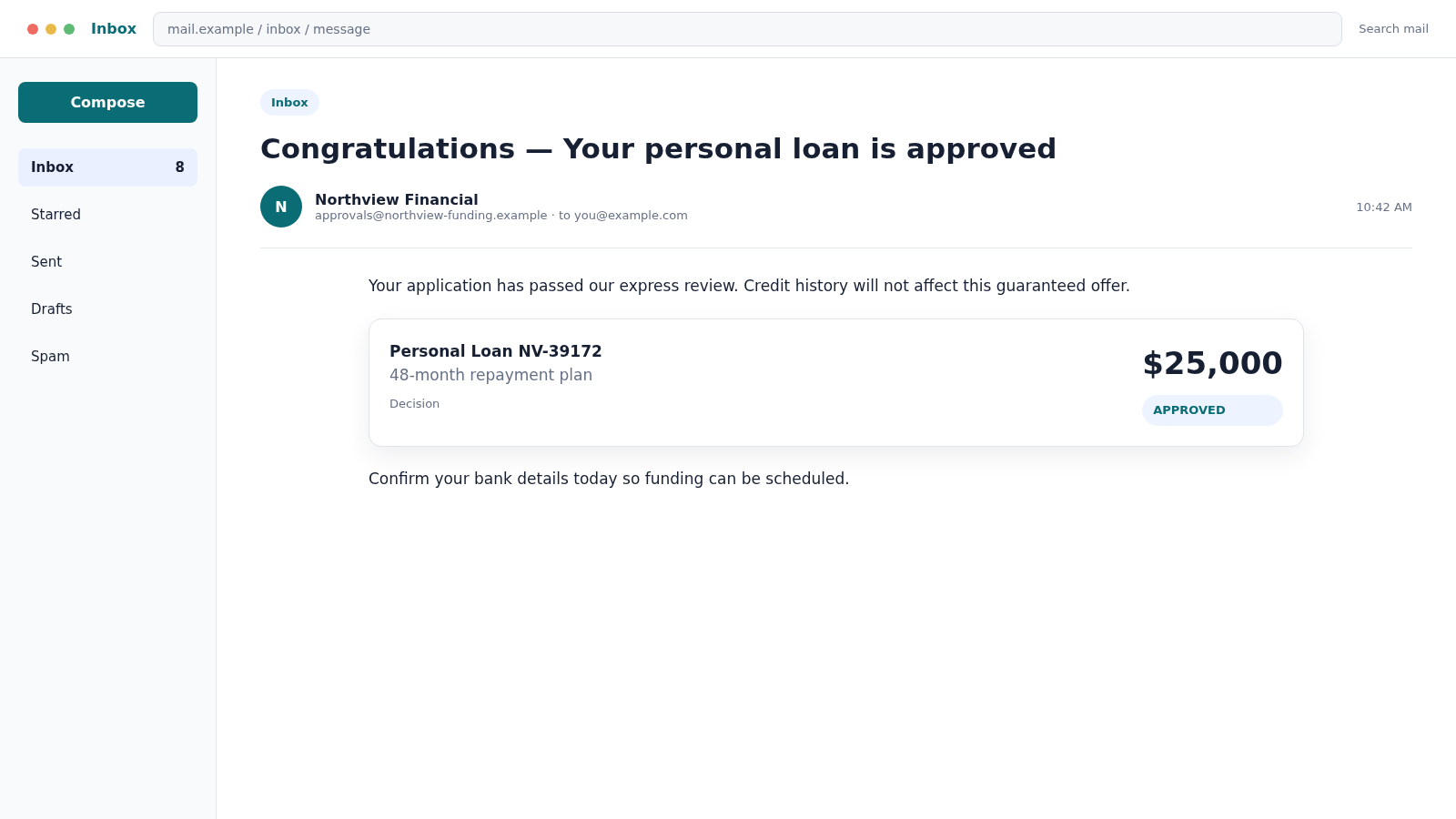
The offer arrives at exactly the right moment: a large personal loan, fast approval, low payments, and no concern about a difficult credit history. “Northview Financial” appears ready to help when other lenders will not.
In the Northview Financial scam, approval comes almost immediately. The money remains one small fee away, then another. That gap between the promise and the payout is where the fraud operates.
Overview
The offer promises certainty before a real credit review
The Northview Financial scam uses a professional-sounding finance name to promote a loan that appears guaranteed. The recipient may be told that $10,000, $25,000, or more is approved without a meaningful application, credit check, or income review.
This warning concerns unverified loan offers using the Northview Financial name and advance-fee script. It does not make a claim about every legitimate business with a similar name. Exact licensing and contact details must be checked.
The loan is always blocked by one advance payment
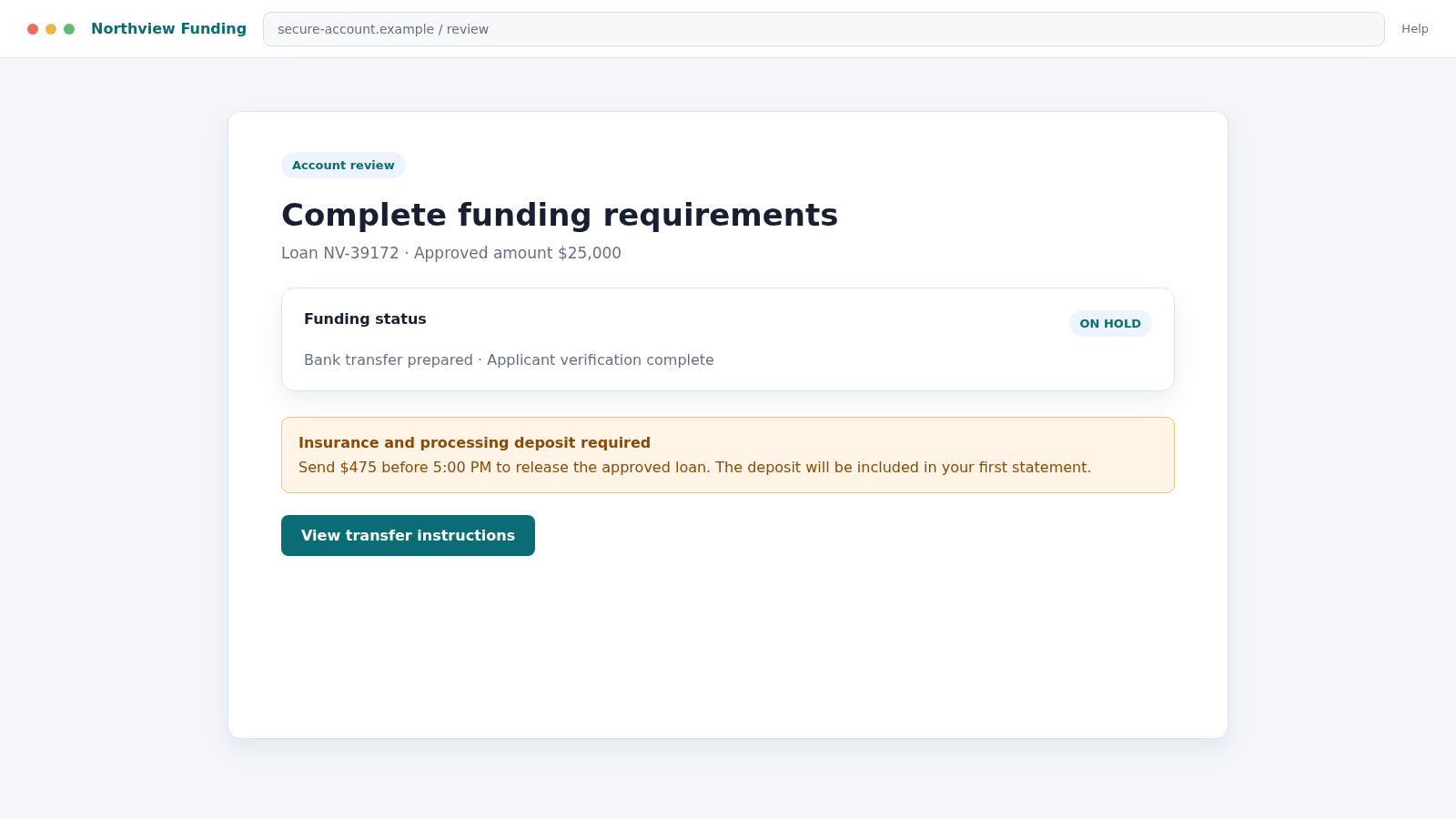
After approval, the supposed lender introduces a processing, insurance, security, collateral, tax, or transfer charge. The fee is described as refundable or included in the first payment, but it must be sent before funding.
If the applicant pays, a new obstacle appears. A bad-credit insurance premium, cross-border transfer code, anti-money-laundering certificate, or release deposit becomes the next condition.
Identity documents create a second path to loss
The application may request a driver’s license, Social Security number, bank statement, direct-deposit details, pay stub, utility bill, and online banking credentials. That information can be valuable even when no fee is paid.
The FTC describes this pattern as an advance-fee loan scam: the promised credit does not exist, and paying the fee does not produce funding.
- Approval arrives before a meaningful underwriting process
- Bad credit is said to make no difference
- A fee must be paid before the loan is released
- The payment goes to an individual or unusual channel
- Identity and banking records are requested quickly
- New charges appear after each payment
Why Advance-Fee Loan Scams Find Willing Targets
People seeking loans often face a real deadline: rent, repairs, medical costs, debt payments, or a family emergency. Rejection from ordinary lenders can make a guaranteed offer feel like the only remaining option.
The scammer does not begin by asking for a gift card. The first stage resembles an application. Forms, reference numbers, contracts, repayment tables, and polite loan officers create the feeling that underwriting is underway.
Approval is delivered quickly because it is the bait, not the outcome of a risk review. A large promised balance makes a $250 or $500 fee appear manageable, especially when the caller says it will be refunded.
After the first payment, sunk cost takes over. The victim may send more because walking away means accepting the earlier loss and giving up the loan they were counting on.
How the Northview Financial Scam Works
Step 1: The target searches for accessible credit
A lead may come from an online loan form, comparison site, social media advertisement, unsolicited text, or robocall. Some lead forms distribute applicant information to several marketers, creating opportunities for abusive follow-up.
The scammer learns the desired amount, employment status, contact information, and urgency. That allows the offer to match the victim’s immediate need.
Step 2: A confident loan officer makes contact
The representative uses the Northview Financial name, a finance-themed email, and a direct telephone number. A license number, office address, or website may be supplied to reduce doubt.
Those details can be invented or copied from another organization. They must be matched through an official financial regulator rather than accepted from the applicant packet.
Step 3: Approval is announced unusually fast
The applicant is told that credit history is not a problem and the requested loan has been approved. A contract shows a favorable rate, monthly payment, and funding date.
A legitimate lender evaluates the ability to repay before guaranteeing credit. A document generated by the person selling the loan is not independent evidence of approval.
Step 4: Personal and banking records are collected
The fake application requests identity documents, bank information, and proof of income. The caller may ask for an online banking login to verify deposits or link the funding account.
No lender should need your password or one-time security code. Account and routing numbers also deserve careful protection because they can support unauthorized debits and targeted fraud.
Step 5: An advance fee becomes the final condition
The supposed loan is ready, but a processing, insurance, collateral, or transfer payment must clear first. The caller says the fee cannot be taken from the loan proceeds because of policy or regulation.
Payment instructions may use a wire, cryptocurrency, gift card, payment app, or deposit to an unrelated personal account.
Step 6: A fake funding problem adds another charge
After payment, the money does not arrive. The bank supposedly rejects the transfer, the insurer changes the risk category, or a regulator requires a certificate.
Each explanation ends with another payment. The caller may provide a screenshot of a pending transfer that exists only inside a controlled portal.
Step 7: Pressure and threats replace the loan promise
If the applicant refuses, the representative may threaten cancellation, collection, legal action, or damage to the person’s credit. A fake contract is used to make the victim feel obligated.
There is no funded loan to collect. The threats are intended to squeeze out one more payment or prevent a bank dispute.
Step 8: Stolen data fuels later fraud
Identity records and financial details can be reused for phishing, account takeover, unauthorized applications, and fake debt collection. The victim may receive calls from another lender that knows the complete story.
A recovery agent may also promise to retrieve the fees. Any unexpected recovery offer demanding payment first should be treated as another scam.
Company, Address, and Fulfillment Checks
The offer name must match a licensed legal entity
Search the lender through your state banking regulator and NMLS Consumer Access when applicable. Match the exact legal name, license, website, address, and telephone number, not just a similar company name.
An office address can be copied or virtual
Check whether the address belongs to the named lender, an unrelated business, residence, shared suite, or mailbox. Contact the verified office independently and ask whether the representative works there.
Real support should explain fees in writing
A legitimate lender can provide disclosures and answer questions without demanding secrecy or an immediate transfer. Email-only agents, changing numbers, generic messages, and refusal to identify supervisors are warning signs.
Funding must occur through a traceable lender process
A real loan has an underwriting decision, agreement, disclosures, identifiable creditor, and documented disbursement. A screenshot of a pending balance inside the seller’s own portal proves none of those things.
What the FTC Says About Advance-Fee Loans
The FTC’s advance-fee loan guidance warns about offers that promise credit regardless of history but require a processing or other payment first.
The agency distinguishes a disclosed application or appraisal charge from paying to guarantee a loan. Legitimate lenders evaluate an application and cannot use an upfront payment as proof that approval is certain.
The FTC also notes that scammers target people with poor credit or difficulty borrowing. Advertisements may promise “no hassle” or claim the applicant’s history does not matter.
Before dealing with an unfamiliar lender, check registration through the state attorney general or financial regulator. Search the exact name, telephone number, domain, and payment instructions separately.
Warning Signs in the Northview Financial Offer
- The lender contacts you after an unrelated online application
- Approval is guaranteed regardless of credit history
- No meaningful income or repayment review occurs
- A fee must be sent before funds are released
- The payee does not match the lender’s legal name
- Gift cards, cryptocurrency, or a personal account are used
- The website controls the only evidence of a pending loan
- Refusing another fee produces threats or urgency
Do not judge the offer by the quality of its contract. Names, signatures, rates, seals, and payment tables can be generated quickly. Verify the entity and license through records the sender does not control.
How to Verify a Lender Before Sharing Documents
Write down the exact legal name, website, physical address, telephone number, representative, and license supplied in the offer. Small spelling differences matter because impersonators register domains and names that resemble established lenders.
Search the entity through the financial regulator for your state or country. In the United States, NMLS Consumer Access may help with many mortgage and financial-service records, while state banking departments handle additional lender categories.
Call the regulator or lender using a number obtained independently. Ask whether the entity is permitted to offer your type of loan in your location and whether the representative and website belong to it.
Review the disclosures before sending sensitive documents. The contract should identify the creditor, annual rate, repayment schedule, fees, privacy practices, and complaint route. Blank spaces, inconsistent company names, and unexplained third-party payments require answers.
- The exact licensed entity and regulator record
- A domain and email belonging to that entity
- A verifiable office and main support number
- Written rate, term, payment, and fee disclosures
- A payee matching the lender or documented provider
- No guarantee based on an advance transfer
Protect documents while comparing offers. Send them only through a verified secure process, redact information that is not required, and never provide an email, bank, or identity-service password.
Finally, compare the loan with offers from known institutions or a reputable credit counselor. A lower payment can hide a longer term or higher total cost, while an impossible offer may be bait for an advance-fee scam.
Keep copies of every version you review. If the promised rate, lender name, payment destination, or funding date changes after questions are raised, stop the application and report the inconsistency.
What to Do if You Have Fallen Victim to This Scam
- Stop sending money. Do not pay a final insurance, tax, transfer, or cancellation charge. Additional payment will not unlock a nonexistent loan.
- Contact the payment provider. Ask the bank, card issuer, exchange, wire service, gift-card company, or payment app whether the transaction can be stopped, disputed, or flagged.
- Notify your bank’s fraud team. Explain which account numbers, statements, logins, security codes, and identity records were disclosed. Ask whether accounts need restrictions or replacement.
- Protect your identity. If you sent a Social Security number, ID, signature, or proof of address, create a recovery plan through IdentityTheft.gov and freeze credit where appropriate.
- Check credit reports. Look for unfamiliar inquiries, accounts, and address changes. Continue monitoring because misuse may not appear immediately.
- Secure email and financial logins. Change passwords from a trusted device, enable multi-factor authentication, revoke unknown sessions, and review recovery details.
- Remove remote access. If a representative controlled your screen, disconnect the device, uninstall the tool, and reset important credentials elsewhere.
- Scan the device. Use Malwarebytes to check downloaded loan files, remote software, and other unwanted programs.
- Reduce access to malicious sites. Report the fake domain and consider AdGuard for blocking known phishing pages and malicious advertising. It cannot reverse a payment.
- Preserve the application trail. Save advertisements, emails with headers, contracts, telephone numbers, portal screenshots, payment instructions, receipts, and documents shared.
- Report the lender identity. Notify the FTC, FBI IC3 when appropriate, state financial regulator, attorney general, and any legitimate organization whose details were copied.
- Ignore recovery and collection threats. Verify any claimed debt in writing through independent channels. Never pay a stranger who promises to recover the advance fee.
Frequently Asked Questions
Is every Northview Financial business a scam?
No. Similar names may belong to legitimate entities. The warning concerns unverified offers using the name and demanding payment before guaranteed funding. Check the exact lender and license independently.
Can a legitimate lender charge an application fee?
Some legitimate credit products have disclosed fees. The critical warning is a fee presented as the condition that guarantees approval or releases a promised loan before proper underwriting.
Why did the caller know I was looking for a loan?
Your information may have come from a lead form, marketer, breach, or previous application. Knowledge of your need does not prove the caller is a licensed lender.
Can the lender damage my credit if I refuse another fee?
A scammer may make that threat, but a fabricated unfunded loan is not a legitimate debt. Check your reports and seek qualified legal help if an unfamiliar account appears.
What if the portal says the loan is pending?
A balance shown on a website controlled by the sender can be fabricated. Confirm funding with your bank and verify the lender outside the portal.
Can I recover an advance payment?
Recovery depends on the payment method and speed of reporting. Contact the provider immediately, preserve evidence, and avoid private recovery services that demand another upfront fee.
The Bottom Line
The Northview Financial scam turns financial urgency into a sequence of advance fees. Guaranteed approval, weak underwriting, unusual payment channels, and endless release problems point to a loan that was never going to be funded.
Verify the exact lender and license independently, protect your identity records, and never pay merely to make promised credit appear. A real loan is not unlocked by gift cards, crypto, or a secret transfer.

Join the discussion
0 commentsShare your experience or ask a question about this article.
Discussion
Start the conversation
Have a question or something useful to share? Add the first comment.