

Tickets appear for a Paris show you thought you had missed. The checkout looks familiar, the seats look available, and the seller says someone else is ready to buy.
That combination can make a fan move quickly. It is also the opening used by several fake Celine Dion ticket sites and social-media sellers documented this year.
Overview
The real concert demand makes the fake offer believable
Celine Dion’s Paris performances are real. Her official site announced additional dates, confirming the excitement that criminals tried to exploit.
Real demand does not make an unfamiliar ticket website official. A fraud page can name the event, show seating categories, and still have no right to sell admission.
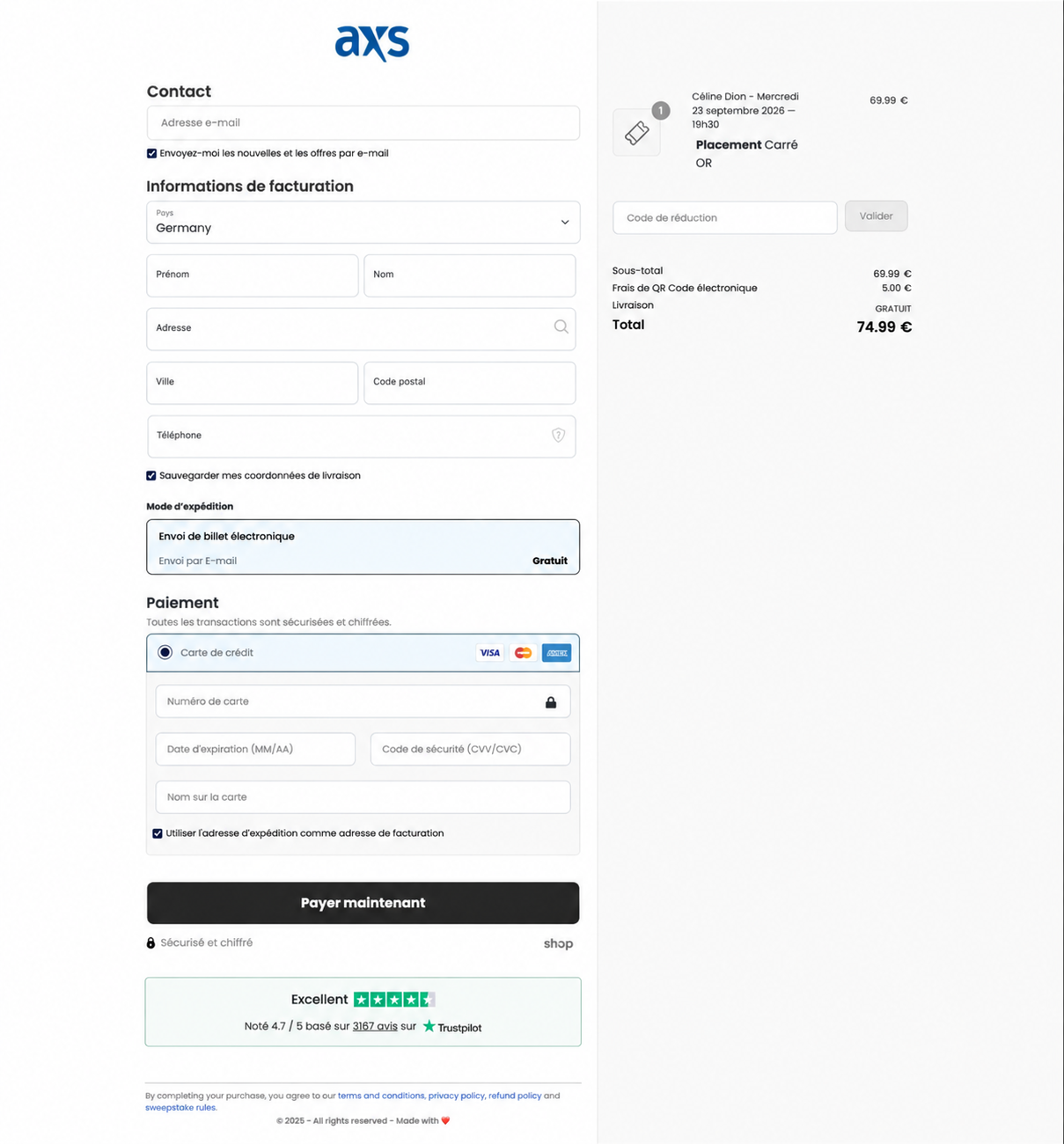
The captured checkout copies AXS styling while collecting a buyer’s email, contact details, and payment information. We replaced its tiny artist thumbnail with an icon.
Even the displayed review score is part of the page’s appearance. Do not treat an embedded rating as an independent review of that specific merchant.
Researchers found a network, not one disappointed buyer
Group-IB’s July 2026 investigation documented multiple ticketing-lookalike domains plus social-media sellers asking for direct bank transfers.
The domains borrowed the singer’s name, Paris, the venue, or ticketing brands. Some were made to resemble official distributor pages and used Shopify infrastructure.
Shopify is a legitimate commerce platform, not the organizer of this fraud. A polished checkout built with a trusted platform does not authenticate the merchant.
Likewise, AXS and Ticketmaster are brands being imitated or misused in the observed pitches. This article is about the impersonators and off-platform demands.
There are two main routes to the same loss
One route is a copied ticket website. Another begins with a seller in a fan group who claims to hold spare seats and insists on bank transfer.
A buyer can be shown a plausible confirmation or transfer link and still need to verify whether the ticket is valid, unique, and transferable for that event.
- High demand makes an unexpected seat listing feel like a lucky find.
- A copied event page or friendly fan profile makes the offer seem local and credible.
- Urgency pushes the buyer to skip the authorized resale channel.
- A fake checkout or direct transfer moves money to the wrong party.
- The problem may surface only when admission or a refund is requested.
Not every resale listing is fraudulent. The documented scam signs are the imitation domains, false affiliation, and payment requests that bypass protected ticketing paths.
Why a Ticket Page Can Look Official Without Being One
The screenshot above is striking because it is not a crude page with a misspelled headline. It looks like a normal ecommerce checkout.
It includes event wording, a seating category, a total in euros, card fields, and a familiar payment layout. Those are visual ingredients, not proof of authority.
The important part is the address and the merchant behind it. A domain combining an artist’s name with “tickets” can be registered by anyone.
Some observed sites added words associated with AXS, Ticketmaster, or the arena. Putting a famous name in an address is not the same as being linked by the real organizer.
The fake checkout may also have a secure connection. Encryption protects the data in transit to that particular site; it does not certify the seller’s right to tickets.
Group-IB found payment and account subdomains across the network. That gives the sites the appearance of a complete, professional ticketing operation.
Those extra pages can actually deepen the deception. A login step or order summary feels normal because genuine ticket platforms also provide them.
Before paying, start from the artist’s official event announcement or venue website and follow its authorized ticket links. Do not reverse that route from an ad.
If a listing appears in search results, compare its destination with the authorized seller named on the official page. Sponsored placement is not approval.
The captured checkout includes a small charge described as electronic QR-code delivery. An extra digital-delivery line can make an invented order feel itemized.
It also displays a Germany billing-country selection beside a French event. That detail is not proof by itself, but shows how broadly the template was assembled.
Farther down, the page includes a review widget with an impressive score. The screenshot cannot establish that those reviews belong to the ticket seller.
Look for the name on the eventual card statement before deciding who took payment. It may differ from the logo the site placed above the form.
That difference can help a dispute, although a merchant name on a statement still does not prove the operator’s legal identity.
How the Fake Celine Dion Ticket Sites Scam Works
Step 1: Criminals attach their offer to a real event
Unlike a fabricated concert, this lure begins with genuine performances and genuine demand. Fans already know tickets are valuable and sometimes scarce.
That makes an unexpected listing easier to believe. The fraudster only needs to fake the sales channel, not the whole event.
Group-IB found domains and pages designed around the artist’s name and Paris venue. That does not mean the singer authorized any of them.
The same strategy can be used for another performer tomorrow. The search phrase changes; the fake-availability pitch stays.
Step 2: A copied page or fan-space seller supplies credibility
On the website route, buyers see a ticket selection and checkout that borrow the style of a real distributor.
On the social route, a person in a fan community claims to have tickets they can no longer use. The account may look ordinary.
Neither setting proves the person controls legitimate inventory. A social profile can be repurposed, and a website can copy images and interface elements.
Group-IB observed sellers making contact in Facebook groups and Marketplace. The pressure built gradually rather than beginning with an obvious demand for money.
One seller’s message in the investigation cited other interested buyers. That line is designed to shrink the time available for verification.
Step 3: The buyer is pushed outside the protected route
A fraudulent seller may resist the official resale or checkout path and request a direct bank transfer. Once sent, that money can be difficult to recover.
On a fake site, the same shift happens more quietly. The buyer believes the checkout itself is official, so entering a card feels normal.
In both cases, the destination matters more than the seller’s confidence. A genuine event does not authorize a payment to an unrelated account.
Ask whether the official distributor recognizes that exact resale process. A seller’s assurance is not a substitute for the platform’s own rules.
A refusal to use the allowed channel is a stronger warning than a badly written message. Scammers can write politely and still choose an unsafe payment path.
One buyer may be told the transfer will appear later. Another may be asked to pay first so the seller can “release” the seats.
Those explanations are not verified ticket-platform policies. Ask the distributor directly what its actual transfer sequence requires for this particular event.
Do not let a seller send you a link that claims to answer the question. Visit the platform independently and read its help pages there.
Step 4: A confirmation can create false relief
After payment, the buyer may see an order page, an email, or a ticket-looking document. Those artifacts can be generated by the same fraudulent site.
Group-IB also described sellers using a real ticket-transfer feature in deceptive resale pitches. A real platform link deserves careful account-level verification.
Do not assume a screenshot of a QR code or a claimed transfer email guarantees entry. Check the ticket inside your own official account.
Whether a ticket can be transferred, resold, or canceled depends on the event and platform rules. We cannot infer those details from a seller’s chat alone.
For that reason, this article does not claim every person buying from a third party receives the same ticket or faces the same outcome.
Step 5: The buyer discovers the gap too late
A fake site can stop responding after payment. A social seller can disappear, deactivate an account, or keep promising a transfer that never resolves.
The problem may not become obvious until the buyer checks the official account, seeks a refund, or reaches the venue.
By then, the fake domain may be gone and the social account may have changed. Save evidence while you still have access.
A ticket-related scam is especially painful because the lost money is only part of it. Travel and accommodation plans may also be affected.
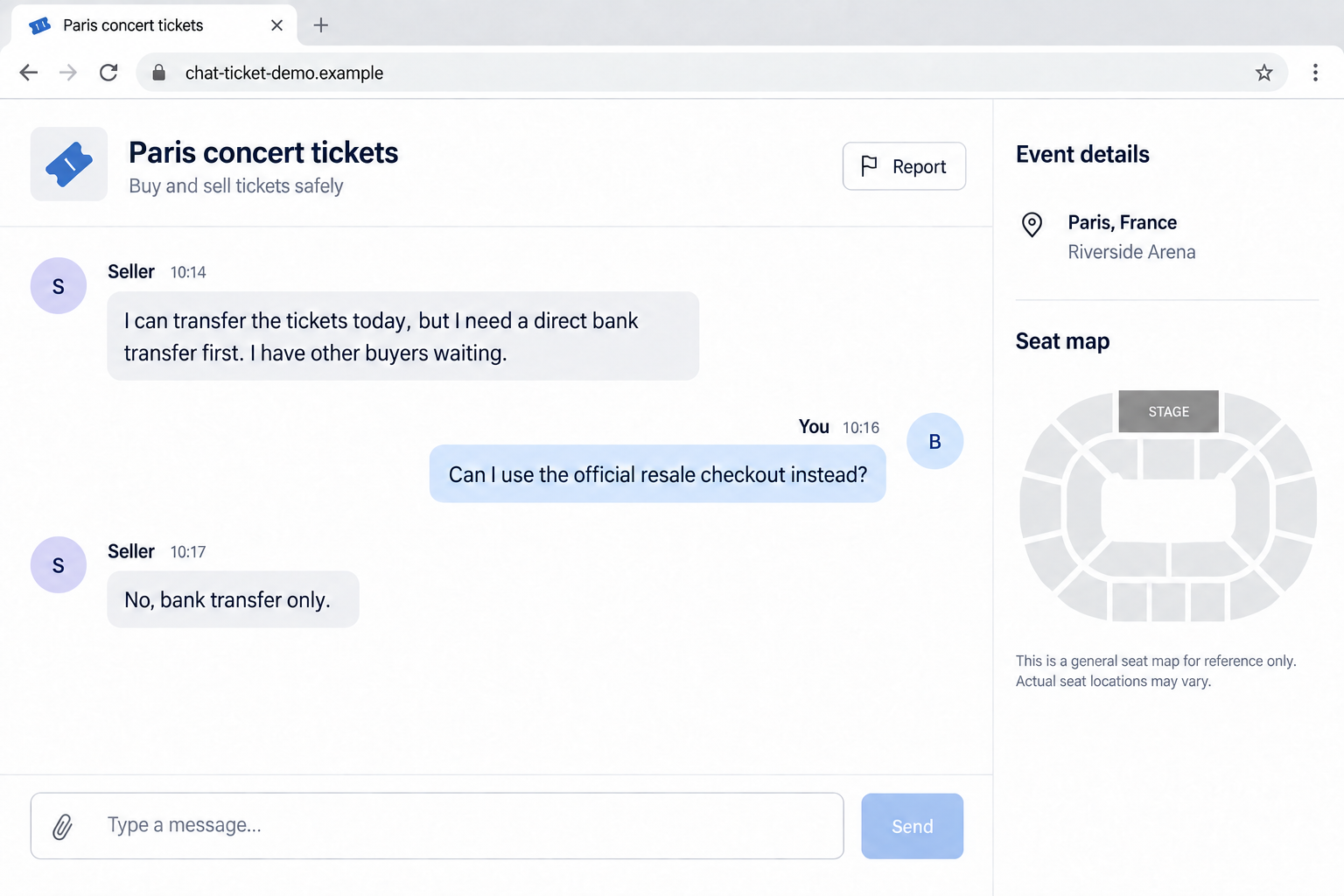
This chat image is an illustrative reconstruction, not a captured conversation. It shows the direct-transfer pressure reported in Group-IB’s real investigation.
How to Verify a Seller Before Money Moves
Begin at the artist or venue’s official website. Follow its own ticket link to the authorized distributor, and read that distributor’s resale rules.
If resale is available, use the platform’s process. Do not let a stranger’s claim of urgency replace the protection built into that process.
Look at the complete web address before signing in or paying. A familiar logo above a different domain is a warning, not reassurance.
Search for the exact domain separately, but do not treat a clean search result as proof. New scam domains may have little history.
Check whether a bank-transfer recipient matches the identity you were told. A mismatch is important evidence, but a matching display name alone is not proof.
Ask the seller to complete the transfer through the official service. If the answer becomes a complicated explanation for why that cannot happen, walk away.
Compare the event date, venue, and seating category with the official listing. Fake pages can copy the headline while inventing inventory underneath.
Check the payment method before sharing personal details. A demand for bank transfer may leave fewer practical options than a protected platform transaction.
When the offer comes from a social profile, note when the account was created and whether its past activity matches the claimed fan history.
Those profile checks are supporting clues only. An old or compromised account can still be used to deceive buyers, so payment route remains decisive.
Do not share a one-time code, account password, or full card details in chat. A legitimate ticket transfer should not require sending those to an individual.
For a website purchase, check the final merchant name and total before confirming. A checkout design can be reused by a fraudster on a new domain.
If a site claims extraordinary availability while official sellers show none, pause. Scarcity alone does not prove fraud, but it raises the need to verify.
A buyer who already has a legitimate ticket should avoid posting its QR code publicly. Screenshots can expose identifiers useful to someone attempting misuse.
Likewise, keep full order numbers out of public help requests. Share them privately with the authorized platform when asking it to verify validity.
What to Do if You Have Fallen Victim to This Scam
- Stop further payments. Do not send an additional release, insurance, or transfer fee to a seller who already failed to complete the sale.
- Contact your bank or card issuer promptly. Explain whether you paid by card or bank transfer and ask about the available dispute or recall route.
- Check your official ticket account. Confirm whether the event and seats appear there, and ask the distributor to examine any transfer you received.
- Preserve the full trail. Save the domain, checkout page, receipt, bank details, conversation, profile link, and any ticket or order reference.
- Report the imitation. Send the fake domain to the impersonated ticketing service, platform host, and relevant national cybercrime reporting channel.
- Secure exposed accounts. If you entered a password on the fake site, change it on the real service and review active sessions and reused passwords.
- Protect exposed card details. Ask the issuer whether to replace the card and monitor later charges. A failed ticket order can still expose payment information.
- Prepare for the event separately. Do not rely on a disputed ticket at the gate. Ask the authorized distributor about its validity before making further travel commitments.
If you only viewed the fake listing, no payment recovery is needed. Still avoid signing in through that page or saving its address for later.
A browser protection tool such as AdGuard may help block some malicious links. Malwarebytes is relevant if a page induced a download, not as a ticket-refund method.
Be wary of anyone offering to “recover” your ticket payment for a new upfront fee. Use the bank, ticket platform, and reporting channels you reached independently.
Frequently Asked Questions
Are the Celine Dion Paris performances themselves fake?
No. The event is real. The documented deception concerns unauthorized ticket pages and sellers taking advantage of demand for genuine shows.
Does an AXS-looking checkout prove the seller is AXS?
No. Group-IB captured a page imitating AXS styling on a fraudulent ticket site. Verify the domain through the official event listing.
Is every ticket sold in a Facebook group fraudulent?
No. The warning is the combination of an unverified seller, pressure, and payment outside the distributor’s approved resale process.
Can a real ticket-transfer link still be part of a dishonest sale?
Yes. The surrounding payment and seller claims can be deceptive. Verify ticket status inside your own official account and with the platform.
Does a Shopify-style checkout make the listing safe?
No. Legitimate commerce software can be used by unrelated merchants. It does not certify event inventory or approve the seller.
What is the first step if I paid by bank transfer?
Contact your bank immediately and explain the suspected fraud. Give the transfer reference and recipient details, then preserve the seller conversation.
The Bottom Line
Fake Celine Dion ticket sites rely on a real event and counterfeit sales channels. The safer route begins with the artist or venue, then its authorized ticket link.
If a seller will only take direct payment outside approved resale, the apparent chance to attend is not worth risking your money or travel plans.

Join the discussion
0 commentsShare your experience or ask a question about this article.
Discussion
Start the conversation
Have a question or something useful to share? Add the first comment.