

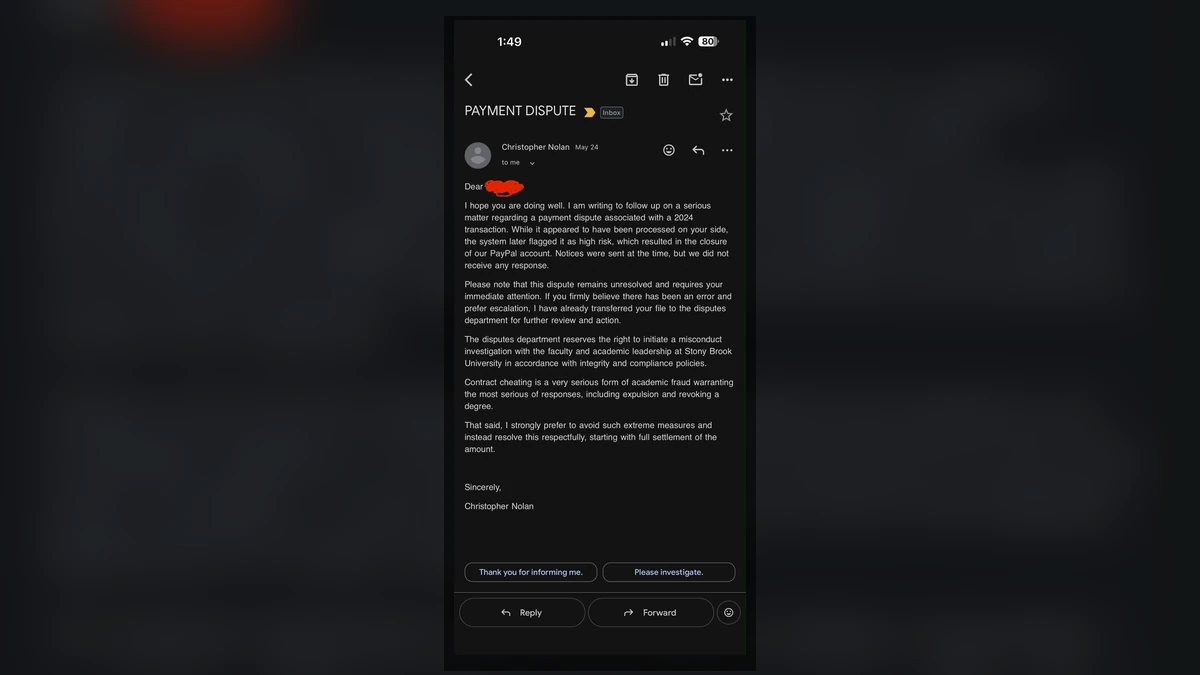
The message accused the recipient of paying for academic cheating in 2024 and threatened to involve a university he had never attended.
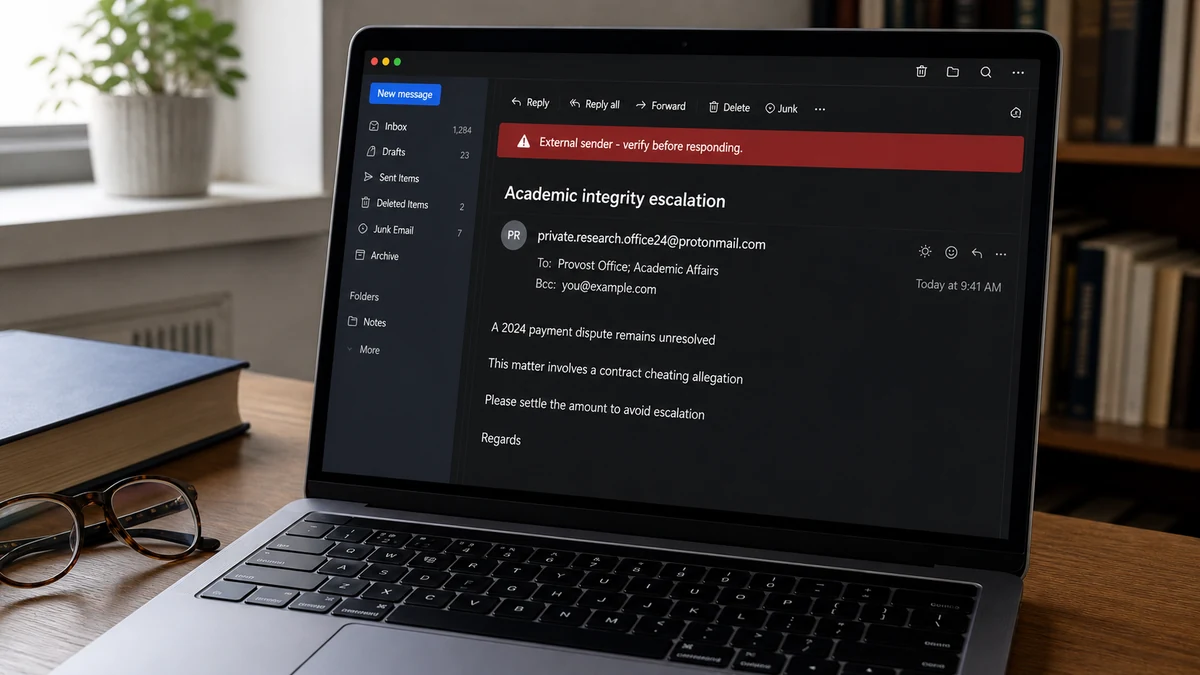
Minutes later, a second email appeared to carry the allegation straight to the provost. One easily missed address field showed why the pressure was not what it seemed.
Overview
An old PayPal claim was tied to a career-threatening accusation
A private Gmail sender using the display name “Christopher Nolan” referred to a 2024 PayPal transaction allegedly marked high risk. The email implied that payment for a service had failed.
The supposed service involved academic contract cheating connected to Stony Brook University. The recipient was told to pay money to resolve the matter before it reached the school.
There was an immediate problem with the story: the recipient had never attended Stony Brook. A different person with the same name reportedly earned a doctorate there in 2024.
A second email made escalation look immediate
Another message soon appeared, this time addressed to the university provost and other administrators. It claimed that evidence existed and asked how a serious academic-integrity allegation should proceed.
If the sender had already reported everything, the demand for money might seem pointless. Why pay to stop something that had supposedly happened?
The answer was in the recipient field. The target had been placed in BCC rather than openly copied. He could see the frightening message, but the visible recipients would not necessarily know he received it.
The email proved only that an accusation was sent
The sender may have targeted the wrong person, used a same-name academic record, or invented the PayPal and cheating story completely. The available evidence cannot choose among those explanations.
No coursework, transaction record, university case, contract, or authenticated evidence appeared. A person who writes an accusation does not make it true.
The warning signs were present throughout the exchange:
- A private Gmail account made a serious university allegation.
- The display name copied a celebrity identity.
- A two-year-old PayPal story appeared without a transaction record.
- Money was demanded to prevent or resolve reputational harm.
- The recipient had never attended the university.
- A same-name graduate created ambiguity the sender could exploit.
- The apparent escalation placed the target in BCC.
- No evidence was supplied before payment pressure began.
The BCC Field Was the Clever Part
CC and BCC look similar when someone is frightened and reading quickly. Their effect is very different. A CC recipient is visible to everyone; a BCC recipient receives the message without appearing in the public recipient list.
The target therefore saw a formal-looking list of university administrators. If those addresses were valid and the message actually arrived, the administrators would not necessarily see that the target was watching.
The sender could also include invalid or mistyped administrator addresses. Any bounce normally returns to the sender, leaving the BCC recipient unaware that the dramatic report went nowhere.
That preserves leverage. The next message can claim, “They have the evidence, but I have not identified you yet.” Payment is then presented as the final chance to stop disclosure.
The body may name the target, but even that cannot prove delivery, review, or an opened university case. It shows what appeared inside one copy of an email.
BCC itself is an ordinary privacy tool. The concern comes from its use inside an unverified allegation, a same-name mismatch, and a demand for money.
How the Fake Cheating Claim Scam Works
Step 1: A name is matched to an academic record
The operator searches commencement programs, dissertations, faculty pages, professional profiles, and public biographies. Then a personal email for someone with the same or similar name is selected.
The match does not need to be correct. A confused reply can reveal where the target studied and help the sender refine the next accusation.
Step 2: An old payment creates unfinished business
The email refers to PayPal, a failed balance, high-risk transaction, or closed merchant account. A date from years earlier makes incomplete records and forgotten details seem plausible.
The target may search statements, admit using PayPal, or explain an academic history. Those reactions provide information the sender did not have.
Step 3: Academic misconduct supplies the fear
The supposed service may be essay writing, exam help, dissertation editing, or contract cheating. The sender claims that payment records prove the recipient used it.
For a real graduate, the allegation can threaten a degree and career. A wrong person can still panic before fully considering that the university makes no sense.
Step 4: Payment is offered as the private solution
The target is asked to settle an old debt, pay for deletion, reimburse losses, or purchase confidentiality. The amount may remain vague so the frightened recipient begins negotiating.
A genuine debt has a contract, parties, dates, invoices, and lawful collection procedures. It does not become payable because a stranger threatens someone’s reputation.
Step 5: A BCC message stages official escalation
The operator writes to university administrators and hides the target in BCC. Formal titles and public email addresses make the threat appear active.
The target cannot see whether the addresses worked, what visible recipients received, or whether anyone opened the message. Fear supplies the missing details.
Step 6: Each reply sharpens the accusation
A denial can lead to a claim of identity theft or a same-name problem that still requires payment. An admission of any school connection gives the sender material for a more specific threat.
Anger and jokes also confirm the mailbox is active. Continued conversation reveals employment, family, school history, and emotional pressure points.
Step 7: One payment leads to more blackmail
Paying cannot delete copies, prove silence, or identify every person who has the allegation. Another demand may follow for an administrator recall, legal release, or final deletion certificate.
PayPal’s scam guidance warns that extortionists use exposure threats and deadlines to force payment. It advises blocking the contact and reporting the threat.
Three Explanations Still Fit the Evidence
The first is a fully fabricated campaign. A sender can combine public graduate records with unrelated personal emails and wait for frightened people to pay.
The second is wrong-person targeting. A same-name graduate may have had some contact with a service, while the sender located the wrong mailbox.
The third is blackmail involving real customer data obtained by a cheating service or criminal. Similar schemes have threatened to expose clients after previous transactions.
The public material cannot determine which explanation applies. The recipient’s lack of connection to Stony Brook makes fabrication or mistaken identity especially plausible.
That does not justify accusing the same-name graduate. A matching name and graduation year are not evidence that another person purchased coursework.
The university and administrators should not be portrayed as participants either. Their public names and addresses may have been copied without their knowledge.
A careful investigation preserves all three possibilities until PayPal records, headers, actual recipient addresses, and university systems can be checked.
Check the PayPal Claim Outside the Email
Do not use a link, phone number, attachment, or payment button in the threat. Open PayPal from a saved bookmark or type the address yourself.
Search account activity for the stated year, amount, sender, and recipient. A genuine payment should have an account record and transaction identifier.
A copied logo, screenshot, or reference number written in an email is not a payment record. Anyone can manufacture those elements.
If unfamiliar activity appears, use the Resolution Center and secure the account. Change the password, revoke other sessions, and review connected cards and bank accounts.
If nothing matches, preserve that result. It weakens the sender’s story without revealing who sent the email or why the target was chosen.
Forward PayPal impersonation material using the company’s official reporting instructions. Save the original headers before forwarding or deleting anything.
Never create a new PayPal payment, send crypto, use Friends and Family, or buy gift cards to make the allegation disappear. The first payment only proves pressure works.
A Real University Process Looks Different
Universities have formal academic-integrity policies. Procedures vary, but a serious claim normally moves through identifiable offices, written notice, evidence review, and an opportunity to respond.
A private Gmail sender does not gain authority by copying a provost’s name. A university does not collect a stranger’s alleged debt by helping that person pressure a graduate.
If you never attended the institution, contact its security office or registrar through the official website. Explain the identity mismatch and ask where the original email should be sent.
Do not send identity documents to the accuser. Start with the complete message, headers, dates, payment demand, and the fact that the alleged university relationship does not exist.
If you did attend, still do not negotiate with the sender. Contact the proper university office and obtain independent legal advice if the allegation could affect a degree or profession.
A legitimate process can survive an independent call. Blackmail depends on keeping the target inside a private thread controlled by the accuser.
Preserve the Email Before Blocking
Save each original in EML or MSG format when possible. Screenshots help people read the threat, but they do not contain all routing and authentication data.
Complete headers may show sending infrastructure, timestamps, message IDs, return paths, authentication results, and differences between visible and technical addresses.
Record the BCC context accurately. The target’s copy cannot prove that every visible address was correct or that every administrator received the same content.
Save attachments without opening them. Let university security, law enforcement, or a qualified analyst inspect them in a controlled setting.
Take screenshots of the demand, sender profile, recipient fields, threats, and timestamps. Redact personal data before sharing anything publicly.
The FBI’s threat and intimidation guide recommends preserving electronic evidence and reporting threats. Immediate physical danger belongs with emergency services.
Keep a dated log of reports, responses, later messages, and case numbers. Do not provoke the sender simply to collect more material.
Why Paying Cannot Buy Silence
The recipient does not know the sender’s legal identity, location, or control over the alleged records. There is no reliable way to enforce a promise made inside an extortion email.
The first amount may be described as the old PayPal balance. Then come deletion charges, legal fees, administrator recall costs, or compensation for keeping the allegation private.
A payment confirms that the mailbox reaches someone worried about academic reputation. That fact can be reused or sold to another extortion operation.
A new sender may later pose as a university investigator and accuse the victim of bribery because of the first transfer. Another payment is offered as the solution.
The pressure resembles sextortion email scams: an unverifiable claim, reputational fear, a deadline, and no credible reason to believe payment ends contact.
If money was already sent, contact the payment provider immediately. Explain that the transaction was induced by a threat and ask about recall or dispute options.
Company, Address, and Fulfillment Checks
The Gmail display name was not a legal identity
Anyone can choose a celebrity name for a free mailbox. It did not identify a company, academic service, debt owner, or authorized representative.
The university identities may have been copied
Provost and administrator names are public. Their appearance in a recipient list does not prove they endorsed, opened, or even received the message.
No lawful collection address was established
There was no verified company, contract, invoice address, court record, or licensed collector connected to the alleged PayPal balance.
No confidentiality service could be fulfilled
The sender offered pressure, not an enforceable resolution. Payment could not prove deletion, prevent copied material from spreading, or guarantee silence.
What to Do if You Have Fallen Victim to This Scam
- Stop replying. Do not argue, negotiate, joke, or reveal more school and identity details.
- Do not pay. A settlement, deletion, confidentiality, or recall fee gives the sender more leverage.
- Preserve the originals. Save complete messages, headers, recipient fields, attachments, and screenshots.
- Check PayPal independently. Review the official account for the claimed 2024 transaction and report anything unauthorized.
- Notify the university. Use its official security or integrity channel, especially if employee identities were copied.
- Report the mailbox. Use Gmail’s abuse tools after preserving the evidence.
- Contact law enforcement. Report extortion, credible threats, and ongoing harassment to local police and IC3.gov.
- Secure exposed accounts. Change reused passwords, revoke sessions, and enable strong multifactor authentication.
- Tell a trusted person. Isolation helps blackmail. Choose someone who can help without spreading the allegation.
- Run a full Malwarebytes scan. Scan if any attachment, viewer, link, or downloaded file was opened.
- Use AdGuard as a supporting layer. It can block many malicious pages, but it cannot judge an academic claim.
- Ignore deletion and recovery services. Do not pay anyone promising to hack the sender or guarantee that records disappear.
Frequently Asked Questions
Does the email prove someone used a cheating service?
No. It contains an accusation, not authenticated evidence. The recipient did not attend the school, and a same-name graduate should not be blamed without proof.
Why was the target placed in BCC?
BCC lets the target see a frightening escalation while remaining hidden from the visible recipient list. That can preserve leverage for another demand.
Should the recipient contact the provost?
Use the university’s official security or integrity route. Do not rely only on addresses that came from the threatening sender.
What if the PayPal transaction is genuine?
Handle it through PayPal and qualified advice. A real payment does not authorize blackmail or prove academic misconduct.
Can one payment make the email stop?
There is no guarantee. Payment often creates additional demands because the sender learns that the reputation threat is effective.
Did the university administrators receive the message?
Possibly, but the target’s copy cannot prove delivery, address accuracy, or what each visible recipient received. The university can check independently.
The Bottom Line
The fake cheating claim mixed an old PayPal story, a same-name academic record, and an apparent message to senior university staff. The BCC field helped stage escalation without giving up the threat.
Preserve the evidence, verify PayPal and the university outside the email thread, and never pay a stranger to keep an unproven allegation private.

Join the discussion
0 commentsShare your experience or ask a question about this article.
Discussion
Start the conversation
Have a question or something useful to share? Add the first comment.