

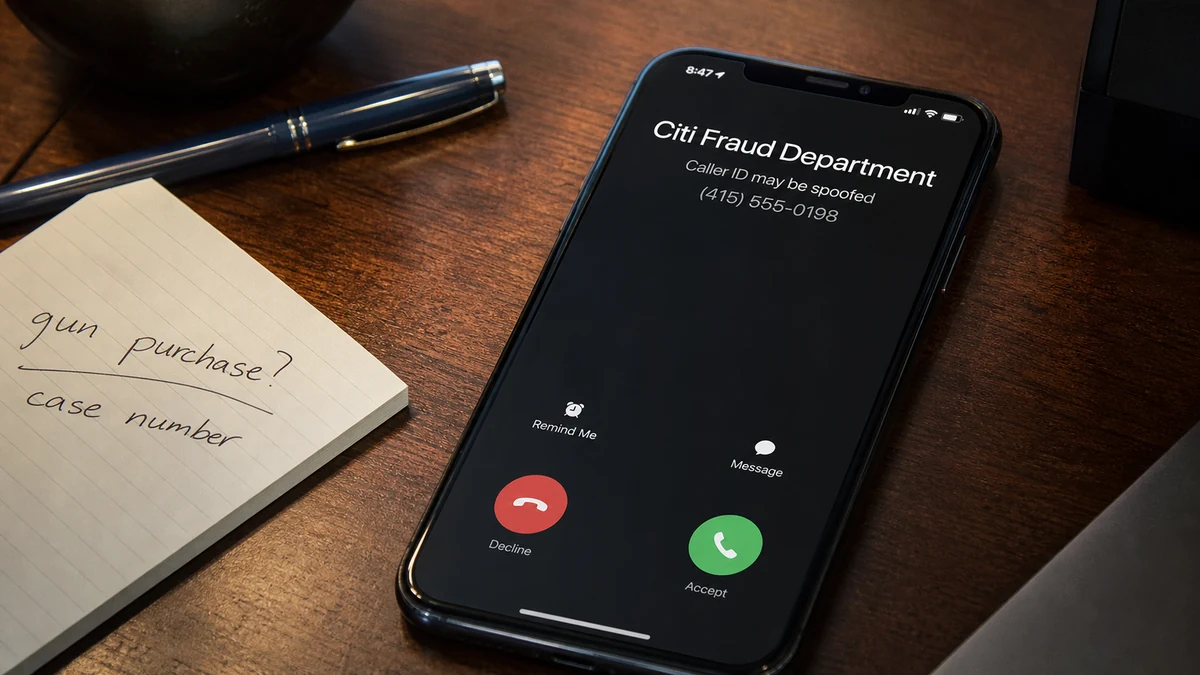
The call began with a terrifying claim: a gun purchased through the victim’s bank account had been used in a crime.
The people on the phone sounded ready to clear everything up. By the time the family learned what “verification” meant, $600,000 had left the account.
Overview
A bank alert became a federal criminal case
A family member described a grandfather who was contacted by people claiming to represent Citi. They said his account had been used to buy a gun connected to a crime.
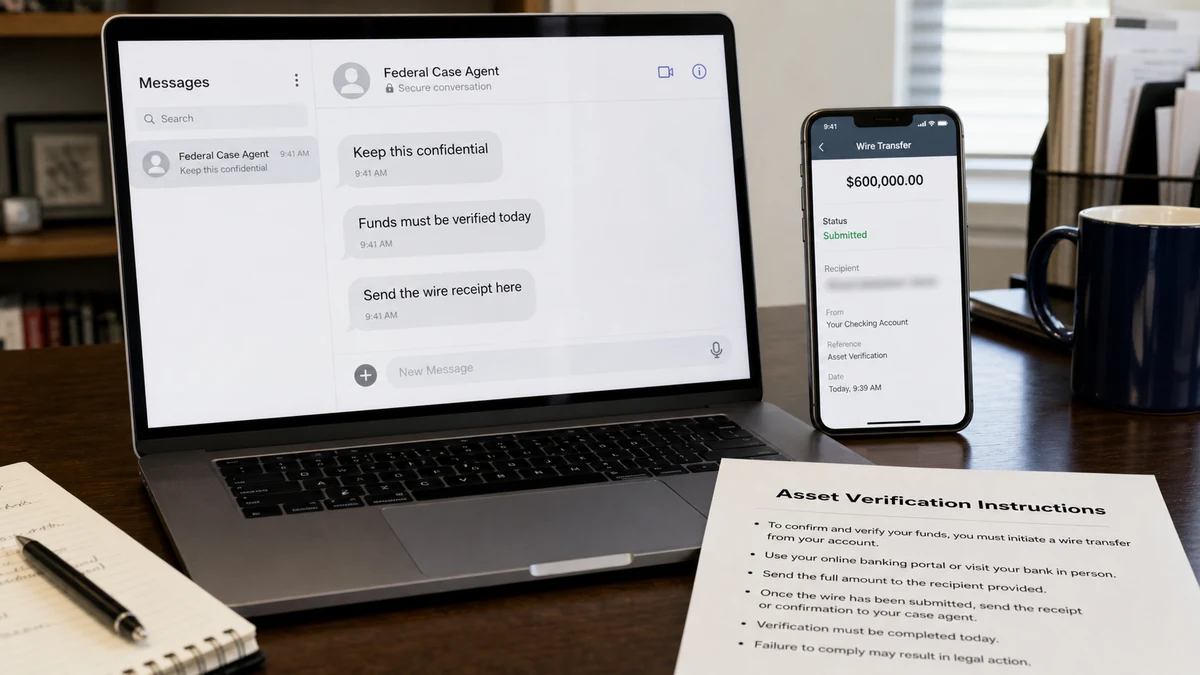
The story quickly expanded beyond an unauthorized purchase. Supposed FBI agents entered the conversation, and communication moved to Signal instead of a bank branch or independently reached government office.
That handoff made the emergency feel confirmed by two organizations. In reality, one criminal team can play the bank, investigator, supervisor, and recovery agent.
“Verification” meant wiring away the savings
The victim was reportedly told to move money so the funds could be checked. He sent about $600,000. The bank later stopped an attempted additional transfer of roughly $400,000.
A wire cannot prove that money is innocent or clear someone in a criminal investigation. Real banks can protect an account without sending its balance to a stranger’s beneficiary.
The transfer was not a safety step hidden inside the investigation. It was the objective. The gun story and fake authorities existed to make the payment feel compulsory.
The operation did not end when the wire left
The family discovered the loss weeks later. The grandfather had contacted police, filed an FBI report, blocked the scammers, and retained some records.
Those actions matter, but a person who sends a large wire becomes an attractive target again. Follow-up callers may pose as bank investigators, lawyers, government recovery agents, or cybersecurity firms.
The warning signs become unmistakable when the entire sequence is viewed together:
- An unexpected bank caller connected the victim to a gun and crime.
- The first caller introduced supposed federal investigators.
- Communication moved onto Signal instead of a verified agency channel.
- The victim was told that savings needed “verification.”
- A six-figure wire was presented as routine cooperation.
- The same contact chain supplied every piece of supposed proof.
- A second transfer was attempted after $600,000 had already left.
- Family members learned about the emergency only after a long delay.
Why the Gun Story Changes How a Victim Thinks
An ordinary card alert gives someone room to think about the transaction. A gun linked to a crime creates fear of arrest, frozen accounts, public shame, and police arriving at the door.
The victim stops asking, “Is this caller real?” and starts asking, “How do I prove I had nothing to do with it?” That shift gives the scammer control.
The fake agent then offers a clear escape: cooperate, keep the case secret, and move the money for examination. The person who invented the threat now owns the solution.
The criminal detail also helps isolate the victim. A caller may say bank staff are involved, family members could interfere, or discussing the case would obstruct an investigation.
The accusation can change to drugs, laundering, tax fraud, identity theft, or a warrant. The instruction remains the same: stay inside the incoming contact and do not ask anyone outside it to verify the story.
The FTC’s warning about moving money to protect it gives a simple rule. Anyone directing you to transfer savings into a safety account is running a scam.
How the Fake FBI Gun Purchase Call Scam Works
Step 1: A fake fraud desk creates the emergency
The victim receives a call or text that appears to come from a bank. Caller ID may even display the institution’s real name or customer-service number.
The caller claims a card or account was used to buy a weapon. Partial personal information, a transaction amount, or a location makes the story feel connected to a live account.
Step 2: The purchase becomes evidence of a crime
The supposed bank employee says the weapon was recovered after a serious offense. A normal fraud dispute suddenly appears too small for the problem.
The victim is warned about arrest, seizure, account closure, or loss of legal protection. Fear is used to prevent a calm call back to the bank.
Step 3: A fake FBI agent takes over
The first caller transfers the victim, provides another number, or introduces an “agent” through Signal. Two roles appear to confirm the same case.
Names, badge photographs, seals, office titles, and case numbers can all be copied. None of them replaces an independent call to the agency.
Step 4: Secrecy cuts off outside help
The fake agent says the matter is confidential and that family or bank employees must not know. The victim may be kept on the phone while traveling to a branch.
If a teller asks about the wire, the scammer supplies a cover story. Continuous contact gives the operation time to talk over every real warning.
Step 5: Theft is renamed as verification
The victim is told to send funds to a federal locker, Treasury account, safety account, or evidence account. The labels sound official, but the beneficiary sits inside the criminal payment chain.
Wires can move quickly and become difficult to recover after funds leave the receiving bank. The victim authorizes the payment because its purpose has been disguised.
Step 6: Every other account is tested
Once the first wire succeeds, the agent says another balance also needs clearance. Retirement funds, brokerage accounts, property proceeds, and a second bank may become targets.
The reported $400,000 attempt fits that escalation. The operation already knew the victim was frightened, isolated, and capable of moving substantial money.
Step 7: Recovery becomes the next impersonation
After the family intervenes, a new caller may claim the stolen funds were located. A bond, tax, court fee, legal retainer, or crypto deposit is required before release.
Legitimate recovery runs through banks, receiving institutions, law enforcement, and independently retained counsel. A guaranteed recovery offered by a stranger is another demand for money.
Signal Did Not Make the Agent Official
Signal is a legitimate encrypted messaging app. Encryption helps protect a conversation from interception; it does not verify that the person on the other end works for the FBI.
Anyone can choose a federal logo, badge image, office title, and professional name for a profile. A temporary number can be operated from almost anywhere.
The app gives scammers a continuous private channel. Instructions can follow the victim from home to the car and into the bank without passing through a real switchboard.
A genuine agency has published offices, records, complaint procedures, and employees who can be reached independently. It does not need a victim to trust a profile created inside a chat app.
The FBI’s government impersonation warning says federal agencies do not call or email people to demand money or threaten arrest.
End the chat and locate the FBI field office through FBI.gov or 1-800-CALL-FBI. Do not ask the person on Signal to provide another badge or supervisor.
What a Real Bank Fraud Review Would Look Like
Banks sometimes call customers about suspicious transactions. That is precisely why the opening is believable. The safe response is to close the incoming channel and create a new one.
Call the number on the card or statement. Do this even when caller ID displayed the same number, because the incoming display can be spoofed.
Open the official banking app yourself and review posted transactions, pending charges, secure messages, contact changes, and alerts. Do not use a link sent during the call.
A bank can block a card, close an account, issue new credentials, dispute a charge, or notify investigators. None of those actions requires the customer to wire the balance elsewhere.
The same safe-account lie appears in bank impersonation scams involving Zelle. Changing the transfer method does not make the protection story genuine.
The real Citi fraud guidance advises customers to be cautious with urgent requests and use verified contact routes. It does not indicate that Citi made the call described in this case.
The First Hours After the Wire
Call the sending bank’s fraud and wire departments immediately. State that a government-impersonation scam induced the transfer and request an urgent recall, receiving-bank hold, and fraud notification.
Ask the bank to preserve wire instructions, beneficiary details, call recordings, branch video, device records, and internal alerts. Record the case number and department handling the matter.
Submit a detailed complaint at IC3.gov. Include the receiving bank, account details, amount, date, Signal profile, phone numbers, messages, and exact explanation used to obtain the wire.
Report to local police as well. A time-stamped report may be needed by banks, insurers, attorneys, or institutions reviewing later transactions.
Preserve the Signal conversation before deleting anything. Save profile details, voice notes, attachments, call history, instructions, and screenshots showing dates.
Do not warn the recipient account that a recall has started. Speed and quiet coordination between institutions offer a better chance than arguing with the criminal.
An older wire is harder to recover, but reporting still matters. Funds may have crossed several institutions, and one complete complaint can connect this payment to a larger case.
How a Family Can Break the Isolation
Large impersonation scams may continue for days or weeks. A victim can seem anxious, secretive, or suddenly busy with repeated trips to banks and calls that must remain private.
Approach without ridicule. Shame reinforces the fake agent’s claim that family members will not understand. Ask what action is expected next and whether the story can survive an independent call.
Use another phone to contact the real bank while the victim stops responding. Document any claim that ending the call will cause an arrest or financial loss.
Create a family pause rule for large wires. Any transfer above an agreed amount waits until a trusted person who is not involved in the request reviews it.
Ask financial institutions about transaction alerts, withdrawal limits, trusted contacts, and verbal passwords. The goal is not to remove autonomy, but to create time when behavior changes suddenly.
Continue supporting the victim after discovery. Someone overwhelmed by shame may stop opening statements or answering investigators. A calm relative can organize records and join verified calls with permission.
Our report on fake Citibank fraud-desk calls explains the broader pattern. This case shows how it can grow from a frightening alert into a total-account transfer.
Company, Address, and Fulfillment Checks
Citi was an impersonated bank identity
The family account says callers claimed to represent Citi. It does not show that Citi originated the call or approved the verification story.
The FBI identity had no verified office behind it
A Signal profile, agent name, case number, and badge image are not a federal office. The supposed agent failed the moment independent verification was discouraged.
The beneficiary was not a safe account
A real bank name, branch, routing number, and beneficiary can sit inside a fraudulent payment route. The sending bank must trace the account and downstream transfers.
No verification service was fulfilled
The wire produced no authenticated clearance, court record, or return of funds. A real investigation does not require victims to transfer ownership of savings to prove those savings are lawful.
What to Do if You Have Fallen Victim to This Scam
- Stop every new transfer. Do not send another wire, fee, bond, tax, or supposed recovery payment.
- Call the sending bank immediately. Reach verified fraud and wire teams and request a recall and receiving-bank hold.
- File a detailed IC3 complaint. Include every payment, profile, phone number, document, date, and impersonated organization.
- Contact local police. Obtain a report number and share it with the bank if requested.
- Preserve the conversation. Save messages, profiles, voice notes, call logs, screenshots, beneficiary instructions, and receipts.
- Secure financial accounts. Change passwords, revoke sessions, review devices, and enable strong multifactor authentication.
- Protect exposed identity data. Use IdentityTheft.gov and consider freezing all three credit files if sensitive documents were shared.
- Warn other institutions. Notify banks, brokerages, retirement custodians, and the mobile carrier that the victim is being targeted.
- Consider independent legal counsel. For a six-figure loss, find and verify an attorney experienced in wire fraud.
- Run a complete Malwarebytes scan. This is important if software, attachments, remote access, or unfamiliar links were used.
- Use AdGuard as a supporting layer. It can block many malicious pages, but it cannot verify callers or recall wires.
- Reject recovery guarantees. An unsolicited person promising to retrieve the $600,000 for an advance fee is another threat.
Frequently Asked Questions
Would the FBI ask me to move money for verification?
No. A legitimate FBI investigation does not require a victim to wire savings into a safety or verification account.
Can caller ID show my bank’s real number?
Yes. Caller ID can be spoofed. End the incoming call and dial the number printed on the card or statement.
Is Signal itself unsafe?
No. Signal is a legitimate encrypted messenger. Encryption does not authenticate someone as a bank employee or federal agent.
Can a $600,000 wire be recovered?
Recovery is not guaranteed. Immediate action by the sending bank, receiving institution, and law enforcement offers the best chance.
Why did the scammers try for another $400,000?
The first successful wire proved the victim had more assets and was responding to pressure. The operation kept inventing balances that needed clearance.
Should the victim trust an offer to recover the funds?
Not from an unsolicited contact. Work through the banks, law enforcement, and an independently verified attorney. Never pay another advance fee.
The Bottom Line
This scam created a criminal emergency, supplied fake bank and federal authorities, isolated the victim on Signal, and renamed a $600,000 wire as verification.
No bank or government agent needs you to move money to protect or prove it. End the contact, reach the institution through a route you control, and let every threat survive independent verification before funds leave.

Join the discussion
0 commentsShare your experience or ask a question about this article.
Discussion
Start the conversation
Have a question or something useful to share? Add the first comment.