


You’ve found the part you need through a Facebook group. The seller can send it across the country, and you’ve agreed on a price that includes delivery.
Then your phone lights up with a WhatsApp message from a freight company you’ve never dealt with before.
Overview
The buyer thought delivery was included
A buyer in Western Australia posted in a Facebook group looking for a canopy for their ute. A seller who presented itself as a wrecking business replied.
The first quote was A$800 for the canopy. When the buyer explained they couldn’t collect it in New South Wales, the seller offered delivery for A$1,000 total.
The buyer transferred the money and provided their delivery information. They expected the canopy to travel across Australia with the courier the seller said it already used.
A WhatsApp account claiming to be the courier then contacted the buyer. It wanted a signed delivery authorization and another A$405 for a bill of lading.
The second fee changed what the buyer was paying for
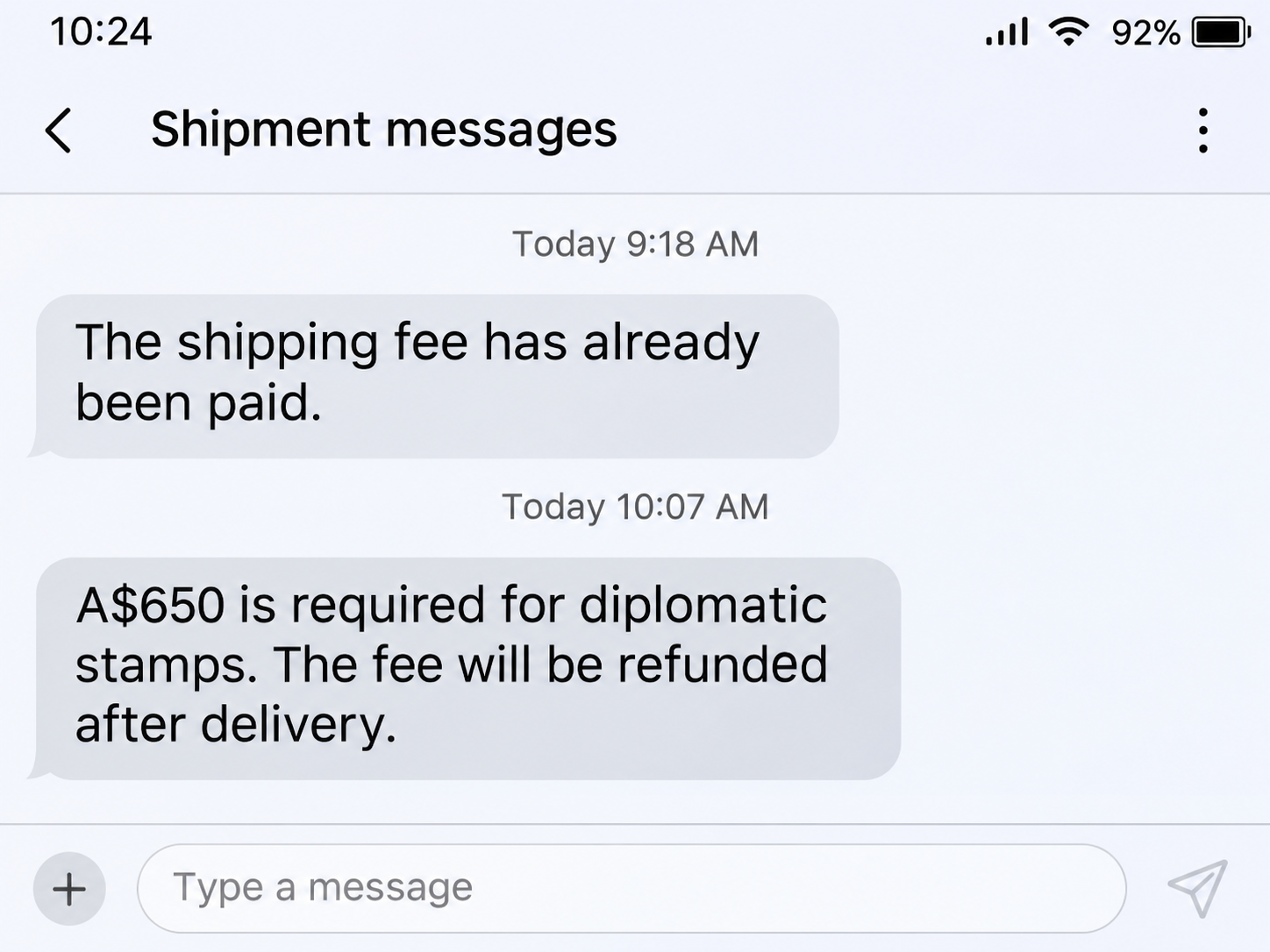
The courier account said the A$405 would be returned after delivery. The buyer paid and then received a new demand for A$650 in supposed diplomatic stamps.
That fee also came with a promise of reimbursement. The sender claimed the shipment needed to be stamped or sealed before it could move between states.
The buyer said the two payments went to different personal bank accounts. They also reported the A$650 demand without saying they had paid it.
Those details matter when you reconstruct the payment trail:
- The seller’s original A$800 quote for the canopy.
- The A$1,000 quote that included delivery.
- The A$405 transfer for paperwork and its separate recipient.
- The A$650 demand for stamps and the promise of reimbursement.
- Any tracking number or paperwork the alleged carrier supplied.
Two official warnings explain why this works
Western Australia Consumer Protection warns that fake Facebook sellers impersonate real wreckers and parts suppliers. They can make a made-up listing look like it belongs to an established yard.
WA ScamNet’s package delivery guidance also flags requests for additional shipping charges after purchase. It advises checking with the real company using contact details you find independently.
The buyer was still trying to verify whether the Facebook account represented the business whose name it used. The messages and payments establish the sequence they described.
There’s no independent finding about who operated the accounts or whether a carrier ever collected the canopy. The payment demand is the part readers can act on.
How the Fake Freight Fee Scam Works
Step 1: A seller answers the exact request you posted
When you ask a vehicle group for a particular part, anyone who can see the post can tailor an offer to your make, model and location.
A seller can name the part, share a plausible yard address and give you a price without proving they have it. Those details make the conversation feel ordinary.
In this case, the part was advertised at A$800. The offer became A$1,000 once the buyer explained that a trip to collect it was impractical.
Ask the business to confirm stock using its own published phone number. Give the person on that line the part description and any stock number you were sent.
Step 2: The delivery arrangement moves into another chat
The seller said it had a long-standing courier relationship. Soon afterward, a WhatsApp account introduced itself as the freight company and appeared to pick up the order.
The timing helps because the second account knows you’re expecting contact. It can repeat the item or the destination and make the handoff look like routine dispatch.
Matching details show that information about the order reached the sender. The same details can come from a genuine dispatch record or from whoever took the first payment.
Find the carrier through a source you choose. Ask its office to match the shipment with a booking reference, pickup point and final destination you already recognize.
Step 3: A real shipping term makes a new fee sound routine
A bill of lading is a genuine kind of shipping document. Using its name in a WhatsApp message gives the request an air of normal freight administration.
The buyer understood that the agreed price included shipping, yet the new account wanted A$405 for the document before the canopy could move.
A delivery authorization can also ask for information. Read what a form actually requests and hold off on signing if it comes through an unverified sender.
The promise of a refund makes the payment feel temporary. Your banking record will show an outgoing transfer before any refund exists, so pause before approving it.
Step 4: Another refundable charge appears after the first payment
After the buyer paid for the paperwork, the account claimed the shipment needed diplomatic stamps. The new demand was more expensive than the fee the buyer just paid.
When someone already has money tied up in a sale, a last-minute charge can feel like the only way to avoid losing everything already spent.
That pressure makes it harder to step back and ask for the agreed delivery terms. Look for the original quote and check precisely what the seller agreed to cover.
The supposed refund exists only in the messages until your bank confirms money came back. Treat a second transfer as a new payment decision.
How to Verify the Seller and Carrier
Contact the wrecking yard without using the Facebook page
Find a contact through the business’s own website or another independent source. A phone number printed in a Facebook cover photo can belong to whoever manages that page.
Give the verified yard the part description and the location you were quoted. Ask whether it has that canopy available and whether the Facebook conversation belongs to it.
If it recognizes the part, verify the price and stock reference separately. Someone can copy a photograph and description from a genuine listing without controlling the item.
Ask for the invoice reference and payment instructions after confirming the business. Compare what the yard tells you with what the seller entered in the message thread.
Ask the carrier to explain each extra charge
Use a phone number or website you found independently to reach the carrier. Provide the tracking number or booking reference the sender gave you.
Ask whether the carrier can see a real consignment from the stated collection point. A dispatch reference that exists only in a chat deserves a second check.
If there’s an extra charge, ask the carrier to identify the service it covers. Get the amount, who invoiced it and how it fits the original shipping terms.
Request a copy of any authorized variation in writing. A legitimate carrier should be able to explain where an invoice came from and who is expected to pay it.
Compare the payee for the item and the paperwork
In the reported case, the buyer said the two payments went to different people. That matters even if both payments were described as parts of one order.
Put both bank receipts beside the original quote. Check the beneficiary names, payment references and whether the documents match the people who actually received the money.
A beneficiary name can differ for an explainable business reason. Confirm the relationship through the real seller or carrier before sending funds to another person.
When a sender provides new bank details after a previous payment, call the company using the contact you already verified. Ask for the beneficiary name without repeating it first.
Ask about delivery dates without following the payment link
If the order is already paid, ask the verified seller whether it can give you a pickup or dispatch date. Check that against any independent carrier record.
Someone may send a tracking page to make a shipment seem real. Open the carrier’s own site yourself and enter only the tracking reference.
Look for the place of pickup and whether the tracking shows a parcel actually collected. A number created on a label can appear before freight has moved.
If a tracking page demands another fee, leave it and speak to the carrier. That also gives you a chance to check whether someone reused a genuine tracking number.
Keep the evidence for the bank and platform
Save the Facebook thread where the seller agreed to the full delivered price. Preserve the WhatsApp request that first introduced paperwork and the one that asked for stamps.
Download your bank’s own receipts and keep the account names and references private. The bank can use them to trace the transfers without posting them in a group.
If a Facebook seller changes names or takes the page down, your screenshots may be the only way to show which account handled the order.
Keep the document as received if you downloaded it already. A screenshot of the request and the sender is enough for an initial report when opening an attachment feels risky.
Find out what personal information reached the sender
An address and phone number are enough to make a later delivery text sound plausible. Tell your household to check unexpected parcel requests through the carrier’s own website.
If you gave someone a bank password, payment code or card number, tell your bank what you shared. The appropriate response depends on what the sender received.
If you submitted ID to a supposed shipping form, note which document or number went out. IDCARE can help Australians plan a response to identity exposure.
The lead image reconstructs the fee demand described by the buyer. It illustrates how a later shipping charge can arrive in the middle of an ordinary conversation.
Check whether the freight quote covered your item
A canopy can require different handling from a smaller part. Ask the genuine carrier what measurements or pickup details it received for the item.
If someone says a fee comes from a government office, ask them to identify the authority in writing. Find that office independently before giving the sender another payment.
For future purchases, settle who pays for freight before transferring the item price. A written total gives you something concrete to compare when a second account contacts you.
What to Do if You Have Fallen Victim to This Scam
-
Stop paying the seller and carrier accounts while you verify the order. Save each payment demand, including any claim that another fee would release a refund.
-
Call your bank through its verified fraud channel and identify every transfer you made. Ask what steps are available for the payment method you used.
-
Give the bank the original delivery quote and explain when the later requests arrived. List different recipients separately so each payment can be checked on its own.
-
Report the seller in Facebook and report the courier chat in WhatsApp. Keep the confirmations and include the genuine business’s details if you’ve verified them.
-
Report the incident to Scamwatch and keep the report reference. If you shared identity information, contact your bank and seek help with securing the affected accounts.
-
Check later refund messages with your bank using the case number you already have. Ignore anyone asking for an upfront fee to recover either transfer.
Contact the bank early even if the seller says a refund is coming. Ask the bank to explain how you’ll learn whether a transfer was recovered.
If the real yard denies the sale, ask whether it wants a copy of the listing so it can report the impersonation. Leave the payment investigation with the bank.
Frequently Asked Questions
Is a bill of lading always a sign of fraud?
A bill of lading is a real freight document. Check the carrier and booking independently when the sender uses that term to demand money outside the agreed price.
Do I need diplomatic stamps for this shipment?
Ask the verified carrier to identify any real requirement and explain why it applies. Do not send the amount requested by an account you reached only through the seller.
Can I get the A$1,405 back if I paid both amounts?
Contact your bank as soon as you suspect fraud. It can explain the options for those transfers. Recovery depends on the payment method and what has happened to the funds.
Can the Facebook group prove the seller is genuine?
A group listing shows who posted the offer on the platform. Check the yard’s own contact and ask it to confirm the listing, stock and beneficiary before paying.
Does a tracking number prove the carrier collected the part?
A real tracking record can help you check collection, but a number alone is insufficient. Enter it on the carrier’s official site and confirm the pickup with its office.
What should I do if I only shared a delivery address?
Expect that future messages could use details from the order. Tell anyone at the address to verify unexpected delivery or payment requests with a carrier they contact themselves.
The Bottom Line
Stop paying when an unfamiliar courier starts adding refundable release charges after a seller promised delivery was included. Verify the order through the real seller and carrier.
If you already transferred money, give your bank the exact amounts and dates before the sender asks again. Keep the seller’s quote and the freight messages together.

Join the discussion
0 commentsShare your experience or ask a question about this article.
Community experiences
Did this happen to you?
Your experience could help someone recognize the same scam. Submit a private report for our team to review.
I experienced this tooReports are reviewed before publication. Sharing publicly is always your choice.
Discussion
Start the conversation
Have a question or something useful to share? Add the first comment.