


A surprise grant could change what a small organization is able to do. An email saying you have already been selected is hard to scroll past.
This one raises a basic question about how the award is supposed to work.
Overview
What does the award email actually promise?
The Philanthropic Support Initiative email scam uses the name of German businesswoman Susanne Klatten. It tells the reader they were chosen to benefit from a charitable initiative in 2026.
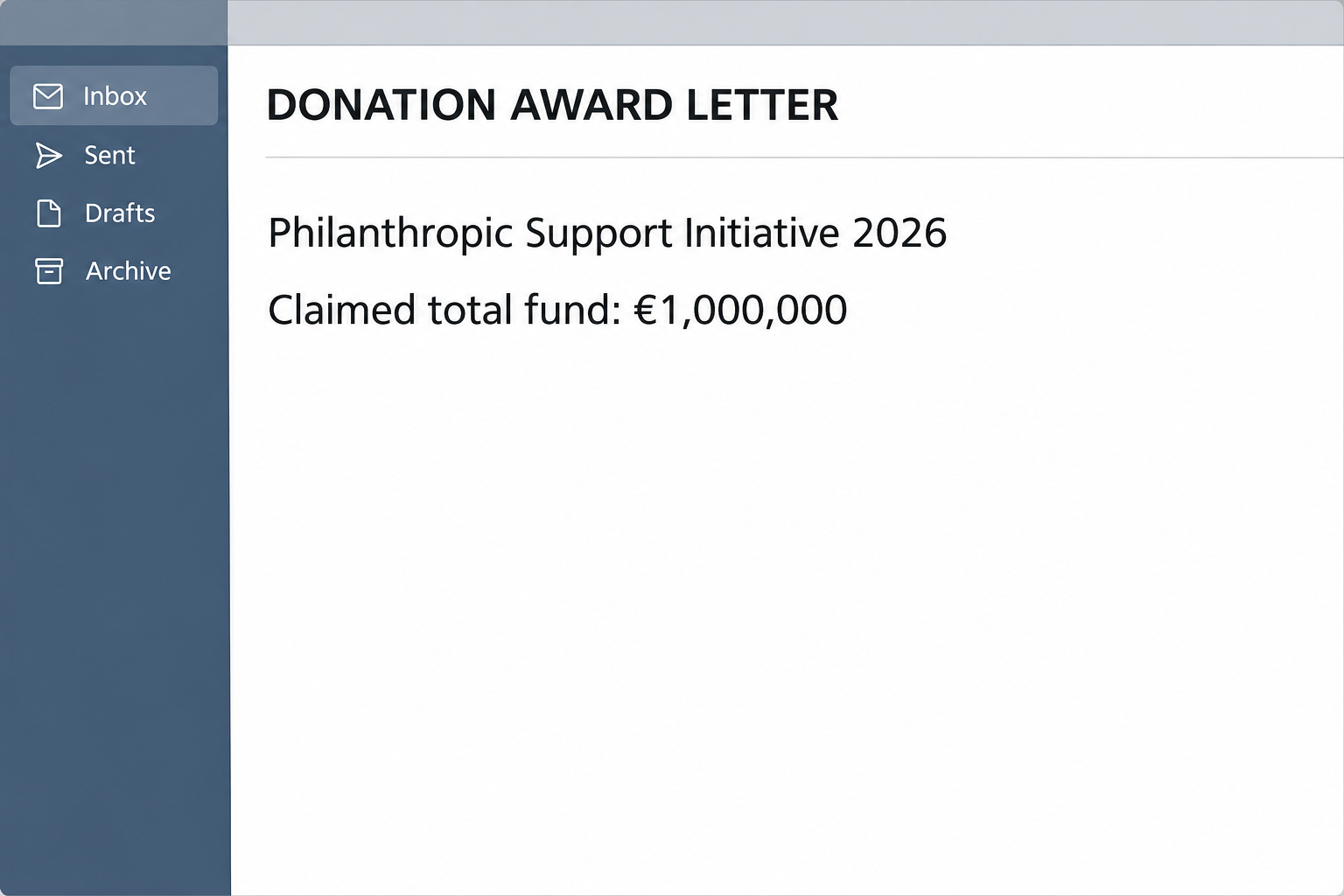
The €1,000,000 figure describes a purported pool for distribution. The email does not offer evidence that anyone has a confirmed individual payment.
It lists broad causes, including education, health, community development and humanitarian relief. That range lets recipients see their own work reflected in the invitation.
The sample asks people to make contact for more information. The opening image recreates that premise without showing a reply address or presenting the message as genuine.
This is a response-first offer, not a payment confirmation. There is no independent evidence that the sender controls a fund or has authority to distribute it.
There is a real philanthropic name to borrow
Klatten did support a charitable initiative called SKala in partnership with PHINEO. The initiative’s official site says it supported 93 nonprofit organizations from 2016 through 2022.
The site makes another important point: applications for that funding are closed. The real program’s published history does not validate an unsolicited award letter from an unrelated sender.
Even finding a real biography would answer only whether the person exists. It would not show that the sender represents her, that you were selected or that money was reserved.
Philanthropy makes the story plausible because public figures do fund projects. A few genuine facts in the background can make an unsupported offer easier to believe.
Where an award stops looking like an award
The documented email begins with selection and asks you to respond. It does not itself show a specific invoice, required fee or confirmed loss.
The risk is what can follow. Someone who presents themselves as a grant administrator can ask for a release fee or personal documents after the conversation starts.
- The large figure is described as a fund, not a confirmed amount payable to you.
- The named philanthropist is real, but the sender supplies no independently verified connection to her.
- The initial email invites further contact instead of providing an independent award record.
- A request for money before you can receive an unsolicited award is a reason to walk away.
You do not need to audit an unfamiliar grant to make an immediate decision. Keep the unknown sender out of your finances while checking independently.
How the Philanthropic Support Initiative Scam Works
Step 1: You are told a decision has already been made
Ordinary fundraising often starts with an application, a referral or a relationship an organization can explain. This email tells you the selection is already done.
If you never applied, there is no record to compare with the letter. The writer turns that missing step into a pleasant surprise.
An organization may run an invitation-only process, but there should still be a way to verify the invitation independently. A reply to the original correspondent is not that check.
If you received it on a charity address, ask the people who manage grants whether they have any relationship with the named program. Do not assume another staff member applied.
Step 2: A large fund sounds more precise than it is
The €1,000,000 figure makes the offer concrete while the amount any one recipient would get remains undefined. Those two facts can easily blur during a quick read.
The list of causes is broad enough to fit a local club, a medical fundraiser or a youth organization. The letter does not explain how your particular organization was evaluated.
People in the middle of a fundraising shortfall have good reason to want the story to be true. That is exactly when an independent check is most useful.
An authorized grant has questions someone other than the email sender should be able to answer. Ask about the legal organization, published program and authorized contact before accepting anything.
Step 3: A reply can become a private onboarding conversation
The initial ask may seem harmless because it is only to get more information. Replying gives the sender an opening to speak to you as though the award were real.
The sample refers to biographical information, but confirming a public figure’s name does not verify the grant. Look for a public program record reached on your own.
Common follow-ups in an advance-fee scheme can include an award form, a request for identity details or someone introduced as a disbursement officer.
The sample does not prove that recipients received those exact requests. The point is to recognize that a conversation can become more invasive than the first email appears.
Step 4: A fee can be presented as the last administrative hurdle
In similar advance-fee frauds, the next request may be described as processing, registration, tax or a legal cost. The name can change without changing the direction the money moves.
Before the award, you are asked to send money away. That is the real financial transaction, regardless of the larger payment somebody says will follow.
A transfer receipt or apparent award certificate sent by the same person cannot corroborate the promised fund. They are parts of the same story.
Do not make a token payment to see what happens. A smaller amount still reaches someone whose authority you have not verified and can invite additional demands.
Step 5: Sunk costs make the next fee harder to refuse
After paying once, a person may fear that walking away will waste the money already sent. A new fee can be framed as the only way to salvage it.
The details may appear to get more official as the conversation goes on. A lawyer’s title, a fee receipt or a different sender does not establish an independent institution.
If the request reaches an organization’s treasurer, share the actual correspondence and transaction history. Do not summarize the fake balance as money the organization owns.
Nobody is obligated to finish this process because they answered an email. You can stop communicating immediately and speak directly to the bank or service that sent the payment.
What to Do if You Have Fallen Victim to This Scam
-
Hold any payment and stop the conversation.
Cancel any unsubmitted instructions in your own account, and ask your bank what can still be paused. Do not ask the grant contact for a final deadline.
If you only replied, stop there and block further contact. A reply may encourage more messages, but it is not a financial transfer.
If this reached a nonprofit, tell the staff member who approves payments. Ask them to flag the specific payee or request without forwarding the original as a live action.
-
Speak to the company that moved the money.
Call your own bank or transfer provider through a verified route. Describe the payment as related to an advance-fee scam and provide the exact timestamp and recipient.
Ask what recall, dispute or reporting routes may apply. A request for a recall is time-sensitive and does not guarantee that the payment can be reversed.
Do not send additional money to make yourself “eligible” for a refund. A verified bank can explain its actual process without relying on the grant sender.
-
Make a private file of documents you shared.
List the name, address, accounts or identification numbers that reached the other person. Do not upload them again to someone who says they can validate your award.
If you shared financial details, ask your bank which accounts or payment methods need monitoring. If you shared identity documents, seek local identity-theft guidance.
Tell an organization’s data lead if the paperwork contained information about staff or beneficiaries. An internal incident can affect people who never saw the email.
-
Keep proof of the transfers and the promises.
Save the messages, payment receipts and any supposed award letters where staff can retrieve them securely. Keep dates and amounts in their original currency.
Record paid charges separately from fees that were only requested. A clear timeline lets a bank or investigator see which losses are real and what may be pending.
Do not publish anyone’s bank details or identity documents to warn others. A redacted description can help people recognize the pitch without exposing more information.
-
Report the scheme outside the original correspondence.
In the United States, submit a report through the FTC fraud reporting service. Elsewhere, use the police or fraud reporting service for your jurisdiction.
If the email used your nonprofit’s identity or reached its donors, coordinate with whoever manages public communications. Keep the warning tied to the specific message and conduct.
When you can do so without losing evidence, use your email provider’s reporting control. That can help isolate further copies of the same appeal.
-
Expect the next offer to sound like help.
Somebody promising recovery may know the amount you lost or the story you were told. Knowledge of the deal does not establish authority to recover funds.
Do not pay a new contact for a guaranteed recovery. Start with the institution you already used, or ask an independent professional to review any new claim.
If you work with volunteers, write down a payment rule for surprise awards. Require a verified organization and a second person before anyone sends funds or identification.
If Someone Sends an Award Certificate
An award letter with a signature can look more substantial than the first email. It is still only a document supplied by the same unverified contact.
Look up the organization it names and use a contact published independently of the letter. Ask whether the organization runs that program and can confirm your own involvement.
Be especially careful when the alleged grant administrator says a separate law firm or customs office must collect a fee. A new name does not make the fee independent.
For a nonprofit, a real grant also has a practical consequence: someone will need to authorize acceptance and understand any restrictions before committing the organization.
Instead of announcing the award to donors or putting it into a budget, let the responsible staff review the proposal. Keep the correspondence out of any live payment queue.
An individual recipient can use the same reasoning. Do not incorporate promised funds into rent, medical or other plans until their origin and availability are independently established.
If you have a genuine grant application pending elsewhere, confirm its status with that program. Contact the person who acknowledged your application rather than assuming these conversations are related.
A real partner can tell you what an award would be used for and whether any terms need acceptance. Keep that conversation separate from the unsolicited offer.
Frequently Asked Questions
Is the Susanne Klatten award email legitimate?
The reported email uses her name in an unsolicited award pitch. It gives no independently verified reason to believe it came from her or an authorized grant administrator.
Real philanthropic work is separate from the message. Check any alleged program through its established public website and contact information, without replying to verify your selection.
Is each recipient promised €1,000,000?
The specimen describes that as the total amount available under the purported program. It does not specify a real individual payment or give evidence that any fund exists.
The figure is part of the pitch, not a deposit a recipient can claim. Do not treat it as committed funding in your personal or organizational plans.
Does the real SKala initiative make the offer credible?
The official SKala site describes a real partnership and previous funding, and says applications are closed. That history does not corroborate this supposed 2026 award.
An email can borrow the reputation created by a genuine program. You still need to know who sent it and whether that person represents the program it names.
Why did the letter not ask for money immediately?
The initial specimen asks for contact rather than payment. In a response-first campaign, requests for money or identity documents can arrive after someone starts talking to the sender.
You do not have to wait for a fee to decline. There is no benefit in continuing an unverifiable discussion simply to learn what it asks for next.
Should I send a copy of my identification to confirm eligibility?
Do not send identity documents to the unsolicited contact. Find a verified organization and a genuine application process before sharing sensitive information.
If you sent a document already, save a private record of which one. Follow guidance for the document and jurisdiction rather than expecting the sender to delete its copy.
Can I get money back after paying a grant fee?
Recovery depends on the payment method, timing and circumstances. Ask the company that moved the funds what it can do and keep the case record.
A person who claims recovery is certain if you pay them is asking you to take another risk. Do not pay the original contact or a replacement.
The Bottom Line
Do not reply to this award email or pay to release funds. The sender borrows a real philanthropist’s name without establishing a real grant or an authorized relationship.
If money or identification left your control, contact the payment provider or identity-theft service directly. Preserve the records and refuse any new fee tied to the same promise.

Join the discussion
0 commentsShare your experience or ask a question about this article.
Community experiences
Did this happen to you?
Your experience could help someone recognize the same scam. Submit a private report for our team to review.
I experienced this tooReports are reviewed before publication. Sharing publicly is always your choice.
Discussion
Start the conversation
Have a question or something useful to share? Add the first comment.