

A fake FTC recovery agent sends a polished message saying your old fraud report has finally produced a result. The sender knows that you lost money and even provides an employee ID and badge. The promise feels like overdue justice.
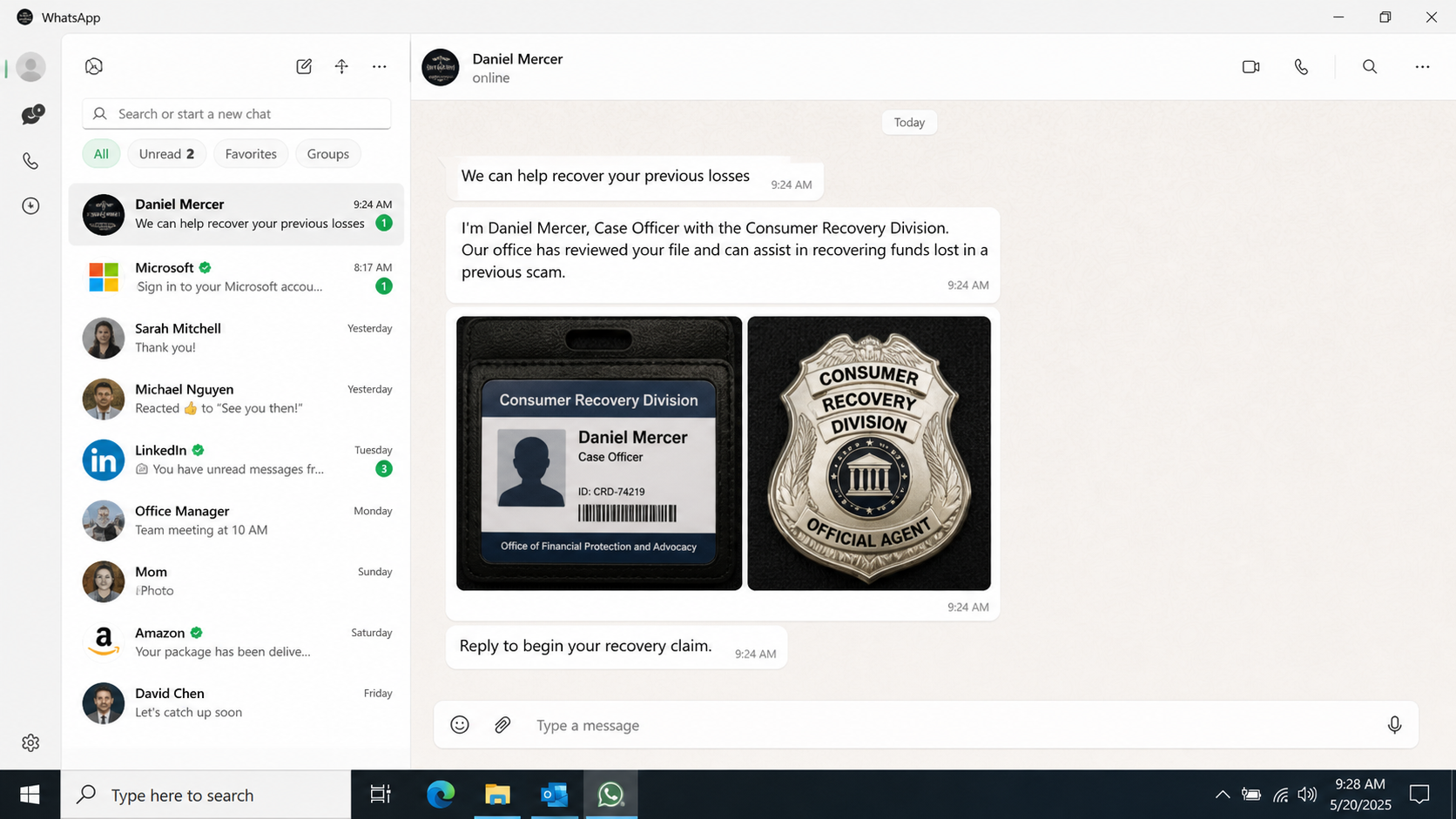
The fake FTC recovery agent approach was highlighted by the Federal Trade Commission in June 2026. Reports described unexpected texts or messaging-app contacts from impostors offering to recover money lost in an earlier scam.
To make the approach convincing, the impostor may send a photograph of an employee credential and badge. Those images are not proof of identity.
A convincing card can be fabricated, altered, stolen from an unrelated person, or generated in minutes.
The conversation then moves from reassurance to extraction. The supposed agent requests financial information, directs the victim to move money, or invents a fee that must be paid before recovered funds can be released.
Overview
For someone who has already been deceived once, that small flash of hope can make the next request seem safer than it really is.
The second scam is built around the pain of the first
Recovery scams work because the victim already wants an ending. They may have contacted banks, police, platforms, or regulators and received no immediate refund.
A message claiming that investigators found the money arrives at exactly the right emotional moment.
The criminal may know about the earlier loss through breached data, a lead list sold by another fraud group, public complaints, or information the victim shared during the first scam.
Sometimes the sender simply guesses and waits for a reply that confirms the story.
A photograph of an ID card is theater, not verification
The credential is designed to end healthy skepticism. It may include a portrait, identification number, agency-style colors, a barcode, and an official-looking title.
None of those details proves that the person controlling the account works for the government.
Real verification happens through an independently located agency channel. A victim should end the conversation, find the official public number without using the message, and ask whether the employee and case number are genuine.
The promised refund becomes a payment or account-access demand
Once trust is established, the impostor invents a release fee, tax, bond, compliance deposit, or identity-verification charge. Other versions ask for online banking access, routing information, a cryptocurrency transfer, or permission to control the victim's screen.
The Federal Trade Commission says its employees do not text a photo of their ID to prove who they are. They also do not offer private recovery help and then ask the consumer to pay, move money to a specified account, or disclose financial details.
- An unexpected text or messaging-app contact claims to be from the FTC.
- The sender says money from an earlier scam has been located.
- A photographed badge or employee ID is offered as proof.
- The victim is told to keep the case private and act quickly.
- A fee, transfer, bank login, or financial record is requested.
- The promised recovery disappears after money or data is surrendered.
Why Previous Scam Victims Are Targeted Again
A person who has already lost money is not gullible or careless. Scammers build persuasive situations, create urgency, and exploit ordinary trust. The recovery operation uses the same skills while pretending to stand on the victim's side.
The first loss also creates a valuable criminal record. A list may contain a name, phone number, amount lost, payment method, and the original story.
Fraud groups can reuse or sell that information because it identifies someone likely to answer a recovery pitch.
A caller who knows the exact amount or merchant name can sound remarkably credible. That knowledge proves only that information escaped somewhere.
It does not prove the person has authority, access to seized funds, or any connection to an investigation.
Shame can deepen the trap. The impostor may say the case must remain confidential because publicity could interfere with recovery. In reality, secrecy prevents the victim from checking with family, a bank, or the real agency.
A legitimate refund administered after an enforcement case should be independently verifiable through an official agency page. It should not depend on paying a stranger through cryptocurrency, a payment app, gift card, or a newly supplied bank account.
What the FTC Warning Establishes
The FTC described a specific 2026 variation in which impostors contact previous fraud victims and claim to be agents who can recover their losses. The sender uses a fake employee ID and badge to create confidence.
The agency's guidance is direct: real FTC employees do not initiate this kind of contact through text messages or WhatsApp. They do not send a photo of an employee ID as a trust test.
The warning also states that a real employee will not ask someone to pay for recovery, move funds into a designated account, or hand over financial information. Those requests identify the recovery offer as an impersonation attempt.
A criminal may combine real agency names, public staff names, and copied visual elements. Accurate surface details do not authenticate the conversation. Verification must begin from an official FTC channel that the recipient found independently.
The clearest evidence is behavioral. An unsolicited recovery promise followed by a payment or account-access request is incompatible with the process the impostor claims to represent.
How the Fake FTC Recovery Agent Scam Works
Step 1: An unexpected recovery message arrives
The contact usually starts by text, WhatsApp, Telegram, email, or a phone call. The sender introduces themselves as an FTC employee, fraud investigator, claims officer, or member of a special recovery unit.
They may reference a previous loss or say a database search linked the recipient to seized funds. If the recipient confirms any detail, the criminal uses that information to make the next message more precise.
Step 2: The impostor builds a believable case file
A case number, recovery amount, court reference, or supposed investigation summary appears. The details may be invented, copied from the victim's earlier complaint, or assembled from information bought from another scam operation.
The sender may know a real regulator's address or the name of a genuine official. Scammers borrow truthful details because people often verify one fact and then assume the entire story is legitimate.
Step 3: A fake employee ID and badge shut down doubt
When the recipient asks for proof, the impostor sends an image of a credential. It may show a portrait, signature, serial number, and badge beside the card.
The image is meant to feel more concrete than a phone number or profile name.
A photograph cannot establish who controls an account. The safest response is to stop, locate the FTC's contact information separately, and verify the claim without telling the sender what you are doing.
Step 4: The victim is moved into a private, urgent process
The criminal says the recovery window is short or that other suspects might move the funds. Instructions may include staying on the phone, avoiding the bank, and not discussing the case with anyone.
That isolation is deliberate. A real bank employee, relative, attorney, or agency representative would quickly challenge a demand for secrecy and irreversible payment.
Step 5: A fee or money-transfer test appears
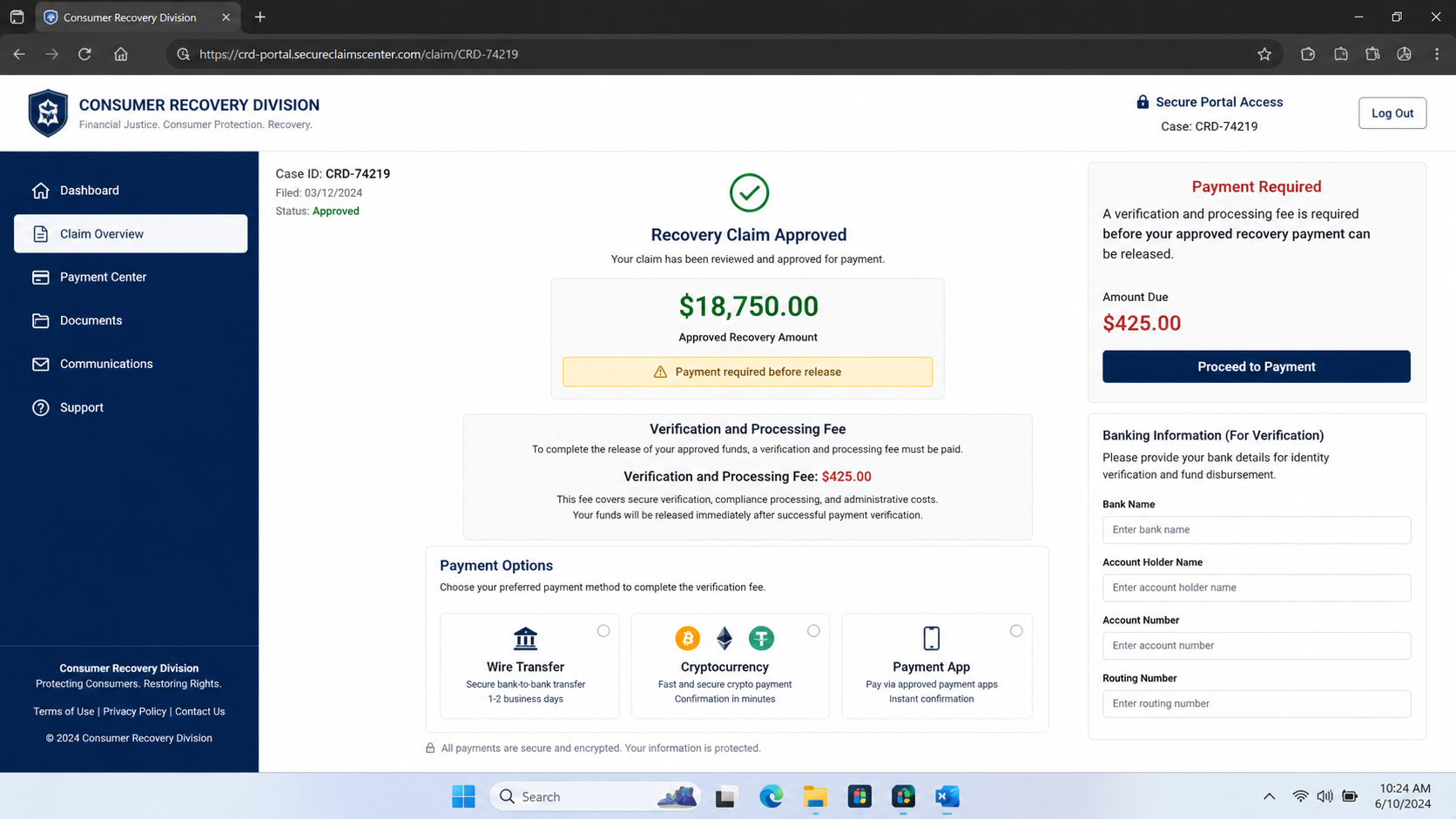
The promised refund is suddenly blocked by a processing charge, tax, insurance bond, anti-money-laundering deposit, or account-verification payment. The label changes, but the victim must send real money before receiving imaginary money.
Payment is often requested through wire transfer, cryptocurrency, gift card, or a payment app. These methods are fast and difficult to reverse, which is why impersonators prefer them.
Step 6: Financial access becomes the larger prize
Some impostors ask for a bank statement, routing number, Social Security number, identity document, or online-banking screenshot. Others direct the victim to install remote-access software so an agent can supposedly trace the stolen funds.
Those requests can enable identity theft, account takeover, unauthorized transfers, and new credit applications. Even if no fee is paid, submitted records may create a serious second loss.
Step 7: The recovery story expands until the victim stops paying
After one payment, another obstacle appears. The criminal may invent a larger tax, international transfer fee, court certificate, or final security deposit. Each demand is presented as the last step.
When the victim refuses or runs out of money, the account disappears. The information may then be passed to another recovery operator who approaches under a different agency or law-firm identity.
Company, Address, and Fulfillment Checks
The agency name is real, but the person contacting you is not verified
Government impersonators borrow names that already carry authority. Seeing FTC in a profile, email signature, or document does not connect the sender to the agency.
Verify from the outside. Use FTC.gov or another independently located government directory, not the phone number, QR code, link, or extension supplied in the conversation.
The address and badge can be copied from unrelated records
A letterhead may list a real federal building, while a badge image may be copied from the internet or assembled from stock graphics. A real address on a fake document does not make the sender an occupant.
Check the full return address, email domain, and delivery channel. A government identity paired with a free mailbox, chat profile, or unrelated commercial domain is a decisive mismatch.
Support vanishes when you contact the agency independently
The impostor controls every channel printed on the fake case file. Calling those numbers only returns you to the same operation and creates the illusion that several departments confirm one another.
A genuine case must survive an independent call. If the public agency channel cannot confirm the employee, case number, and requested action, do not continue.
The money trail must lead to an accountable government process
A federal recovery process should never terminate at a stranger's crypto wallet, payment-app handle, gift-card code, or personal bank account. Those destinations do not provide a traceable public disbursement path.
The identity named on a transfer request matters. A mismatch between the claimed agency and the receiving person or company is not a paperwork detail. It is evidence that the story and payment destination do not belong together.
How to Verify a Real Government Refund Without Trusting the Message
Do not try to win an argument with the sender. Preserve the message, end the conversation, and begin a new verification path. Search for the agency yourself or type FTC.gov directly into the browser.
Look for a public announcement describing the enforcement matter and refund administrator. Confirm the contact information on that page, then ask whether your name, case number, and required action match its records.
Never let the caller keep you on the line while you contact a bank. Hang up and use the number printed on the back of your card or inside the official banking app.
Explain that a government impersonator may be attempting a transfer.
Treat remote-access software as account access. Anyone controlling the screen can view balances, intercept one-time codes, alter transfer details, or hide activity.
A regulator does not need remote control of a consumer's device to issue a refund.
If the claim is legitimate, it will remain legitimate after independent verification. Any supposed agent who punishes a pause, demands secrecy, or says verification will cancel the refund has revealed the manipulation.
Warning Signs to Watch For
- An FTC employee contacts you through text or a private messaging app.
- The sender offers to recover money from a previous scam without a request from you.
- A photographed employee ID or badge is used as the main proof.
- You are told not to speak with your bank, family, or local police.
- A fee or deposit must be paid before recovered money is released.
- Payment must be made by crypto, wire, gift card, or payment app.
- The sender asks for bank credentials, identity documents, or remote access.
- Every contact number comes from the same message or fake case file.
One red flag is enough to pause. The combination of a recovery promise, photographed credentials, secrecy, and an irreversible payment request is a clear reason to stop and verify independently.
What to Do if You Have Fallen Victim to This Scam
- Stop communicating and do not send another payment. Save the conversation first, then block the account. Do not pay a supposed final fee, even if the impostor threatens to cancel the recovery or prosecute you.
- Contact the bank or payment provider immediately. Use a trusted number and report government impersonation fraud. Ask whether a wire, card charge, payment-app transfer, or crypto purchase can be stopped, recalled, flagged, or traced.
- Secure every financial account you exposed. Change passwords from a clean device, sign out unknown sessions, enable strong multifactor authentication, and ask the bank to replace compromised account or card numbers.
- Protect your identity if documents were submitted. Place a fraud alert or credit freeze, review credit reports, and create an IdentityTheft.gov recovery plan if the scammer received your Social Security number, license, passport, or bank statement.
- Remove remote-access tools and scan the device. Disconnect from the internet if someone controlled the screen. Uninstall the remote tool, review startup items and extensions, then run a full Malwarebytes scan to find malicious files or unwanted software.
- Reduce exposure to the ads and pages that may retarget you. AdGuard can block many malicious advertising domains and known scam pages. It cannot reverse a transfer, but it can reduce repeat exposure while accounts are being secured.
- Report the impersonation through the real FTC channel. Submit the message, phone number, profile, payment destination, and credential images at ReportFraud.ftc.gov. Do not use a reporting link supplied by the impostor.
- Tell trusted people that recovery scammers may call again. Warn family and financial institutions that your information is circulating. Ask them to treat new refund, investigator, lawyer, or asset-recovery contacts as unverified.
- Reject anyone who promises guaranteed recovery for a fee. Follow-up callers often claim they traced the first criminal. Do not pay another private agent, hacker, or law firm that guarantees recovery or demands money before producing independently verifiable results.
Frequently Asked Questions
Will a real FTC employee contact me on WhatsApp?
The FTC says its employees do not use text messages or messaging apps such as WhatsApp for this recovery approach. Verify any claimed contact through FTC.gov.
Can an FTC employee send a photo of an ID card?
A photographed credential is not a valid verification method. The FTC specifically warns that real employees do not text a photo of their employee ID to prove their identity.
Does the FTC charge a fee to release recovered money?
A demand to pay, move money, or provide financial details before a recovery is released is a scam warning. Do not send the requested payment.
How did the impostor know about my earlier loss?
Information can come from a prior scammer, leaked lead list, public complaint, data breach, or details confirmed during the new conversation. Knowledge does not prove authority.
What if the case number looks genuine?
Case numbers are easy to invent or copy. Contact the agency through an independently found number and ask whether the number, employee, and requested action are authentic.
Can a private recovery company guarantee my money back?
No private service can honestly guarantee recovery. Be especially cautious when it requests upfront fees, secrecy, crypto, remote access, or identity documents.
The Bottom Line
The fake FTC recovery agent scam turns a previous loss into the bait for a second one. A badge photograph and detailed case file may look official, but neither proves who is controlling the conversation.
A real recovery should withstand an independent check. It should not require secrecy, remote access, bank credentials, or an irreversible payment to a destination supplied by a stranger.
If this message reached you, stop before replying. Verify through FTC.gov, protect exposed accounts, and remember that legitimate help does not demand more money to recover money you already lost.

Join the discussion
0 commentsShare your experience or ask a question about this article.
Discussion
Start the conversation
Have a question or something useful to share? Add the first comment.