

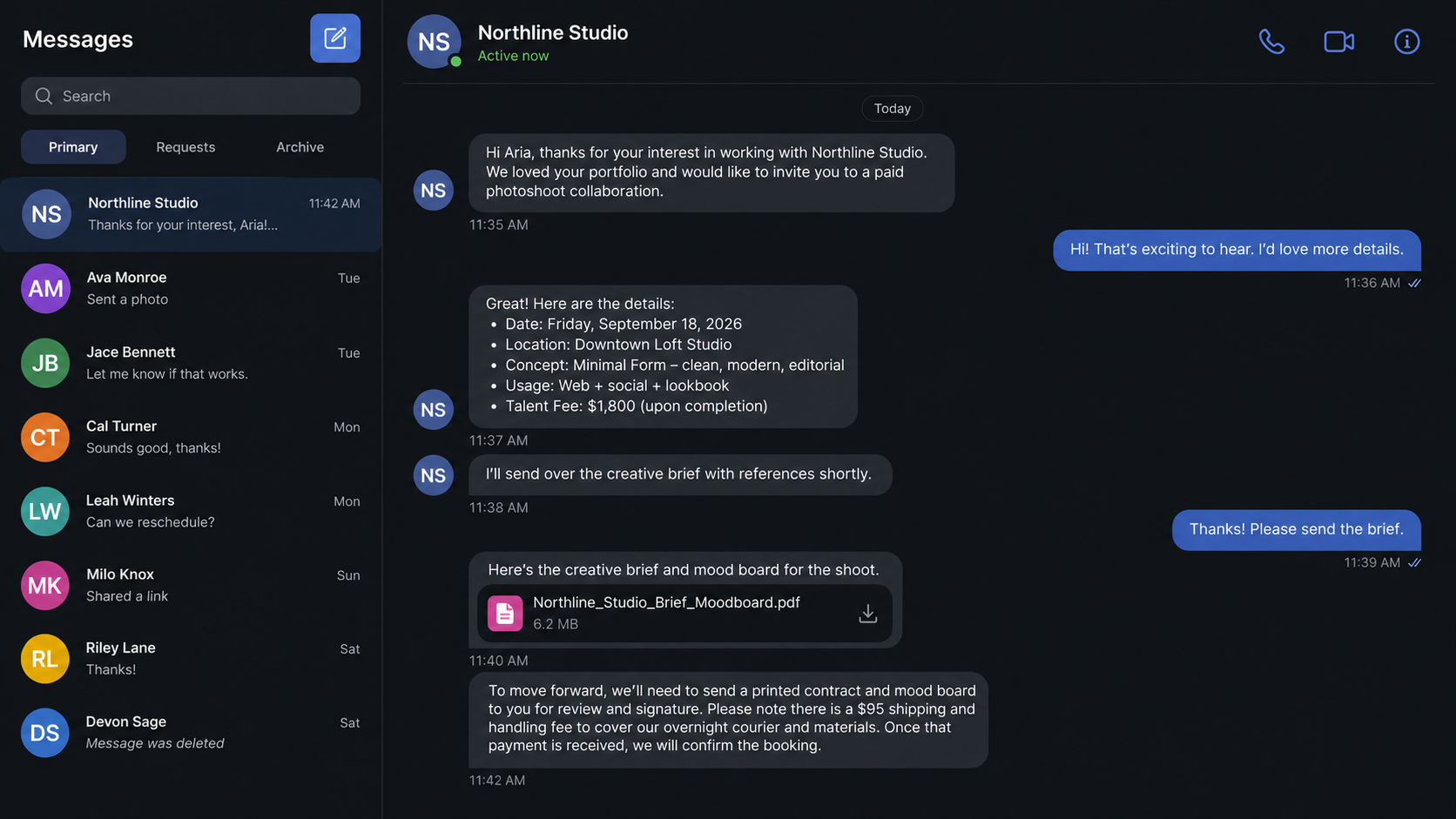
The message sounds like the break a working model has been waiting for. A recognizable type of brand wants a campaign, the shoot has a date and location, and the promised fee makes the opportunity feel serious.
Then the fake model collaboration scam introduces one practical detail. A printed contract and mood board must be shipped first, and the talent needs to cover the fee before the booking can be confirmed.
The amount is small beside the paycheck. That comparison is the trap.
Overview
The offer is built to flatter before it asks
A fake model collaboration scam usually begins through Instagram, TikTok, email, or another platform where portfolios are public. The sender claims to be a creative director, casting manager, recruiter, photographer, or brand representative who discovered the person’s work.
The first message is rarely crude. It may discuss usage rights, call time, styling, travel, deliverables, and a generous talent fee. Those details make the recipient feel selected rather than targeted.
The Federal Trade Commission has warned influencers that impostors pose as brand ambassador managers, promise products and pay, then seek money or financial information. A polished social profile does not turn an unsolicited offer into a verified job.
The shipping fee is payment dressed as paperwork
The scammer says a hard-copy contract, mood board, wardrobe package, product sample, or access pass must be sent by overnight courier. The model is asked to pay $95, $150, or another amount that appears minor beside a promised four-figure booking.
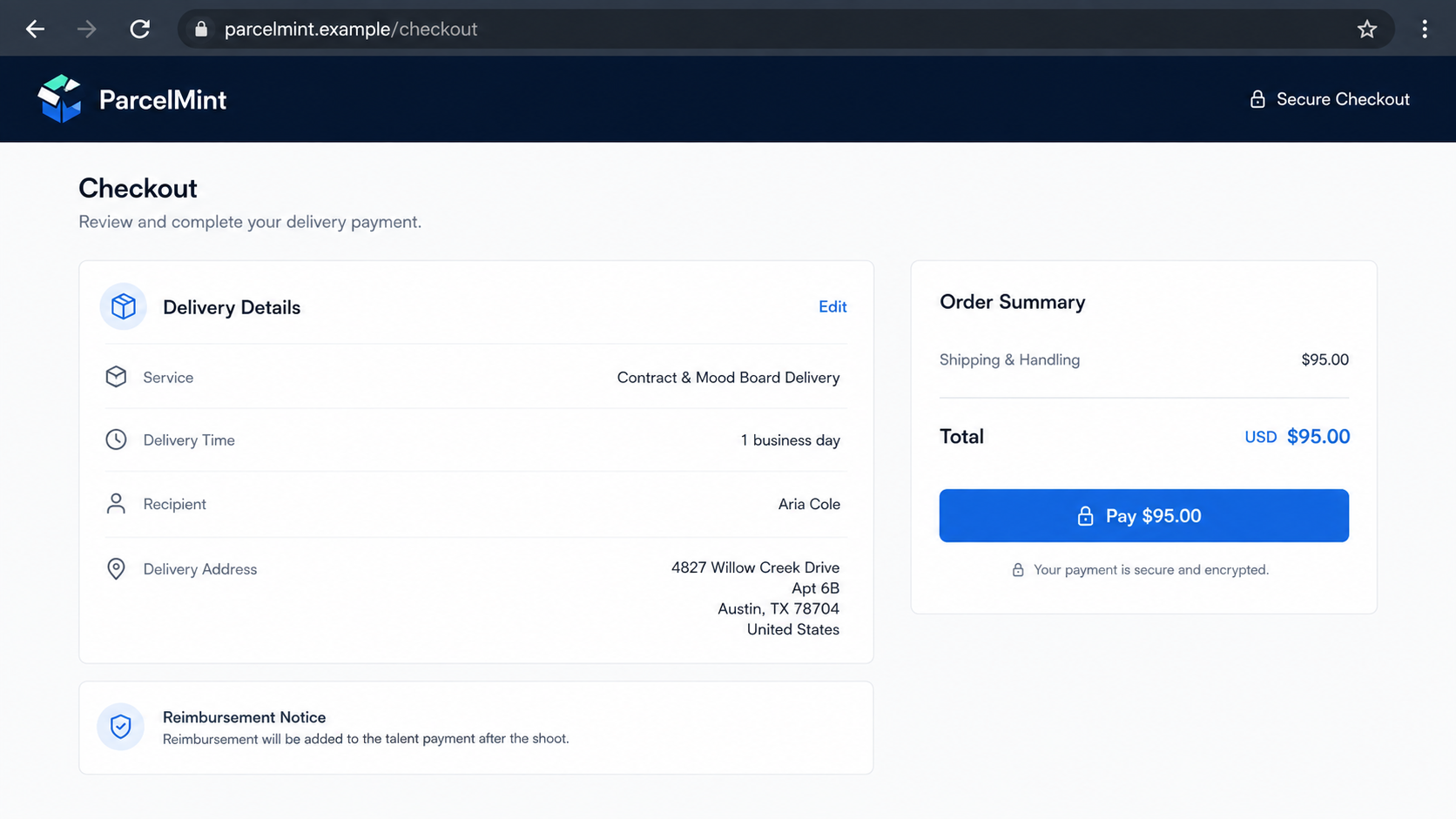
The reimbursement promise removes the final objection. The fee will supposedly be added to the talent payment after the shoot, so paying now is presented as a temporary formality.
Real contracts can be signed electronically or reviewed before money changes hands. A supposed client that will pay $1,800 for talent does not need the talent to finance delivery of its own hiring documents.
The brand identity may be borrowed from a real company
Scammers often choose a real fashion label, cosmetics company, agency, or retailer because the target can find a convincing website and active social account. Those genuine pages belong to the company, not necessarily to the person sending the message.
The contact account may add copied campaign images, purchased followers, a near-identical username, and a biography that links to the real brand. A fake contract can contain genuine executives’ names and office addresses found in public records.
Common warning signs include:
- The offer arrives unexpectedly and skips a normal casting process.
- The sender praises the portfolio without naming specific work.
- The promised fee is high for a first contact with no audition.
- The conversation moves quickly to private messaging.
- The email domain does not match the company’s official domain.
- A printed contract or mood board supposedly requires urgent shipping.
- The talent must pay before the booking is confirmed.
- The fee will allegedly be reimbursed after the shoot.
- The courier or payment page was supplied only by the recruiter.
- The sender resists confirmation through the company’s main office.
- A second fee appears after the first payment.
How the Fake Model Collaboration Scam Works
Step 1: Public portfolios supply a list of targets
Models, actors, creators, photographers, makeup artists, and influencers publish exactly what a fake recruiter needs: contact details, location, availability, style, audience size, and the kind of campaign they hope to book.
The criminal can send a generic pitch to hundreds of people or tailor a message using a recent post. A sentence about a specific image may feel like professional interest even when it took seconds to copy.
Step 2: A brand or agency identity is assembled
The sender creates a near-match username or email address. Logos, campaign photographs, staff names, and corporate language are copied from a legitimate site. A new profile can be padded with old posts so it does not look empty.
Sometimes the account itself was stolen from a real creator or agency employee. A long history and genuine followers can therefore coexist with a fraudulent message. Verification has to reach the company through a different channel.
Step 3: The dream booking is made unusually easy
The recipient is told that the look is perfect and the client wants to move quickly. There may be no live interview, casting call, portfolio review, contract negotiation, or discussion of representation.
A detailed schedule substitutes for those missing steps. The message lists a studio, wardrobe theme, call time, campaign duration, and rate. A real location may be named even though nobody has booked it.
Step 4: Professional files create a sense of commitment
A PDF arrives with a logo, signature, job number, confidentiality language, and payment terms. The criminal wants the recipient to imagine the shoot as settled before encountering the fee.
The document may request identification, tax data, bank information, measurements, or a signed release. That expands the scheme from advance-fee theft into identity theft, account fraud, or misuse of the person’s images.
Step 5: A small shipping charge appears
The supposed brand needs to send a printed contract, mood board, product, wardrobe box, or access badge. Overnight shipping is quoted at an inflated price, and the target is directed to a payment link or personal payment account.
The FTC’s modeling scam guidance is direct: real modeling agencies do not ask people to pay for a test shoot, photographs, or a place in a job. A required advance payment is not made safe by calling it shipping.
Step 6: Reimbursement and urgency defeat hesitation
The recruiter says the expense will be returned with the talent fee. They may claim the campaign launches tomorrow, the courier cutoff is approaching, or another model is ready to take the slot.
This turns caution into a threat to the opportunity. The target is not simply deciding whether to spend $95. They are made to feel they could lose $1,800, a major brand credit, and future work by waiting.
Step 7: The payment opens the door to more demands
After the shipping fee, the parcel may need insurance, customs, wardrobe security, studio access, identity verification, or a refundable deposit. Each charge is described as the final obstacle.
If the target stops paying, the account blocks them or threatens breach-of-contract penalties. The promised shoot never occurs. Any identification or bank data already collected can be used in separate fraud.
Why the Fake Contract Looks So Convincing
A contract is only as trustworthy as the parties behind it. Desktop publishing tools make a professional document easy to imitate, and a genuine company’s public information provides the names, address, typography, and legal language.
Look beyond the visual finish. Does the representative’s email use the official domain? Can the company switchboard connect you to that person? Does the campaign appear in a verified casting channel? Will the client discuss terms on a scheduled video call?
Read the document for operational detail. A legitimate agreement should identify the legal client, scope, compensation, usage, duration, territory, cancellation terms, and payment schedule. It should not require payment to unlock the job.
Be careful with electronic signatures. A signature image can be pasted into a PDF. A familiar signing platform proves how the document was delivered, not that the named company approved the project.
Do not send a passport, driver’s license, tax form, or bank information simply because the request appears in a contract. Confirm the employer first, understand why each field is needed, and use a verified secure process.
The Questions a Real Booking Can Answer
Ask for the full name, role, corporate email, and office number of the person hiring. Ask which agency, production company, casting director, and photographer are attached. Real professionals understand that talent verifies new clients.
Contact the company from the information on its independently reached website. Do not use the number, email, or link inside the offer. A simple question to the communications or legal team can stop an impersonation before data is shared.
Ask for a video meeting and a digital contract that can be reviewed without paying. Verify the shoot location directly. If a studio is named, call the studio through its own published contact and ask whether the production is booked.
If the sender claims a package is already prepared, ask for the carrier and tracking number. Then open the carrier’s official site yourself. Do not pay an insurance or release fee through a tracking page supplied by the recruiter.
Bring an agent, manager, parent, or trusted colleague into the conversation. A scammer benefits when excitement stays private. A second person can ask ordinary production questions without feeling that the dream booking is at risk.
Company, Address, and Identity Checks
The social profile is not the hiring company
Follower counts, copied posts, and a polished biography can be manufactured. Reach the brand through its verified site and ask whether the account and campaign belong to it. Do not let the recruiter provide the verification contact.
The email domain must match the real organization
A free mailbox or near-match domain is a major warning. Read the entire address carefully. Added words such as casting, careers, projects, or studio can make an unrelated domain look plausible.
The shoot address must connect to a real booking
A real studio address can be copied into a fake schedule. Contact the venue independently and confirm the date, production name, and responsible company. Do not arrive alone at an unverified private location.
The payment recipient must be accountable
A legitimate production should not route contract shipping through a stranger’s payment-app handle, gift card, cryptocurrency wallet, or unrelated company. The legal client and payment recipient should form a clear, verifiable chain.
What to Do if You Have Fallen Victim to This Scam
- Stop sending money and documents. Do not pay a final insurance, customs, cancellation, or verification charge. More payment will not create the job.
- Contact the payment provider immediately. Report the transaction as an impersonation and advance-fee scam. Ask about a reversal, card replacement, transfer recall, or account freeze.
- Notify the real brand or agency. Use contact details from its official site. Send the impersonating username, email domain, contract, payment account, and screenshots so the company can warn others.
- Report the profile and payment page. Use the social platform, hosting provider, domain registrar, and payment service’s fraud tools. Preserve evidence before the pages disappear.
- Protect identity documents. If you shared a driver’s license, passport, tax form, or Social Security number, follow a recovery plan at IdentityTheft.gov and consider credit freezes.
- Secure your email and social accounts. Change reused passwords, end unknown sessions, enable strong multifactor authentication, and check recovery details and connected applications.
- Tell your bank exactly what was exposed. Bank account details intended for payroll can be abused even if no money has left yet. Ask the bank what monitoring or account changes are appropriate.
- Check downloaded files. If the contract, mood board, or courier page installed anything, run a complete Malwarebytes scan and remove unfamiliar browser extensions or remote-access tools.
- Add phishing protection after cleanup. AdGuard can block many known malicious pages and ads, but it cannot verify a casting contact or recover an advance payment.
- Report the fraud. File at ReportFraud.ftc.gov and submit significant internet-enabled theft to IC3.gov. Include transaction identifiers and the impersonated company.
- Warn collaborators privately. If the scammer copied your portfolio or contacts, tell people who may receive follow-up offers. Avoid publishing sensitive identity documents in the warning.
- Reject recovery promises. A stranger offering guaranteed refunds, account tracing, or hacker services for another fee is targeting the loss again.
Frequently Asked Questions
Do models ever pay for legitimate portfolio services?
Models may independently hire photographers or training services, but that is different from a client requiring an advance payment to release a promised job. The service and the booking must not be deceptively tied together.
Is a printed contract normal for a photoshoot?
A production may use paper, but it can provide terms for review without making talent pay an urgent courier fee. The method does not justify payment before verification.
What if the recruiter uses a real brand’s logo?
Logos and campaign images are easy to copy. Contact the brand through its independently reached website and confirm the representative, project, and email domain.
Can a verified or established social account be compromised?
Yes. A stolen account can retain its history, followers, and verification status. Confirm unusual business offers through another official channel.
Should I send identification before the shoot?
Only after the client and need are verified, and only through an appropriate secure process. Do not send identity documents to an unsolicited social account or unfamiliar email.
Can I recover a shipping fee already paid?
Contact the payment provider immediately and report fraud. Recovery depends on the payment method and timing, but a fast report offers the best chance.
The Bottom Line
The fake model collaboration scam makes a small advance charge look like the final administrative step before a large, exciting job. The schedule, contract, and brand identity exist to make the fee feel ordinary.
A real opportunity can survive verification. Contact the company independently, confirm the production, and never pay a recruiter to release a job. If the booking disappears when you refuse a shipping fee, there was no booking to lose.

Join the discussion
0 commentsShare your experience or ask a question about this article.
Discussion
Start the conversation
Have a question or something useful to share? Add the first comment.