


One page has a turquoise robot. Another uses a pale token illustration. A third puts a familiar meme inside the same orbit-shaped graphic.
Read past the names and colors. The three pages start to look less independent than they first appear.
Overview
Three token names, one recognizable claim-page design
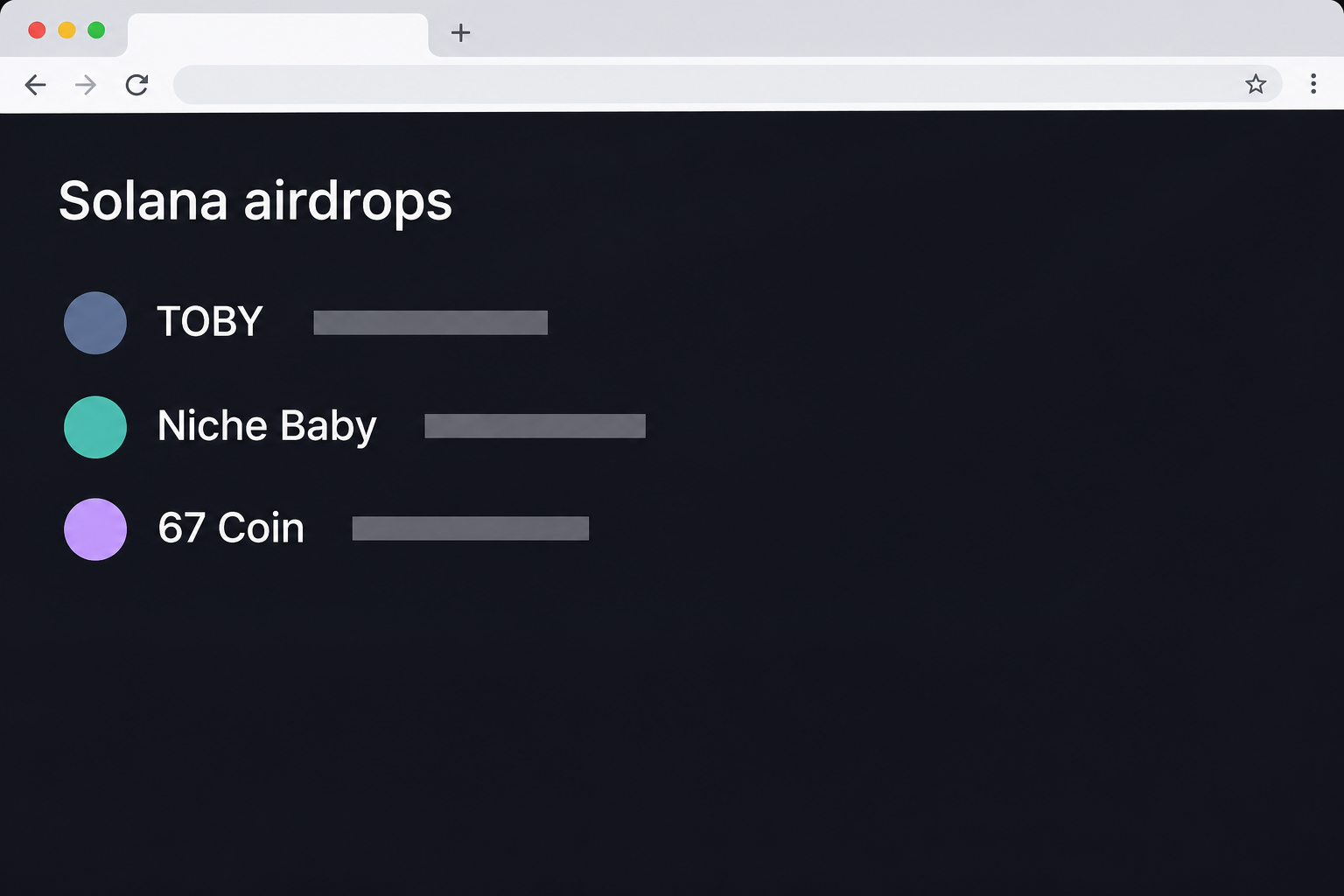
Archived pages for TOBY, Niche Baby, and The Official 67 Coin showed the same basic layout. Each presented a named Solana airdrop in a dark promotional panel.
TOBY appeared at join-tbysol[.]xyz, Niche Baby at join-babysol[.]xyz, and the 67 Coin offer at drop67[.]fun. Those are the reported addresses, not places to check eligibility.
Each example showed a colored coin illustration beside a large heading, a claim described as official, and navigation for background information, a chart, and frequently asked questions.
The language also followed a pattern. Each page advertised the named offer and suggested that visitors could find or claim other free rewards from Solana projects too.
What changed between the pages
TOBY used a robot and turquoise accents, while Niche Baby used pale purple. The 67 Coin page changed the central image and displayed the number as a token ticker.
Those changes give a person who arrives at one page a reason to believe it belongs to that particular community. They do not show that a team authorized the site.
The visual and wording similarities support treating the pages as examples of a reusable lure. They do not demonstrate that one operator ran all three.
This is a warning about the pictured claim sites, not a verdict about every person trading a similarly named token, any actual issuer, or the Solana network.
The identical decision waiting under the branding
The captured sequences for all three reached a wallet selector. Changing the coin’s artwork did not change the practical decision: whether to trust a wallet request from that site.
The record does not show a completed malicious transaction from any of the samples. It shows the claims and path to the chooser, which is sufficient reason to avoid them.
Remember four distinctions when you find a page like these:
- A token name is not an authenticated announcement.
- A chart does not identify the publisher of the page.
- A checkmark drawn by a site is not outside verification.
- A normal connection and a signed asset request have different consequences.
These distinctions are more useful than trying to memorize every meme or domain. A name can change much faster than the decision the page asks you to make.
How the Reused Solana Airdrop Lure Works
Step 1: Recognition puts the visitor in the right mood to trust
People who follow token communities may see multiple names in a single day. Recognizing the illustration or ticker makes a promotion feel like news from one of those communities.
Each example gives the recognized name most of the visual space. The surrounding language is broad enough to work when the highlighted token changes.
If you came looking for TOBY, it may not occur to compare the page with one about Niche Baby. The comparison reveals a similarity a visitor would otherwise miss.
Treat a shared token name as a search term, not proof of origin. You still need an independently verified project announcement that describes the exact campaign.
Step 2: The badge claims authority without showing who granted it
The three sites used wording that called the airdrop official. The badge itself sat inside the page and was supplied by whoever published it.
That is different from checking a confirmed announcement from a genuine project channel. A self-applied cue cannot tell you who controls the site.
An unchanged layout would not necessarily be suspicious by itself. Many legitimate sites use common design components. The important clues include what is repeated and what independent evidence is absent.
Here, each page used the same presentation to advertise a different reward. None of the captures supplied independent proof that its offer came from a verified issuer.
Step 3: The text makes a small promotion sound like a continuing service
The offer is not limited to a token name. The pages also suggest you can find, participate in, and claim other rewards across the same ecosystem.
That turns a one-time offer into something a visitor might bookmark or share. You could believe you are joining a directory even when you only intended to look up news.
The archived pages do not establish that such a service was operating. They show a promise about future opportunities and a path toward a wallet chooser.
Ask whether the page actually lists distinct, verifiable campaigns. A general promise of future rewards says very little about who has committed to distribute anything.
Step 4: The selector familiarizes the last action
The samples displayed a list of wallet applications after the introductory promotion. A recognizable wallet name can make a page feel ready to use.
But a popup can name services that do not endorse the site. Its contents are not a sign that any wallet provider vouched for the claim.
Look at the request through your installed wallet, if one has already appeared. Decline if you cannot identify the action or did not mean to give access.
Do not treat an unfamiliar request as harmless because the page promised a reward. Reading a publicity claim and authorizing on-chain activity are different steps.
Step 5: A copied page may persist after people stop talking about that token
A memorable meme can bring people to a link long after a post was written. The same design can also return with new labels and an unrelated token.
This is why older captures are useful. They show how the pages made the same request even while the parts most likely to be shared looked different.
The domains in the examples help identify those copies, but they are not a complete blocklist. You may encounter the same style at an address none of the captures showed.
Do not read visual similarity as evidence about who owns another site. Use it as a prompt to verify before agreeing to any asset request.
What to Do if You Have Fallen Victim to This Scam
-
Stop using the page you reached. Save the name, address, and original referral privately if they are still available, and do not open the page again.
If you warned a friend by forwarding the link, tell them it was not verified. Avoid recirculating the clickable address when you correct the earlier message.
-
If you only looked at it, do not assume your wallet was affected. Identify whether you opened the separate wallet interface or merely saw a list of app names.
A chooser may have been visible without you choosing anything. Look at what you actually did before deciding whether you have an account to investigate.
-
If you connected, remove the session through your app. Use the wallet’s settings rather than any “disconnect” route supplied by the claim page.
If you switched wallets to check multiple accounts, list them before reviewing activity. The first account may not be the one that received a confirmation request.
-
If you approved a request, review the relevant account history. Identify the network and action, then consult a reputable explorer or the wallet provider if anything is unclear.
For unexplained permission changes, use an official or reputable revocation route where the wallet and network support it. Decline offers from private messages claiming to remove access.
Phantom’s guidance for scam victims explains what to look for after a suspicious interaction. Ask the provider you actually use for its product-specific steps.
-
If you disclosed a secret, plan for a fresh wallet. A recovery phrase or private key remains exposed even if you remove the website from a connected list.
Create new recovery information on a trusted device and get official guidance about protecting remaining assets. Do not send more funds to a compromised wallet to test it.
-
If you lost assets, document the transaction and report it. Retain the amount, timestamp, network, destination, and identifying reference in a secure place.
Report through the appropriate local fraud service and notify an identifiable exchange if relevant. The FTC’s crypto scam guidance includes reporting information for U.S. readers.
Do not pay a private recovery service on the strength of a transaction it found. An address or public transfer does not prove that anyone can reverse it.
How to Recognize a New Version Without Memorizing Page Designs
Check the claim, the project, and the network separately
Start with the name that appears in the headline. Find a known source for the real project rather than searching the new domain to see what it says about itself.
A ticker alone does not identify a token. Different tokens can have the same or similar names, and the existence of one does not confirm a giveaway from another.
Compare an actual announcement for the event, dates, and participation rules. If you cannot find those conditions without going through the promotional page, the offer remains unverified.
A project can confirm a real promotion without asking you to test the page. Do not use a new wallet connection as your way to look for proof.
Take chart and community cues for what they are
A live chart link can point to market information without proving where the offer originated. A real price or trading pair does not validate a different site offering a claim.
Similarly, the image on a token or badge does not establish a relationship with people shown on it. Reused artwork is not proof of an endorsement.
Community members sometimes forward a link without checking it. Ask for the original announcement rather than trusting that other people have seen the same page.
If you moderate a group, publish the reason for the warning. In this case, different names appeared over the same broad rewards story, followed by a wallet request.
Notice what you never needed to do
You can gather the essential facts without signing a transfer, approving a contract, installing an app suggested by a stranger, or entering a recovery phrase.
If a known community has since confirmed something unrelated, keep that announcement separate. A genuine event does not turn an old lookalike into a reliable route to it.
Compare what stays put after the token changes
The same circular illustration held different central artwork across the samples. That detail is useful because you can recognize the repeated composition without identifying every logo.
Look at the nearby text as well. A reusable offer can mention a named token at the top while making broad promises about the rest of a network below.
Notice whether the badge, navigation, and sequence also match. Those repeated choices are more distinctive together than the presence of a dark background by itself.
Even then, do not infer shared software from a similar chooser. An interface can be reused, copied, or imitate another product without establishing who operates it.
Make a report about the page, not the token
When you alert a community, identify which version you saw. A warning about an unofficial claim page is more accurate than saying that every token with that name is fraudulent.
Your report can include what was displayed before the chooser appeared. Do not try to trigger additional prompts just to make the warning more complete.
Where a namesake project exists, readers may already know its chart or other community material. Explain why those genuine things do not verify the archived page you are warning about.
If the old address stops loading, that will not authenticate a new one. Compare future offers to their own official announcements rather than to a list of old imitations.
Frequently Asked Questions
Are the TOBY, Niche Baby, and 67 Coin pages the same website?
They were captured at separate addresses. Their presentation, wording, and wallet-selection sequence were similar, but the archived material does not establish common ownership.
Does the “official” badge make a Solana airdrop genuine?
A badge the page displays about itself is not independent evidence. Verify the offer through a trusted source associated with the actual issuer.
Did these pages offer the same amount of cryptocurrency?
The examples advertised different token names and did not establish a verified distribution. The shared element was the presentation and route toward wallet interaction, not an authenticated amount.
Is the “$67” label a promise to pay $67?
The 67 page used the label like a crypto ticker, not a verified cash amount. Do not treat a token symbol as a promise of payment in any currency.
Can a real token exist alongside a fake claim page?
Yes, and that is why the offer needs its own verification. Token existence or trading activity does not authorize another website to ask for access to funds.
Is a connection the same as exposing my recovery phrase?
A normal connection shares account information, not the recovery phrase. An approval or deliberate secret disclosure is a different exposure and needs a different response.
The Bottom Line
Do not use these copycat claim pages to verify a Solana airdrop. A change in token name, color, or domain does not establish that a verified issuer is behind it.
If you used one, review the precise wallet action you took. Protect your remaining assets based on what you approved or disclosed, not on what the site called the offer.

Join the discussion
0 commentsShare your experience or ask a question about this article.
Community experiences
Did this happen to you?
Your experience could help someone recognize the same scam. Submit a private report for our team to review.
I experienced this tooReports are reviewed before publication. Sharing publicly is always your choice.
Discussion
Start the conversation
Have a question or something useful to share? Add the first comment.