


A countdown can make an offer feel like it was already underway when you arrived. Add a familiar stablecoin, and it can look like something you learned about late.
The site in this case called itself a USDC token distribution. Before worrying about how long the round has left, look at what’s actually in front of you.
Overview
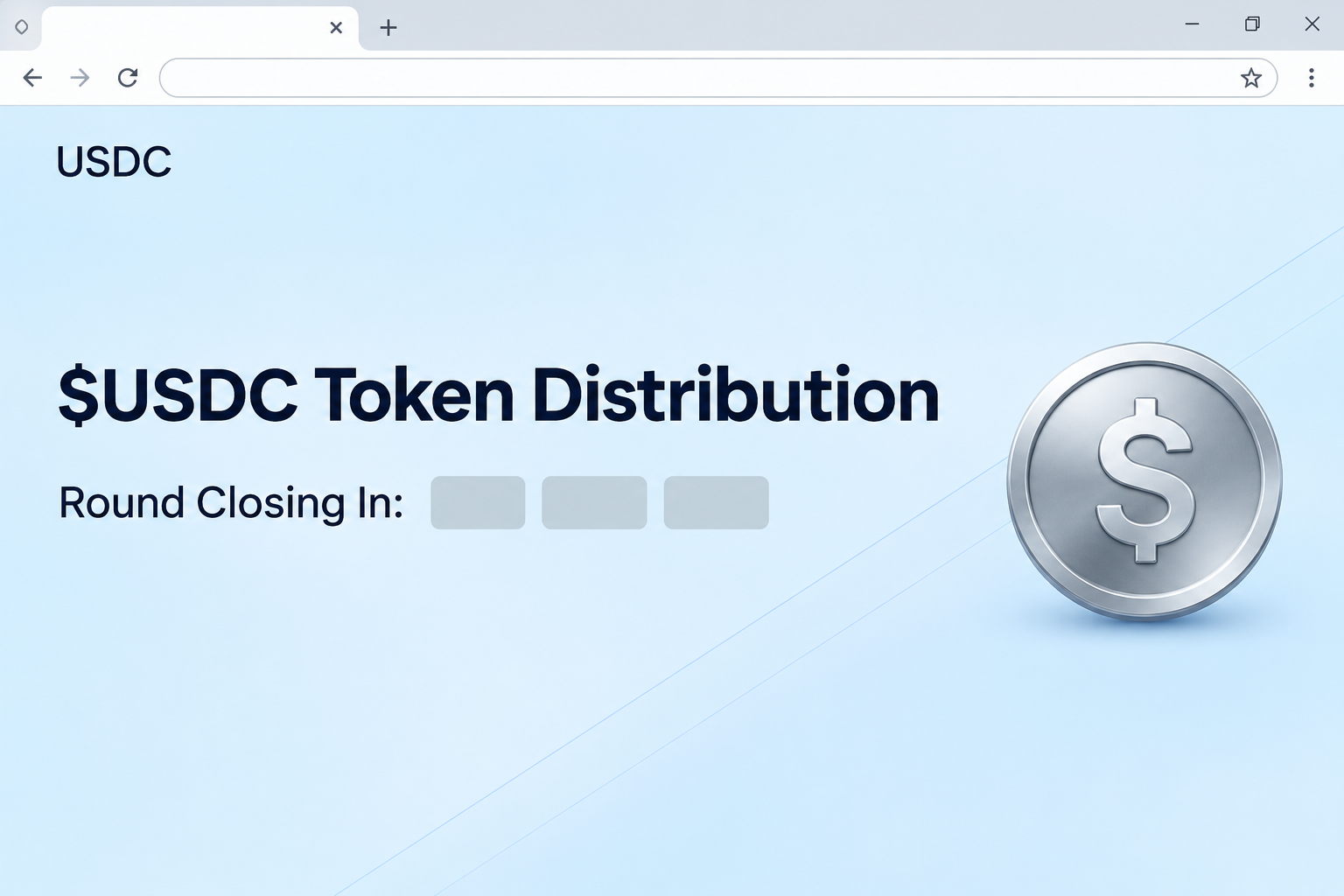
The page promised 10,000,000 USDC under a closing clock
The fake USDC token distribution appeared at nft2[.]top under a path labeled USDC.
It advertised a pool of 10,000,000 USDC and put a countdown next to the claim.
There was a note suggesting a signature might be required to prove ownership of a wallet. That wording matters because a signature can authorize something much more consequential than identification.
The recorded visit shows the promotional page and the wallet picker it displayed. It does not show an actual allocation calculator, payment to a visitor, or confirmed loss.
The page used a real token name but did not establish the identity of the distributor. Neither the pictured coin nor the published pool number could answer that question.
USDC is real, but the asset is not the event
Circle’s USDC page identifies the stablecoin as issued by Circle. It explains the asset and where it is available, not the offer on this unrelated site.
USDC is designed to maintain a value around $1. That can make a giveaway sound more immediate than a promotion involving a token with little trading history.
The amount on the fake page still wasn’t your balance. It described a supposed total for a round, without establishing that anybody funded it or that you qualified.
An exchange, wallet, or unrelated community can talk about USDC without speaking on behalf of Circle. Verify a promotion’s actual organizer rather than assuming the named currency is its sponsor.
An ownership check is not permission to move money
A person can point to a public wallet address without handing someone the private information that controls it. A wallet may also sign requests for many different reasons.
The important question is what this particular request would authorize. Labels on the webpage don’t tell you whether the wallet is requesting a simple message, an approval, or a transfer.
Do not accept a prompt simply because the page calls it proof of ownership. Find out who published the offer and whether a real program describes the same action.
- Verify the organizer before reading the clock as a deadline.
- Check the whole website address, not the USDC logo or page title.
- Never enter a recovery phrase to prove you control a wallet.
- A pending claim screen is not evidence of an incoming transaction.
How the Fake USDC Token Distribution Scam Works
Step 1: The familiar asset gives the promise weight
The page uses the name USDC and puts a familiar currency-like design next to the offer. You don’t have to work out what a brand new token might be worth.
The total looks like a financial figure rather than a vague gift promise.
But an amount printed by the site tells you nothing about its reserves, funding, or chances of paying.
If you reached the page through an ad or message, trace the promotion back to the alleged organizer independently. The archive does not identify where any particular visitor found it.
You can verify that Circle issues USDC without accepting that this page works for Circle. Those are separate checks, and the first is much easier for an imitator to pass.
Step 2: The closing window tries to make checking feel expensive
The countdown says the round will close soon. It invites you to think about missing something, although the offer has yet to explain your eligibility.
Check whether the dated terms exist outside the promotion. A clock placed on a page has no independent authority to determine whether you can receive an asset.
If you are in a group chat, don’t take somebody else’s screenshot of a running timer as confirmation. It shows what that page displayed to that person at that moment.
A deadline only matters after you can verify the event. If the time runs out during that check, you’re still better off than approving a request you didn’t understand.
Step 3: The page reframes the wallet prompt as proof
The page suggests that a signature may be needed to establish control of a wallet. That makes the next screen sound procedural rather than financial.
The captured flow then opens a list of wallets. The familiar names don’t authenticate the giveaway, and the list does not show that any provider endorsed it.
If the site is unknown, don’t pick a wallet to see which approval comes next.
There’s no reason to offer a public address or any other access to verify the organizer.
You can leave this page and use a trusted wallet independently. It will show its own connection and activity records without needing you to return to the distribution.
Step 4: The response depends on what you actually approved
A site with a connection can ask a wallet to perform further actions. An approved transfer or permission is a separate event and may expose funds.
A signature isn’t automatically harmless because the page asks for no visible fee. The effect depends on what the wallet was asked to sign and the network involved.
There is no specific signed request or confirmed withdrawal in the recording. Don’t assume opening the promotion moved your funds, but don’t ignore an unexplained wallet approval either.
After leaving the fake page, look for the request in your wallet and its network history. Those records are more useful than a message saying the free tokens are coming.
What to Do if You Have Fallen Victim to This Scam
-
Close the page and ignore prompts to finish the round. If all you did was open the website or see its wallet list, don’t return to inspect the timer.
Keep the original source of the link and the approximate time. Don’t forward a clickable claim to another user as a way to ask what they think.
-
Remove the connection from your own wallet if you established one. Check the particular account and network you were using rather than whichever account opens by default.
Review the time around the visit for any separate approvals or spending activity. A connected-app entry doesn’t establish that a transfer happened.
MetaMask’s incident guidance explains how to inspect unauthorized activity and respond if the account itself was compromised.
-
Check the asset and permission if you accepted another request. Look for the transaction identifier, affected token, network, and recipient in the wallet’s own records.
Follow guidance from the wallet provider to revoke an unfamiliar permission if appropriate. Removing a site from connected apps doesn’t remove an approval already recorded on a blockchain.
Keep any unrelated tokens and networks in mind. An order advertised as a USDC reward might have asked for an action affecting another asset.
-
If you shared a recovery secret, treat it as a separate compromise. Closing a browser or changing its wallet password won’t invalidate a private key somebody else obtained.
Follow the wallet provider’s instructions to set up a new wallet with distinct recovery information. Move only recognized assets when it is safe to do so.
Tell legitimate support about assets you cannot move ordinarily. Do not type the old phrase into a form offering a faster recovery.
-
Save evidence before seeking help about a transfer. Record the transaction reference, network, time, and assets involved, and preserve any relevant correspondence.
Contact an exchange through its existing account if it processed a related transfer. FTC guidance on cryptocurrency scams gives reporting options for U.S. readers.
A confirmed transfer typically isn’t reversible through a wallet app. Don’t pay an unsolicited helper who says they can release the giveaway or get your balance back for a fee.
How to Verify an Unexpected USDC Offer
Match the asset on the exact network
USDC is available on more than one blockchain. Circle’s contract-address documentation lists identifiers for supported native USDC assets, which depend on the network.
A symbol or icon in your wallet isn’t enough to identify an asset. A token can be labeled USDC without being the one described by Circle.
If a token unexpectedly appears, don’t use links attached to it to decide whether it is genuine. Compare its network and identifier using information obtained separately.
Ask who arranged the giveaway, not who issued the token
A genuine asset can be part of a real promotion run by somebody other than its issuer. So the useful question is who published this particular offer and where.
Look for matching terms and an independently confirmed destination. A logo, storage balance, or copy of the issuer’s branding does not answer who funded the advertised pool.
Circle warns about unsolicited airdrop offers. Its general warning helps explain the risk, but the suspicious page’s own behavior is why this offer should be avoided.
Keep your payment history separate from the claim
If you were waiting for USDC from an exchange or someone you know, use the transaction record they provided through the channel you already trust.
An unrelated site promising a new claim has no role in tracing that transfer. Don’t authorize an unfamiliar request just because the amounts you expected happen to sound similar.
If a deposit doesn’t appear, check the address and network through the provider that actually sent it. That’s a different problem from a website advertising an unsolicited distribution.
Keep an advertised pool separate from a real balance
An amount like 10,000,000 USDC can look substantial enough to be a company promotion.
The number becomes useful evidence only if you can establish who published it and on what terms.
A real balance on a network tells you what an address holds, not necessarily that the funds are available to you.
Ownership of a token and entitlement to a reward differ.
Even seeing an authentic transfer to somebody else wouldn’t tell you that a stranger’s page runs the same offer. It could be unrelated to the message you received.
If a page offers a smaller follow-up amount after supposedly finding your address, don’t treat that new figure as proof either. Check the relevant organizer before accepting a request.
The same caution applies to a so-called activation fee. Don’t pay somebody to release a balance that exists only on the site asking you for money.
If you really expect a payment from another person, ask them to verify the amount and network in an existing conversation. An unsolicited giveaway isn’t the place to trace it.
Frequently Asked Questions
Is the USDC distribution at nft2.top legitimate?
The recorded page was a false distribution offer at a site unrelated to Circle’s published USDC information. It should not be used to verify wallet ownership or collect tokens.
Confirm the exact promotion through the purported organizer before trusting a similar link. There’s no need to see what the fake site’s next button would do.
Did Circle offer 10,000,000 USDC on this page?
That figure was printed by the imitation. The capture does not establish that Circle announced it, that someone funded it, or that an individual was owed a share.
Use Circle’s own site when checking anything claimed in its name. A real token can be used in fake marketing without involvement from its issuer.
What if the page says a signature only proves ownership?
Read the actual wallet request rather than relying on the explanation above it. Some signatures and approvals can authorize meaningful actions even when a page describes them as simple verification.
When the source is untrusted, reject the request. Don’t sign it to learn whether there’s a prize.
Is an unsolicited USDC-looking token safe to move?
Don’t interact with an unfamiliar token just because its symbol looks right. Compare the network and token identifier independently, and use your wallet’s hide or report controls when available.
A token unexpectedly visible in an account doesn’t itself show that a stranger controls it. Clicking links or authorizing actions is a different matter.
Is disconnecting enough after opening the distribution?
If you connected but approved nothing, remove the connection and review your wallet activity. If you authorized something, check for completed transfers or permissions that remain active.
If you shared a private key or phrase, follow wallet-replacement guidance instead of relying on disconnection. The exposure can outlast the website session.
Can USDC’s issuer reverse a completed claim-related transfer?
Don’t assume that an issuer or wallet provider can undo a completed transfer. Contact the service that actually handled the movement, and report it if appropriate.
Keep the network and transaction identifier for those conversations. A person claiming guaranteed recovery shouldn’t be given more crypto or the secret that controls your wallet.
The Bottom Line
Don’t use the fake USDC distribution at nft2[.]top. The pool figure and closing clock did not authenticate it, and the wallet prompt wasn’t proof of a reward.
If you already approved a request, check the network, transaction, and remaining permissions.
If you only wanted to verify USDC or an offer using it, start with an independently confirmed source.

Join the discussion
0 commentsShare your experience or ask a question about this article.
Community experiences
Did this happen to you?
Your experience could help someone recognize the same scam. Submit a private report for our team to review.
I experienced this tooReports are reviewed before publication. Sharing publicly is always your choice.
Discussion
Start the conversation
Have a question or something useful to share? Add the first comment.