

Fat burning shorts are being promoted across social media as wearable body-sculpting garments that claim to burn fat, tighten the stomach, reduce cellulite, and boost metabolism with little effort.
The ads make the product look like a breakthrough in passive weight loss. But the claims, visuals, pricing, and refund structure raise serious concerns.
This article breaks down how these products are marketed, what they can realistically do, and why consumers should be careful before ordering.
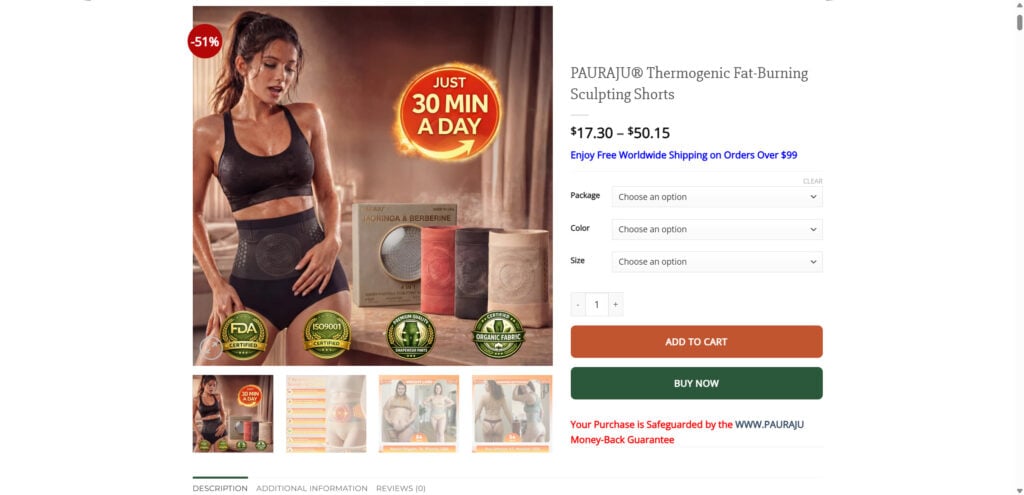
Scam Overview
Fat burning shorts are sold under multiple names across different websites and social media ads. Some brands call them thermal sculpting shorts, microparticle fat-burning shorts, moringa and berberine shorts, bioactive shaping shorts, or thermogenic slimming shorts.
The product names change, but the claims are usually the same.
Common claims include:
- Burn belly fat
- Tighten loose skin
- Reduce cellulite
- Boost metabolism
- Increase calorie burn
- Simulate exercise
- Activate fat burning in 5 minutes
- Create visible results in 30 minutes a day
- Help lose weight without dieting or workouts
These claims are designed to make ordinary compression shorts sound like advanced weight-loss technology.
The problem is simple: clothing cannot melt fat.
What Fat Burning Shorts Actually Are
Most of these products appear to be basic compression shapewear or sauna-style shorts.
They may:
- compress the stomach area
- make the waist look smoother while worn
- increase sweating
- feel warm during use
- create temporary water-weight loss
But they do not directly burn fat through skin contact.
That distinction matters.
Sweating can make someone feel like something is happening, but sweat is mainly fluid loss. It is not the same as losing body fat. Actual fat loss requires the body to use stored energy over time, usually through a calorie deficit, exercise, or both. Cleveland Clinic explains that fat loss happens when the body metabolizes fat and releases byproducts as water and carbon dioxide, not because fat is “sweated out” through clothing.
Major Red Flags
1. The “Burn Fat Without Exercise” Claim Is Misleading
Many ads suggest you can wear the shorts while sitting, sleeping, working, or doing light chores and still enter “fat-burning mode.”
That is a classic weight-loss red flag.
The FTC warns that claims promising weight loss without changing habits are false. Products that imply you can lose weight without diet, exercise, or meaningful lifestyle change should be treated with skepticism.
Fat burning shorts may make you sweat. They may shape your body temporarily. But they cannot replace exercise, nutrition, or real metabolic change.
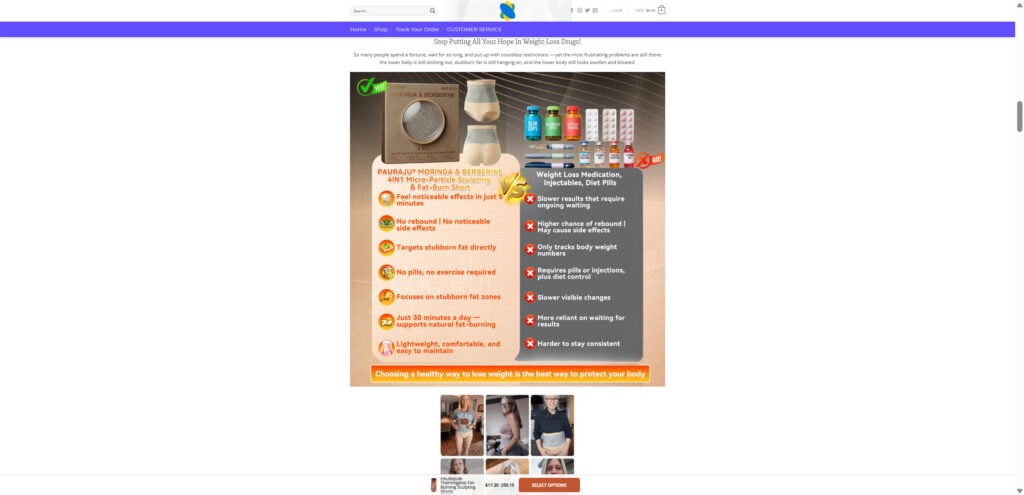
2. Scientific-Sounding Buzzwords Are Used to Sell the Product
These websites often use phrases like:
- Thermal fat activation
- Infrared slimming technology
- Metabolic stimulation fabric
- Nano bioactive fibers
- Zeolite thermal sculpting
- Molecular sieve detox
- Passive fat-burning technology
- Bioactive permeation
- Thermogenic compression system
These terms sound impressive, but they are usually not backed by real product-specific science.
A legitimate product making body-fat claims should show:
- clinical trial data
- named researchers
- study methodology
- measurable body composition results
- independent testing
- product-specific evidence
Most fat burning shorts pages do not provide that. They rely on technical language to make a normal garment sound revolutionary.
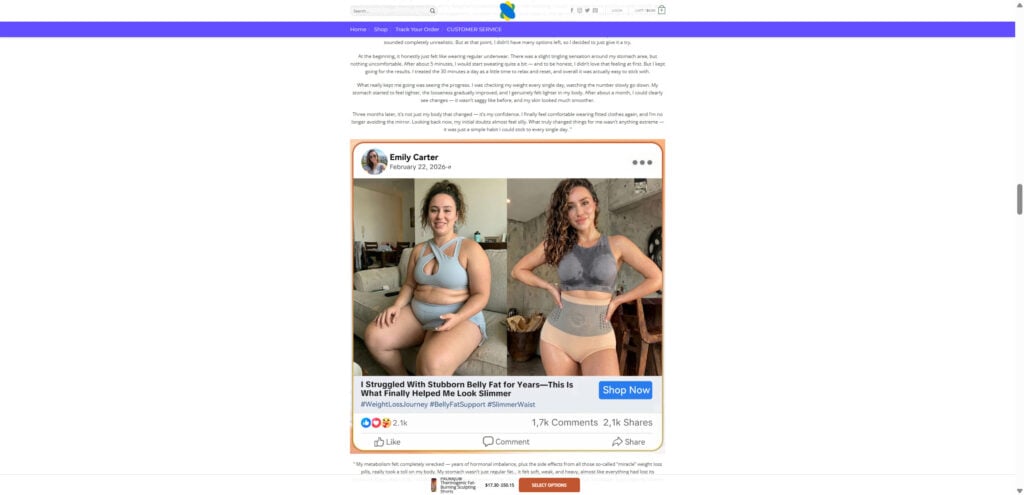
3. Sweating Is Presented as Fat Loss
A major trick in this type of marketing is confusing sweat with fat burning.
The ads often show:
- people sweating heavily
- heat graphics around the waist
- glowing stomach areas
- “thermal core” diagrams
- before-and-after body changes
This creates the impression that heat equals fat loss.
It does not.
Sweating is the body’s cooling mechanism. A sauna-style garment can make you sweat more, but that does not mean it is burning belly fat. Any temporary scale drop from sweating is usually water loss and returns after rehydration.
4. The Product Is Often Just Cheap Shapewear
Many of these shorts appear similar to inexpensive shapewear sold on wholesale platforms and marketplaces.
The likely business model is:
- source cheap compression shorts
- add a new brand name
- create dramatic ads
- claim “fat-burning technology”
- sell at a large markup
This is typical dropshipping behavior.
The product may physically arrive, but it may be far less advanced than the ads suggest.
5. “Moringa and Berberine Fabric” Claims Are Highly Questionable
Some versions claim the shorts contain ingredients like:
- moringa
- berberine
- green tea
- curcumin
- zeolite
- herbal slimming compounds
The claim is that these ingredients are woven into the fabric and absorbed through the skin to trigger metabolism or fat burning.
That is a serious claim, and it would require serious proof.
The seller would need to prove:
- the ingredients are actually present in the fabric
- they remain active after manufacturing
- they transfer through skin in meaningful amounts
- they reach fat tissue
- they cause measurable fat loss
- the exact product was clinically tested
Without that evidence, it is marketing, not science.
6. Similar Claims Have Already Been Challenged Before
This is not the first time clothing has been sold with slimming claims.
The FTC previously took action against marketers of caffeine-infused shapewear after they claimed the garments could reduce cellulite, shrink measurements, and make users visibly slimmer.
That case is directly relevant because fat burning shorts use a similar idea: clothing plus “active” ingredients or heat equals body fat reduction.
Regulators have already shown that these kinds of clothing-based weight-loss claims require real evidence.
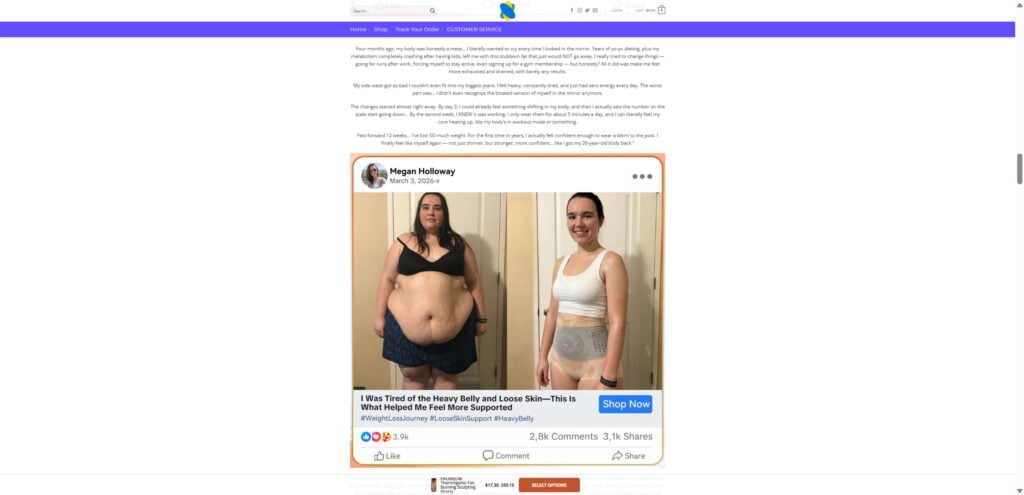
7. Before-and-After Images May Be Edited or Misleading
Many fat burning shorts ads use dramatic before-and-after photos.
These images may be manipulated through:
- different lighting
- changed posture
- different underwear or shapewear
- stomach sucking
- posing tricks
- compression effects
- filters
- AI-generated models
- stolen transformation photos
Even real shapewear can make someone look slimmer while wearing it. That does not mean fat was burned.
The difference between temporary compression and actual fat loss is central to understanding the scam.
8. Testimonials Often Look Fake or Reused
The testimonials usually follow the same pattern:
- generic names
- dramatic weight-loss stories
- “I didn’t change anything”
- “I lost inches in weeks”
- “My belly melted”
- “I finally feel confident”
- “I wear them 30 minutes a day”
Many of these testimonials are difficult to verify.
Warning signs include:
- no full names
- no independent review platform
- same review text across different sites
- stock photos
- AI-looking images
- unrealistic timelines
- identical wording used by multiple brands
If the reviews only exist on the seller’s landing page, treat them as marketing content.
9. Fake Doctor or Lab-Coat Authority
Some ads use people in lab coats or claim the shorts are:
- doctor recommended
- clinically proven
- FDA approved
- certified technology
- lab tested
- used by experts
These claims are often vague.
If a product says “clinically proven,” ask:
- proven by whom?
- where was the study published?
- how many participants?
- was there a control group?
- was the exact product tested?
- were the results independently verified?
If the site cannot answer those questions clearly, the authority claim is weak.
10. Pressure Tactics Are Everywhere
Fat burning shorts ads commonly use:
- countdown timers
- “sale ends tonight”
- “only 3 left”
- “someone just ordered”
- “limited stock”
- “70% off today”
- bundle deals
- buy-more-save-more pricing
These are not product features. They are sales pressure tools.
They are designed to stop buyers from thinking carefully, checking reviews, or comparing prices.
Why the Product Feels Convincing
Fat burning shorts work as an ad concept because they combine several persuasive ideas:
They target a common insecurity
The ads focus on belly fat, loose skin, cellulite, bloating, and body confidence.
They promise an easy solution
Instead of diet, exercise, or time, the product offers a simple shortcut: wear the shorts.
They create a physical sensation
Warmth and sweating make users feel like the product is “working.”
They show dramatic visuals
Heat effects, glowing stomach graphics, and before-and-after photos make the result feel real.
They use low-risk pricing
Many shoppers think, “It’s not too expensive, I’ll try it.”
That is exactly how these funnels work.
What Fat Burning Shorts Can Realistically Do
A realistic version of the product may provide:
- temporary compression
- smoother appearance under clothes
- more sweating in the covered area
- warmth during workouts
- mild posture or shaping support
That is all.
What They Cannot Realistically Do
Fat burning shorts cannot:
- melt belly fat
- target fat in one body area
- permanently reduce cellulite
- tighten loose skin
- mimic exercise
- boost metabolism in a meaningful way
- replace diet and movement
- create long-term fat loss while sitting at home
If the ad promises these results, the marketing is misleading.
Dropshipping Pattern
This product category has all the typical signs of a dropshipping operation.
Common dropshipping indicators include:
- same product sold under many brand names
- identical ads across multiple sites
- low-cost generic product design
- heavy markup
- unclear company identity
- vague manufacturing details
- fake urgency
- difficult returns
- refund conditions hidden in policy pages
- shipping from China
- customer-paid return shipping
The product may arrive, but the buying experience can still be poor.
Return Problems
One of the biggest risks is the refund process.
Many buyers discover after ordering that:
- returns require shipping back to China
- return shipping costs more than the product
- opened or worn items are not eligible
- the seller offers only partial refunds
- support replies slowly
- the return window is short
- the product must be unused and in original packaging
This creates a practical problem.
A seller can advertise a “money-back guarantee,” but if the customer must pay international shipping to return low-cost shapewear, the guarantee becomes almost useless.
Is Fat Burning Shorts a Scam?
Not necessarily a fake-product scam
The shorts may exist. Customers may receive a pair of compression shorts or shapewear.
But the marketing is misleading
The problem is the claim that wearing shorts can burn fat, boost metabolism, tighten skin, and mimic exercise.
That is not supported by credible evidence.
The most accurate classification is:
Fat burning shorts appear to be ordinary compression or sauna-style shapewear sold through exaggerated weight-loss claims, fake science, and dropshipping-style sales tactics.
Should You Buy Them?
For most people, no.
Reasons to avoid them:
- no proof they burn fat
- misleading exercise-mimicking claims
- questionable testimonials
- possible AI-generated or edited visuals
- inflated pricing
- difficult returns
- same product sold under multiple names
- unrealistic promises
If you still want them
Buy only if you understand what they are: compression shorts.
Do not buy them expecting:
- real fat loss
- body transformation
- cellulite removal
- skin tightening
- metabolism activation
- exercise replacement
What To Do If You Already Bought Fat Burning Shorts
1. Save all evidence
Take screenshots of:
- fat-burning claims
- before-and-after images
- refund policy
- checkout total
- return instructions
- product page
- emails with support
2. Do not wear or wash them if you may return them
Many sellers reject returns if the item is worn, washed, stained, stretched, or missing packaging.
3. Check the return address
If the return address is in China or another overseas location, calculate the shipping cost before sending anything back.
4. Contact support quickly
Send a direct refund request:
I am requesting a refund for order #[number]. The product does not match the advertised fat-burning claims. Please provide the return address, return instructions, and refund timeline in writing.
5. Watch for subscription or extra charges
Some funnels use upsells, bundles, or recurring charges. Check your bank statement carefully.
6. Dispute the charge if needed
If the seller refuses a reasonable refund, ships the wrong product, charges you unexpectedly, or becomes unresponsive, contact your payment provider.
Use the reason:
- item not as described
- misleading advertising
- unauthorized charge
- product materially different from claims
The Bottom Line
Fat burning shorts are not revolutionary weight-loss technology.
They appear to be basic compression or sauna-style shapewear marketed with exaggerated claims about metabolism, thermal fat activation, cellulite reduction, and effortless body transformation.
The product may make you sweat. It may temporarily shape your waist while worn.
But that is not fat loss.
The safest conclusion is simple:
Fat burning shorts look like a dropshipping product category built around fake science, inflated claims, edited testimonials, and refund terms that often make returns difficult or impractical.
FAQ
Are fat burning shorts a scam?
Fat burning shorts are usually not a “nothing arrives” scam. In many cases, buyers receive a real pair of compression or sauna-style shorts. The problem is the marketing. These products are often promoted with exaggerated claims about burning fat, boosting metabolism, tightening skin, and mimicking exercise, none of which is realistically supported by credible evidence.
Can fat burning shorts actually burn belly fat?
No. Shorts cannot directly burn belly fat through skin contact. They may make you sweat more around the waist, but sweating is not the same as fat loss. Any temporary weight drop from sweating is usually water loss and returns once you rehydrate.
Do fat burning shorts help you lose weight?
Not in any meaningful or proven way. Real weight loss depends on calorie balance, nutrition, movement, sleep, and overall lifestyle. Wearing compression shorts alone will not create lasting fat loss.
Why do people feel like the shorts are working?
Because they may create heat, pressure, and sweating. That physical sensation can make users feel like fat is being burned, but the effect is usually temporary. The shorts may also compress the body, making the waist look slimmer while worn.
Can they tighten loose skin?
No reliable evidence shows that these shorts can tighten loose skin. Loose skin is affected by age, genetics, weight changes, collagen, skin elasticity, and time. A garment may temporarily smooth the appearance of the area, but it cannot permanently firm skin.
Do fat burning shorts reduce cellulite?
No credible evidence shows that wearing these shorts can permanently reduce cellulite. Compression may temporarily smooth the appearance of skin, but that is not the same as removing cellulite.
Are “moringa and berberine” fat-burning shorts real?
Some ads claim the fabric contains moringa, berberine, zeolite, green tea, or other ingredients. The problem is that these claims are usually not backed by product-specific proof showing that the ingredients are present, absorbed through the skin, and capable of producing fat loss.
Are the before-and-after photos real?
Some may be real customer photos, but many ads use images that appear edited, staged, AI-generated, or taken from unrelated fitness transformations. Different lighting, posture, compression, filters, and angles can create dramatic differences without any real fat loss.
Why are the same shorts sold under different names?
That is a common dropshipping pattern. Sellers source a generic product, create a new brand name, add aggressive marketing, and sell it through social media ads. The same product may appear as thermal sculpting shorts, fat-burning shorts, slimming shorts, or bioactive shaping shorts.
Why are returns often difficult?
Many of these stores require returns to be shipped back to China or another overseas address. The buyer usually pays return shipping, and the item often must be unused, unwashed, and in original packaging. In practice, returning the product may cost nearly as much as the purchase.
What should I do if I already bought fat burning shorts?
Save screenshots of the product claims, refund policy, checkout total, and order confirmation. Do not wear or wash the shorts if you plan to return them. Contact support quickly and request return instructions in writing. If the seller refuses a reasonable refund or the item is not as described, contact your payment provider and dispute the charge.
Are fat burning shorts safe?
Basic compression shorts are usually low-risk for most healthy people, but overly tight garments can cause discomfort, skin irritation, overheating, or circulation issues. Stop using them if you feel pain, numbness, dizziness, rash, or breathing discomfort.
Should I buy fat burning shorts?
Only if you want ordinary compression or sauna-style shorts and understand their limits. Do not buy them expecting real fat loss, cellulite removal, skin tightening, or exercise-like results.








