

Pauraju Thermogenic Fat-Burning Sculpting Shorts are promoted as body-shaping shorts that claim to activate fat burning, improve metabolism, reduce stubborn fat, firm loose skin, and deliver visible results with only 30 minutes of daily use.
The offer looks like another viral body-sculpting product sold through a dropshipping-style website. This review breaks down the claims, the red flags, the return risks, and what buyers should know before ordering.
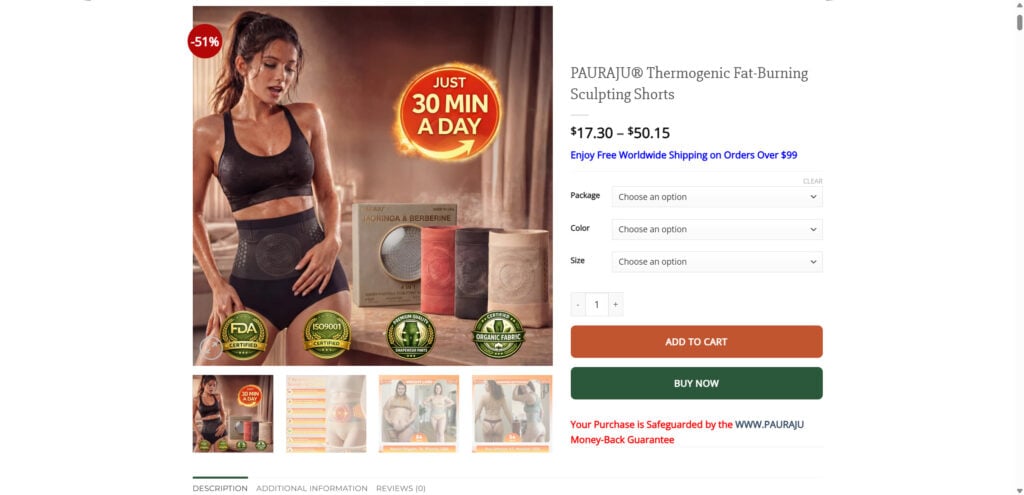
Scam Overview
Pauraju sells the product as PAURAJU Thermogenic Fat-Burning Sculpting Shorts, with prices ranging from $17.30 to $50.15 depending on package, size, and color. The product page claims the shorts use thermogenic fabric, zeolite micro-dots, infused ingredients such as moringa and berberine, and “nano-level bioactive permeation” to activate metabolism and burn fat through skin contact.
That is an extremely aggressive pitch for a pair of shaping shorts.
The site does not simply claim compression or sweat support. It claims the shorts can:
- activate fat burning within minutes
- reduce stubborn fat
- firm sagging skin
- stimulate circulation
- release berberine and moringa through the fabric
- support blood sugar and metabolism
- simulate HIIT-like biochemical effects
- help with bloating, edema, and body contouring
Those claims go far beyond normal shapewear.
What Pauraju Claims
The product page claims the shorts can:
- simulate a high-intensity metabolic state
- support circulation activation
- help the body use fat as energy more efficiently
- reduce stubborn fat areas
- improve skin laxity
- create a firmer and smoother body contour
- start “fat-burning activation” in 5 minutes
- deliver a full 30-minute effective cycle
- work without extra high-intensity workouts
The page also says the shorts are backed by ISO 9001 and GMP certification, evaluated by “40+ experts,” and recognized with a “2026 Thermogenic Fat-Burning Technology Innovation Award.” However, the page does not clearly show independent proof, a certifying body, a certificate number, the names of experts, or a verifiable award source.
Major Red Flags
1. The weight-loss claims are unrealistic
The central claim is that wearing shorts can trigger fat burning, reshape the body, and firm loose skin with little effort.
That is exactly the type of claim consumers should treat with caution.
The FTC warns that claims suggesting people can lose weight without changing habits are not true. It specifically says promises that weight loss can happen simply by using a product instead of making real lifestyle changes are a warning sign.
Pauraju’s pitch relies on the same idea: wear the shorts, feel warmth, and supposedly activate fat burning.
That is not how meaningful fat loss works.
A garment may make you sweat. It may compress the body temporarily. It may make the stomach look flatter while worn. But that is not the same as burning deep fat, reversing loose skin, or reshaping the body long term.
2. The “ingredient-infused fabric” story sounds like recycled slimming-shapewear marketing
Pauraju claims the shorts contain moringa, berberine, zeolite, green tea extract, curcumin, white kidney bean extract, and even “Irisin,” described as an exercise hormone. The page says these ingredients are embedded into the fabric and released through skin contact to activate metabolism, fat oxidation, blood sugar regulation, detoxification, and skin tightening.
This is extremely similar to past “slimming shapewear” claims regulators have already challenged.
The FTC previously charged companies over caffeine-infused shapewear claims, saying the marketers falsely claimed garments could reduce cellulite, shrink body measurements, destroy fat cells, and slim the body. The companies had to settle and pay refunds.
The same logic applies here: if a garment claims embedded ingredients can burn fat or reduce body size, the seller needs serious scientific proof.
Pauraju does not show that proof.
3. The product claims “transdermal” effects without evidence
The site says active compounds are released through skin contact and penetrate deep into the adipose layer to “reboot metabolism at a molecular level.”
That is a very strong claim.
To support it, a seller would need evidence showing:
- the ingredients are actually present in the fabric
- the ingredients remain active after manufacturing and washing
- they are released in meaningful quantities
- they penetrate human skin deeply enough to affect fat tissue
- they produce measurable fat loss in controlled human studies
- the exact Pauraju product was tested, not just unrelated ingredients
None of that is clearly provided on the product page.
Instead, the site uses technical-sounding language that makes the shorts seem scientific without showing product-specific proof.
4. The testimonials are extreme and highly emotional
The page includes long “customer” stories claiming major body changes, weight loss, reduced bloating, firmer stomachs, smoother skin, improved confidence, and even stretch marks fading or disappearing. One testimonial claims visible changes by day 3 and major transformation after 12 weeks. Another claims stretch marks started fading by day 15 and vanished after a month and a half.
These stories read less like normal product reviews and more like sales copy.
They are also attached to major body-transformation claims that a pair of shorts should not be expected to deliver.
If a product review implies typical weight-loss or body-sculpting results, the seller should have reliable evidence that most buyers can expect similar outcomes. The FTC’s health-products guidance says health-related advertising claims must be truthful, not misleading, and supported by science.
5. The page claims strong review credibility, but the product has zero reviews
This is one of the clearest contradictions.
The site header repeatedly claims a “99% positive review rate.” But the product page’s own review section says “There are no reviews yet” and invites users to be the first to review the product.
That is a major trust problem.
A site cannot convincingly claim huge positive review performance while the actual product review tab shows zero reviews.
6. The wording looks broken and template-like
Several parts of the product page appear rushed or poorly assembled.
Examples include:
- image alt text showing unrelated or broken wording such as “beevyne”
- headings like “How Does ® — – & – Work?”
- repeated brand-symbol formatting instead of a clean product name
- overlong scientific-sounding sections with unclear grammar
- exaggerated medical-style copy written like a sales script
This does not prove fraud by itself, but it strongly suggests the page was assembled quickly using copied or generated materials.
That is common in dropshipping stores.
7. The return policy makes refunds difficult
Pauraju’s customer service page says refunds are only provided under limited circumstances such as damaged goods, wrong items, or orders that do not arrive within 45 business days.
The delivery policy is more restrictive. It says customers must request a return within 14 days of receiving the order, the item must be unused, unwashed, in perfect condition, with original packaging, and the buyer is responsible for return shipping. Original shipping charges are not refunded.
That means if you wear the shorts and discover they do not burn fat, do not fit well, or do not match expectations, getting a refund may be difficult.
8. Shipping from China creates return friction
The site states that orders are shipped from China and the US. It also says buyers are responsible for return shipping costs.
This is important.
If the return address is overseas, the cost of returning the product may be close to or higher than the value of the order. That makes the refund promise practically weak even if a return is technically allowed.
For many buyers, this turns the purchase into a one-way transaction.
9. Cancellations are not allowed after purchase
The delivery policy says buyers are not allowed to cancel purchases after orders are placed. It also says changes must be made within 24 hours and before fulfillment.
That is another risk.
Dropshipping stores often process orders quickly on paper, making cancellations difficult even if the item has not actually shipped yet.
10. The “7-day money back guarantee” conflicts with the product page promise
The product page says the purchase is protected by the Pauraju money-back guarantee. But the delivery policy calls it a 7-day money-back guarantee and then limits refund eligibility to specific reasons such as damage, wrong item, missing parts, website error, or fit issues.
That does not sound like a broad satisfaction guarantee.
It sounds like a limited defect-based return system.
What You Are Probably Buying
If the product arrives, you are likely getting:
- basic compression or shaping shorts
- stretchy synthetic fabric
- possible warming or sweating effect
- temporary smoothing while worn
- no proven fat-burning mechanism
- no reliable evidence of skin tightening or cellulite reduction
You are probably not buying:
- a medical-grade fat-burning garment
- a product that melts stubborn fat
- transdermal berberine therapy
- a substitute for exercise or nutrition changes
- a proven body-contouring treatment
- a guaranteed way to reduce stretch marks or sagging skin
The most realistic benefit is temporary compression and sweating.
That is very different from actual fat loss.
Why This Operation Looks Like Dropshipping
The pattern is familiar
Pauraju shows several typical dropshipping indicators:
- generic imported-product setup
- broad worldwide shipping claims
- orders shipped from China and the US
- aggressive discounting
- limited refund conditions
- buyer-paid return shipping
- emotional testimonials
- exaggerated health and body claims
- broken/template-like page elements
The site may ship a product. That does not mean the product is worth the claims.
The business model is simple
The likely model is:
- Source low-cost shapewear or slimming shorts.
- Add a premium “thermogenic fat-burning” story.
- Use scientific-sounding terms like zeolite, berberine, irisin, micro-particles, and metabolic activation.
- Add emotional testimonials.
- Sell multi-packs.
- Make returns difficult through strict eligibility and return shipping costs.
That is a standard high-margin ecommerce funnel.
Is Pauraju Thermogenic Fat-Burning Sculpting Shorts a Scam?
Not necessarily a fake-product scam
A buyer may receive shorts.
The product may exist as a physical item.
But the marketing is highly questionable
The main concerns are:
- unrealistic fat-burning claims
- no visible product-specific clinical proof
- ingredient-infused fabric claims that sound unsubstantiated
- testimonials that appear exaggerated
- contradiction between “99% positive review rate” and “no reviews yet”
- shipping from China and the US
- buyer-paid return shipping
- strict refund eligibility
- no cancellations after purchase
The most accurate classification is:
Pauraju Thermogenic Fat-Burning Sculpting Shorts appear to be a high-risk dropshipping-style shapewear product promoted with exaggerated weight-loss and body-sculpting claims.
Should You Buy It?
For most buyers, caution is warranted.
Reasons to avoid it
- Wearing shorts will not meaningfully burn fat by itself.
- The transdermal ingredient claims are not backed by visible evidence.
- The product page makes claims that resemble previously challenged slimming-garment claims.
- The review signals are inconsistent.
- Returns may be costly or impractical.
- Refund eligibility is limited.
- The product is sold with weight-loss claims that sound too good to be true.
If you still want shapewear
Buy it as compression clothing only.
Do not buy it expecting:
- targeted fat loss
- cellulite elimination
- stretch mark removal
- collagen repair
- rapid metabolism activation
- weight loss without diet or exercise
- medical or therapeutic benefits
What To Do If You Already Ordered
1. Save the product page immediately
Take screenshots of:
- “thermogenic fat-burning”
- “fat-burning activation starts in 5 minutes”
- “no extra effort needed”
- “Moringa and Berberine” fabric claims
- “Irisin” claims
- “stubborn fat” claims
- “stretch mark” or skin-firming testimonials
- money-back guarantee
- return policy
- checkout total
These screenshots matter if the product does not match the advertising.
2. Check the order details
Confirm:
- quantity ordered
- size selected
- color selected
- package selected: 1PC, 3PCS, or 5PCS
- shipping charge
- merchant name on your receipt
- payment processor
Multi-pack selection can increase the total quickly.
3. Try to cancel immediately if needed
The policy says buyers are not allowed to cancel after orders are placed, but if you ordered by mistake, email support immediately anyway and save the message.
4. Inspect the product before wearing it
When it arrives, check:
- size
- stitching
- fabric quality
- odor
- labels
- care instructions
- whether it matches the photos
- whether ingredient or certification claims appear on packaging
Do not wash or wear it if you plan to return it, because the return policy requires unused and unwashed condition. (Pauraju)
5. Start a return quickly
The return window is short. The policy says returns must be requested within 14 days of receiving the order and returned within 7 days if accepted. (Pauraju)
Send a direct message:
I am requesting a return for order #[number]. The product does not match the advertised claims and expectations. Please provide the return address, return instructions, and refund timeline in writing.
6. Be prepared for return shipping costs
The policy says the buyer pays return shipping and original shipping charges are not refunded. (Pauraju)
If the return address is overseas, returning the item may not be financially practical.
7. Dispute the charge if necessary
If the product never arrives, support refuses a reasonable return, the product is materially different from the page, or refund terms are not honored, contact your payment provider.
Use evidence showing:
- what was advertised
- what arrived
- the refund policy
- your support emails
- tracking details
- photos of the product
The Bottom Line
Pauraju Thermogenic Fat-Burning Sculpting Shorts are not a proven fat-loss technology.
They appear to be compression or shaping shorts sold through a high-risk dropshipping-style store using exaggerated claims about thermogenesis, transdermal ingredients, metabolism, skin tightening, cellulite reduction, and body contouring.
The product may arrive.
But the claims are the issue.
The safest conclusion is simple:
Pauraju Thermogenic Fat-Burning Sculpting Shorts look like a dropshipping shapewear product promoted with unrealistic fat-burning claims and a return policy that may make refunds difficult, especially if customers are required to pay international return shipping.








