

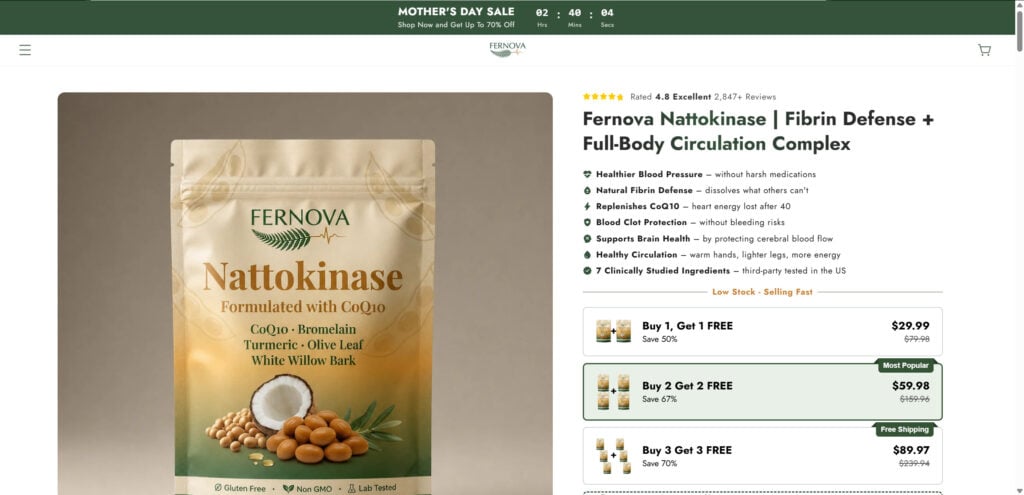
Fernova Nattokinase is promoted as a “Fibrin Defense + Full-Body Circulation Complex” designed to support blood pressure, circulation, heart energy, fibrin balance, and cardiovascular wellness.
The product page looks polished and uses scientific language, customer stories, and a 90-day guarantee to build trust. But the marketing also raises serious red flags, especially around blood pressure claims, clot-related language, aggressive testimonials, subscription billing, and refund conditions.
This review breaks down what Fernova claims, what the product actually appears to be, and what buyers should know before ordering.
Overview
Fernova sells Fernova Nattokinase – 120 Softgels for $39.99. The product is marketed as a 7-in-1 cardiovascular support formula with 4,000 FU nattokinase, 50mg CoQ10, bromelain, turmeric, ginger, olive leaf, and white willow bark. The page claims the product supports healthier blood pressure, natural fibrin defense, blood clot protection “without bleeding risks,” brain health, circulation, and heart energy.
That is a very strong claim stack for a dietary supplement.
The concern is not that nattokinase is fake. Nattokinase is a real enzyme derived from natto, a Japanese fermented soybean food. The issue is that Fernova’s marketing pushes the product into serious cardiovascular territory: blood pressure readings, arterial plaque, fibrin, blood clots, cholesterol, blood flow, long COVID brain fog, and even testimonials involving prescription drugs like Losartan, Eliquis, and statins.
That makes this product a high-risk supplement funnel, even if the capsules themselves exist.
What Fernova Claims
The site claims Fernova can support:
- Healthier blood pressure
- Natural fibrin defense
- Blood clot protection
- Brain health through cerebral blood flow
- Healthy circulation
- Warmer hands and lighter legs
- Heart energy through CoQ10
- Arterial support
- Blood pressure improvements within weeks
The product page also claims nattokinase has “200+ studies and 15+ clinical trials,” mentions a study where arterial plaque was reduced by 36.6%, and says nattokinase lowered systolic blood pressure by 5.55 mmHg in 8 weeks.
This is where the marketing becomes concerning. Referencing ingredient studies is not the same as proving that this exact Fernova product produces the results implied on the sales page.
Major Red Flags
1. The claims go far beyond normal supplement support
Fernova does not simply say it “supports heart health.”
It uses much stronger language, including:
- “dissolves what others can’t”
- “blood clot protection”
- “your arteries need clearing”
- “clear the buildup”
- “blood pressure support”
- “dissolves excess fibrin that thickens blood and stiffens arteries”
Those phrases create a medical-level impression. They suggest the product may affect clotting, arterial buildup, blood pressure, and circulation in meaningful ways.
That matters because cardiovascular conditions are not casual wellness issues. Blood pressure, blood clot risk, arterial plaque, and circulation problems should be handled with medical supervision, not through a social-media supplement funnel.
2. “Blood clot protection without bleeding risks” is especially concerning
One of Fernova’s front-page bullets says “Blood Clot Protection – without bleeding risks.”
That is a serious red flag.
Nattokinase may affect fibrin and clot-related pathways. Memorial Sloan Kettering notes that nattokinase may increase bleeding risk when used with anticoagulant, antiplatelet, and fibrinolytic drugs, and it specifically warns that patients with coagulation disorders or those using anticoagulant drugs should not take it.
So the phrase “without bleeding risks” is not something buyers should accept casually.
Anyone taking aspirin, Eliquis, Xarelto, warfarin, Plavix, heparin, NSAIDs, blood pressure medication, or preparing for surgery should speak with a doctor before using nattokinase.
3. The testimonials imply medical outcomes
Fernova’s customer stories go much further than ordinary supplement reviews.
Examples on the product page include people claiming:
- blood pressure dropped from around 148/92 to 128/79 and 125/81
- they were on Eliquis after a clot scare and later tried Fernova with a doctor
- cholesterol dropped 23 points after statin problems
- brain fog after COVID improved
- blood pressure dropped from 142/88 to around 122/76
- a doctor asked what changed
These testimonials are highly persuasive because they imply real cardiovascular improvement.
But testimonials are not clinical proof. The FTC says health-related claims must be truthful, not misleading, and supported by science. That applies not only to direct claims, but also to implied claims made through testimonials and endorsements.
If a testimonial suggests typical results, the seller should have strong evidence that buyers can generally expect those results.
4. The “clinical-strength dose” framing may exaggerate the product
Fernova claims it delivers 4,000 FU per serving, calling it “clinical-strength,” and says most nattokinase supplements use 2,000 FU or less.
That sounds impressive, but “more” does not automatically mean “better” or “safer.”
With an ingredient that may affect clotting, dose matters. A higher-dose product may not be appropriate for everyone, especially people already taking cardiovascular medication or blood-thinning drugs.
The marketing frames the higher dose as a benefit. Buyers should also view it as a safety consideration.
5. “Third-party tested” is claimed, but proof is not clearly shown
Fernova says every batch is third-party lab tested for purity and potency.
That sounds reassuring, but the product page does not clearly show:
- the lab name
- certificate of analysis
- lot number
- test date
- heavy metal results
- microbial testing
- enzyme activity verification
- full batch-specific documentation
Without accessible proof, “third-party tested” remains a trust phrase, not verification.
For a cardiovascular supplement making fibrin, blood pressure, and clot-related claims, visible testing documentation should be expected.
6. The product page uses scarcity pressure
Fernova’s page includes a “Low Stock Notice” and says its “Nagano-fermented nattokinase sold out 12 times last year.” It also warns buyers not to purchase counterfeits on Amazon or eBay.
That is classic scarcity marketing.
It pushes customers to buy quickly before comparing alternatives, researching safety, or reading the refund and subscription policies.
This does not prove the product is fake. But it does show the page is designed as a high-conversion sales funnel.
7. Subscription billing is part of the store structure
Fernova has a “Manage Subscription” link in the navigation, and its subscription policy says subscription products renew automatically every 28 days at the checkout rate. It also says customers must cancel at least 24 hours before the next billing date to avoid a renewal charge.
That creates a real subscription risk.
Even if a buyer intends to place a one-time order, they should carefully check the checkout page for:
- subscription selection
- monthly refill
- auto-renew
- recurring billing
- subscribe and save
- next billing date
- payment authorization language
The policy also says that once a renewal order enters the fulfillment queue, it cannot be cancelled, though the company may offer a return option or a 15% goodwill refund.
That is exactly the kind of setup that can lead to unwanted repeat shipments if a customer misses the cancellation window.
8. The refund promise has conditions
The product page says customers can try Fernova for 90 days and get every penny back, “no questions asked.”
But the refund policy is more detailed.
For unopened products, Fernova says items must be unopened, unused, sealed, and in original packaging. For opened products, the 90-day satisfaction guarantee requires the customer to have used the product consistently for at least 14 days, applies only to the first order, is limited to one refund per household, and excludes taste or subjective preference concerns.
That is not necessarily the worst policy, but it is not as simple as the front-end “no questions asked” message suggests.
9. Cancellations have a very short window
Fernova’s refund policy says orders can be cancelled only within 3 hours of being placed. After that, orders enter fulfillment and cannot be cancelled.
That is a narrow cancellation window.
If a buyer accidentally orders, selects the wrong option, or misses that a subscription was active, they may have very little time to fix the issue before shipment.
10. FDA approval should not be assumed
Fernova is sold as a dietary supplement. The FDA explains that dietary supplements are not approved by the FDA for safety and effectiveness before they are marketed. The FDA also states that supplement claims must include a disclaimer that the product is not intended to diagnose, treat, cure, or prevent disease because only a drug can legally make those claims.
That distinction matters.
Even if Fernova uses real ingredients and has a professional-looking page, it should not be treated as an FDA-approved treatment for blood pressure, clot prevention, plaque, cholesterol, or circulation problems.
What Fernova Probably Is
Fernova appears to be a real supplement product built around a common cardiovascular supplement trend: nattokinase plus supporting ingredients.
The product may contain:
- nattokinase
- CoQ10
- bromelain
- turmeric
- ginger
- olive leaf
- white willow bark
But the key issue is not whether these ingredients exist. The issue is the marketing.
Fernova is presented as a powerful fibrin-clearing, circulation-supporting, blood-pressure-supporting, artery-focused formula. That kind of positioning can mislead consumers into thinking they are buying something closer to a medical intervention than a supplement.
Why This Type of Funnel Works
It targets real fear
Heart disease, blood pressure, clots, stroke risk, circulation problems, and family history are emotionally powerful topics.
People want to feel proactive.
It uses scientific-sounding language
Terms like fibrin, arterial plaque, blood viscosity, ACE inhibition, and cerebral blood flow make the product sound highly technical and credible.
It uses dramatic testimonials
Stories about doctors noticing changes, blood pressure dropping, cholesterol improving, and people feeling better after years of symptoms make the product feel proven.
It reduces hesitation with a guarantee
A 90-day guarantee makes the purchase feel safe, even though the policy contains important conditions.
It supports recurring purchases
The subscription policy encourages ongoing use and renews every 28 days if a subscription is selected.
That turns a one-time supplement purchase into a potential recurring billing relationship.
Is Fernova Nattokinase a Scam?
Not necessarily a fake-product scam
Fernova likely ships a real supplement. Customers may receive softgels.
But it is high-risk from a marketing and safety standpoint
The concerns are:
- aggressive blood pressure and clot-related claims
- “blood clot protection without bleeding risks” wording
- testimonials implying medical outcomes
- subscription renewal every 28 days if selected
- short 3-hour cancellation window
- refund conditions that are more limited than the sales-page language
- no clearly visible batch-specific lab reports
- safety concerns for people on blood thinners or cardiovascular medication
The most accurate verdict is:
Fernova Nattokinase appears to be a high-risk cardiovascular supplement funnel marketed with strong medical-style claims and subscription mechanics that buyers should inspect carefully.
Should You Buy Fernova?
For most people, caution is warranted.
Reasons to be careful
- The product discusses serious cardiovascular issues.
- Nattokinase may increase bleeding risk in certain situations.
- The claims are stronger than ordinary wellness language.
- The testimonials imply medical results.
- The subscription policy allows automatic renewal every 28 days.
- The cancellation window for regular orders is very short.
- The product should not replace prescribed care.
Do not use it as a substitute for:
- blood pressure medication
- anticoagulants
- antiplatelet medication
- statins
- medical monitoring
- cardiology care
- emergency treatment
- prescribed treatment after blood clots, stroke, or heart attack
Anyone with cardiovascular disease, clotting history, high blood pressure, stroke history, surgery coming up, or medication use should consult a clinician before using nattokinase.
What To Do If You Already Ordered Fernova
1. Check whether you selected a subscription
Look for:
- subscription
- monthly refill
- auto-renew
- recurring billing
- next billing date
- Shop Pay subscription
- manage subscription portal
Fernova’s own policy says subscription products renew automatically every 28 days. (Fernova)
2. Cancel immediately if you did not intend recurring billing
Cancel through the subscription portal and email support.
Save:
- cancellation confirmation
- screenshots from the portal
- email replies
- next billing date removal
- order numbers
3. Review your order quickly
Because the cancellation window is only 3 hours, check the order confirmation immediately after purchase.
Confirm:
- number of bottles
- subscription status
- total charged
- shipping fee
- billing frequency
- merchant name
- payment method
4. Save the product claims
Take screenshots of:
- “blood clot protection”
- “without bleeding risks”
- “dissolves what others can’t”
- blood pressure claims
- plaque claims
- customer testimonials
- 90-day guarantee
- refund policy
- subscription policy
- checkout total
These may help if you need to dispute a charge.
5. Do not stop medication
Do not stop or reduce blood pressure medication, statins, aspirin, anticoagulants, antiplatelet drugs, or any prescribed treatment because of Fernova.
Memorial Sloan Kettering warns that nattokinase may increase bleeding risk with anticoagulant, antiplatelet, and fibrinolytic drugs
6. Watch for side effects
Stop using it and seek medical advice if you notice:
- unusual bruising
- bleeding gums
- nosebleeds
- black stools
- blood in urine
- severe headache
- dizziness
- chest pain
- weakness
- allergic reaction
- shortness of breath
7. Request a refund in writing
Use a clear message:
I am requesting a refund for order #[number]. The product does not match the expectations created by the sales page. Please confirm the refund process, whether a return is required, and the refund timeline in writing.
Keep all replies.
8. Dispute if needed
If you were charged for a subscription you did not intend to select, cannot cancel, were charged again after cancellation, or the refund terms are not honored, contact your bank or payment provider.
Use reasons such as:
- unauthorized recurring charge
- subscription not clearly disclosed
- item not as described
- refund terms not honored
- misleading health claims
The Bottom Line
Fernova Nattokinase may be a real supplement, but the marketing is the concern.
The product is sold with strong cardiovascular claims involving fibrin, blood pressure, circulation, blood clots, brain health, and arterial support. It also uses dramatic testimonials, scarcity language, a 90-day guarantee, and subscription infrastructure that renews every 28 days if selected.
The safest conclusion is simple:
Fernova Nattokinase looks like a high-risk cardiovascular supplement funnel. Buyers should treat the claims cautiously, check for subscription billing before paying, and never use it as a replacement for medical care or prescribed heart, blood pressure, or blood-thinning medication.








