

Joint Caps is promoted as a natural joint-support supplement for people dealing with chronic joint pain, stiffness, inflammation, and reduced mobility.
The sales page presents it as a powerful formula with a long money-back guarantee, thousands of reviews, and bundle discounts. But the way this product is marketed raises serious concerns, especially around exaggerated health claims, expensive multi-bottle offers, refund friction, subscription risks, and reports of buyers receiving or being charged for more bottles than they intended to order.
Overview
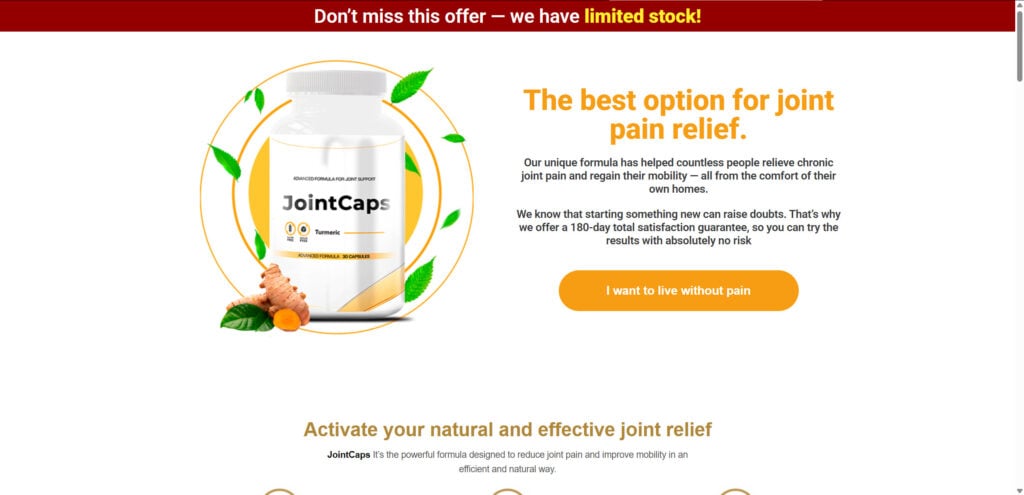
Joint Caps is sold through the site jointcaps.online, which promotes it as “the best option for joint pain relief.” The page claims the formula has helped “countless people” relieve chronic joint pain and regain mobility from home. It also says Joint Caps can reduce persistent pain, improve flexibility, relieve inflammation, boost energy, and support long-term joint and cartilage health.
Those are strong health claims for a dietary supplement.
The product page also uses familiar high-pressure funnel tactics:
- “Limited stock”
- “Only 40 bottles left”
- “Claim your batch while supplies last”
- “If you close this page, you will lose this special offer”
- Large review count: “Based on 18,312 reviews”
- Multi-bottle pricing bundles
- A 180-day satisfaction guarantee
The checkout is handled through Digistore24, with separate offers for 1 bottle at $89, 3 bottles at $177, and 6 bottles at $294.
That setup does not automatically prove fraud. But it is consistent with many supplement funnels that push high-value orders through dramatic claims, urgency messaging, and refund promises that may be harder to use in practice.
What Joint Caps Claims
The site claims Joint Caps can:
- Reduce persistent joint pain
- Target pain in the knees, hips, and back
- Improve joint flexibility
- Relieve inflammation
- Reduce swelling and stiffness
- Support cartilage and long-term joint health
- Improve mobility naturally
- Work without “extreme measures”
- Produce noticeable changes within a few weeks
The site also states that Joint Caps is made with “100% natural ingredients” and manufactured in the USA in an FDA-registered facility following GMP standards.
That sounds reassuring, but buyers should be careful. FDA registration is not the same as FDA approval. The FDA says it does not approve dietary supplements before they are marketed and generally does not approve supplement claims or labeling before use.
Major Red Flags
1. The claims are too strong for a normal supplement
Joint Caps is not marketed as a mild wellness supplement. It is marketed as a solution for chronic joint pain, inflammation, swelling, stiffness, cartilage support, and mobility problems.
That is a serious claim stack.
Joint pain can be caused by many issues, including arthritis, injury, inflammation, autoimmune disease, age-related degeneration, overuse, obesity, nerve pain, or other medical conditions. A supplement cannot be assumed to “relieve chronic joint pain” without strong product-specific evidence.
The FTC says health-related product claims must be truthful, not misleading, and supported by science before they are used in advertising.
2. “Relieves inflammation” is a medical-style claim
The page says Joint Caps relieves inflammation and reduces swelling and stiffness
That matters because inflammation is not just a vague wellness term. It can be part of real medical conditions, including arthritis and autoimmune joint disease.
A supplement page can use general structure/function language, but when the advertising creates the impression that the product treats pain, inflammation, or mobility limitations, buyers should ask for real clinical proof.
3. The review count is difficult to verify
Joint Caps claims it is “Based on 18,312 reviews.”
That is a huge number for a product with limited visible brand transparency.
The issue is not simply that a product has reviews. The issue is that the reviews appear to be part of the seller-controlled landing page. The page does not clearly show an independent review platform, verified purchase history, or transparent review sourcing.
Large review counts are commonly used in supplement funnels because they create fast trust.
But seller-hosted review numbers are not proof.
4. The site pushes expensive multi-bottle bundles
The product page presents three buying options:
- 1 bottle for $89 plus shipping
- 3 bottles for $177 with free shipping
- 6 bottles for $294 with free shipping
The site labels the 6-bottle package as “Best Value” and recommends ordering a 3- or 6-month supply for the “best experience and results.”
This is a common funnel strategy.
Instead of encouraging buyers to try one bottle cautiously, the page pushes larger orders before the buyer knows whether the product works, whether the formula agrees with them, or whether returns will be easy.
5. Reports of buyers receiving more bottles than expected
A recurring complaint pattern with these supplement funnels is that people believe they selected a smaller package but later discover they were charged for more bottles than intended.
This can happen through:
- preselected package options
- confusing bundle layouts
- “best value” buttons
- checkout upsells
- order bumps
- post-purchase offers
- unclear final totals
With Joint Caps, the product is sold through separate 1-, 3-, and 6-bottle checkout options. Buyers should carefully verify the final package and total before paying.
If someone intended to buy one bottle but ends up with three or six, getting a refund may be much more difficult than expected.
6. Subscription and recurring-billing risk
The visible Joint Caps page does not clearly present itself as a subscription-only product. However, users report unwanted subscription-style charges with products sold through similar supplement funnels.
Because the checkout runs through Digistore24, buyers should watch carefully for any recurring billing, rebilling, installment, or subscription language before paying. Digistore24’s own help center explains that subscription products can have minimum terms and that cancellation may stop payments only after the minimum term has expired, depending on the setup.
This does not prove every Joint Caps order is a subscription. It means buyers must inspect the checkout carefully before entering payment information.
Look for words like:
- subscription
- rebilling
- recurring
- auto-renewal
- monthly
- installment
- payment plan
- minimum term
- future charges
7. The guarantee sounds stronger than the real-world return process may be
Joint Caps advertises a 180-day satisfaction guarantee and says customers can “return everything within 180 days” to receive every penny back, with “no fine print.”
That sounds simple.
But buyers should be cautious with any supplement that requires physical returns, especially if reports indicate products ship from overseas or require return shipping to China. In practice, refund problems often happen when:
- the seller requires bottles to be returned
- return shipping is expensive
- used bottles are disputed
- support replies slowly
- return instructions are unclear
- the customer is asked to pay international postage
- the refund window is consumed by delays
Digistore24 also explains that product return periods can vary and that return periods do not apply the same way to subscription products.
8. “FDA-registered facility” can mislead buyers
The site says Joint Caps is manufactured in an FDA-registered facility following GMP.
That may sound like the FDA reviewed or approved the product. But dietary supplements are not approved by the FDA before marketing, and firms are responsible for ensuring their products and claims comply with the law
So this wording should not be treated as proof that Joint Caps is effective for joint pain, inflammation, or cartilage repair.
9. The “natural and safe” claim is too broad
The page says Joint Caps is “100% natural and safe
That is not a meaningful safety guarantee.
Natural ingredients can still cause:
- allergic reactions
- stomach upset
- medication interactions
- blood-thinning effects
- liver or kidney concerns
- problems for people with chronic illness
Anyone taking blood thinners, anti-inflammatory medication, diabetes medication, blood pressure medication, immune-related medication, or other supplements should be cautious before using any joint formula.
10. The “product from China” concern
According to buyer reports and supplier-pattern comparisons, this product appears to be part of a broader private-label/dropshipping supplement model where similar capsules are sourced cheaply, rebranded, and sold through high-pressure pages.
That does not automatically mean every bottle is fake. But it does raise questions:
- Who actually manufactures it?
- Where is it made?
- Is the label accurate?
- Are the ingredients tested?
- Is there a certificate of analysis?
- Is the return address domestic or overseas?
- Who is responsible if there is a problem?
If a supplement claims to be made in the USA but customers report overseas fulfillment or China-based returns, that gap deserves scrutiny.
How This Operation Appears to Work
Step 1: Target people in pain
The page focuses on chronic joint pain, stiffness, swelling, back pain, knee pain, hip pain, and reduced mobility.
These are emotional problems. Buyers want relief quickly.
Step 2: Present the supplement as natural and low-risk
The page says the product is natural, safe, and made in an FDA-registered facility.
That reduces hesitation.
Step 3: Use large review numbers
The page claims more than 18,000 reviews.
That makes buyers feel the product is already widely trusted.
Step 4: Push multi-bottle packages
The page recommends a 3- or 6-month supply and presents the 6-bottle option as the best value.
That increases the order amount.
Step 5: Use urgency messaging
The page says there is limited stock, only 40 bottles left, and that closing the page means losing the special offer.
That pressures buyers to act quickly.
Step 6: Make refunds harder after purchase
Once the buyer has paid, the practical refund process may involve contacting support, returning bottles, waiting for approval, and potentially dealing with expensive return shipping.
That is where many buyers get stuck.
Is Joint Caps a Scam?
Not necessarily a fake-product scam
Joint Caps may ship a physical product. A buyer may receive bottles of capsules.
But it is high-risk
The main concerns are:
- exaggerated joint pain and inflammation claims
- huge seller-controlled review numbers
- expensive multi-bottle bundles
- “limited stock” pressure
- unclear manufacturer transparency
- reports of products from China
- reports of difficult refunds
- risk of unwanted subscriptions or recurring charges
- risk of receiving or being charged for more bottles than intended
The most accurate verdict is:
Joint Caps appears to be a high-risk joint supplement funnel sold with aggressive health claims, bundle pressure, and refund or billing risks that buyers should not ignore.
Should You Buy Joint Caps?
For most people, caution is warranted.
Reasons to avoid it
- The product claims are stronger than the evidence shown on the page.
- The review count is not independently verified.
- The page pushes 3- and 6-bottle bundles.
- Joint pain may require medical diagnosis.
- Refunds may be difficult if return shipping is required.
- Subscription or rebilling language must be checked carefully.
- Reports suggest buyers may receive more bottles than expected.
If you still consider buying it
Do not treat Joint Caps as a replacement for:
- arthritis medication
- physical therapy
- doctor-prescribed treatment
- joint injections
- medical evaluation
- imaging or lab testing
- lifestyle changes recommended by a clinician
If your pain is severe, sudden, one-sided, worsening, associated with swelling, fever, injury, numbness, weakness, or inability to walk, get medical advice instead of relying on an online supplement.
What To Do If You Already Ordered Joint Caps
1. Check how many bottles you were charged for
Immediately review:
- order confirmation
- checkout receipt
- payment statement
- package selected
- total charged
- shipping fee
- taxes
- add-ons
Confirm whether you bought 1, 3, or 6 bottles.
2. Check for subscription or rebilling terms
Look for:
- recurring payment
- subscription
- installment
- rebilling
- auto-renew
- payment plan
- next billing date
- future charges
If any recurring billing appears, cancel immediately and save proof.
3. Save all evidence
Take screenshots of:
- pain relief claims
- inflammation claims
- cartilage claims
- 180-day guarantee
- limited stock warnings
- review count
- product pricing
- checkout total
- emails with support
This helps if you need to dispute the purchase.
4. Do not open all bottles
If you received multiple bottles and want a refund, keep as many bottles sealed as possible.
Some sellers dispute refunds if bottles are opened or used.
5. Request cancellation or refund quickly
Send a clear message:
I am requesting cancellation/refund for order #[number]. I did not intend to purchase this quantity / I do not want any subscription or recurring billing. Please confirm cancellation, refund status, return address, and refund timeline in writing.
Keep all replies.
6. Be careful with return shipping to China
If the seller requires international return shipping, calculate the cost first.
If return postage is nearly as expensive as the refund, document that. This may help with a payment dispute.
7. Contact Digistore24 if the order used their checkout
If your receipt shows Digistore24, use their order support system and provide the order ID. Their checkout pages show Joint Caps products being processed through Digistore24.
8. Dispute the charge if needed
If you were charged for more bottles than ordered, enrolled in recurring billing without clear consent, denied a reasonable refund, or forced into impractical return shipping, contact your bank or payment provider.
Use reasons such as:
- item not as described
- misleading advertising
- unauthorized recurring charge
- charged for more items than ordered
- refund terms not honored
FAQ About Joint Caps
Is Joint Caps a scam?
Joint Caps may not be a fake-product scam where nothing ships. The concern is that it appears to be marketed through a high-risk supplement funnel using strong joint pain claims, large review numbers, urgency tactics, and multi-bottle pricing.
Does Joint Caps really relieve joint pain?
The site claims it can reduce persistent pain, improve flexibility, and relieve inflammation. However, the page does not provide enough product-specific clinical evidence to prove those results for typical buyers.
Is Joint Caps FDA approved?
No dietary supplement should be assumed to be FDA approved. The FDA says it does not approve dietary supplements before they are marketed and generally does not approve supplement claims before use.
Why are there 3-bottle and 6-bottle offers?
This is common in supplement funnels. Larger bundles increase the order value and are often presented as the “best value” or recommended supply.
Can I get charged for more bottles than I wanted?
That risk exists with confusing checkout funnels. Always verify the final package, quantity, and total before paying.
Is there a subscription risk?
The visible sales page is bundle-focused, but buyers should inspect the checkout carefully for subscription, installment, or rebilling terms. Reports of unwanted recurring charges are common with similar supplement funnels.
Are refunds easy?
The site advertises a 180-day guarantee, but actual refunds may depend on return instructions, bottle condition, shipping costs, and support response. If returns require shipping back to China, refunds may become impractical.
Should I use Joint Caps instead of arthritis medication?
No. Do not replace prescribed medication or medical care with an online supplement.
The Bottom Line
Joint Caps is not clearly a “nothing arrives” scam. Buyers may receive capsules.
The problem is the sales model.
The product is promoted with strong joint pain, inflammation, mobility, and cartilage claims, while the site uses limited-stock pressure, large review numbers, expensive bundle pricing, and a broad 180-day guarantee that may be harder to use in practice.
The safest conclusion is simple:
Joint Caps looks like a high-risk joint supplement funnel sold with exaggerated claims and buyer-risk issues, including difficult refunds, possible subscription concerns, and reports of customers receiving or being charged for more bottles than intended.








