


The Forever Living pitch might reach you in a friend’s inbox or an old group chat. It can sound less like a job offer than a favor.
Before you count on those earnings, see what a federal order says you can ask for. The answer is more useful than another distributor’s success story.
Overview
The FTC case was about income, not aloe
Forever Living sells aloe drinks and other products. The case brought by the Federal Trade Commission concerns something different: the money people were led to expect from the business opportunity.
Participants in that opportunity were known as Forever Business Owners, or FBOs. The title made them sound like established retailers even when they had only just joined.
The FTC’s case record names two Forever Living companies and officers Gregg Maughan and Aidan O’Hare. It does not accuse shoppers of doing anything wrong by buying products.
It also does not tell you whether a particular aloe drink is good value. The regulator was looking at how people were recruited and what they were told about profit.
What the complaint alleged about typical results
The FTC said people were encouraged to see the program as a flexible way to bring in extra money. That impression mattered even when a specific salary wasn’t promised.
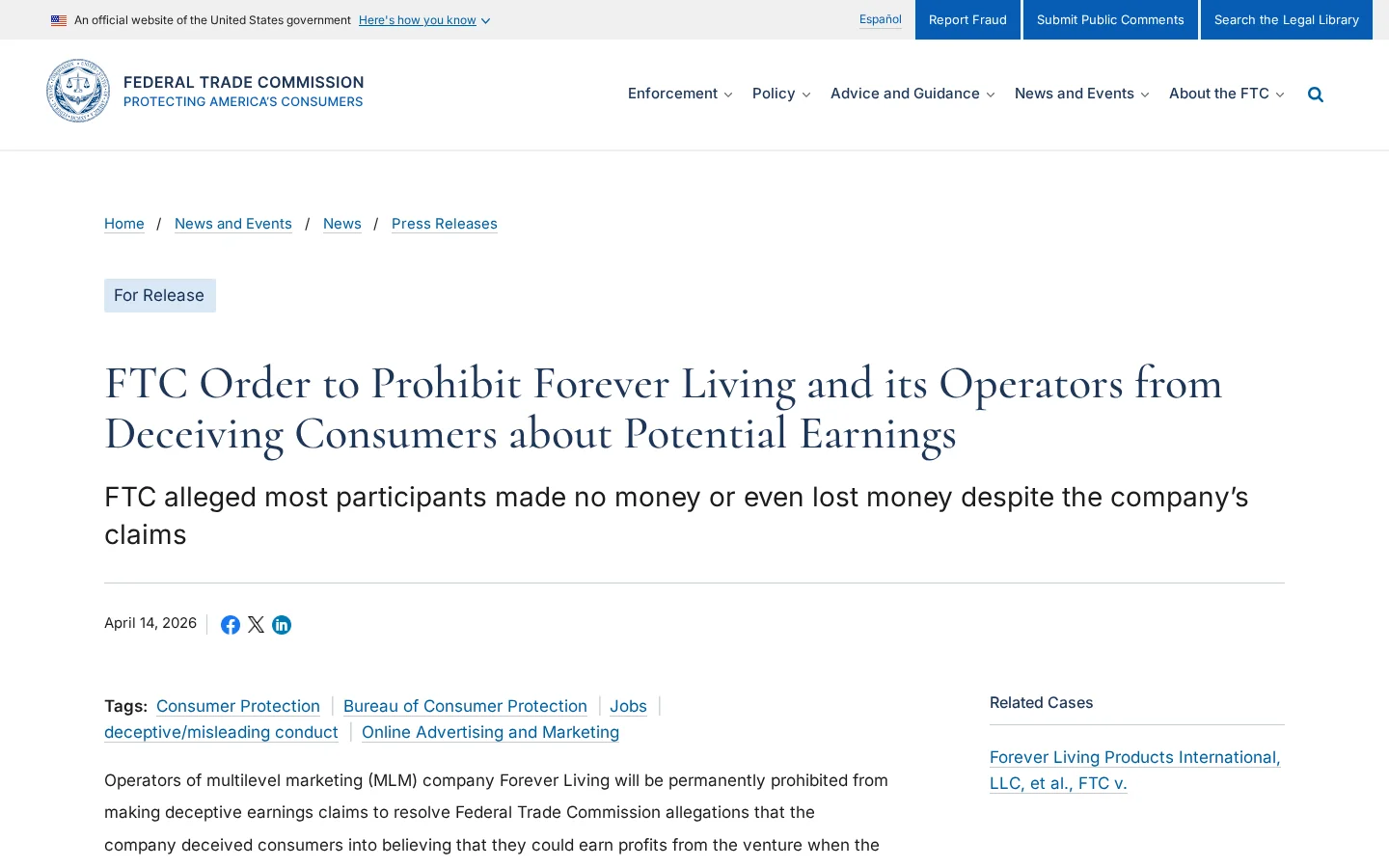
According to the FTC’s April 2026 announcement, most participants made nothing or lost money. The agency made that allegation in its civil complaint.
That allegation should make you ask about the quiet accounts. The recruiter sharing a commission screenshot has little reason to show the person who bought stock and made no sales.
It is easy to mix up three different measures when somebody says their team is doing well:
- Retail sales: What customers paid before the seller’s product costs, refunds, shipping and other expenses came out.
- Company payments: What the distributor received from the compensation plan, which may not include separate direct retail income.
- Net profit: What remains after the expenses needed to earn that income, not the amount on a commission screen.
What the court order changed
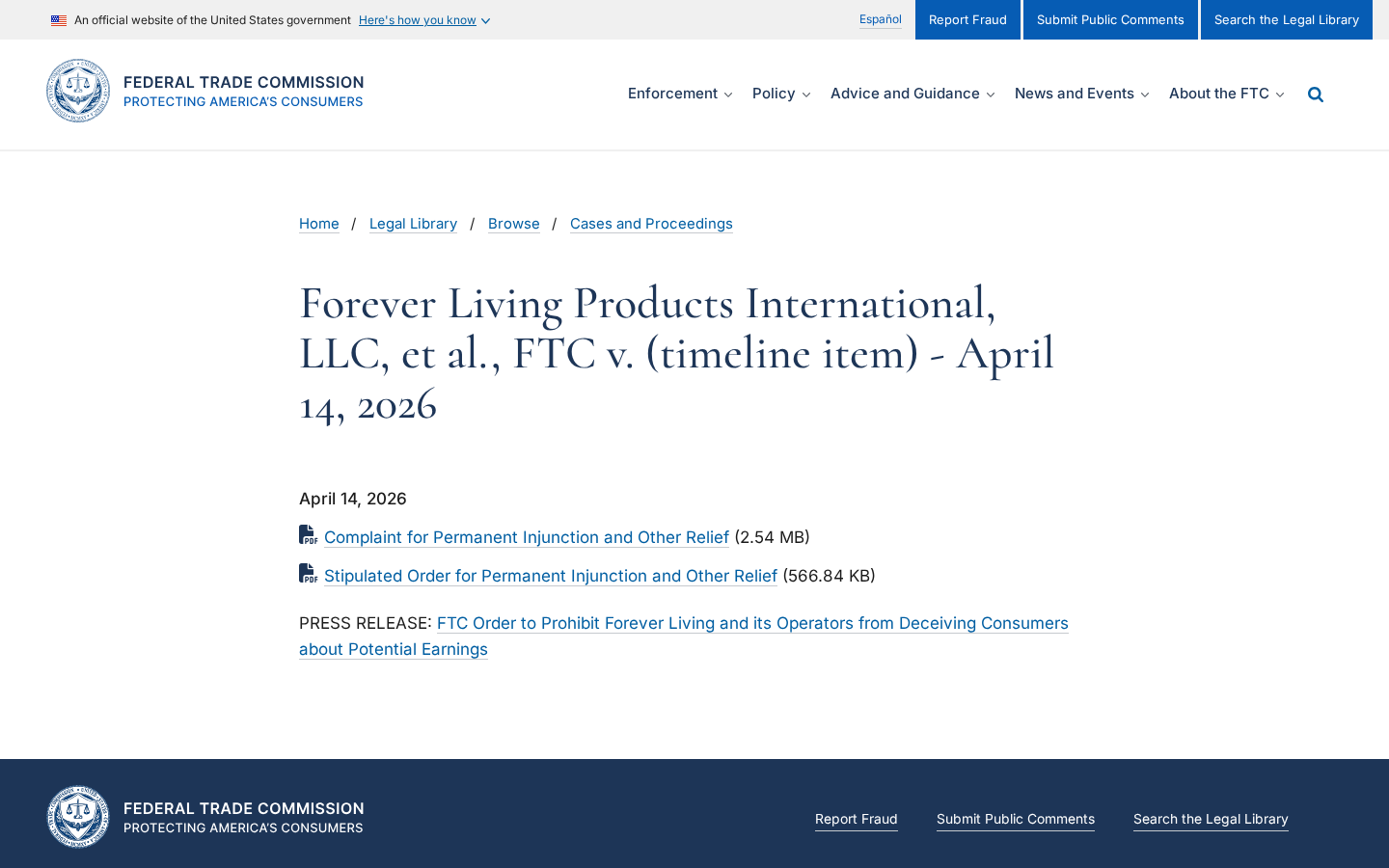
The FTC’s federal litigation status report says the permanent injunction was entered on April 20, 2026. The April 14 announcement describes the proposed terms before that entry.
The distinction matters because the public announcement and the signed agreement are not the same as an order becoming effective in court.
The injunction sets rules for earnings representations and requires written support for covered claims. The stipulated order also sets out a notice to eligible United States participants.
It is not a criminal conviction. Nor is it a declaration that every person who sold a product made a deceptive claim.
How the Forever Living Earnings Pitch Worked
Step 1: You are shown a flexible way to earn on the side
The FTC described recruiting that positioned the program as flexible extra income. That is an attractive promise if family commitments or another job make fixed shifts unrealistic.
The pitch can feel especially credible when it comes from someone you already know. A person you trust may be recounting a training message rather than inventing a claim.
Neither familiarity nor sincerity tells you how many people make enough to cover their costs. That is a question about outcomes, not a judgment about your friend.
Try writing down what the offer led you to expect before looking for a disclaimer. If you heard reliable extra income, a distant possibility was not the impression you received.
Step 2: The story you hear leaves little room for inactive accounts
People who earn a bonus have something to post. Participants who never qualify usually disappear from the conversation without sharing their expenses or the hours they spent trying.
Ask whether the earnings chart includes every person invited to start a business, only active sellers or only people who received a payment. Those definitions can yield very different averages.
For an illustration, imagine ten people signed up and two received $200. A chart that averages those two checks says $200. Across all ten, company payouts averaged $40.
Neither number tells you what sellers kept. If the hypothetical sellers paid for delivery, samples or promotion, those costs still matter even if none appears on the platform’s report.
Ask how long it took participants to qualify. A chart of what people got in one payment period won’t tell you how much they spent getting there.
Step 3: Money comes in, but the expenses are on a different screen
A distributor might produce an authentic payment screenshot without misrepresenting the amount paid. The trouble starts when the audience is encouraged to read it as take-home income.
Check what was purchased for resale, what was given away, what was returned and what remains unused. If it is sitting in your closet, it has not become revenue.
Use the card or checking account you actually used. A back-office report may show credited sales while your bank statement shows the costs incurred to get them.
It may make sense to keep household purchases in a separate category from business stock. Keep the original receipts so you can explain your decision if questioned later.
Step 4: An official notice explains the new limits
Under the order, Forever Living had to notify certain United States participants who had engaged with the business since January 1, 2023.
The covered group includes people who bought or sold, recruited a participant or preferred customer, or otherwise engaged with the business during the stated period.
The notice is not a payout confirmation. Its purpose is to explain what the injunction prohibits and what information people can request when covered earnings claims are made.
The order requires written support to be available on request to the FTC and covered United States participants or prospects. Ask for it, not another presentation.
If the email came through a recruiter’s group, compare it with the attachment to the public order before you reply to the sender.
What to Do If You Joined Forever Living Based on an Earnings Claim
- Put any new purchase on hold. Give yourself time to check returns and earnings records instead of adding stock to recover what you have already spent.
- Save the pitch you relied on. Keep the presentation, messages, commission examples and signup page. Note who sent them, when you saw them and their exact wording.
- Calculate what you kept after expenses. Add the company’s payouts and direct retail sales. Subtract what you spent on products, returns, promotion and events.
- Check the status of outstanding orders. Look for account invoices and shipping records. Ask the company directly about an open shipment or return.
- Ask the company for written substantiation. Identify the exact earnings representation and tell the company you want the underlying results and the group counted. Keep the request and reply together.
- Look up the return terms that applied. If a charge was unauthorized, call your issuer using the number printed on your card.
- Report an earnings claim that misled you. In the United States, use the FTC’s reporting page. Identify the company and give dates, the representation you saw, and any resulting expenses.
- Ignore offers to expedite a settlement payment. Do not send identification, payment details or money to a recruiter who says they can add you to a payout list.
How to Tell Whether an Earnings Disclosure Answers Your Question
A disclosure can be factual but still leave you unable to work out the likely return on an order. Read the notes under the table before the large numbers.
Look for the reporting period and whether it includes people who left. Somebody who did not qualify for a payment that year still belongs in your understanding of financial risk.
Averages are useful only when you know how much a few people at the top affect them. If the median or counts by earnings band are available, read those too.
The expense side is harder because sellers may spend different amounts. An estimate based on no purchases or travel may tell you little about a pitch that requires either.
Ask what happens if you cut those costs. A forecast that depends on going to an event is not complete without the ticket, travel and time away from work.
Samples can be part of those expenses. Include the cost of free bottles in the budget, even if your sponsor describes them as an investment.
Check which entity issued a disclosure and which market it covers. A table from another country won’t tell you what to expect now.
For former distributors, gathering records often matters more than arguing with a team leader about whose experience was representative. Save your own data before you close an account.
Export the full set if possible, including itemized orders and commission statements. A screenshot of a single total will not tell you which items later received a partial refund.
If you bought as a customer and were never pitched an income opportunity, handle a product or delivery problem separately. The existence of this case does not settle that dispute.
Read the three numbers in their proper order
The FTC said that in each of the five years it examined, at least 77% of FBOs who bought, sold or recruited that year received no compensation from the company.
That group does not describe a collection of dormant logins. The agency was pointing to people who had actually done one of those things.
The FTC also said more than 89% of new FBOs had not received enough from the company to cover an initial cost above $300 after two full years.
The second number is not just another way to say no payout. Some people received money and still did not earn back what the agency identified as their start-up cost.
One more number addresses recruiting specifically. The complaint says fewer than 7% received income from the purchases and sales made by people they recruited into their downline.
Read each figure with its own group and measure. None tells you exactly what a particular person made from direct retail sales or spent out of pocket.
Watch the assumptions behind the car and travel photos
The FTC described training that encouraged distributors to show cars or destination events while talking about earnings. The photos could be genuine and still create a misleading impression.
A trip can be a reward earned under conditions that only a few people reach. It shows those people reached it, not how many tried or what they spent.
If you are sent a car photo, ask whether it represents a purchase, lease allowance or other incentive. See what it takes to qualify and to keep the benefit.
More importantly, ask what someone with an average result could expect after costs. The answer should not depend on assuming you reproduce the outcome of a standout seller.
Check the email without joining another group
The order provides the wording of the notice. If a message claims to be that notice, check its contents against the public court document before you use anything in it.
The company was required to use an address it regularly uses for United States participants. A matching display name alone does not show that the address is the same.
If you signed up through a family member, their forwarded copy may help you identify what to look for. It is not a substitute for checking your own account.
Some former sellers may have changed email addresses. If you do not see the notice, save your old account number if available and contact the company through a known channel.
Frequently Asked Questions
Did the FTC say that Forever Living aloe products are fake?
The Forever Living FTC action discussed here targeted earnings claims used in the business opportunity. It was not a finding that all branded products were counterfeit or defective.
Did Forever Living admit every allegation?
The injunction was entered after the parties stipulated to its terms. A stipulated civil order is not a trial verdict establishing every allegation in the complaint.
Does the April notice mean I am getting money back?
The notice required by the order concerns earnings representations. It should not be read as a private payment approval or a request to pay a processing charge.
Can a distributor show a real payment and still give a misleading impression?
A real gross payment can leave an incomplete picture of typical results. You would also need to know who earned nothing and what expenses affect the amounts shown.
What if I joined before January 2023?
The notice rule looks at qualifying activity since that date. It is not written simply as a cutoff on when you first opened an account.
Does the order make the business illegal around the world?
The material discussed here concerns a United States federal enforcement action and its terms. Do not assume those terms answer whether an offer elsewhere is available or allowed.
The Bottom Line
Do not buy inventory or pay to join on the strength of a Forever Living earnings story. Ask for written results that include non-earners and make room for costs.
If you already joined, pause new spending and save your records. Treat any message promising money from the FTC case as unverified until it matches an official announcement.

Join the discussion
0 commentsShare your experience or ask a question about this article.
Community experiences
Did this happen to you?
Your experience could help someone recognize the same scam. Submit a private report for our team to review.
I experienced this tooReports are reviewed before publication. Sharing publicly is always your choice.
Discussion
Start the conversation
Have a question or something useful to share? Add the first comment.